Volume 152 — TASTY DISHES.
Reading edition
(By Mr. Punch's Food Specialist.)
Mr. Punch considers it to be his duty at the present time to show how an abundance of excellent and nourishing food may be obtained from the most unlikely materials. In doing this he is aware that he is merely following the example set him by countless culinary experts, who have communicated their ideas to the daily press; but Mr. Punch is not to be deterred from doing a helpful action by any paltry jealousy as to precedence. His readers, he knows, will be grateful to him for his generosity.
No. I.—For General Use.
Take two Committees—it is not absolutely necessary that they should meet more than once—and, having added to them a Chairman, stew on a slow fire until a Secretary emerges. Turn into an enamelled saucepan and set to simmer over gas. Then boil up twice into resolutions and votes of thanks, and let the whole toast for at least three hours. Sprinkle with amendments and add salt and pepper to taste. Then brown with a salamander and serve up hot in egg-cups.
No. II.—For a Householder in Streatham or Camden Town.
To half a tennis-lawn add two ounces of croquet-mallet and three arches of pergola, and reduce the whole to a fine powder. Drench with still lemonade and boil into a thick paste. Add two hundredweight of dandelions and plantains together with at least three pounds of garden-roller and five yards of wire-netting carefully grilled. Let this be roasted and basted for an hour and then flavoured with vantage. Turn out into a mould, and serve overhand as fast as possible, having first shred into the mixture half a ton of daisies or buttercups, according to taste.
No. III.—Beesting Jelly for Apiarians.
Catch one thousand bees and extract their stings. Then throw away the bees and lay the stings gently but firmly on a mash composed of the breasts of five Buff Orpington cockerels. Sift the whole through a fine cloth and add the yolks of a hundred poached eggs. Beat up together for an hour and ten minutes. Flavour with coffee and dilute with elderberry wine. Allow the mixture to simmer in a hot oven and serve with fresh asparagus cut before breakfast.
No. IV.—Puntpole Pie for Riparian Owners.
Chop into small pieces three or four puntpoles, having first melted down the metal shoes, and spread thin over as many canoe paddles as can be obtained for the purpose. Immerse the whole suddenly in the river and dry before a quick fire. Add one boat's rudder and twenty-four dab-chicks, and season with three yards of grated swans' necks, six barbel, four dace and a dozen gudgeon, close time for these fish being strictly observed. Sprinkle with cowslips and willow leaves, insert in a pie-dish and cover with a thick paste of bulrushes and marsh grass. Then set to bake for three hours, and stick four pigeons' claws into the crust. Picnic baskets from which the salt has been omitted may be shredded over the surface instead of parsley.
Mr. Punch has many more recipes equally cheap and excellent, and is prepared to disclose them to those of his readers who may desire to practise a rigid economy and at the same time to enjoy an abundance of good food.
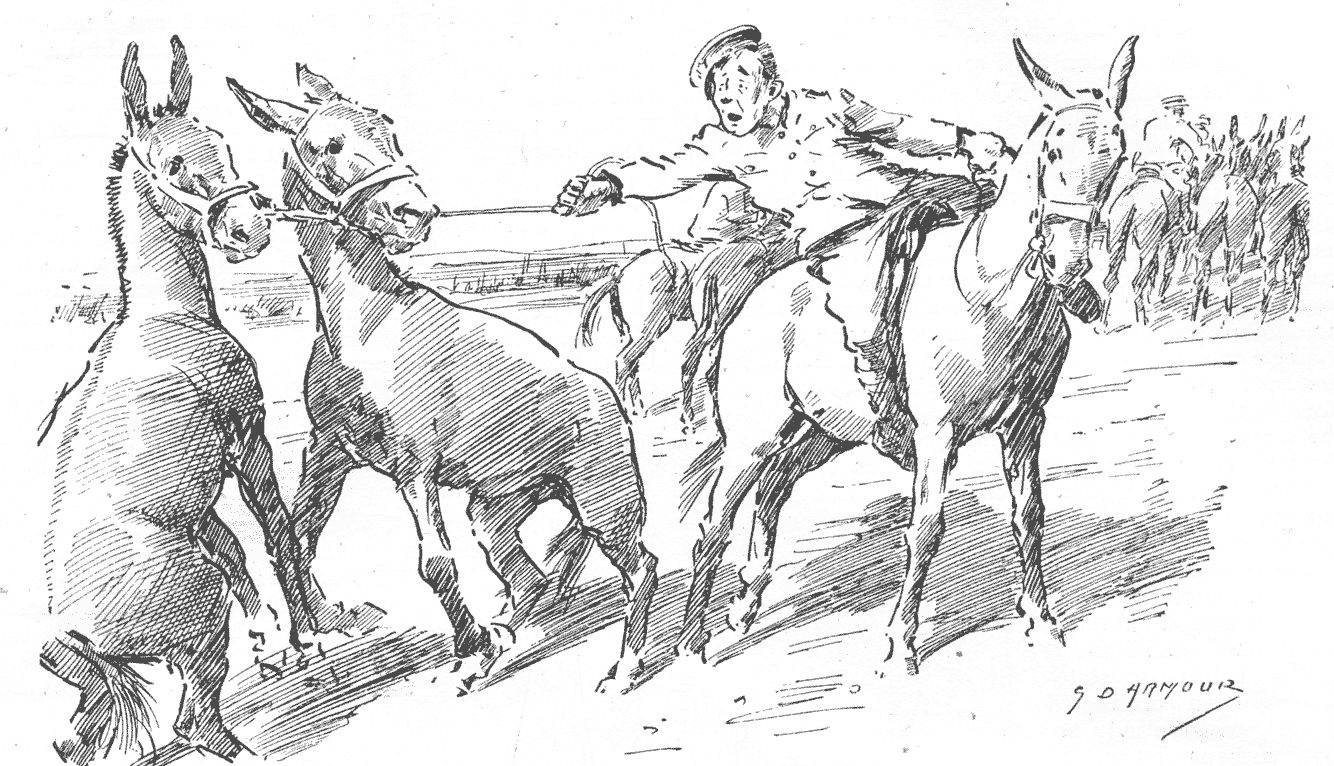
Recruit (with exercising party). "If I lets the blighters go the Corporal'll cuss me into 'eaps. an' If I 'olds on to 'em I'll break my blinkin' neck!"
The End of the Story.
"Will the soldier who assisted the Gentleman with a motor cycle and sidecar on the Downs on Tuesday communicate with him at Greenbank Cemetery."—Bristol Evening News.
"Harry Wilson, milkman, of Devonport, has no connection of any kind with Woodrow Wilson, of United States of America."Auckland Paper.
Harry is now sorry he wrote.
"The daily rations of the shirkers are:— Bread . . . . . . . . . . . 9 oz. (uncooked, including bone)." Daily Mail.
The conscientious objector doesn't seem to be having such a soft time after all.
TYRTÆUS.
When Sparta's heroes, tired of truce, The fires of battle woke, Tyrtæus sang them golden lays And bravely on their marching days His queenly Muse outspoke. Tyrtæus' name's come down the years And did deserve to do, For so he dried men's eyes of tears, So loosed their hearts from idle fears, Stouter they thrust their ashen spears, Their javelins further threw. In those fair days Tyrtæus' song Was all men had to trust, But while he hymned the coming fight They did not wail, "He can't be right," They heard and cried, "He must!" When men of craven soul came in— Which now may Heaven forbid— Then stout Tyrtæus would begin:— "Mere argument can be no sin, But whining is; we're going to win." And so, of course, they did. Tyrtæus' heart has ceased to beat, But still his measures run, And still abides the British Press, Which men must credit, more or less, To tell how things are done. So by all bards with hearts of fire Cheerfully be it sung, That still our people may not tire In doing well, but yet aspire; Let these renew Tyrtæus' lyre, Let others hold their tongue.