Volume 152 — ESSENCE OF PARLIAMENT.
Reading edition
Monday, May 7th.—The Royal House has found an unexpected defender in Mr. Outhwaite. He alone has perceived the hidden danger underlying the recent proposal of the Lower House of Convocation to restore King Charles I. to his old place in the Church Calendar. This, he considers, is a direct encouragement to the persons who seek the restoration of the Stuart dynasty, and would make Prince Rupprecht of Bavaria heir-apparent to the British Throne. The House was relieved to hear from Mr. Brace that there was no immediate danger of this contingency. Indeed, Prince Rupprecht has had so much trouble already with his prospective subjects that he has probably no desire for their closer acquaintance.
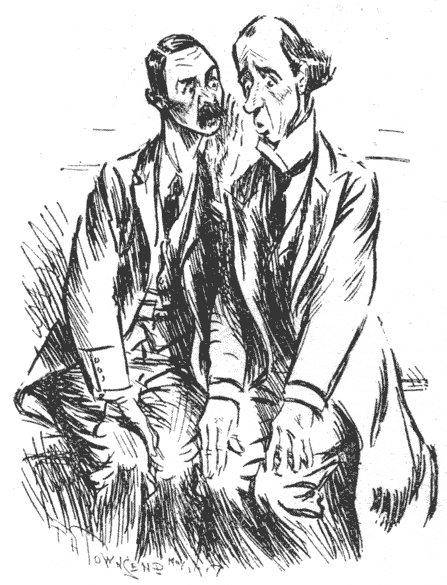
Mr. Bonar Law (to Mr. McKenna). "As one chancellor of the exchequer to another, what do you do when you're seventy million pounds out?"
Sir Leo Chiozza Money is ordinarily a chirpy little person, quite able to take care of himself. But he was obviously depressed by his inability to furnish a plausible reason why two food-ships, having arrived safely in home ports, should have been sent away undischarged, with the result that they were torpedoed and their cargoes lost. The statement that he was "still inquiring" brought no comfort to the House of (Short) Commons. Why doesn't the Shipping Controller organise a Flying Squadron of dock-labourers?
Tuesday, May 8th.—The official reticence regarding the names and exploits of our airmen was the subject of much complaint. Mr. Macpherson declared that it was quite in accordance with the wishes of the R.F.C. themselves. But Sir H. Dalziel was still dissatisfied. He knew of a young lieutenant who had brought down forty enemy machines and been personally congratulated by the Commander-in-Chief, and yet his name was not published. It is obvious that praise even from Sir Douglas Haig is not the same thing as a paragraph in Reynolds' Newspaper.
A request for an increased boot-allowance to the Metropolitan Police met with a dubious reception from Mr. Brace, who explained that it would involve an expenditure of many thousands of pounds. It is rumoured that the Home Office is considering the recruitment of a Bantam Force, with a view to reducing the acreage of leather required.
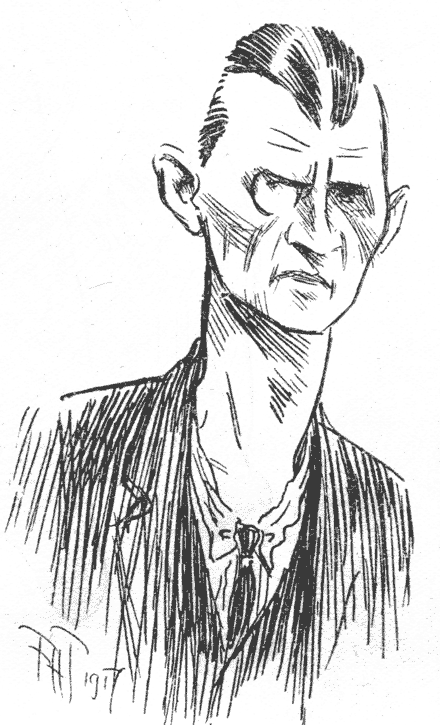
Beau Brummel Billing gives the "No-starch" movement a good send-off.
Wednesday, May 9th.—If the Chancellor of the Exchequer should be accused of having taken advantage of his knowledge of the Budget-proposals to lay in a secret hoard of tobacco he will have no one to blame but himself. He solemnly assured the House that nothing has been brought to his notice to show that the trade is making undue profits. It is clear, therefore, that he has not had occasion to go into a tobacconist's and ask for his favourite mixture, only to find that his three-half-penny tax has sent the price up by twopence.
By prohibiting the manufacture of starch the Government has done something to please Mr. Pemberton-Billing. The hon. Member, who has always affected the "soft shirts that Sister Susie sews," is flattered to think that he has set a fashion which must now become universal. When Captain Bathurst, falling into his humour, assured him that even Beau Brummel would accept the position with patriotic resignation, Mr. Billing felt that he had found his true vocation as an arbiter of taste.
In moving a Vote of Credit for the unexampled sum of five hundred millions, Mr. Bonar Law apologised for a slight error in his Budget statement. He had then estimated the expenditure of the country at five and a half millions a day. Owing to fortuitous circumstances, the amount for the first thirty-five days of the financial year had turned out to be seven and a half millions a day. Mr. Mckenna, conscious of some similar lapses in calculation during his own time at the Exchequer, handsomely condoned the mistake. Still one felt that it strengthened the stentorian plea for economy made by Mr. J.A.R. Marriott in a maiden speech that would perhaps have been better if it had not been quite so good. The House is accustomed to a little hesitation in its novices and does not like to be lectured even by an Oxford don.
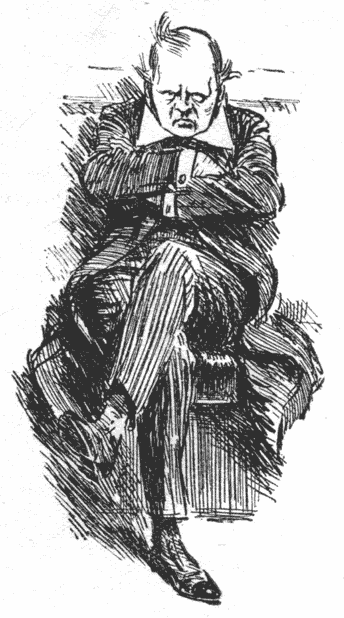
THE SECRET SESSION.
Winston. "No report of speeches. It hardly seems worth while."
The debate produced a number of speeches more suitable for the Secret Session that was to follow. Our enemies will surely be heartened when they read the criticisms passed by Mr. George Lambert, an ex-Minister of the Crown, upon our Naval policy, and by Mr. Dillon On the Salonika Expedition; and they will not understand that the one is dominated by the belief that no Board of Admiralty that does not include Lord Fisher can possibly be efficient; and that the other is congenitally unable to believe anything good of British administration in Ireland or elsewhere.
For once Mr. Bonar Law took the gloves off to Mr. Dillon, and told him plainly that more attention would be paid to his criticism if he was himself doing something to help in the prosecution of the War.
Thursday, May 10th.—I gather from Mr. Speaker's report of the Secret Session that nothing sensational was revealed. The Prime Minister's "encouraging account of the methods adopted to meet the submarine attack" was not much more explicit, I infer, than the speech which Lord Curzon was making simultaneously, urbi et orbi, in the House of Lords, or Mr. Asquith would not have observed—again I quote the official report—that "hardly anything had been said which could not have been said openly."
That none of the Nationalists should have addressed the House was perhaps less due to their constitutional reticence than to the depressing effect of the South Longford election, where their nominee was defeated by the Sinn Fein candidate—one Mcguinness, and evidently a stout fellow. But it is odd to find that the debate was conducted without the assistance of Messrs. Billing, Pringle and Hogge. Their eloquent silence was a protest, no doubt, against the eviction of the reporters. Mr. Churchill was probably suffering equal anguish, but with patriotic self-sacrifice he refused to deprive his fellow-legislators of the privilege of hearing once again his views on the conduct of War.
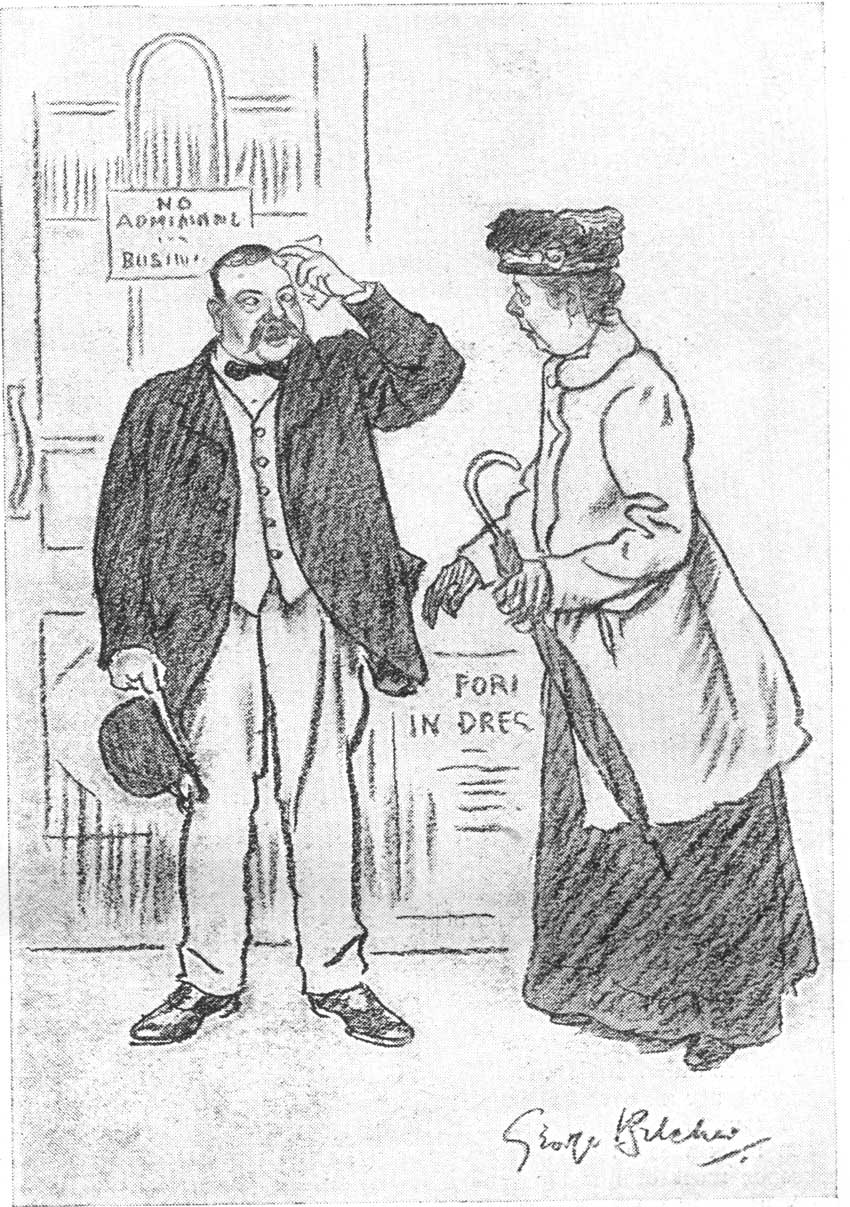
Mrs. Smith (to Mr. Smith, who has just been examined by Army Medical Board). "What did the Doctor say to yer?"
Mr. Smith. "'E sez to me, 'you've got a stigma an' a congenial squint.'"
JILL-OF-ALL-TRADES AND MISTRESS OF MANY.
[The Daily Chronicle, writing on women farmers, quotes the tribute of Hutton, the historian, to a Derbyshire lady who died at Matlock in 1854: "She undertakes any kind of manual labour, as holding the plough, driving the team, thatching the barn, using the flail; but her chief avocation is breaking horses at a guinea per week. She is fond of Pope and Shakespeare, is a self-taught and capable instrumentalist, and supports the bass viol in Matlock Church."]
Though in the good old-fashioned days The feminine factotum rarely Was honoured with a crown of bays When she had won it fairly; She did emerge at times like one For manual work a perfect glutton, Blue-stocking half, half Amazon, As chronicled by Hutton. But now you'll find her counterpart In almost every English village— A mistress of the arduous art Of scientific tillage, Who cheerfully resigns the quest Of all that makes a woman charming, And shows an even greater zest For gardening and farming. She used to petrify her dons; She was a most efficient bowler; But now she's baking barley scones To help the Food Controller; Good Mrs. Beeton she devours, And not the dialogues of Plato, And sets above the Cult of Flowers The Cult of the Potato. The studious maid whose classic brow Was high with conscious pride of learning Now grooms the pony, milks the cow, And takes a hand at churning; And one I know, whose music had Done credit to her educators, Has sold her well-beloved "Strad" To purchase incubators! The object of this humble lay Is not to minimize the glory Of women of an earlier day Whose deeds are shrined in story; 'Tis only to extol the grit Of clever girls—and none work harder— Who daily do their toilsome "bit" To stock the nation's larder.
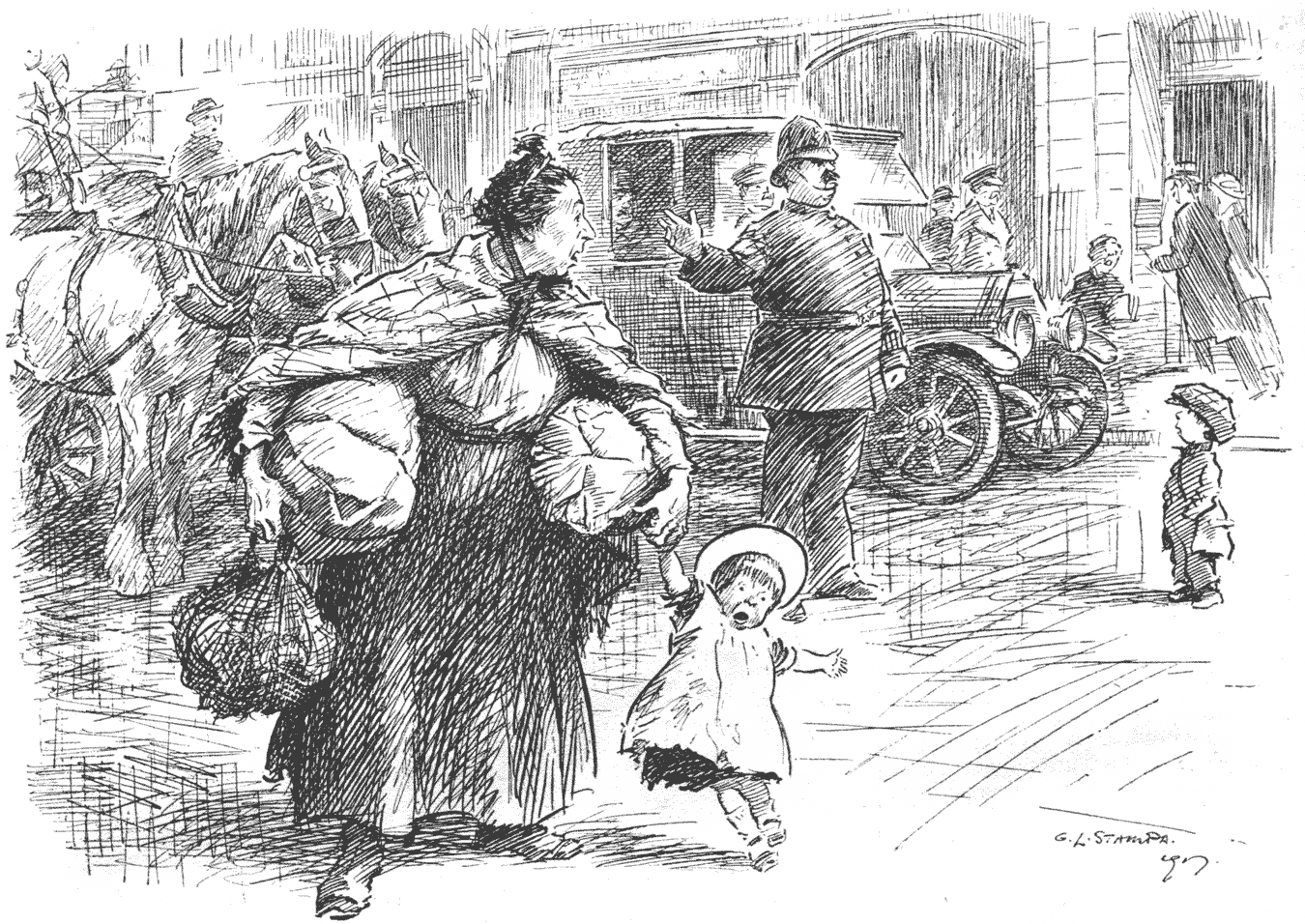
Overburdened Mother. "Git a move on, Albert—keepin' the 'ole bloomin' world back—an' a war on, too!"