Volume 152 — ESSENCE OF PARLIAMENT.
Reading edition
Monday, February 26th.—The new Member for Roscommon has not yet appeared in the House, but he is nevertheless doing his bit more effectively, perhaps, than some of his compatriots. The SPEAKER'S ruling is "No seat, no salary"; so Count PLUNKETT will have the satisfaction of knowing that by his self-sacrificing absence he is paying the expenses of the War for at least five seconds.
With suitable solemnity Sir EDWARD CARSON gave a brief account of the exploits of the German destroyer squadrons. One of them, comprising several vessels, had engaged a single British destroyer for several minutes before cleverly executing a strategic movement in the direction of the German coast; while another had simultaneously bombarded the strongholds of Broadstairs and Margate, completely demolishing two entire houses. The damage would have been still more serious but for the fortunate circumstance that the fortresses erected on the foreshore last summer by an army of youthful workpeople had been subsequently removed.
Any gloom engendered by the fore-going announcement was quickly dissipated by Mr. BONAR LAW, who read a telegram from General MAUDE, announcing the fall of Kut-el-Amara.
The rest of the afternoon was chiefly occupied by a further combat over the merits of Lord FISHER. Although, as Dr. MACNAMARA subsequently remarked, "this is not the time for fighting battles along the Whitehall front," I am afraid the House thoroughly enjoyed Sir HEDWORTH MEUX'S discursive account of his relations with the late FIRST SEA LORD, who really seems to be quite a forgiving person. At least it is not everybody who, after being greeted at a garden-party with "Come here, you wicked old sinner," would afterwards invite his accuser to lunch at the Ritz.
In the first statement of policy made by Mr. LLOYD GEORGE after his appointment as Prime Minister he said that the primary step towards a settlement of an age-long Irish trouble would be the removal of the suspicion of Irishmen by Irishmen. Mr. DILLON'S notion of contributing to that desirable end is to accuse Sir BRYAN MAHON, who has had to deport certain recidivist Sinn Feiners, of being the tool of a Dublin Castle gang. Not, of course, that Mr. DILLON is in sympathy with Sinn Feiners; on the contrary he dislikes them so much that he would like to keep St. George's Channel between them and himself. But by his own speeches he has hypnotized himself into the belief that everything done by the British Government in Ireland must have a corrupt motive. His colleague from West Belfast is not much wiser, to judge by the tone of his speech to-night; and I think Mr. DUKE, who is doing his best to reconcile the irreconcilable, must have been tempted to adapt one of MR. DILLON'S phrases and to say that Ireland was between the DEVLIN and the deep sea.
Tuesday, February 27.—The capture of Kut has had an exhilarating effect upon Lord CREWE. Not long ago he was warning us against excessive jubilation over the British advance in that region. Now he justified his title by coming out as a regular Chanticleer, and invited Lord CURZON to tell the assembled Peers that we might be confident of regaining predominance in the whole of Mesopotamia.
LORD BUCKMASTER'S DREAM OF A BRIGHTENED HOUSE OF LORDS.
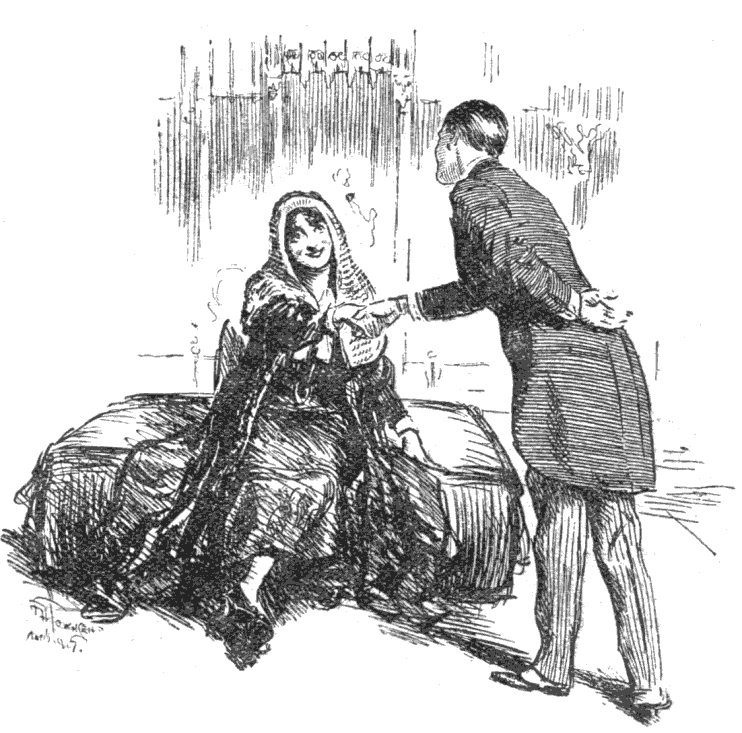
In these times the Lords can refuse nothing to the Ladies. In moving the second reading of a Bill to enable women to become solicitors Lord BUCKMASTER may have approached his subject in the spirit of a cautious knight-errant, as Lord SUMNER said, but he carried his argument. He owed something, perhaps, to the unintentional assistance of his opponents. Lord BUCKMASTER had incidentally mentioned that a woman once sat on the Woolsack, and there administered such very odd law that the City of London rose in mutiny. This shocked the historical sense of Lord HALSBURY, who hastened to point out that the lady in question had left the Woolsack for a reason entirely creditable to her sex, namely to become the mother of one of our greatest Kings. Then Lord FINLAY, who now occupies the seat alleged to have been filled by ELEANOR of Provence, endeavoured to frighten their Lordships by the thin end of the wedge argument. If women were admitted solicitors they would next want to practise at the Bar, and even become Judges. But the Peers refused to be intimidated, and gave the Bill a second reading.
Mr. MACCALLUM SCOTT'S colossal intellect, like the elephant's trunk, can grapple with the most minute objects. Yesterday it was the shortage of sausage-skins; this afternoon it was the grievance of Scottish bee-keepers, who are deprived of sugar for their charges, and compelled to put up with medicated candy at twice the price. In spite of the FOOD CONTROLLER, I understand that MR. SCOTT has no intention of parting with the very promising swarm that he carries in his national headgear.
Wednesday, February 28th.—Mr. WATT was seized with a bright idea this afternoon. The CHIEF SECRETARY FOR IRELAND had explained to Mr. GINNELL, that certain men had been convicted of having attempted to cause disaffection by singing disloyal songs. "Will the right hon. and learned gentleman give the House a sample?" interjected Mr. WATT. The notion of Mr. DUKE, vir pietate gravis, if ever there was one, indulging in ribald melody, caused much laughter, which was increased when the right hon. gentleman in his most portentous manner implied that his only reason for not granting the request was fear that the SPEAKER might intervene.
SIR FREDERICK BANBURY AND COLONEL MARK LOCKWOOD CONSULT THE WATER LIST.
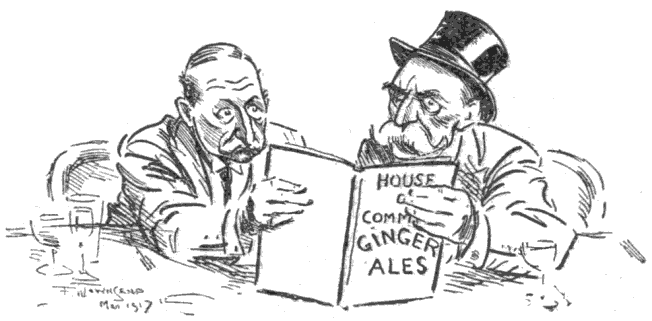
A brief recrudescence of the MEUX-CHURCHILL duel was not much to the taste of the House, which is evidently of opinion that LORD FISHER might now be left alone both by foes and by friends. Members were glad to seek solace in the drink question, and gave a sympathetic hearing to the proposal of Mr. WING that they should voluntarily submit to the same restricted hours of consumption as they had imposed on the outside world. Mr. WING is a temperance reformer, but on this occasion he had the redoubtable assistance of Mr. GEORGE FABER, a stout friend of the "trade" whose hair had grown white, he declared (though in other respects he still looks delightfully juvenile), in fighting the Licensing Bill of 1908. In his opinion the House could no longer keep itself in a compartment apart—especially as it was not a watertight compartment. Sir FREDERICK BANBURY, who is naturally a champion of cakes—and ale—made a despairing effort to preserve the privileges of the Palace of Westminster, but did not carry his protest to a division; and after a few valedictory remarks from Colonel LOCKWOOD, including two quotations from LUCRETIUS (derived from a crib, as he modestly explained), the House unanimously decided that its habits should be in conformity with its debates—dry with moist intervals.
Thursday, March 1st.—Copies of the unexpurgated edition of the Report of the Dardanelles Commission marked "confidential" are to be sent to the SPEAKER and to the leader of every political party in the House. If Mr. BONAR LAW thought by this announcement to allay curiosity he was disappointed. Requests for a definition of the term "political party" rained upon him from all quarters. It really is a rather nice point. Mr. ASQUITH, Mr. REDMOND and Mr. WARDLE will, of course, receive their copies of the editio princeps. But what about Mr. WILLIAM O'BRIEN, who commands a bare half-section, even if one includes Mr. T.M. HEALY as odd file? What, too, of the Peace-without-Victory party, which is all leaders? The case of Mr. PRINGLE and Mr. HOGGE, which was publicly mentioned, presents little difficulty. Much as they love one another, neither is prepared to acknowledge the other as his leader.
The greatest crux is furnished by Mr. GINNELL and Mr. PEMBERTON-BILLING. Each of them leads a distinct party, making up by its activity and volubility for its comparative lack of size. Logically they may look forward to receiving copies of the "confidential" document too sacred for the inspection even of Peers and Privy Councillors. But I should not encourage them to hope.
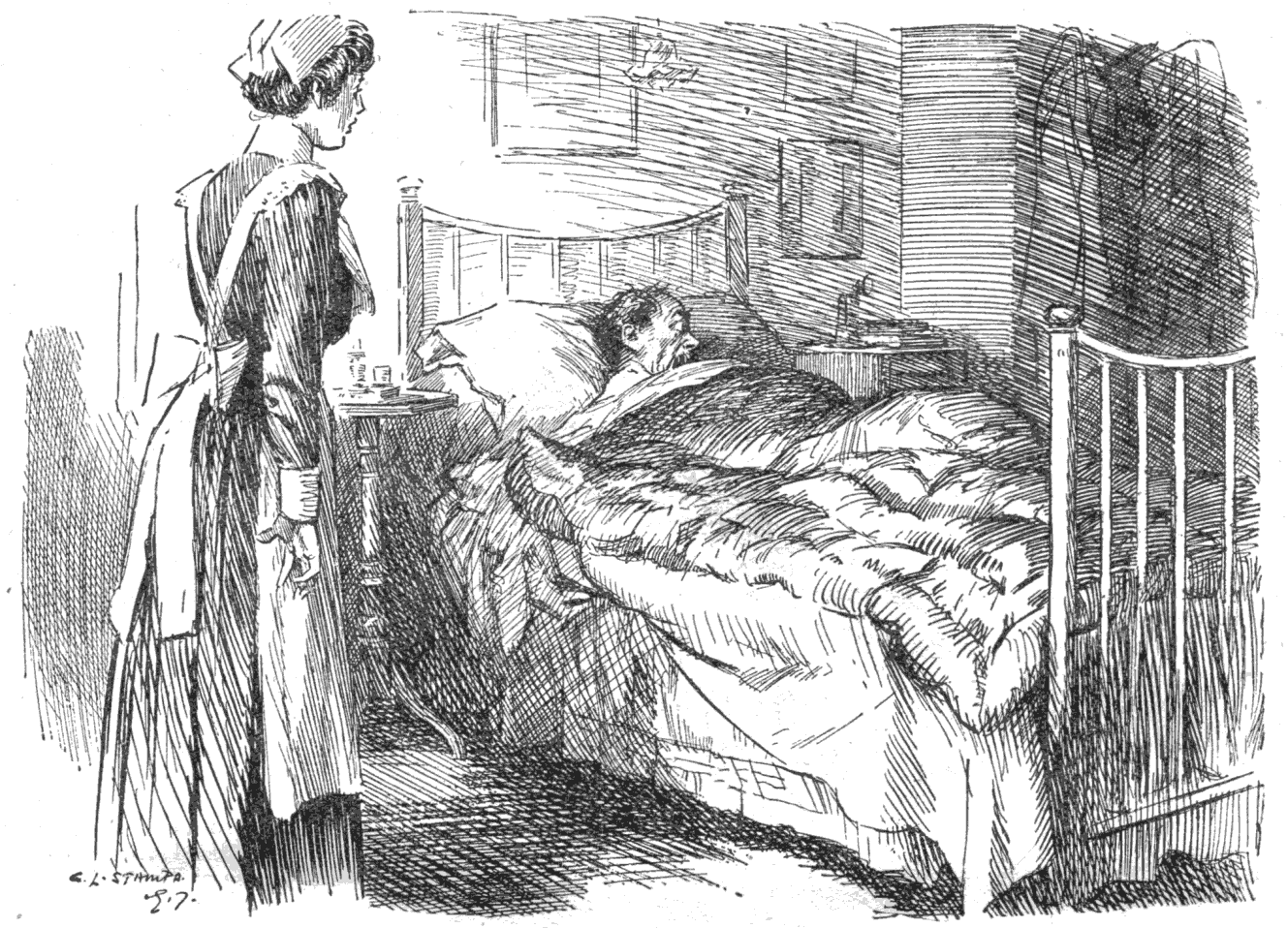
Maid. "THE DOCTOR HAS CALLED TO SEE YOU, SIR."
Government Official (faintly). "TELL HIM TO FILL UP A FORM, STATING THE NATURE OF HIS BUSINESS AND IF BY APPOINTMENT."
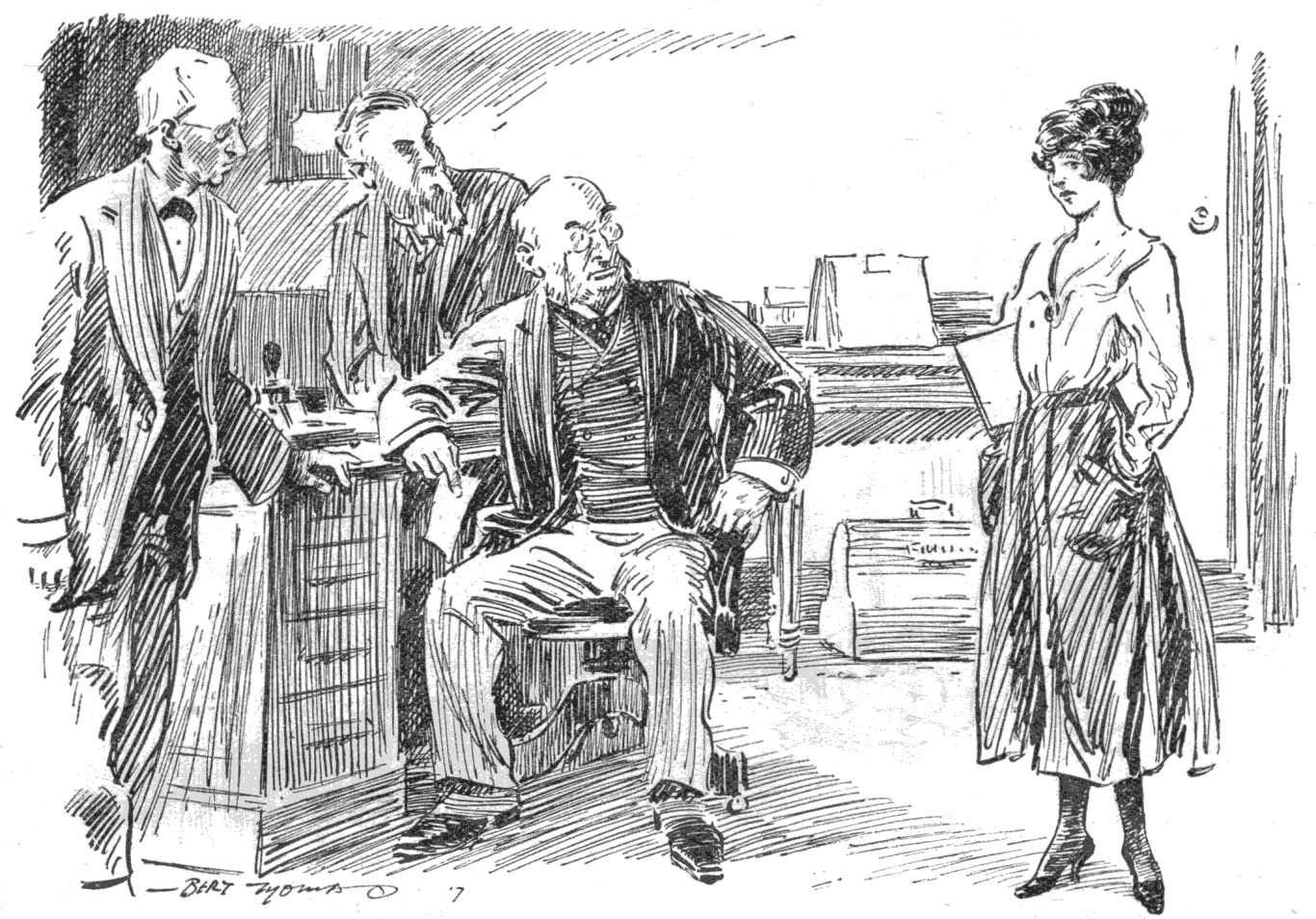
Boss (to typist, a war flapper, who is very late). "EH, YE'VE COOM AT LAST. WE WERE JUST TALKIN' ABOOT YE."
Typist. "AH, I WONDERED WHAT MADE MY EAR BURN."
CLASSICAL AMERICA.
[A correspondent of The Westminster Gazette remarks in a recent issue, "I am told American students sing their Pindar."]
A WRITER in the evening Press Lays quite unnecessary stress Upon the fact that youthful scholars, Residing in the land of dollars, Where men are shrewd and level-headed, Sing songs to PINDAR'S verses wedded. Yet why this wonder, when you think How strongly welded is the link That binds Columbia and its glory To lands renowned in classic story? There's hardly any town of note Mentioned by MOMMSEN or by GROTE Except Byzantium, perhaps— Which doesn't figure in our maps. Of Ithacas we have a score, And Troys and Uticas galore; Chicago has a Punic sound, And pretty often, I'll be bound, Austere Bostonians heavenward send a Petition calling her delenda; While Philadelphia, Pennsylvania Betray the classicising mania. We have a Capitol, also, As fine as Rome's of long ago; Pompey and Romulus and Remus (I'm not so sure of Polyphemus) Are names with us more often worn Than in the lands where they were born. Then, as true classicists to stamp us, Each College has its separate Campus, And we have Senators whose mien Might well have turned old BRENNUS green. Why even the Bird that proudly soars In majesty to guard our shores Before migrating to these regions Was followed by the Roman legions. But we have writ enough to show What everybody ought to know, That, spite of hustle and skyscrapers, And Tammany and yellow papers, The spirit of both Greece and Rome Has found a second lasting home Across the wide Atlantic foam.
More War Economy.
"Perambulator, cheap, for cash, as new; cost £9 15s., receipt shown; owner getting rid of baby."—Birmingham Daily Mail.
"Turn to the annals of the period 1914-1917, everlastingly to be remembered by the Meuse of History."—Jamaica Paper.
The Meuse needs no reminder.
"DOING WITHOUT."
A valued correspondent writes:— "We are deluged in the Press just now with information on how to 'do without.' One morning a splendid recipe for making pancakes without eggs; another, a perfect Irish stew without potatoes; another, a Welsh rabbit without cheese. Meatless days are to be as natural as wireless telegraphy; and the other day we were asked seriously to consider the problem of a school without teachers! But there is a certain little corner of the daily paper headed, 'London Readings,' which could better, in war-time phrases, be expressed thus: 'Stern Facts must be Faced—How to do without Sunshine,' for all that the Meteorological expert can find to say is, 'Yesterday Sunshine, 0.0. Previous day Sunshine, 0.0.' O! O!"
What a Woman Notices.
"Sears succeeded in cashing two of the cheques at the bank, the woman cashier not noticing that they were crossed. When she came to the bank a third time, however, the cashier recognised the hat she was wearing, and caused her to be detained."—Times.