Volume 152 — CHARIVARIA.
Reading edition
"A motor car repairer," says Mr. Justice BRAY, "is like a plumber. Once you get him into the house you cannot get him out."... Unless, of course, you show him a burst bath pipe, when he will immediately go out to fetch his mate.
According to Herr WILDRUBE, a member of the Reichstag, Germans should "rejoice at the departure of Mr. GERARD and his pro-Entente espionage bureau." They have some rubes in the U.S.A., but nothing quite so wild as this.
An historical film, called "The Discovery of Germany," is being exhibited widely through the Fatherland under the auspices of the Government. A further discovery of Germany—that she has been fatally misled by her rulers—has not at present received the approval of the Imperial House.
The German Army authorities have issued an urgent warning to the public not to discuss military matters. Their own communiqués are to be taken as a model of the right kind of reticence.
An American film syndicate have overcome their difficulty in finding a man to take the place of CHARLIE CHAPLIN. They have decided to do without.
In Vienna, so as not to infuriate the indigent poor, tables are no longer placed near the window of the dearer restaurants. Similar establishments in Germany for the same reason were long ago made sound-proof.
We note that German and Turkish diplomats have been engaged in conference for the purpose of drawing the two countries closer together. Any little pressure from outside (as on the Tigris and the Ancre) is doubtless welcome as contributing to this end.
"The right way to dissipate the submarine nightmare" is how a contemporary describes the new restrictions on imports. The embargo on tinned lobster should certainly have that effect.
A museum is to be established at Stuttgart "to interest the masses of the people in overseas Germans and their conditions of life." Several Foreign Governments, it is understood, have expressed their willingness to supply specimens in any reasonable quantity.
Lively satisfaction is being expressed among members of the younger set at the appointment of Mr. ALFRED BIGLAND, M.P., as Controller of Soap. They are now discussing a resolution calling for the abolition of nurse-maids, who are notorious for using soap to excess.
A Bill has been introduced into the House of Lords with the object of admitting women to practise as solicitors. The raising of the statutory fee for a consultation to 6s. 8¾d. is also under consideration.
At Old Street Police Court a man charged with bigamy pleaded that when a child he had a fall which affected his head. It is not known why other bigamists do it.
At Haweswater, Westmoreland, some sheep were recently dug out alive after being buried in a snow-drift forty days. It is thought that a morbid fear of being sold as New Zealand mutton caused the animals to make a supreme struggle for life.
A lady correspondent of The Daily Telegraph suggests that tradesmen should economise paper by ceasing to send out a separate expression of thanks with every receipted bill. A further economy is suggested by a hardened creditor, who advocates the abolition of the absurd custom of sending out a quarterly statement of "account rendered."
Beer bottles are now said to be worth more than the beer they contain, and apprehension is being felt lest the practice shall develop of giving away the contents to those who consent to return the empty bottles.
Difficulty having been found in replacing firemen called up for military service, the Hendon Council, it is rumoured, are requesting the residents not to have any conflagrations for the present at least.
Mr. JOHN INNS, of Stevenage, has just purchased the whole parish of Caldecote, Herts; but the report that he had to do this in order to obtain a pound of sugar proves incorrect.
NOTICE.
In order to meet the national need for economy in the consumption of paper, the Proprietors of Punch are compelled to reduce the number of its pages, but propose that the amount of matter published in Punch shall by condensation and compression be maintained and even, it is hoped, increased.
It is further necessary that means should be taken to restrict the circulation of Punch, and on and after March 14th its price will be Sixpence. The Proprietors believe that the public will prefer an increase of price to a reduction of matter.
Readers are urged to place an order with their Newsagent for the regular delivery of copies, as Punch may otherwise be unobtainable, the shortage of paper making imperative the withdrawal from Newsagents of the "on-sale-or-return" privilege.
In consequence of the increase in the price of Punch the period covered by subscriptions already paid direct to the Punch Office will have to be proportionately shortened.
APOLOGY OF A WARRIOR MINSTREL.
Lucasta, don't be cruel If my bewildered lyre Amidst such stores of fuel Seems reft of sacred fire.
For if you know what France is You know how it is hard To blend, as in romances, The warrior with the bard.
The troubadours of story
Knew no such woes as we,
Whose hopes of martial glory
With songs and swords and horses They learned their careless rôle, While we are sent on courses That starve the poet's soul.
With gay anticipations They feasted ere a fight, But we in calculations Wear out the chilly night.
And if some hour of leisure Permits a lyric mood My wretched Muse takes pleasure In nothing else but food.
Thus when I am returning Ice-cold from some O.P., And in the East is burning Aurora's heraldry,
That spark she fails to waken With which of yore I glowed, Who, fain of eggs and bacon, Tramp ravening down the road,
Aware, with self-despising, Which interests me most— The silvery mists a-rising Or marmalade and toast.
Such are the War-bard's passions— Rank seedlings of a time That chokes with maths and rations The bursting buds of rhyme.
A ROMANCE OF RATIONS.
"Not like to like, but like in difference." "The Princess."
I have always misjudged Victorine—I admit it now with shame. While other girls have become engaged—and disengaged quite soon after—she has remained unattached and solitary. As I watched the disappointed suitors turn sadly away I put it down to pride and self-sufficiency, but I was wrong. I see now that she always had the situation well in hand.
As for Algernon, he is the sort of man who writes sonnets to lilies and butterflies and the rosy-fingered dawn—this last from hearsay as he really knows nothing about it. He is prematurely bald and suffers from the grossest form of astigmatism, and I thought that no woman would ever love him. I never dreamt that Victorine had even noticed he was there.
One day I heard that they were engaged. It was too hard for me to understand.
On the third morning I went to see her.
"Victorine," I said, "you have never loved before?"
"Never," she assented softly.
"Now, this man you have chosen—you do not care overmuch for lilies and butterflies and rosy-fingered dawns?"
"Not overmuch," she admitted sadly.
"Then what is it brings you together? What strange link of the spirit has been forged between you? To speak quite plainly, what do you see in him?"
"Yesterday we lunched together, and two days before that he got here in time for breakfast."
"And the engagement still holds?" I am no optimist.
"Before that we dined. Yes, I do not exaggerate. It was my suggestion. One sees so much unhappiness now-a-days, and I wished to be quite sure we were suited to one another."
"And you are convinced of the sincerity of the attachment?"
"Why, I feel for him as Mother does for the knife-and-boot boy, and Uncle Stephen for the charlady. We cannot be separated. It would be monstrous."
I ceased to be articulate. Victorine suddenly became radiant.
"We must always be together—at any rate for the duration of the War, you see. I eat under my meat and he is over. In flour and sugar—oh, how can I confess it?—I exceed. He is far, far below his ration. Apart we are failures; together we are perfect. We both saw it at once."
I realised suddenly the inevitability of this mutual bond.
"So marriage is the only thing?" I asked; but I was already conquered.
She assented with a regal air.
As I went away I saw a new and strange beauty in the problem of Food Shortage.
SONGS OF FOOD PRODUCTION.
IV.
The Farmer's Boy (New Style).
The Hun was set on making us fret For lack of food to eat, When up there ran a City man In gaiters trim and neat— Oh, just tell me if a farm there be Where I can get employ, To plough and sow for PROTH-ER-O, And he a farmer's boy, And be a farmer's boy. "In khaki dight my juniors fight— I wish that I could too; But since the land's in need of hands There's work for me to do; Though you call me a 'swell,' I would labour well— I'm aware it's not pure joy— To plough and sow for PROTH-ER-O And be a farmer's boy, And be a farmer's boy." The farmer quoth, "I be mortal loth, But the farm 'tis goin' back, And I do declare as I can't a-bear Any farming hands to lack; So if you've got grit and be middlin' fit An'll larn to cry, 'Ut hoy!' And to plough and sow for PROTH-ER-O, You shall be a farmer's boy, You shall be a farmer's boy." Bold farmers all, obey the call Of townsfolk game and gay! And you City men put by the pen And hear me what I say:— Get straight enrolled with a farmer bold, And the Hun you'll straight annoy, If you plough and sow for PROTH-ER-O And be a farmer's boy, And be a farmer's boy.
The Sex-Problem Again.
"FOR SALE.—A 3-year-old Holstein gentleman cow."—Canadian Paper.
"A Liverpool master carter told the Tribunal that the last 'substitute' sent him for one of his men backed a horse down a tip and landed him in an expense of £50."—Yorkshire Evening Post.
Many men have lost more by backing a horse on a tip.
A Bare Outlook.
"THINGS YOU HAVE GOT TO DO WITHOUT. CLOTHES AND FOOD."—Daily Sketch.
This seems to bring the War even closer than the PREMIER intended.
MORE OR LESS.
The fleet of Dutch merchantmen which has been sunk by a waiting submarine sailed, it now appears, under a German guarantee of "relative security": and the incident has been received in Holland with a widespread outburst of relative acquiescence. Germany, in the little ingenious arrangements that she is so fond of making for the safety and comfort of her neighbours, is so often misunderstood. It should be obvious by this time that her attitude to International Law has always been one of approximate reverence. The shells with which she bombarded Rheims Cathedral were contingent shells, and the Lusitania was sunk by a relative torpedo.
Neutrals all over the world who are smarting just now under a fresh manifestation of Germany's respective goodwill should try to realise before they take any action what is the precise situation of our chief enemy. He has (relatively) won the War; he has (virtually) broken the resistance of the Allies; he has (conditionally) ample supplies for his people; in particular, he is (morally) rich in potatoes. His finances at first sight appear to be pretty heavily involved, but that will soon be adjusted by (hypothetical) indemnities; he has enormous (proportional) reserves of men; he has (theoretically) blockaded Great Britain, and his final victory is (controvertibly) at hand.
But his most impressive argument, which cannot fail to come home to hesitating Neutrals, is to be found in his latest exhibition of offensive power, namely, in his (putative) advance upon the Ancre.
Realism.
From a cinema announcement:—
"The management regret that 'The Lost Bridegroom' missed the boat on Sunday."—Guernsey Evening Express.
A Family Affair.
From an account of a "gift sale":
"Alderman —— advised the Committee to sell the donkey in the evening, when there would be a lot present."—Provincial Paper.
More Impending Apologies.
I.
"Mr. —— writes from New Cross:—'Sir,—I was pleased to see that you do not intend increasing the price of 'The Daily News,' and hope that you will not have to reconsider your decision. If necessary I, for one, would be quite content with four pages only."—Daily News.
II.
"The nurses who have a seven minutes' walk to their home quarters, have never had a rude word said to them, 'even,' she added, 'when they have had too much to drink.'"—Daily Province (Vancouver, B.C.).
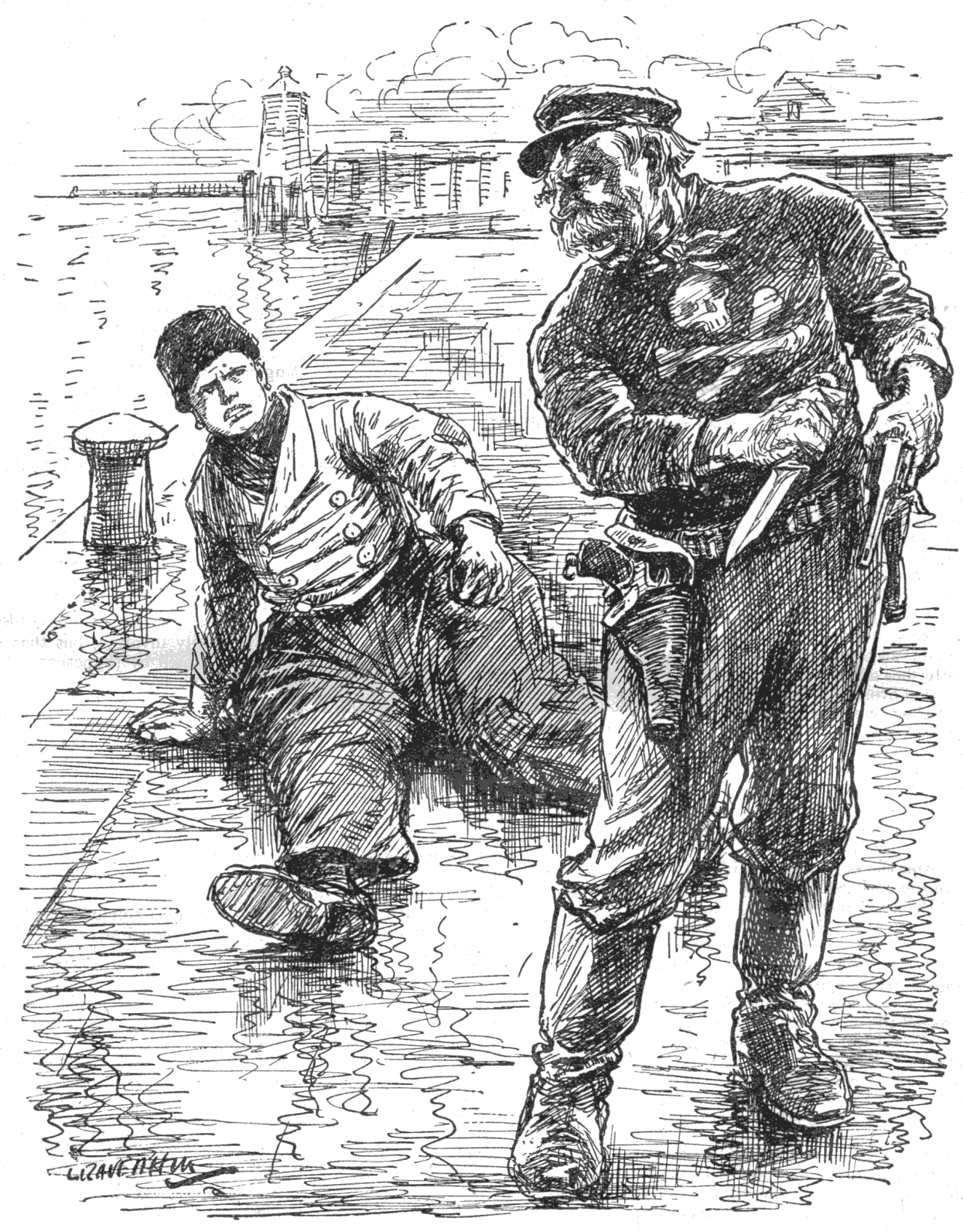
"THE FREEDOM OF THE SEA."
HOLLAND. "YOU'VE TAKEN A GREAT LIBERTY WITH ME."
GERMANY. "OF COURSE I HAVE. I'M THE APOSTLE OF LIBERTY."
THE THEATRE OF WAR.