Volume 152 — THE EVERLASTING ROMANCE.
Reading edition
The other day I did a perfectly dreadful thing: I intruded, all unconsciously but in the most blundering way, on a love scene. It was in the National Gallery, long famous as the meeting-place of affinities, in the big room where the pictures lent by the Duke of WESTMINSTER and the Duke of BUCCLEUCH are now hanging, and before I knew it I found myself standing between two young people whose eyes were fixed on each other. Naturally I moved away at once, but later I returned and made so bold as to study them a little, for it was clearly, if not yet a passion, a mutual interest of such tender depths that no outsider could affect it.
The boy—for he was no more—was one of the most beautiful that I have ever seen. His hair was perhaps a thought longer than we encourage to-day, but one always sees odd people in the National Gallery, where artists—most careless of men—are now constant visitors, drawn there by the many new pictures, and especially, perhaps, the modern French examples from Sir HUGH LANE'S collection. His hair was the more noticeable because he carried his hat in his hand; his clothes were noticeable too, being a shade too fanciful for London in winter—but then, who cares how people dress in London? I am sure I don't; and especially so when they have such eyes as this boy's, dark and rich, and such a curve to such lips.
There he stood, perfectly still, his steady gaze fixed on the lady opposite, while she in her turn never wavered in her gaze upon him. But whereas there was something bold in his homage there was a half-shy way with her. He was facing her squarely, but she looked at him a little sideways, and a little curiously, in demure dubiousness. One could see that she was enormously intrigued, but her interest was not expressed by any movement. In fact neither moved; they remained some twenty yards apart all the time I observed them: each, I suppose, leaving it to the other—the boy because he was so young, the girl because she was already woman, and woman likes to force advances from man.
I never saw a prettier thing than the little lady, with her cool white skin, and the faintest flush on her cheeks, and her eyes not less dark than the boy's but lacking the sensitive depths of his.
The odd thing was that, although they were so engrossed each in the other, both, I observed, looked also at me. It struck me as not the least strange part of this charming drama that its hero and heroine, while completely absorbed in their own sympathetic relationship, should be able to turn a calm survey upon a stranger too. This gift made them the more memorable and perhaps explains why, for all the rest of the day and at intervals in the night and morning following, I thought of these young people, speculating as to how they were getting on; and perhaps that is why, the next afternoon, drawn by invisible wires, I found myself in the National Gallery again.
Will you believe it?—they also were there. This is an absolute fact. There they were, exactly as I had left them. And yet, not exactly, for I am certain that there was a hint more of seriousness in the lady's glance and a shade more troubled earnestness in his. But as regards actual distance, they were still as far apart, although certainly nearer in spirit.
Curiosity as to names is a foible which should be, I am convinced, discouraged; but on this occasion I could not resist the desire to know more of such assiduous habitués. Drawing one of the attendants aside, I asked him if he could tell who these romantic young things were. "To be sure," he said. "The young gentleman is 'The Blue Boy,' by GAINSBOROUGH, and the young lady is the Lady ELIZABETH MONTAGU, by REYNOLDS."
Only portraits after all, you say. But don't be too hasty. Go rather to the National Gallery and see for yourself. Maybe you will then realise that there is more there than paint....
Shallow people talk about accidents. But the wise know that accidents do not happen. The wise know that the War broke out in order that Grosvenor House, where "The Blue Boy" normally resides, and Montagu House, the home of this little Buccleuch lady with skin like an anemone, might be needed for War-work, so that when the pictures were sent to the National Gallery for safer keeping these two might be placed opposite each other in the same room. Chance? The only chance is destiny.
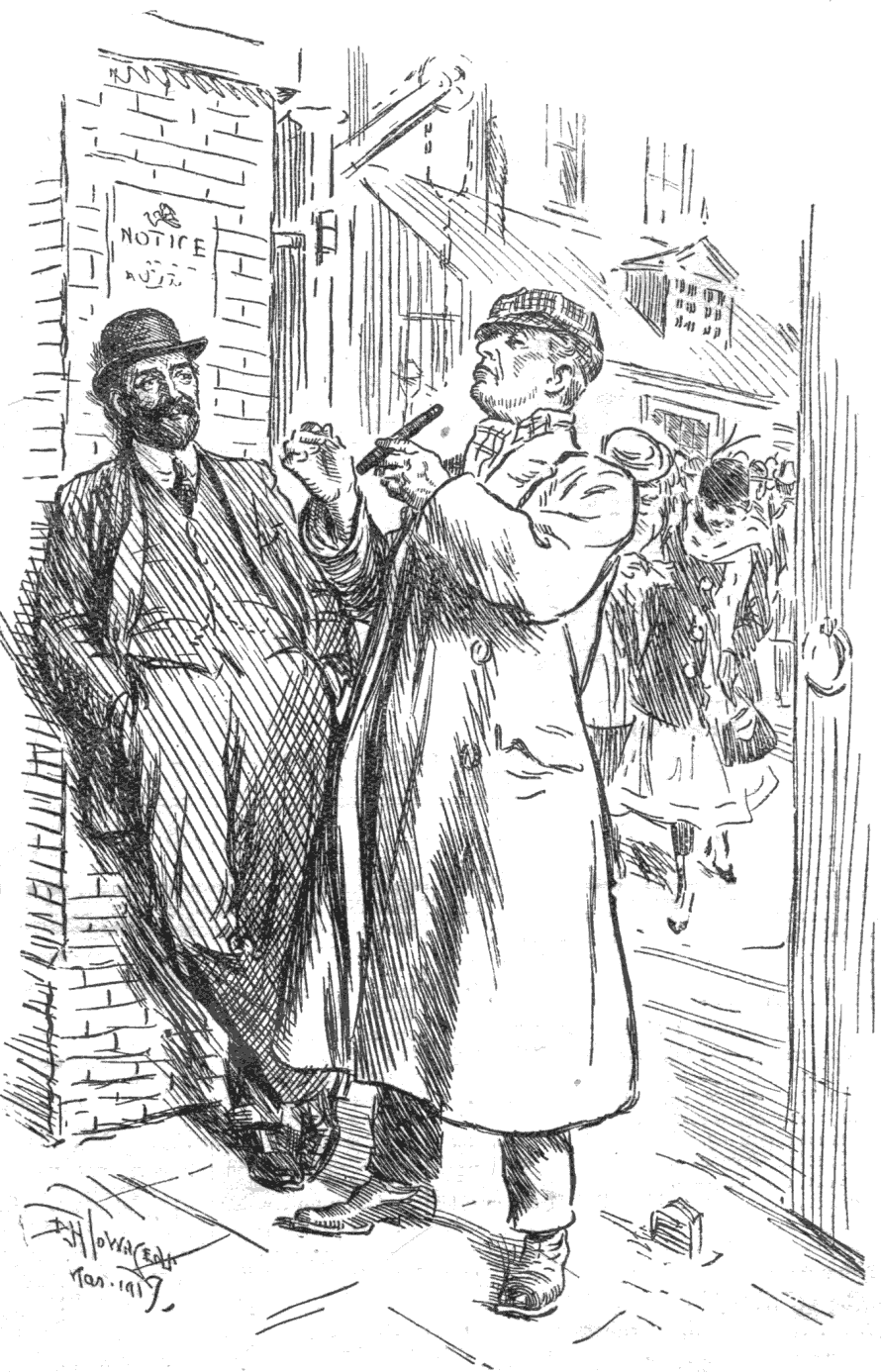
Munition Worker. "I'VE BOUGHT A PIANO."
Foreman. "GOT ANYBODY AT HOME WHO CAN PLAY IT?"
Munition Worker. "NO, NOT AT PRESENT; BUT WE'VE A FRIEND COMING ROUND THIS EVENING TO PUT US IN THE WAY OF IT."
"Fish, or woman, for block work; must be exp. and accustomed to best class trade."—Daily Paper.
Why not combine the two and get a mermaid?
"MAN WHO WILL KEEP EYE ON POTATOES. MR. DENNIS AS VEGETABLE AND FRUIT DIRECTOR."—The Daily Mirror.
Mr. D. need not trouble; we prefer them without eyes.
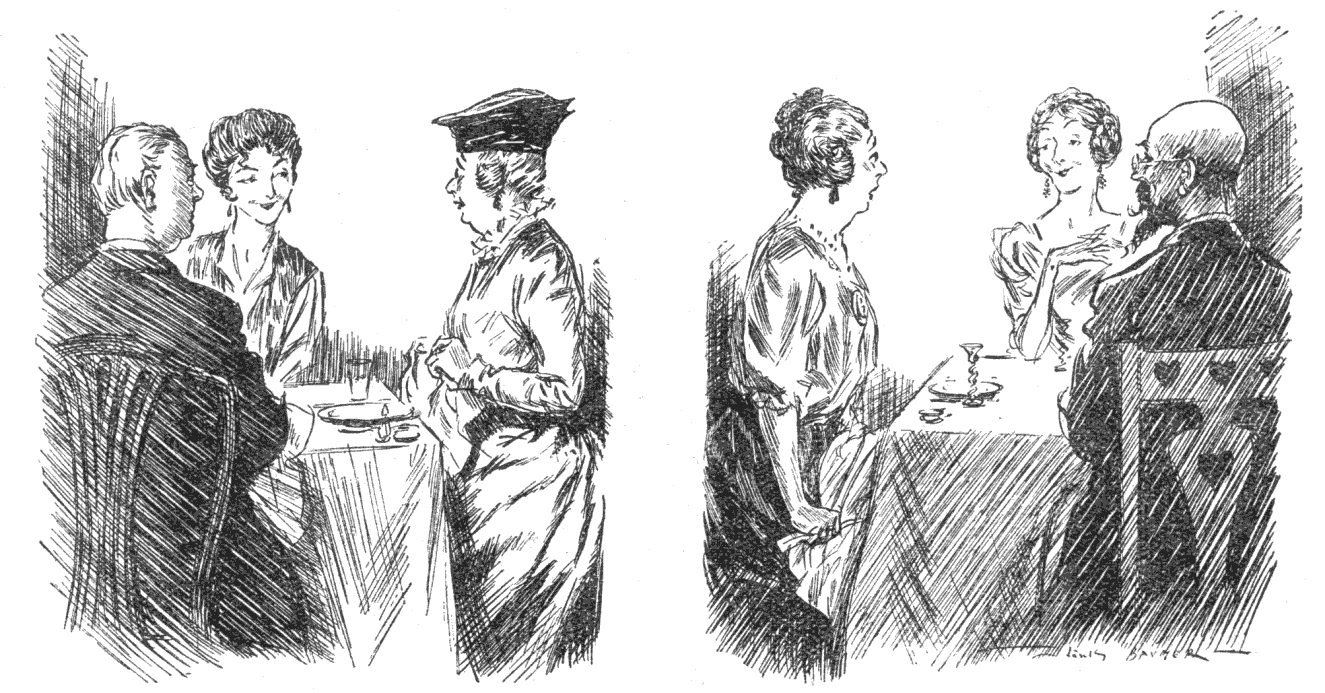
A LEAN DAY.
Luncheon Hostess. "I DO HOPE YOU DON'T MIND, MRS. STOKER, BUT ON WEDNESDAYS WE ONLY HAVE MEAT AT DINNER." Dinner Hostess. "I DO HOPE YOU DON'T MIND, MRS. STOKER, BUT ON WEDNESDAYS WE ONLY HAVE MEAT AT LUNCHEON."
MON SOLDAT ET MON CURÉ.
"Donne un peu, Maman, s'il te plaît," said Jeanne eagerly.
Maman handed over the newspaper from which she had just read aloud and explained the passage so full of touching interest to them both, and Jeanne, with help at the difficult places, read out:—
"'CITATIONS À L'ORDRE DU JOUR.
Jacques Martin, soldat au 170e d'infanterie, grenadier d'élite, au cours des combats du 26 et du 27 novembre, 1916, a, par son mépris du danger et par son ardeur, assuré la progression dans un boyau défendu pas à pas par l'ennemi.
Le soldat Jacques Martin est Monsieur l'abbé Martin, curé de ——.'
"Oui, nous savons bien d'où il est curé!" cried Jeanne, in admiration and awe. "C'est bien beau, hein, Maman?" Then suddenly she became silent and thoughtful, remembering the subsequent fate of her friend and hero.
"Dire qu'il est maintenant prisonnier en Alle... en Bochie!" she said. They had known long ago that he was mentioned in despatches, and they had been on the look-out for the glorious details in print, but only this morning had they heard of his capture.
How proud they were of their gentle curé and brave soldier! Jeanne had at first been greatly perplexed by the strange dual personality, with its incompatibilities, and many were the questions that had arisen in her active little mind. "Le curé de Suzanne, c'est autre chose," she reflected, for though technically a soldier was he not a brancardier rescuing the wounded? Her own practical conclusions, however, and the answers to her questions smoothed away many difficulties, and perfect faith in her friend did the rest.
Still she had never been able quite to merge the religieux and the poilu into one picture; besides, she liked to play with the idea and confront the one with the other. "Que va dire Monsieur le curé lorsque le soldat tuera un homme?" And she had slipped into the habit of calling him "Mon soldat et mon curé," suddenly inspired to adapt the title of Cousin Juliette's absorbing book, Mon Oncle et mon Curé, and she refused to abandon it when told that they were two separate persons. For that matter so were the soldat and the curé.
"Maman, nous allons tout de suite préparer son paquet de conforts," urged Jeanne. And, thinking out what comforts had best be included in the parcel, her mind went off now in one channel, now in another, as she pictured the priest or the piou-piou. The latter presented no difficulty—for him good things to eat were the first necessity—but the curé would require spiritual comforts.
"Des livres de messe," she said to herself; and thereupon the image of the cold and hungry soldier arose before her, and "un poulet ou un bon bifteck!" she added. Then, her eye lighting upon an advertisement in the newspaper before her, "Maman, que veut dire por-ta-tif?" she asked. The explanation received, she clapped her hands with joy; yes, surely a portable one was the very thing! "Maman, si nous envoyions à mon curé un autel por-ta-tif?"
But Maman thought that, all things considered, it would be better to send only food in the first parcel. So Jeanne reconciled herself to the idea, although the curé still remained a shadowy figure in the background with his own especial need.
And prisoners were cold as well as hungry. What a pity something hot could not be sent.
"Tiens! J'y suis!" cried Jeanne. "Ô Maman, j'ai une si bonne idee! Si nous envoyions un bon repas bien chaud dans l'auto-cuiseur!" Perhaps it would keep hot for a day or two. How long did it take for a parcel to reach Bochie?
But Maman decided this plan could not be risked; there was often delay, and the moist food might turn sour.
A little chilled but nowise daunted, for she was sure the hay-box would come in somehow, Jeanne remained for some time plunged deep in thought. Then came light and her face grew radiant. Why not send the auto-cuiseur filled with dry food? Les Boches would surely give, or sell, some boiling water and let him just start cooking on their stove. And he would be able to use the cooker constantly, buying des choses pas chères to cook; and yes, why not slip into the package a copy of Plats économiques, the little cookery book whose recipes they had found so satisfactory?
"Et mon curé?" But now the two figures merged more nearly than ever before into one, and Jeanne felt that his first need was one with that of the soldier, and the marmite would hold enough for both.
"Mais oui," she exclaimed, "c'est cela!... Écoute, Maman! Envoyons l'auto-cuiseur aux deux... Ne vois-tu pas que mon soldat pourra alors manger tous les jours un bon repas bien chaud, et que mon curé pourra en donner aux autres affamés? C'est là tout juste l'affaire d'un curé. L'auto-cuiseur est comme ça deux cadeaux en un, comme mon soldat et mon curé sont deux hommes en un!"
"GERMANY IS STARVING.—THE REAL FACTS."—Cassell's Magazine of fiction.
Not exclusively fiction, we trust.
From the Appendix to the Report of the Royal Commission on the Public Service in India:—
"The two last pensions depended entirely on the approval of Government, so that a man might retire after 85 years' service on Rs. 5000 pension only..."
And not before he had deserved it.
"Deptford Borough Council will recommend to the authorities that considering the brief period of darkness in May, June, July, and August resulting from the daylight saving scheme, it is desirable to dispense with street lighting during these months except at dangerous street crossings."—Daily Express.
Apparently by a slight amendment of the Summertime Act Great Britain might be transformed into the land of the Midnight Sun.
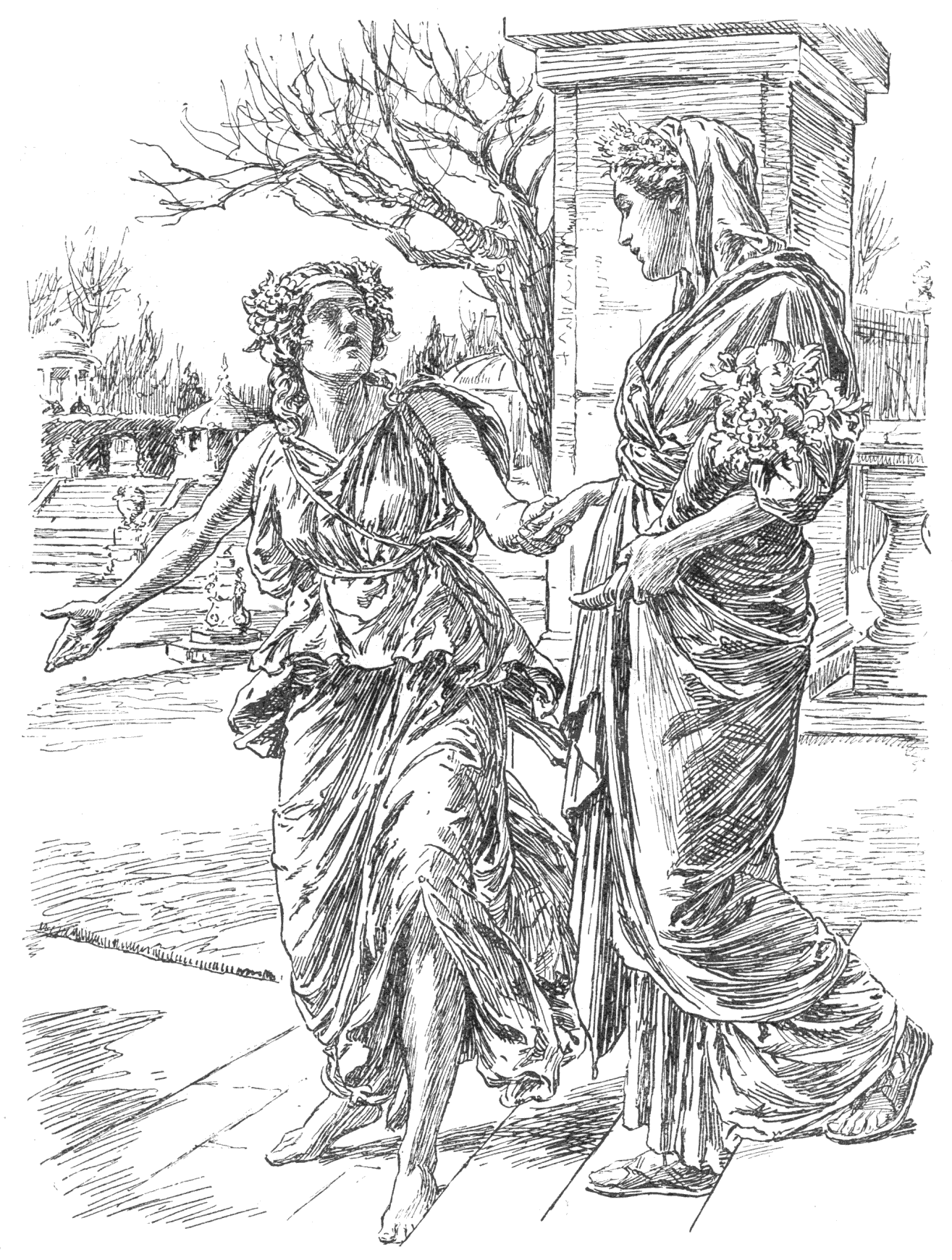
THE GREATER NEED.
FLORA (
To Ceres.
) "ENTER, AND TAKE MY PLACE. THIS IS YOUR YEAR."