Volume 152 — ESSENCE OF PARLIAMENT.
Reading edition
Monday, March 5th.—General cheers greeted Mr. CHAMBERLAIN'S announcement that the Government of India had undertaken to pay the interest on a hundred millions of war-debt, but when he proceeded to say that part of the new revenue required would be obtained by an increase in the cotton duties there was a notable cooling of enthusiasm among Members from Lancashire. Mr. RUNCIMAN at once sounded the alarm on behalf of Manchester by asking if there would be a corresponding excise duty on Indian cottons. "All India is against it," replied Mr. CHAMBERLAIN, who is finding, as his father did before him, how difficult it is to get Englishmen to "think imperially" where their own particular trade is concerned.
There is no doubt that the FOOD CONTROLLER possesses a sense of judicial humour. Complaints have been made of late that while the ordinary British citizen was expected to confine himself to four pounds of bread per week the pampered German prisoner, instead of getting less, was given nearly three times that amount. Lord DEVONPORT has now approved a new dietary scale for prisoners, under which the bread ration will be cut down to sixty-three ounces, or just one ounce less than the allowance of the free and independent Englishman. On the Army Estimates Mr. PRINGLE attacked the Salonika Expedition with a vigour which must have greatly pleased the Bulgar. By a curious lapse of memory, as Mr. CHURCHILL pointed out, he omitted all reference to the position of M. VENIZELOS and our honourable obligations to our Allies.
Mr. CHURCHILL was indeed more statesmanlike than he has been of late, His "amphibious intervention" was on this occasion quite justified. There was good sense in his warning that, while perseverance towards a definite objective was a virtue, "perseverance with an eye on the past" was an equally serious vice; and I hope it signifies a determination on his part not to allow his brilliant future to be all behind him.
Tuesday, March 6th.—Ever since the War began, Mr. SWIFT MACNEILL'S most cherished ambition—second, of course, to his desire to quit Westminster for College Green—has been to get the Dukes of CUMBERLAND and SAXE-COBURG deprived of their British titles. He has worried three successive Governments on the subject, and some time ago received a definite promise that it should be dealt with. A further question regarding it stood in his name to-day, but when he rose to put it Mr. GINNELL squeaked out, "May I ask you, Mr. SPEAKER, what this House has to do with these family matters?" Mr. MACNEILL, of course, like most of his countrymen, has royal blood in his veins, but nevertheless did not seem pleased with the allusion.
Further protests against the mutilation of the Dardanelles Report were made by Sir WALTER ESSEX, Sir CHARLES HOBHOUSE, and Sir JOHN JARDINE. Free disclosure to all Members of Parliament, and no preferential treatment of party-leaders, was their demand. Mr. BONAR LAW manfully resisted their assaults, and the SPEAKER declined to accept a motion for the adjournment. A word from Mr. ASQUITH would no doubt have quelled the storm, but as one of the favoured few who are to receive the full Report he felt himself, I suppose, precluded from saying it. The late Mr. LABOUCHERE would probably have suggested that the difficulty should be solved, on the analogy of a famous edition of MARTIAL, by issuing the Report as expurgated, together with an appendix containing all the omitted passages. But there is no LABOUCHERE in the House to-day—more's the pity.
What Mr. HOGGE does not know about pensions is not worth knowing. He has already made havoc of more than one Government scheme, and unless he has an official ring put in his nose he will evidently do his best to upset the latest of them. On the whole, however, Mr. BARNES'S exposition of the new pension scheme was well received. Though not unduly generous—that would be impossible in the circumstances—it will at least, as Capt. STEPHEN GWYNN put it, "enable us to look disabled men in the face."
Wednesday, March 7th.—Lords SHEFFIELD and PARMOOR are much disturbed because British subjects have been interned without trial, and had to be reminded by the LORD CHANCELLOR that there was a war in progress, and that it was better that individuals should lose a portion of their liberties than that the community should lose them altogether.
A full appreciation of this truth might have prevented the Irish Nationalists from seeking at this moment to get Home Rule out of cold storage. If the attempt had to be made Mr. T.P. O'CONNOR was not perhaps the best person to make it. For over an hour he meandered through the more melancholy episodes of Irish history, from the Treaty of Limerick to the Easter Monday rebellion, rather in the manner of one of those film-dramas of which he is now the Censor. I am afraid his endeavour to prove that Ireland is not "an irrational country, demanding impossible things," was not entirely convincing.
It failed, at any rate—although backed by a brief appeal by Major WILLIE REDMOND, which touched the House by its manifest sincerity—to convince the PRIME MINISTER that this was the accepted time for plunging Ireland once more into civil strife. Those parts of Ireland that wanted Home Rule could have it to-morrow if they wished; neither he nor any other British statesman would force the people of N.E. Ulster under a government they disliked. When those two facts were thoroughly understood there might be a chance of a settlement.
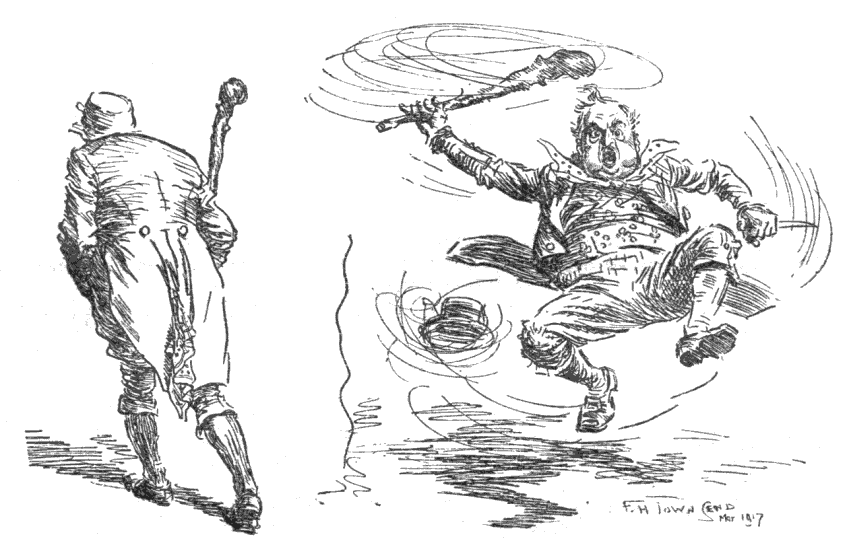
A TRUE IRISHMAN.
Mr. John Redmond. "I'VE FINISHED WITH THE BRITISH EMPIRE— —EXCEPT, BEDAD, THAT WE'RE GOING TO BEAT THE BOSCH!"
Mr. JOHN REDMOND, refusing to continue what he regarded as a futile and humiliating debate, marched out of the House at the head of his supporters. This manoeuvre, rather effective in the Gladstonian era, did not much impress the House on this occasion; for news that something of the kind was intended had leaked out; and Mr. HEALY'S subsequent allusion to it as "a dramatic skedaddle" was felt to be justified.
Thursday, March 8th.—I should have thought that the Dardanelles Report, which everyone is reading, contained enough sensations to satisfy the most outrée taste. But Sir CHARLES HOBHOUSE is still anxious to know the real meaning of the tantalizing asterisks which occur here and there in it, and wants a day to discuss the matter. Mr. BONAR LAW did not absolutely refuse, but hoped that when his right hon. friend had examined the Report he would forgo his desire for further information. It may safely be said that the omitted passages, whatever they are, could hardly alter the public verdict on the extraordinary notions of conducting a war which seem to have prevailed in the Cabinet of which Sir CHARLES HOBHOUSE was himself a member.
The determining factor in the inception of the Dardanelles affair seems to have been the disastrous confidence of the then First Lord of the Admiralty in the 15-inch guns of the Queen Elizabeth. The outcome recalls a verse from a song popular when Master WINSTON was in petticoats:—
"I joined the Naval Demon-strat-i-on, But we never fired so much as a gun, And the Turk he laughed and said, 'Oh, what fun! It's all on account of Eliza!'"
Distressing Sequel to Early Marriage.
"An exciting scene on Waterloo Bridge was described at Bow-street yesterday when Lydia Wilderspin, aged 2, married, was charged with attempting suicide."—Illustrated Sunday Herald.
"RANK AND FILE.
The following casualties are reported under various dates:—
(The home team is Liverpool except where otherwise shown)."—Liverpool Daily Post.
But surely this is an "away" match?
Extract from interview with French journalist:—
"Mr. Lloyd George's face lit up proudly as he modestly replied."
Will the PRIME MINISTER please tell us how is is done? It might solve the problem of getting about in the darkened streets.
"JAMES KENNEDY, Monumental Sculptor,
Having been called up for Military Service, Mr. Kennedy is forced to close down his Business, all the other male members of the family being already on Service. He begs to take this opportunity of thanking all patrons who have accorded him their support in the past, and he hopes that any who might have business requiring his attention may be able to hold over same until his return to business."—Ayrshire Post.
We shall do our best to oblige. "Live and let live" is our motto.
CHILDREN'S TALES FOR GROWN-UPS.
II.
BELLING THE CAT.
"The only question is," said the old mouse, "who is to bell the cat?"
"An absurd question," said the strategist.
"It has finished the story for hundreds of years," said the old mouse crossly.
The strategist turned his back on the old mouse. "What is needed," he said, "is a plan. We must make the cat appear ridiculous, and the people of the house will see it is no use as a mouser. Then they will turn it into a pet cat and bell it themselves."
"Shall we send a deputation?" growled the old mouse.
"We must go out and hunt for food in the daytime," said the strategist.
"We shall all be killed," cried the mice, shivering with terror.
"No more than are killed now," said the strategist. "Less, in fact, because cats do not see so well in the daytime."
And it turned out as the strategist predicted. Mice ran about boldly everywhere, and though the cat caught some of them the people of the house were dissatisfied. "We might as well drown that cat at once and get a real mouser," said the master.
"Oh, don't drown poor pussy," said the little girl. "Do let me keep her."
"Well, mind you put a bell round her neck, then," laughed the master of the house, "so that she may know that she's not a real mouser."
That night there was joy unheard of among the mice. They scampered about happily, and ran away chuckling when pussy came tinkling along. The strategist was crowned king.
Next day the real mouser arrived. His first victim was the strategist.
Illumination.
"In my youth I had learnt, by sedulously imitating the pantaloons in the harlequinades, to drop flat on my face instinctively, and to produce the illusion of being picked up neatly by the slack of my trousers and set on my feet again."—Mr. Bernard Shaw in "The Daily Chronicle."
This revelation of youthful self-culture helps one to understand so much that Mr. SHAW does to-day.
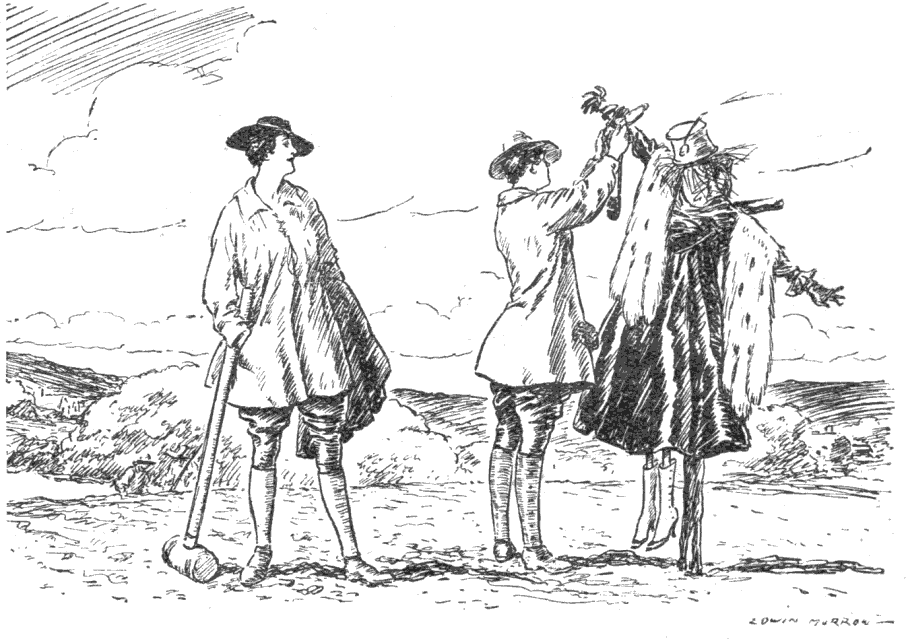
THE SCARECROW.
A SONG OF FOOD-SAVING.
[Being a faithful effort to versify the article written by Dr. E.I. SPRIGGS, at the request of the FOOD CONTROLLER, on the food requirements of people of different ages and build.]
Good people, who long for a lead On the paramount crux of the time, I pray you give diligent heed To the lessons I weave into rhyme; And first, let us note, one and all— Whether living in castles or "digs"— "Large people need more than the small," For that's the first maxim of SPRIGGS. Now, as most of the food that we eat Is wanted for keeping us warm, The requisite quota of heat Is largely a question of form; And the ratio of surface to weight, As anyone readily twigs, Is the root of the point in debate As sagely expounded by SPRIGGS. Hence the more we resemble a sphere Less heat on the surface is lost, And the needful supply, it is clear, Is maintained at less lavish a cost; 'Tis economy, then, to be plump As partridges, puffins or pigs, Who are never a prey to the hump, So at least I interpret my SPRIGGS. Next, the harder it freezes or snows The greater the value of fat, And the larger the appetite grows Of John, Sandy, Taffy and Pat. (Conversely, in Midsummer days, When liquid more freely one swigs, Less viand the appetite stays— This quatrain's a gloss upon SPRIGGS). For strenuous muscular work A larger allowance of grub We need than is due if we shirk Exertion, and lounge in a pub; For the loafer who rests in a chair Everlastingly puffing at "cigs" Can live pretty nearly on air, So I gather at least from my SPRIGGS. Why children need plentiful food He nextly proceeds to relate: Their capacity's larger than you'd Be disposed to infer from their weight; They're growing in bulk and in height, They're normally active as grigs, And exercise breeds appetite— This stanza is absolute SPRIGGS. Last of all, with an eloquent plea For porridge at breakfast in place Of the loaf, and for oatcake at tea A similar gap to efface; For potatoless dinners—with rice, For puddings of maize and of figs, Which are filling, nutritious and nice— Thus ends the Epistle of SPRIGGS.
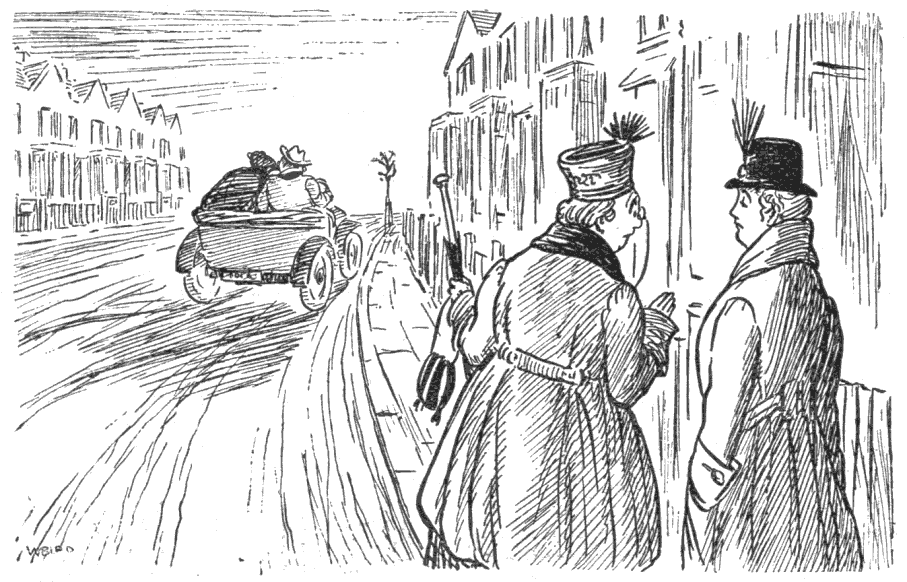
Short-sighted Lady. "THAT'S RATHER AN AFFECTIONATE COUPLE."
Her Friend. "THAT'S MY HUSBAND." Short-sighted Lady. "OH, I'M SO SORRY."
Her Friend. "AND I'M SORRY, TOO, FOR I SEE HE'S GOT HIS LIGHT OVERCOAT ON, AND I TOLD HIM NEVER TO WEAR IT WHEN BRINGING HOME THE COALS."
"The L.C.C. had decided to grant only £5,300 amongst £21,000 teachers, which would average a shilling a head per week. (Shame!)"—Daily Paper.
We agree. Why any War bonus at all to such bulging plutocrats?
"As I watched youths obediently obeying the whistle I wondered what football would be like after the war."—Daily Paper.
At present it seems rather redundantly redundant.
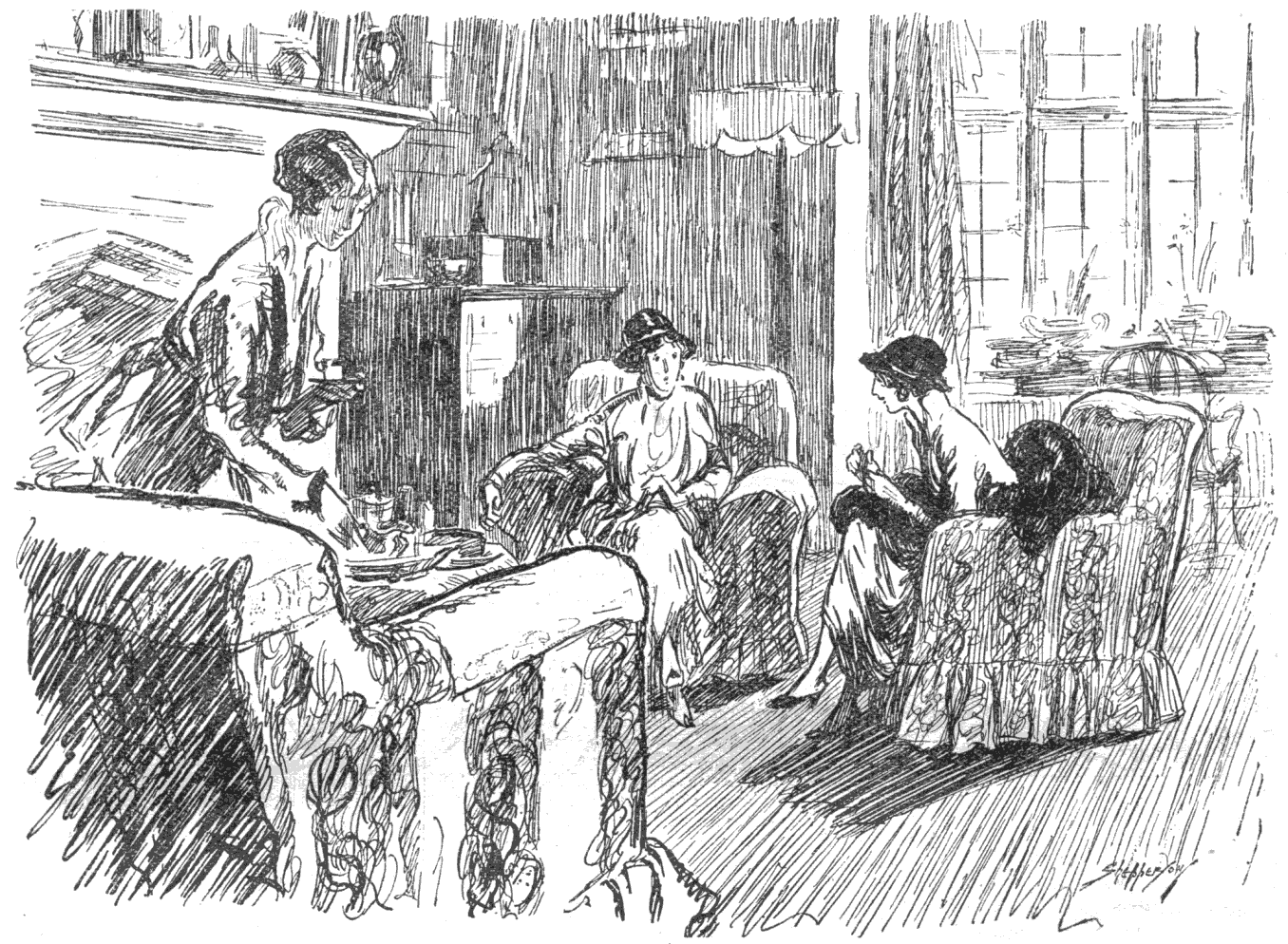
First Lady (an old resident, gushingly). "AH, MRS. ROBINSON, I AM SO ASHAMED OF MYSELF FOR NOT HAVING BEEN TO CALL UPON YOU. DO FORGIVE ME AND CONSIDER THIS AS MY CALL, WON'T YOU?"
Mrs. Robinson (a new-comer, sweetly). "OH, CERTAINLY; AND YOU WILL CONSIDER IT AS MY RETURN CALL, TOO, WON'T YOU?"