Volume 152 — THE WATCH DOGS.
Reading edition
LXII.
My dear Charles
,—I've become so artful these days in disguising identities under assumed names that I'm hanged if I can remember myself which of my people is which. Still I daresay your own memory isn't too good, so we'll call him Ross this time, and trust to luck that that is what we called him last time. He is that one of my friends and fellow sinners who was plugging along nicely at the Bar in 1914, and was just about to take silk, when he changed his mind, came to France and got mixed up in what he calls "this vulgar brawl on the Continent." After nearly three years of systematic warfare in the second line he has at last achieved the rank of full lieutenant, which is not so bad for a growing lad of forty-five; and is running one of those complicated but fascinating side-shows which, to oblige Their Exigencies, we have to label Queer Trades, and leave at that.
Whether his department is or is not making history it is certainly one which calls for a vast amount of special knowledge in its personnel. Ross, having been at the Bar, knows nothing and knows that he knows nothing, but is able to pretend to know just enough to keep his end up with Thos. J. Brown, who, disguised as a corporal, really runs the business. "Our Mr. Brown," as Ross calls him, is one of those nice old gentlemen who wear large spectacles and cultivate specialist knowledge on the intensive system. Owing to his infallibility in all details and upon all occasions he was much sought after in peace time by the larger commercial houses. When War broke out our Mr. Brown disdained peace. He made at once for the Front; but his aged legs, though encased in quite the most remarkable puttees in France, were found to be less reliable than his head, and he was held up on his way to the trenches and diverted to the stool of Ross's office.
He began by putting some searching and dreadfully intelligent questions to Ross; dissatisfied with Ross's answers, he concentrated his mind on the business for twenty-four consecutive hours, at the end of which period he was the master of it in more senses than one. Since that time Ross has ensured the efficient running of his office by keeping out of it when it is busy. When for appearance sake he has to be there he does as his Mr. Brown tells him, and never wastes the latter's time by arguing.
In the Army, all fleas have bigger fleas upon their backs to bite 'em. Were this not so somebody would have to act upon his own responsibility, and that, as you will admit, would make war an impossibility. Accordingly in every department there is a series of authorities, starting with "other ranks" at the bottom, proceeding in an ascending scale of dignity and worth, and disappearing through a cloud of Generals into an infinite of which no man knoweth the nature. Thus, with Ross's business (to take the tail end of it) the letter which the Corporal writes the Lieutenant signs on behalf of the Major. It is when the Major wants to do something more active that trouble arises. Let us take an incidental matter of administrative detail for example, setting it forth, as all military matters should be set forth, in paragraphs, separately numbered:—
1. Lt. Ross possessed a bicycle, motor, one. No. 54321 L/Cpl. Burt possessed feet, two, only. Ross had no occasion, ability or disposition to ride a motor bicycle. No. 54321 could neither do his business nor enjoy life afoot. Accordingly, No. 54321 rode the bicycle, while, for the purposes of what is known to better people than ourselves as Establishment, Ross owned it. But that was in the good old days, before Traffic and Police and all the Others interested themselves.
2. The first thing Traffic did was to say that all owners of motor bicycles must own cards, and produce them when demanded. That was easy: No. 54321 got the card. Then Police issued some vague but menacing literature with regard to the fate of people who stole other people's property or failed to stick to their own. There was no difficulty about this; Ross publicly fathered the thing.
3. Traffic, issuing new cards, said next that all owners of cards must also own bicycles. Realising the quandary, Ross was for saying he wouldn't play any more, but would declare a separate peace. His Mr. Brown however got up a long and intricate correspondence, at the end of which Ross was still owner and No. 54321 was still rider; both had cards, and all the authorities had, unknowingly, made themselves parties to the fraud.
Suddenly the Major declared his intention of putting the whole of Ross's establishment (including bicycle) on what he called a satisfactory basis by a series of orders which he proposed to draft himself. Ross, always ready to be put on a satisfactory basis by anybody, took note of the draft, and laid it before his Mr. Brown. The latter was aghast, and proved, by infallible reasons, the fatal results which would follow if the matter was stirred up. Ross made a careful note of the reasons, and laid them before the Major. The Major explained gently that discipline was discipline. And so Ross went to and fro between the two, until the Major said, "Really, Ross!" and his Mr. Brown said, "I'm very sorry, Sir, but there it is;" and yet Ross couldn't sack his Major, and he couldn't break away from his Mr. Brown.
He was between the Devil and the Deep Sea. What was he to do about it? Well, he just told the Deep Sea to keep calm a little longer, and went and waited outside the Devil's Mess. He saluted and asked the Devil if he'd care to come for a walk, and, the latter consenting, he led him to the Deep Sea. Then, when the Devil himself had been introduced to the Deep Sea itself, Ross slipped off and left them in his office to fix it up between themselves.
Ross dined with the Major that night, and the latter said he wasn't feeling at all well. The way Ross's Mr. Brown had licked his thumb and the lightning speed with which he had turned up exactly the right correspondence, office minute or Routine Order, had nearly given the Major heart disease. Besides, he'd lost the argument. "I was too heavily handicapped from the start," said he, "by not being in a position to lick my thumb or to stick my pencil behind my ear."
It was a good idea to introduce the Major and Mr. Brown, wasn't it, Charles? The Major says he was the first to suggest it, and Ross is careful to leave the credit with the Major, because he is sure that the idea really originated in the fertile and masterful brain of his Mr. Brown.
Yours ever,
Henry.
Miss Daisy Dimple, the revue favourite, sells flags.
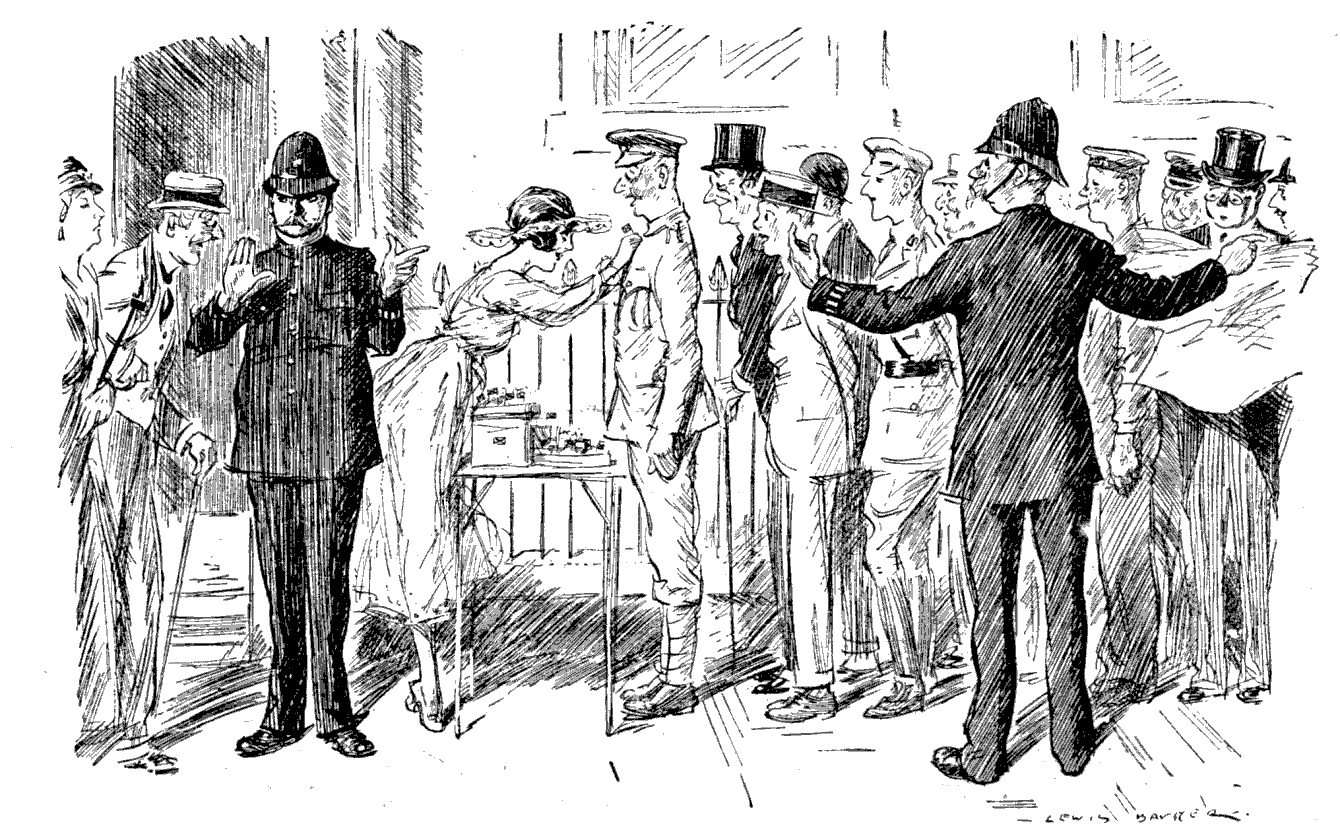
Another Impending Apology.
From a South African Parish Magazine:—
"Many thanks to the Rev. —— and the Rev. —— for coming to St. —— during the past month. The Rector went off to Clifton and Park Town, and enjoyed the change almost as much as the congregation."
"A bird flew into Willesden Court yesterday and perched above the magistrate's head.
Alderman Pinkham: 'It's not often we 'get the bird' on the bench.'"
But the "Beak" is there all the time.
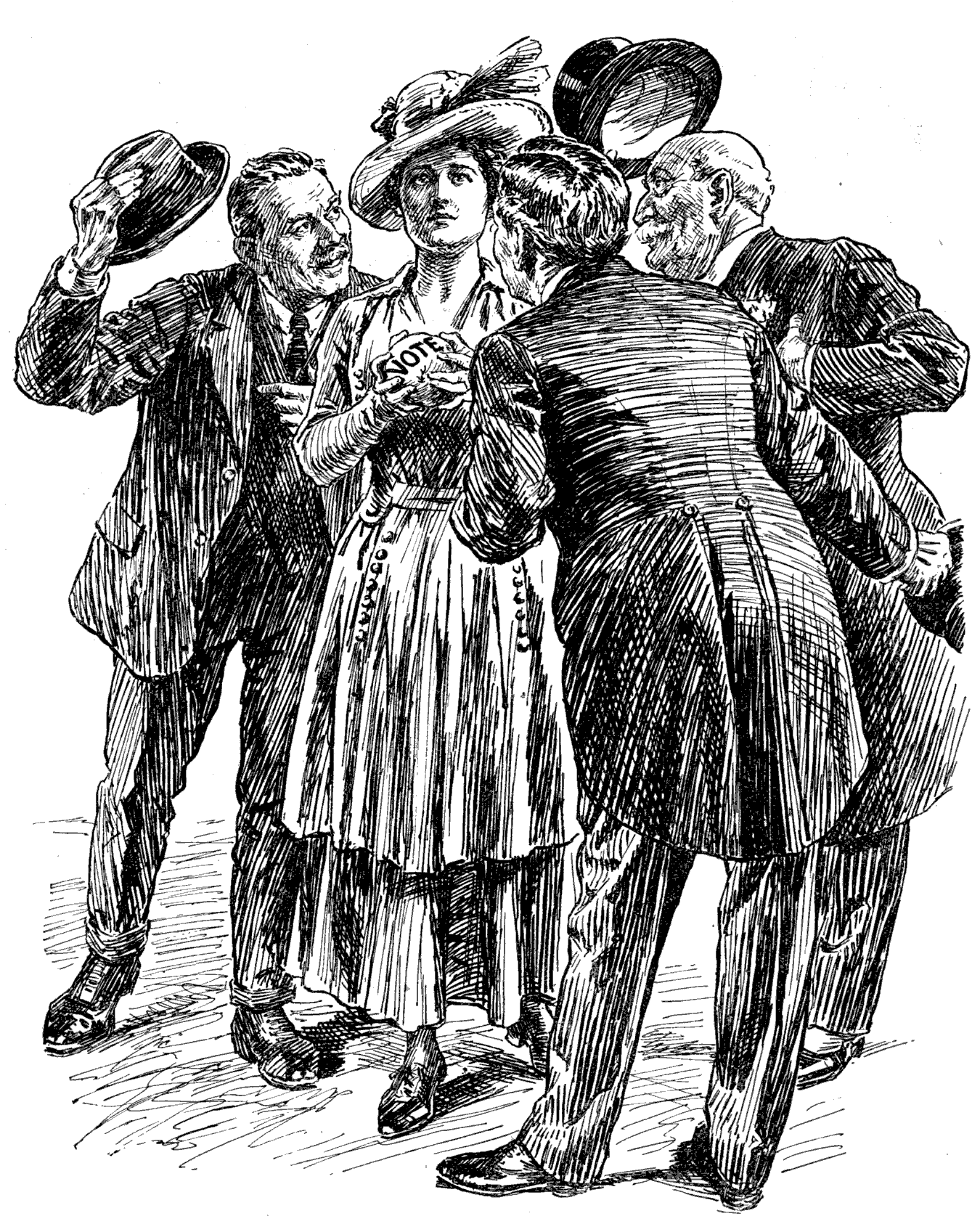
THE JUDGMENT OF PARIS: LATEST INVERSION.
{Conservatism, Liberalism, Labour.} "DON'T FORGET, DEAR LADY, WHEN THE TIME COMES, THAT IT WAS I WHO GAVE YOU THE APPLE."
ESSENCE OF PARLIAMENT.
Monday, June 18th.—Arising out of the dethronement of Tino a cloud-burst of questions descended upon Lord Robert Cecil, who took refuge under a wide-spreading umbrella of official ignorance. Mr. Lynch was annoyed because his question whether the Allies would oppose the foundation of a Greek Republic was dismissed as "hypothetical," but Lord Robert assured him that there was "nothing abusive" in the epithet. But is that so? Suppose he were to describe Mr. Lynch as a "hypothetical statesman"?
A detailed history of a Canterbury lamb, from its purchase in New Zealand at 6⅜d. a pound to its sale to the British butcher at 10½d., was given by Mr. George Roberts. He threw no light, however, on the problem why it should double in price before reaching the consumer. This is engaging the anxious consideration of Lord Rhondda, who declares that there is no adequate economic reason why Little Mary should have only a little lamb.
In the House of Commons as in a music-hall you can always get a laugh by referring to "the lodger." Whether the lodger, who is considered quite good enough to vote for a mere Member of Parliament, should also be allowed a voice in the election of really important people like town councillors was the theme of animated discussion. It ended ultimately in the lodger's favour, with the proviso that the apartments he occupies should be unfurnished. On such niceties does the British Constitution depend.
Tuesday, June 19th.—Mr. Balfour received a warm welcome from all sections of the House on making his first appearance after his return from America. Even the ranks of Tuscany, on the Irish benches, could not forbear to cheer their old opponent. Besides securing American gold for his country, he has transferred some American bronze to his own complexion, and has, if anything, sharpened his faculty for skilful evasion and polite repartee by his encounters with Transatlantic journalists.
In the course of the daily catechism on the subject of air-raids Mr. MacMaster inquired, "Why is it that Paris appears to be practically immune, while London is not?" The answer came, not from the Front Bench, but from the Chair, and was delivered in a tone so low that even the Official Reporter failed to catch it. That is a pity, because it furnishes a useful hint for Ministers. In future, when posed with futile or embarrassing questions about the War, let them follow the Speaker's example, and simply say, "You must ask the Kaiser!"
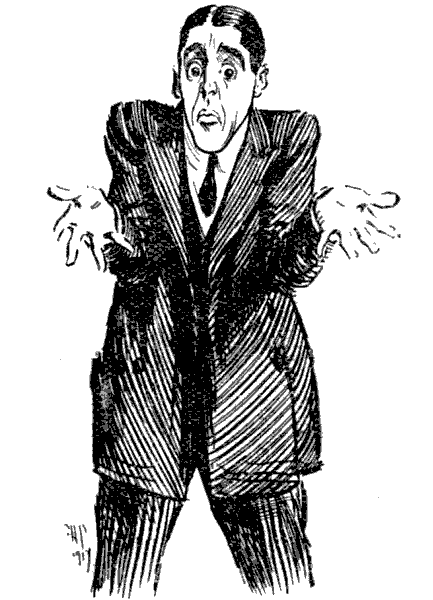
THE BETTER PART OF VALOUR.
Sir Frederick Smith. "What's the good of struggling?"
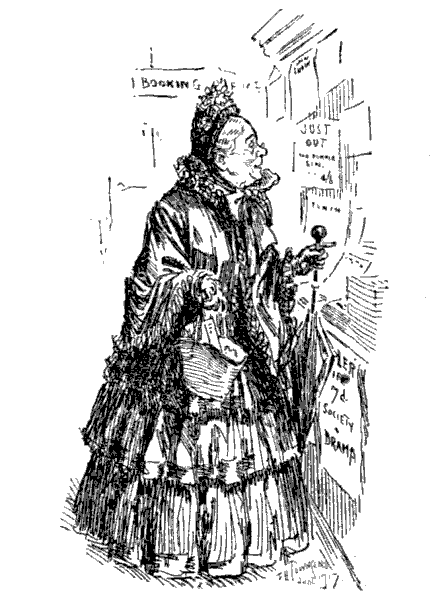
Literary Dame (at bookstall). "Have you any books by that rising young novelist, Lord Hugh Cecil?".
In a perfectly free division, in which Ministers and ex-Ministers were mixed up together in both Lobbies, woman's right to be registered as a Parliamentary elector was affirmed by 385 votes to 55. Some capital speeches were made on both sides, but if any of them turned a vote it was probably the cynical admission of the Attorney-General that he was as much opposed to female suffrage as ever, but meant to vote for it because it was bound to come. This probably had an even greater effect upon the average Member, who is not an idealist, than the nutshell novelette in which Lord Hugh Cecil lightly outlined the possible future of the female politician.
Wednesday, June 20th.—Military metaphors come naturally to the Duke of Marlborough. Yet I cannot think he was happily inspired when, in reminding the farmers of their duty to put more land under the plough, he compared the compulsory powers of the Board of Agriculture to a sword in its scabbard, and hoped there would be no necessity to rattle it. Everybody knows that the sword in question is a converted ploughshare, and that it rests with the War Office to turn it back again.
Last night fifty-five Members resisted Votes for Women. By this afternoon twenty-five of them had so far changed their minds as to protest against the limitation of the privilege to women over thirty. Major Rowland Hunt, convinced that women would soon vote themselves into the House, expressed a naïve preference for "young 'uns."
Thursday, June 21st.—During Sir Edward Grey's long tenure of the Foreign Secretaryship he rarely visited the House of Commons more than twice a week. Until his voyage to the United States, Mr. Balfour was even less attentive to his Parliamentary duties and left most of the "donkey-work"—if one may so describe the business of answering the questions of curious Members—to Lord Robert Cecil. Since his return Mr. Balfour has developed a new zest for this pastime, and to-day for the third time in succession appeared in his place. Everybody is pleased to see him there, except perhaps the curious Members aforesaid, who find him even more chary of information than his deputy. Had not the President of the United States said something about Alsace-Lorraine? ventured Corporal Lees-Smith. Mr. Balfour, fresh from the White House, blandly replied, "I do not propose to discuss President Wilson's Notes."
The notion, prevalent at the beginning of the War, that every German waiter was an emissary of the Kaiser, only awaiting "The Day" when he should return to take a full revenge for meagre gratuities, still subsists in certain minds. Mr. Brookes was manifestly disappointed when Dr. MacNamara assured him that the aeronaut captured in the recent raid was not, as he supposed, one of these returned Ganymedes, but was making his first appearance on English soil.
"A small fire at a variety theatre burnt some dresses all up, but the revue went on as usual."—Berrow's Worcester Journal.
No need to worry over little things like that.
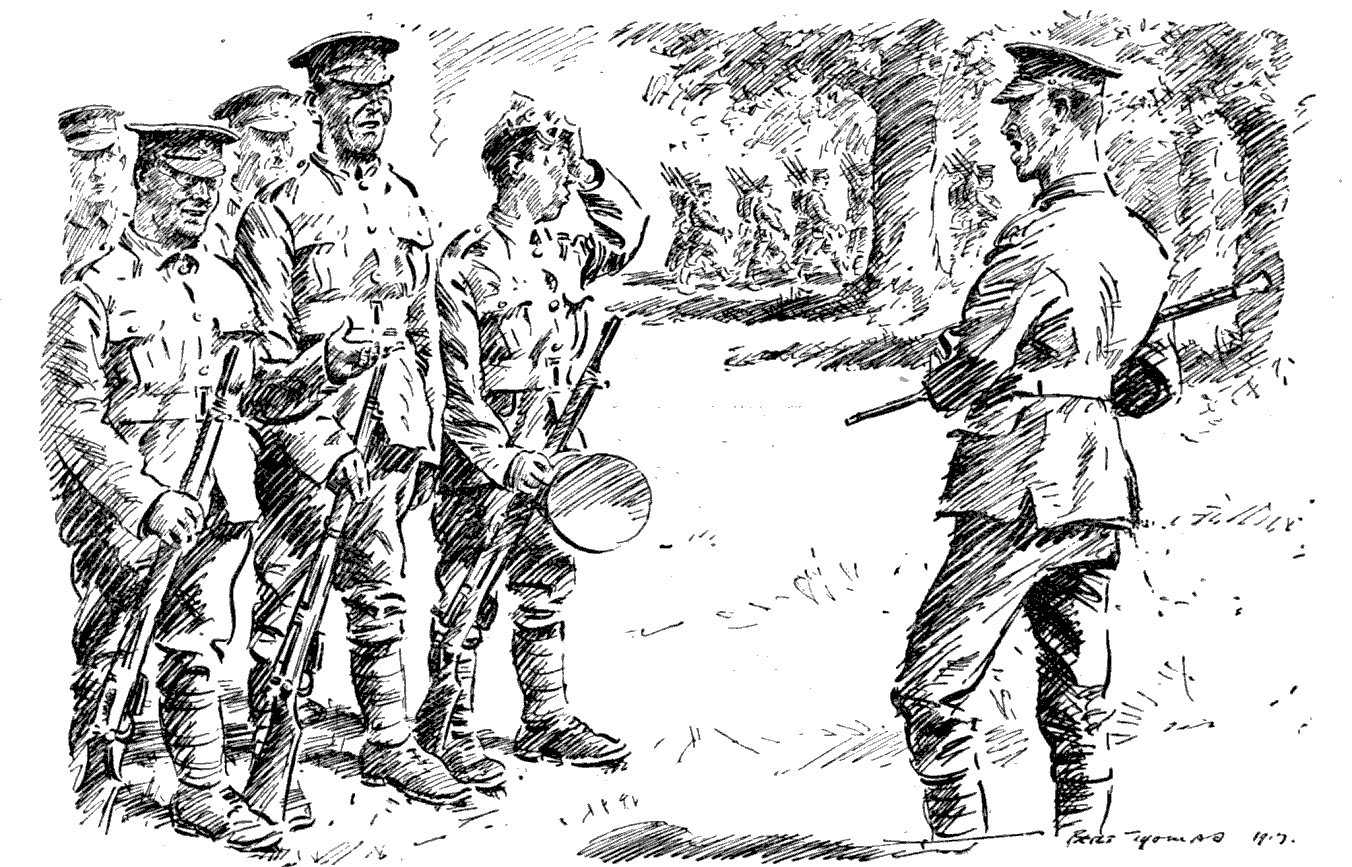
Long-suffering Sergeant. "We got another arf-hour to go yet. I don't know what to do with yer."
Rookie (suggestively). "There's some trees over there, Sergeant."
Sergeant. "Yes, I know. But there ain't any ropes."