Volume 152 — CHARIVARIA.
Reading edition
The favourite reading of the Sultan of Turkey is said to be criminal literature. A gift-book in the shape of a new Life of the Kaiser is about to be despatched to him.
King Alexander
of Greece originally proclaimed that he would "carry out his father's sacred mandate." But when it was pointed out to him that, if this was really his desire, an opportunity of following in his father's footsteps would doubtless be granted him, he tried again.
During the last air raid we are told that the employees of one large firm started singing "Dixie Land." We feel, however, that to combat the enemy's aircraft much sterner measures must be adopted.
"The Huns' diet is low," says a correspondent of The Daily Mail. But then their tastes are low too.
Writing of the recent Trentino offensive, Mr. Hamilton Fyfe says that several Austrian forts captured by the Italians were built of solid ice. It is time that London had some defences of this character.
The arrival of ex-King Tino at Lugubrioso, on the Swiss-Italian frontier, has been duly noted.
The Lord Mayor of London has decided in future to warn the City of impending air raids. Ringing the dinner-bell at the Mansion House, it is thought, is the best way of making City men take to their covers.
A new epidemic, of which "bodily swellings" are the first symptom, is reported by the German papers. And just when the previous epidemic of head-swellings was beginning to subside.
A Marylebone boy, arrested for forgery, told the police that he had made two complete £1 notes out of paper bags. Is this the paper-bag cookery of which we have heard so much?
A market gardener told the Enfield Tribunal that a conscientious objector whom he had employed was found asleep at his work on two successive days. People with highly-strung consciences very rarely enjoy this natural and easy slumber.
The American scientist who claims to have invented a substitute for tobacco cannot have followed the movement of the age. We have been able to obtain twopenny cigars in this country for years.
An applicant who said he had six children has been given six months' exemption. A member of the Tribunal remarked that the exemption would mean one month for each child. This great discovery proved too much for the poor fellow, who is said to have collapsed immediately.
A new ship is being fitted out for Captain Amundsen, who is to proceed shortly with an Arctic exploration party. In case he should discover any new land, arrangements have been made to hold a flag-day for the inhabitants, if any.
Judging by the latest reports the Stockholm Conference is like the gun that they didn't know was loaded.
Because his wife accused him of not loving her, a farmer of Husavik, Manitoba, assaulted her with a pen-knife just to show that he did.
Special "storm troops"—men picked for their youth, vigour and daring, to carry out counter-attacks—are now a feature of the German Armies. Even our ordinary British soldiers, who are constantly compelled to take these brave fellows prisoners, bear witness to the ferocity of their appearance.
Taxes on watering-places, it is announced, will be a feature of the new French Budget. It is feared that this will bear hardly on breweries and dairies.
We are not permitted to publish the name of the Foreign Office official who strolled into a Piccadilly Bar last week and ordered a Clam-Martinic cocktail.
According to a report of the National Physical Laboratory the Tower of London is moving towards the Thames. The hot weather is thought to have something to do with it.
The Board of Agriculture advises the killing of all old cocks and hens. Lively competition between the railway refreshment rooms and the tyre factories should ensure a satisfactory price.
The High Court at the Hague has ordered a new trial in the case of the Editor of the Telegraaf, who was sentenced for referring to "a group of rascals in the centre of Europe." The rascality of the persons in question is now deemed to be proved beyond the shadow of a doubt.
The announcement that there will be no more Sunday music at the Zoo has been received with satisfaction by the more conservative residents, who have always complained that the presence of a band tended to reduce the place to the level of a mere circus.
A well-known inn at Effingham having changed its name from the Blücher to the Sir Douglas Haig, it is further suggested that the name of the village should be changed to Biffingham.
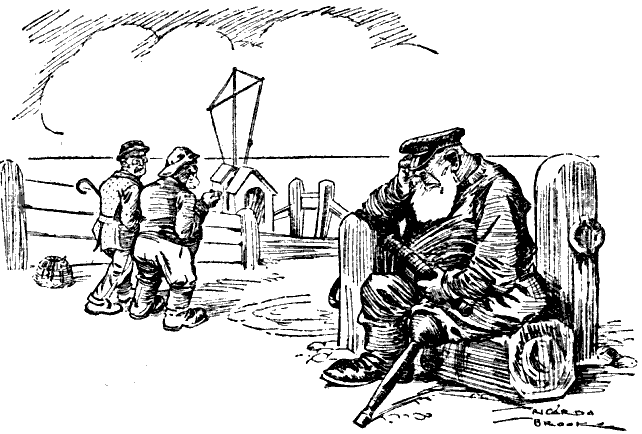
"Ay, poor old Ben's rooined by the war. All 'is yarns wos about above-sea pirates!"
How to Cure a Wound.
"A wounded soldier jumped or fell from a passing S.E.R. Red Cross train between Swanley Junction and Bromley to-day. The train was running at about twenty miles an hour. When picked up the man was found to be uninjured."—Evening Paper.
TITLE AND HALF-TITLE PAGES.
With a view to economy of paper, the title and half-title pages of the Volume which is completed with the present issue are not being delivered with copies of Punch as hitherto; they will however be sent free, by post, upon receipt of a request.
Those readers who have their Volumes bound at the Punch Office, or by other binders in the official binding-cases, will not need to apply for copies of the title and half-title pages, as these will be bound in by the Punch Office or supplied direct to other binders along with the cases.
ALGY.
Algy, it must be admitted, is no Adonis, but at least there is something in his great round pudding-face and his cheery idiotic smile which gives one the impression of a warm and optimistic nature.
Algy is humble and not ambitious; but for all that he is doing his bit, just as you and I are doing. He never goes on strike, and if he had any money, which he never does have, I know he would invest it in War Loan. Above all he is not a food-hog; not for him the forbidden potato or the millionaire's beer—no! Against all luxuries Algy has resolutely steeled his voluminous tummy. He has turned into the strictest of teetotalers, and, though a glass of Scotch may bring a wistful look into his eyes, yet he remains captain of his soul, unbroken as St. Anthony.
His job is war-work of the steeliest order, such as very few men would care to undertake. All for the cause he stands, day after day, with a little band of comrades, facing uncomplainingly the most terrible buffetings, so that men may learn from him how to strike terror into the heart of the Hun.
Needless to remark, he is beloved by all the Tommies who inflict such pain upon the region of his gaudy blue waistcoat; he never seems to care and never grouses, but beams down on them undaunted with that quaint old grin of his.
'Twas a great and solemn day when we installed him. Conspicuous by his horrible suit of reach-me-downs, supported on one side by the sergeant-major, on the other by the sergeant, he was led gently but firmly out of his billet and initiated into his honourable task.
Algy has but one grievance. He wants badly to sport a few golden stripes on his cuff. He is modest and does not push himself forward, but as he has several times been severely wounded be thinks it only fair that he should receive the coveted distinction. But the authorities will not grant his simple request because, they say, he has shed no blood.
He has outlived all his compeers; lesser men may succumb but Algy goes on. One day, I suppose, he will meet the common fate; but may that sorry day be far ahead. For we could ill spare our Algy—our dear old bayonet dummy!
"INDIAN WAR LOAN.—The amount applied for in Rangoon yesterday was Rs. 00,000, making the progressive total Rs. 00,00,000."—Rangoon Times.
Nothing to boast about.
THE BAN ON RACING.
Dear Mr. Punch,—In this bitter controversy I hope that a few moderate and impartial words from one, like myself, who sees clearly both sides of the question, may not be out of place. In any case I feel it is incumbent upon me to do all I can to avert the dire consequences of the frightful catastrophe that has fallen upon us through the mad act of an insensate War Cabinet. I can only say that if this is to be our spirit we are indeed defeated. Where is our devotion to manly sports, so potent in the moulding of our National character? What has become of our immemorial Right to Look On? Where is our boasted liberty, deprived as we are now to be of a chance to find the winner? What did Wellington say of Waterloo? and Marlborough of Blenheim? and Bottomley of the Battle of the Somme? By what perversity of reasoning are we thus to asphyxiate the best instincts of our race?
We are said to be fighting for all that we hold sacred. Yet there is nothing that is held more sacred in every cottage home throughout the land than the Preservation of our Bloodstock. Let us not deceive ourselves. It is our supremacy in Bloodstock alone that makes possible the governess car, the milk van, the brewer's dray, the very plough itself. These are fundamental facts.
It has been suggested that, in order to avoid the assembling of frivolous crowds in war-time, races might be run in private. But that is quite impracticable. Only on the public racecourse can the lofty virtues of our British Bloodstock be displayed. The exciting presence of the crowd is absolutely essential to tune up its nerve and temper. Already our Bloodstock has suffered cruelly from gaps in the Grand Stand.
Then again there are some who actually complain that petrol is consumed in large quantities by those attending race meetings. Are we to put new heart into our enemies by letting it be known that we are short of petrol?
And finally there are some who so little understand the qualities of the Thoroughbred as to suggest that gambling should be stopped in war-time. The horse, unlike the Cabinet, is intelligent. Can he be expected to exhibit his priceless qualities of speed and stamina if no one puts his money up?
I need say no more. Such flippant legislation is bad enough at any time; during the Armageddon period it is little short of treason. One wonders when our Government will begin to realise that we are at war.
I am, Yours helpfully, as usual, Statistician.
THE DIARY OF A CO-ORDINATOR.
June 17th.—Flew in an aeroplane to Los Angeles and correlated the industrial functions of the East and West. Returned to the White House for dinner, and co-ordinated grape juice with lemonade and Perrier.
June 18th.—Breakfasted with Hearst and co-ordinated him for half-an-hour with the editor of New York Life, a task needing the highest diplomatic qualities. Flew to Harvard and delivered lecture on Mr. Balfour's Theology as correlated with his style in golf. A great reception. Despatched report by wireless to London, Paris and Petrograd. Returned to New York in the afternoon and co-ordinated Upton Sinclair, Colonel Roosevelt, Tumulty and Charles Dana Gibson.
June 19th.—In the morning dictated articles for the Novoe Vremya, Matin and Corriere della Sera, emphasizing the need of co-operative cosmopolitan co-ordination. Flew to Chicago to deliver supplementary lecture to that given by Arthur Balfour on Aristotle. Took for my subject "Aerial Trade Routes, as co-ordinated with Terra-firma Routes for Motor-lorries." Enthusiastic reception. Co-ordinative cold collation at 9 p.m. at Philadelphia with Gompers, Rockefeller, Mrs. Atherton and Billy Sunday.
June 20th.—Dictated article on the New Diplomacy for The New York Journal. In the afternoon co-ordinated the tenets of Shin-Toism, Christian Science and Mormonism. A heavy day.
June 21st.—Much annoyed by report of Curzon's extraordinary speech in the House of Lords. Called at the White House and the British Embassy to put matters right, and sent wireless to Curzon: "Nothing 'succeeds' like success."
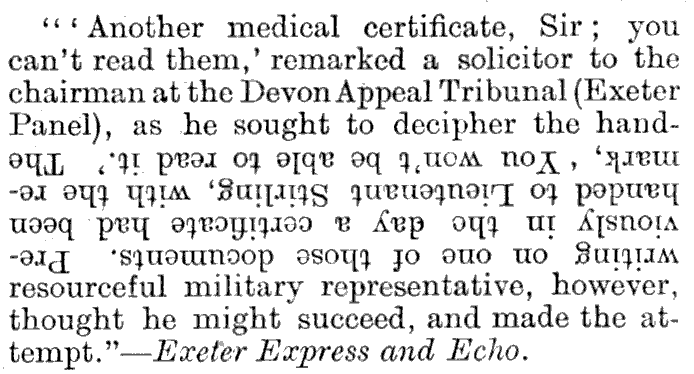
Standing on his head, we suppose.
Extract from a report of a sermon by Father Bernard Vaughan:—
"They might as well go on to one of the main lines and attempt to stop one of the engines gorging from Euston to Edinburgh."—Express and Echo (Exeter).
Perhaps it would be wiser to refer the matter to the Food-Controller.
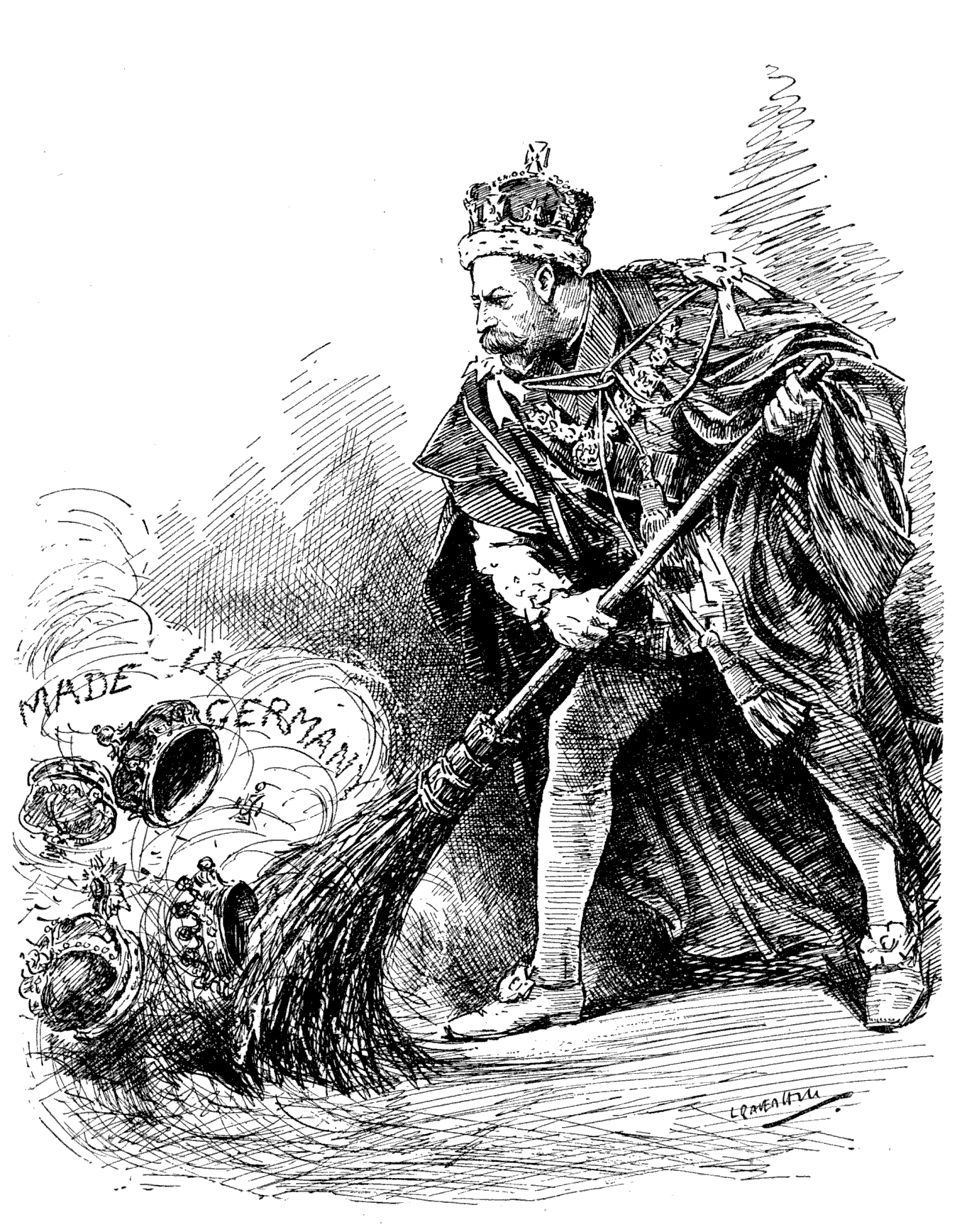
A GOOD RIDDANCE.
[The King has done a popular act in abolishing the German titles held by members of His Majesty's family.]
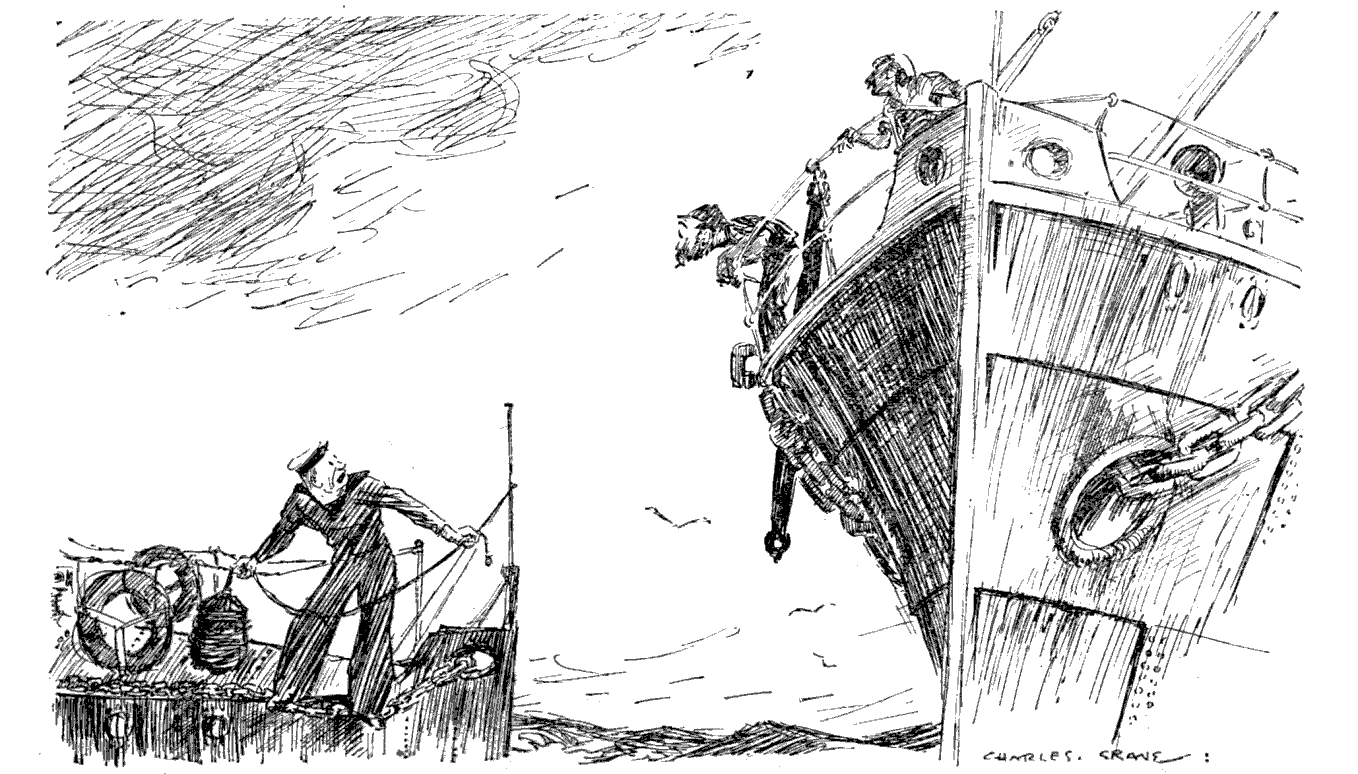
Bluejacket (on torpedo-boat that has only just avoided collision with a neutral steamer). "I know you love me, Alfonso, but there's no blinkin' need to try and kiss me every time we meet."