Volume 152 — "THE ROAD TO VICTORY."
Reading edition
GERMANY. "ARE WE NEARLY THERE, ALL-HIGHEST?"
ALL-HIGHEST. "YES; WE'RE GETTING NEAR THE END NOW."
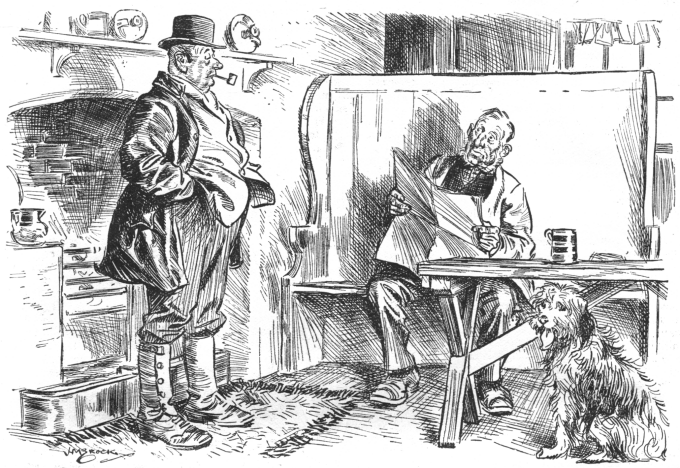
"'AVE YOU 'EARD ABOUT THESE 'ERE NEW INVISIBLE ZEPPELINS THEY'RE MAKIN'?"
"YES. BUT I DON'T RECKON WE SHALL SEE MANY OF 'EM OVER 'ERE."
TAXIS AND TALK.
Conversation in the streets of London has never been easy; not, at any rate, until the small hours, when the best of it is done. But it becomes even more complex when one of the talkers is pressed for time and wants a taxi, and disengaged taxis are as rare as new jokes in a revue.
Let the following dialogue prove it. I leave open the question whether or not I have reported the real terms of our conversation, merely reminding you that two men together, removed from the frivolity of women, tend, even in the street and when the thermometer is below freezing-point, to a high seriousness rare when the sexes are mingled.
Imagine us facing a wind from the east composed of steel filings and all uncharity. We are somewhere in Chelsea, and for some reason or other, or none at all, I am accompanying him.
He (looking at his watch). I've got to be at Grosvenor Gardens by half-past one and there's not a taxi anywhere. We must walk fast and perhaps we'll meet one. Dash this War anyhow. (He said, as a matter of fact, "damn," but I am getting so tired of that word, in print that I shall employ alternatives every time. Someone really must institute a close season for "damns" or they won't any longer be funny on the stage; and, since to laugh in theatres has become a national duty, that, in the present state of the wit market, would be privation indeed.)
I (submerged by brain wave). Perhaps we'll meet one.
He. Keep a sharp look out, won't you? I 've got to be there by half-past one, and I hate to be late.
I. Those tailors you were asking me about—I think you'll find them very decent people. They——
He (excitedly). Here comes one. Hi! Hi!
[A taxi, obviously full of people, approaches and passes, the driver casting a pitying glance at my poor signalling friend.
He. I thought it was free.
I. The flag was down.
He. I couldn't be sure. What were you saying? Sorry.
I. Oh, only about those tailors. If you really want to change, you know, I could——
He. Do you mind walking a little faster?
I (mendaciously). Not at all. I could give you my card, don't you know. But of course you might not like them. Tastes differ. To me they seem to be first-rate, as tailors go.
He (profoundly—though he is not more profound than I am). Of course, as tailors go.
I. They 're best at——
He (excited again). Here's another. Hi! Hi! Taxi. No, it's engaged.
I (with a kind impulse). If you'll ask me, I'll tell you whether the flags are up or not. I think I must be able to see farther than you.
He. Do.
I. I was always rather famous for long sight. It's——
He (turning round)). Isn't that one behind us? Is that free?
I. I can't tell yet.
He. Surely the flag's up.
[He steps into the road and waves his stick.
I. It's a private car.
He. Hang the thing! so it is. They ought to be painted white or something. Life is not worth living just now.
I. They're best for trousers, I should say. Their overcoats——
He (pointing up side-street). Isn't that one there? Hi, taxi! Good heavens, that other fellow's got it. We really must walk faster. If there isn't one on the rank in Sloane Square, I'm done. If there's one thing I hate it's being late. Besides, I'm blamed hungry. When I'm hungry I'm miserable till I eat. No good to anyone.
I. As I was saying——
He. What I want to know is, where are the taxis? They're not on the streets, anyway; then where are they? One never sees a yard full of them, but they must be somewhere. It's a scandal—a positive outrage.
I. Their overcoats can be very disappointing. I don't know how it is, but they don't seem to understand overcoats. But they're so good in other ways, you know, that really if you are thinking——
He. Here's one, really empty. Hi! Hi! Taxi! Hi! Hi!
[The flag is up but the driver shakes his head, makes a noise which sounds like "dinner" and glides serenely on.
He. Well, I'm blamed! Did you ever see anything like it? What's that he said?
I. It sounded like "dinner."
He. Dinner! Of all the something cheek! Dinner! What's the world coming to?
I (brilliantly). Perhaps he's hungry.
He. Hungry! Greedy, you mean. Hansom drivers never refused to take you because they were hungry. It's monstrous. Bless the War, anyway. (Looking at his watch) I say, we must put a spurt on. You don't mind, do you?
I (more mendaciously, and wondering why I'm so weak). Oh, no.
[We both begin to scuttle, half run and half walk.
I (panting). As I was saying, they're not A1 at overcoats, but they've a first-class cutter for everything else. Just tell me if you want to change and I'll introduce you, and then you'll get special treatment. There's nothing they wouldn't do for me.
He (breathlessly). Ah! There's the rank. There's just one cab there. How awful if it were to be taken before he saw us. Run like Heaven.
I (running like Heaven). I think I'll leave you here.
He (running still more like Heaven, a little ahead). Oh no, come on. I want to hear about those tailors. Hi! Hi! Wave your stick like Heaven!
[We both wave our sticks like Heaven.
He (subsiding into a walk). Ah! it's all right. He's seen us. (Taking out his watch) I've got four minutes. We shall just do it. Good-bye.
[He leaps into the cab and I turn away wondering where I shall get lunch.
He (shouting from window). Let me know about those tailors some day; if they're any good, you know.
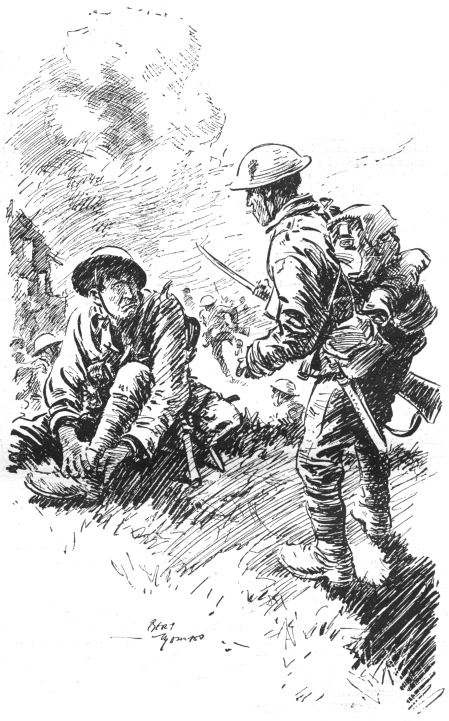
"ARE YE WOUNDED, TERENCE?"
"I AM THAT, MICHAEL; 'TIS IN THE FUT."
"BAD CESS TO THIM BODY-SHIELDS! I NIVER HAD MUCH FAITH IN THIM!"
"'The best people are still wearing their own clothes,' said Mr. Williams."—Star.
With all respect, Mr. WILLIAMS, the best people are wearing the KING'S.
"DONKEYS.—Wanted to purchase 100 reasonable. Apply M.S." Advt. in Colonial Paper.
We have never met this kind of donkey ourselves, but we wish M.S. the best of luck.
AT THE PLAY.
"ANTHONY IN WONDERLAND."
It was not till about the middle of the play, and after a narcotic had been administered to him, that Anthony got there; but we were in Wonderland almost from the start, without the aid of drugs. For we were asked to believe that Mr. CHARLES HAWTREY was a visionary, amorous of an ideal which no earthly woman could realise for him. Occasionally he had caught a glimpse of it in the creations of Art—at the Tate Gallery or Madame TUSSAUD'S or the cinema; but in Bond Street never.
And the pity of it was that he had come in for a fortune of seven hundred thousand pounds odd, which would pass elsewhere unless he married by a given date. It was therefore the clear duty of his relatives—a couple of sisters and their husbands—to find a wife for him. After vainly trying him with every pretty woman of their acquaintance they had resort, in desperation, to the black art of a certain Mr. Mortimer John (U.S.A.), an infallible inventor of stunts, who made a rapid diagnosis of the case and at once pronounced himself confident of success.
Briefly—for it is a long and elaborate story—his scheme is to choose a charming girl, and make a film drama round her. Anthony, with family, is taken to see the show and occupies the best box in the Prince of Wales's Theatre, from which, after a little critical comment upon us in the audience, he falls in love with the heroine. It is the typical film of lurid life on a Californian ranch, and might almost have been modelled on one of Mr. Punch's cinema burlesques. There are the familiar scenes of a plot to hang the girl's lover, swiftly alternating with scenes of her progress on horseback through the primeval forest, and concluding with her arrival just in time to shoot the villain and untie the noose that encircles her lover's carotid.
On the return of the party from the cinema, Mortimer John describes to Anthony the powers of a drug which induces the most vivid of dreams. He, John, had once been in Anthony's pitiful case, and through the services of this drug had achieved his quest of the ideal woman. Anthony, greatly intrigued, consents to swallow a sample of the potion. It is a simple narcotic, and under its influence he is conveyed, in a state of coma and a suitable change of apparel, into the heart of Surrey, where at sunrise he is restored to animation and has the scenes of the evening's drama re-enacted before his eyes, as originally filmed for exhibition. Under the impression that this is merely the vivid dream that he had been promised, he himself takes part in the living drama, playing the noble rôle of an exceptionally white man. In the course of it he exchanges pledges of eternal love with Aloney the heroine. Finally, in a spasm of heroic self-sacrifice, he takes poison with the alleged purpose of saving the heroine's life. We never quite gather how his suicide should serve this end, but then the whole atmosphere is charged with that obscurity which is the very breath of the film-drama.
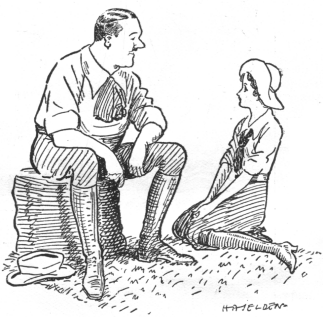
AN IDYLL OF MOVIE-LAND.
Anthony Silvertree MR. CHARLES HAWTREY.
Aloney MISS WINIFRED BARNES.
The poison is nothing worse than another dose of the narcotic, and under its spell he is spirited back to London, where, on arrival, he is confronted with the lady of his "dream," and Mortimer John secures a colossal fee. In addition, for he has had the happy thought of selecting his own daughter for the heroine, he secures a plutocrat for his son-in-law.
The worst of a play in which one is conducted out of ordinary life into the regions of improbability by processes of which every step has to be just conceivably possible, is that the conscientious development of the scheme is apt to be tedious. And, frankly, the first scene or two, though lightened by expectation, were on the heavy side.
But the film itself, when we got to it, was excellent fooling, and the reconstruction of the original drama at Dorking-in-the-Wild-West was really delightful. You can easily guess that Mr. CHARLES HAWTREY, as a cinema hero, very conscious of his heroism ("it's a way we have in Montague Square"), but always comfortably aware that in a dream, as he imagines it to be, he can well afford to make the handsomest of sacrifices, had a great chance. And he took it.
As the heroine, who has to play a rather thankless part in the mercenary designs of her parent, Miss WINIFRED BARNES contrived, very naïvely and prettily, to preserve an air of maiden reluctance under the most discouraging conditions. As Mortimer John Mr. SYDNEY VALENTINE had admirable scope for his sound and businesslike methods. Of Anthony's relations, all very natural and human, Miss LYDIA BILBROOKE was an attractive figure, and the part of Herbert Clatterby, K.C., was played by Mr. EDMUND MAURICE with his accustomed ease of manner.
If I wanted to find fault with any detail of the construction, it would be in the matter of the ring which Anthony places on the finger of Aloney in the cinema play. This was a spontaneous act not included in the scheme for which Mortimer John was given the credit. Yet as the means by which Anthony identified her on his return to consciousness it went far to bring that scheme to fruition. I think also that he ought to have shown some trace of surprise (I should myself) on finding that he had unconsciously exchanged his spotless evening clothes for the kit of a broncho-buster.
I have hinted already at the comparative dulness of the long introduction to what is the clou of the play—the film and its reconstructed scenes. Why not take a further wrinkle from the cinematic drama and throw upon the screen a succinct résumé of the previous argument? Three or four minutes of steady application to the text, and we might plunge into the very heart of things. I throw out this suggestion not with any hope of reward, but in part payment of my debt for some very joyous laughter. O.S.
"Wanted, Gentlewoman a few days old." The Lady.
This is much prettier than "Baby taken from birth."
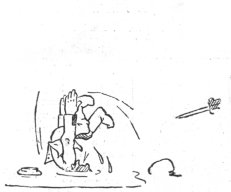
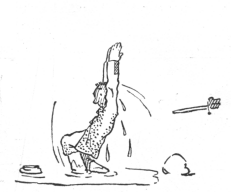
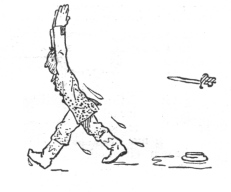
"AND LOOK HERE, FRITZ— —WHATEVER HAPPENS— —SEE YOU KEEP—
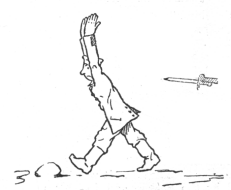
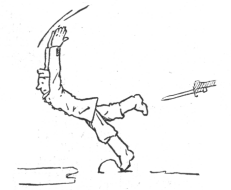
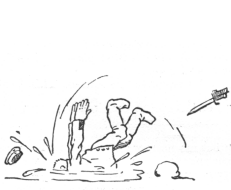
—THEM HANDS OF YOURS— —WELL ABOVE— —YOUR BLINKIN' HEAD."
A SONG OF THE WOODLAND ELVES.
We hear the ruthless axes; we watch our rafters fall; The seawind blows unhindered where stood our banquet-hall; Our grassy rings are trampled, our leafy tents are torn— Yet more would we, and gladly, to help the English-born. For, leafy-crowned or frosted, the English oaks are ours; The beeches are our playrooms, the elms our outlook towers; And we were forest rangers before these woods had name, And we were elves in England before the Romans came. We watched the Druids worship; we watched the wild bulls feed; We gave our oaks to ALFRED to build his ships at need; And often in the moonlight our pricked ears in the wood Have heard the hail of RUFUS, the horn of ROBIN HOOD. But if our age-old roof-beams can serve her cause to-day, The woodland elves of England will sign their rights away; For none but will be woeful to hear the axes ring, Yet none but would go homeless to aid an English King. W.H.O.
GOOD OLD GOTHIC.
[An agitation for the total disuse of the Latin character, we learn from Press quotations published in The Daily Chronicle, is raging through the German Empire, and the Prussian Minister of the Interior has forbidden the use of any other character than German Gothic in the publications of the Statistical Bureau.]
The ways of the Hun comprehension elude, They're so cleverly crass, so painstakingly crude; For, in spite of his cunning and forethought immense, He is often incurably stupid and dense To the point of allowing his patriot zeal To put a large spoke in his own driving-wheel. An excellent instance of zeal of this sort Is the movement, endorsed by official support, To ban Latin type in the papers that flow From the press of the Prussian Statistics Bureau. Now the pride of the Germans, as dear as their pipe And their beer, is their wonderful old Gothic type; It makes ev'ry page look as black as your hat, For the face of the letters is stodgy and fat; It adds to the labour of reading, and tries The student's pre-eminent asset, his eyes, And in consequence lends a most lucrative aid To people engaged in the spectacle trade. But these manifest drawbacks to little amount When tried by the only criteria that count: Though the people who use it don't really need it, It exasperates aliens whenever they read it. It is solid, echt-Deutsch, free from Frenchified froth, And in fine it is Gothic, befitting the Goth. So when the great Prussian Statistics Bureau Proscribes Latin letters and says they must go, They are giving a lead which we earnestly hope Will be followed beyond its original scope; For the more German books that in Gothic are printed The more will the spread of Hun "genius" be stinted, And the larger the number, released from its gripe, Of the students of Latin ideas—and type.
"Furniture for Poultry: 2 easy chairs, solid walnut frames, nicely upholstered and sound, 12/6 each; also 2 armchairs, 4 small chairs, walnut frames, nicely upholstered and sound, £2; 5 other chairs, upholstered in tapestry and leather, 5/- each."—The Bazaar.
Has this sort of thing Mr. PROTHERO'S approval? Some hens are already too much inclined to sit when we want them to lay.
THE TIPINBANOLA.
"There," I said, "you've interrupted me again."
"Tut tut," said Francesca.
"And the dogs are barking," I said, "and the guinea-hens are squawking."
"I daresay," she said; "but you can't hear the guinea-hens; they're much too far away."
"Yes, but I know they're squawking—they always are—and for a sensitive highly-strung man it's the same thing."
"Tut-t——"
"Tut me no more of your tuts, Francesca," I said, "for I am engaged in a most complicated and difficult arithmetical calculation."
"If," said Francesca deliberately, "two men in corduroys, with straps below their knees, and a boy in flannel shorts, all working seven hours and a half per day for a week, can plant five thousand potatoes on an acre of land, how many girls in knickerbockers will be required to——"
"Stop, Francesca," I said, "or I shall go mad."
"If," she continued inexorably, "a train travelling at the rate of sixty-two miles and three-quarters in an hour takes two and a half seconds to pass a lame man walking in the same direction find how many men with one arm each can board a motor-bus in Piccadilly Circus, having first extracted the square root of the wheel-base."
"Stow it," I said.
"Isn't that rude?" she said.
"Yes," I said; "it was intended to be."
"Well, but what are you doing?"
"I'm calculating rates of percentage on the new War Loan," I said.
"Why worry over that?" she said. "It announces itself as a five-per-center, and I'm willing to take it at its word. What's your difficulty? Surely you do not impute prevarication to the CHANCELLOR OF THE EXCHEQUER."
"No," I said, "far from it. I have the greatest possible respect for him. I'm sure he would not deceive a poor investor; but he doesn't know my difficulties. It's this getting £100 by paying only £95 that's knocking me sideways; and then there's the income tax, and the other loan at four per cent., on which no income tax is to be charged, and the conversion of the old four-and-a-half per cent. War Loan, and of the various lots of Exchequer Bonds. It's all as generous as it can be, but for a man whose mathematical education has been, shall we say, defective, it's as bad as a barbed-wire entanglement."
"Oh, don't muddle your unfortunate head any more. Just plank down your money and take what they give you. That's my motto."
"No doubt," I said; "that's all very well for you. You aren't the head of the household, with all its cares depending on you. Heads of households ought-to know their exact position."
"Well, then, heads of households ought to have learnt their arithmetic better and remembered more of it. The children and I haven't allowed ourselves to be hindered by little obstacles of that kind."
"What," I said, "are you and the children in it too?"
"Yes, we're all in it. I've put in the spare money from the housekeeping——"
"I always knew you got too much."
"And the children have chipped in with their savings."
"Savings?" I said. "How have they got any savings?"
"Presents from affectionate godmothers and aunts, which were put into the Post Office Savings Bank. They're all out now and into the Loan—all, that is, except Frederick's little all."
"And what's happened to that?"
"That's put into War Certificates. It was his own idea. He was fascinated by the poster, and insisted that his money should go in the purchase of cartridges, so there it is."
"And at the end of five years he'll get back £1 for every 15s. 6d. he's put in."
"Yes, he'll get £5. He made a lot of difficulty about that."
"You don't mean to say he jibbed about getting his money back?"
"That's precisely what did happen. He said he'd given the money for cartridge buying, and how could he take it back with a bit extra after the cartridges had been bought. He's really rather annoyed about it."
"I shall tell him," I said, "not to let it worry him, and shall explain to him how much per cent. he's getting per annum."
"You'll have to work it out yourself first of all," she said, "and I know you can't do that. And, by the way, you may as well be ready for him; he's going to ask you if he may join the Army as a drummer-boy."
"What on earth's put that into his head?"
"He's been talking to the Sergeant-Major, and he's invented a musical instrument of his own. It's made out of a cardboard box, some pins and two or three elastic bands. There it is—you'll find its name inscribed on it."
I took it up and saw inscribed upon it in large pencilled letters this strange device: "THE TIPINBANOLA; made for soldiers only."
"Francesca," I said, "it's a superb name. Where did he get it from?"
"Out of his head," she said.
"I wonder," I said, "if he keeps any arithmetic there?"
"Ask him; I'm sure he'd be proud to help you."
"No," I said, "I must plough my weary furrow alone."
"And the guinea-hens," she said, "are still squawking."
"Yes," I said, "isn't it awful?"
"I'll go and stop them," she said.
"It's no good," I said, "I shan't hear them stop."
R.C.L.
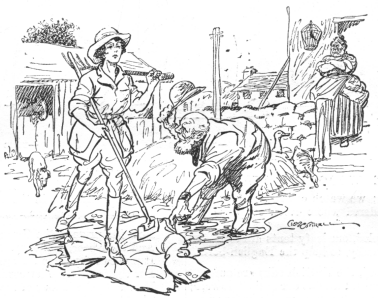
THE MODERN RALEIGH.
"If the ploughman is taken the farmer may as well put up his shutters."—A farmer in "The Daily News."
And if the shop-walker is taken, the tradesman may as well let his windows lie fallow.
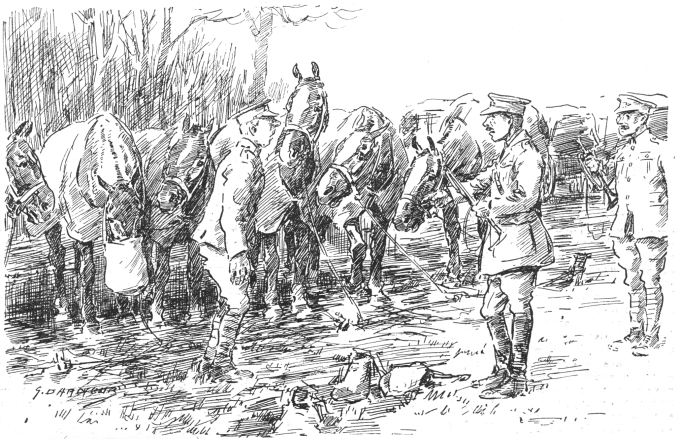
Officer. "WHAT DO YOU MEAN BY FEEDING THAT HORSE BEFORE THE CALL SOUNDED?"
Recruit. "I DIDN'T THINK AS 'OW 'E'D START EATING BEFORE THE TRUMPET BLEW, SIR."
OUR BOOKING-OFFICE.
(By Mr. Punch's Staff of Learned Clerks.)
Mr. S.P.B. MAIS, in a dedicatory letter to Interlude (CHAPMAN AND HALL), tells us that he has "simply tried to show what a man constituted like Shelley would have made of his life had he bean alive in 1917." Without any doubt his attempt has succeeded. I am, however, bound to add this warning (if Mr. MAIS'S is not enough), that a novel with such a purpose is not, and could not be, milk for babes. Nothing that I had previously read of Mr. MAIS'S had prepared me for the proficiency he shows here. Obviously attached to the modern school of novelists, he has many of its faults and more of its virtues. One may accept his main point of view, yet be offended sometimes by his details. But the fact remains that in Geoffrey Battersby he has given us a piece of character-drawing almost flawlessly perfect. Not for a very long time has it been my good fortune to attend such a triumph, and I wish to proclaim it. The women by whom Geoffrey, the weak and the wayward, was attracted hither and thither are also well drawn; but here Mr. MAIS shows his present limitations. Nevertheless I feel sure that he has within him the qualities that go to make a great novelist, and that if he will free himself from certain marked prejudices his future lies straight and clear before him.
It was a happy idea of the Sisters MARY and JANE FINDLATER to call their new book of short stories Seen and Heard (SMITH, ELDER), with the sub-title, Before and After 1914. I say short stories, but actually these have so far outgrown the term that a half-dozen of them make up the volume. They are all examples of the same gentle and painstaking craft that their writers have before now exhibited elsewhere. Here are no sensational happenings; the drama of the tales is wholly emotional. My own favourites are the first, called "The Little Tinker," a half-ironical study of the temptation of a tramp mother to surrender her child to the blessings of civilisation; and how, by the intervention of a terrible old woman, the queen of the tribe, this momentary weakness was overcome. My other choice, the last tale in the collection (and the only one contributed by Miss MARY FINDLATER), is a dour little comedy of the regeneration, through poverty and hard work, of two underemployed and unpleasant elderly ladies. A restful book, such as will keep no one awake at nights, but will give pleasure to all who appreciate slight studies of ordinary life sketched with precise and careful finish.
Their Lives (STANLEY PAUL) has at least this point of originality, that it ends with the wedding of somebody other than the heroine, or rather, I should say, the chief heroine, because, strictly speaking, all three daughters of Mr. and Mrs. Radmall might be said jointly to fill this post, but it is Christina, the eldest, who fills most of it. The other two were named Virgilia and Orinthia, and I can't say that these horrific labels did them any injustice. As for the story of "their lives," as VIOLET HUNT tells it, there is really nothing very much to charm in a history of three disagreeable children developing into detestable young women. Perhaps it may have some value as a study of feminine adolescence, but I defy anyone to call the result attractive. Its chief incident, which is (not to mince matters) the attempted seduction by Christina of a middle-aged man, the father of one of her friends, mercifully comes to nothing. I like to believe that this sort of thing is as unusual as it is unpleasant. For the rest, the picture of the "artistic" household in which the children grew up, of their managing mother, and the slightly soured and disappointed painter their father, is drawn vividly enough. But what unamiable people they all are! "MILES IGNOTUS," who supplies a quaintly attractive little preface, in which he speaks of having read the book in proof under shell-fire, affects to discover in them a kinship with Prussia. Certainly they are almost frightful enough.
Having read all about The Rise of Ledgar Dunstan (DUCKWORTH) from obscurity to wealth, literary success and aristocratic wedlock, I should be infinitely content to leave him at that and have done; but Mr. ALFRED TRESIDDER SHEPPARD warns us that there is more to follow, and even hints that the sequel, opening in July, 1914, may in many respects be far indeed from the dulness of happily-ever-after. If Ledgar had been satisfied to marry the sweetheart of his school-days there might have been some danger of such a disaster; but, having put his humble past, including his Nonconformist conscience, too diligently behind him for that, he will have to face whatever his author and the KAISER may have in store, supported only by a wife who is going, I trust and believe, to revenge on him all the irritation which she and I both felt at his attitude of unemotional superiority towards all the world. Some people may think it almost a pity that the lady cannot deal similarly with Mr. SHEPPARD himself in just reprisal for his long-winded and nebulous way of talking about Anti-Christ and Armageddon, and for his revolting incidents of murder and insanity introduced without any excuse of necessity. The book contains a considerable element of lively if undiscriminating humour, but its insistence on the gruesome is so unfortunate that unless his hero's future fate be already irrevocably fixed in manuscript one would like to remind the author that essays in this kind are the easiest form of all literary effort and the least supportable.
With Serbia into Exile (MELROSE) is a book that will suffer little from the fact that its tragic tale has already been told by several other pens. Mr. FORTIER JONES, the writer, has much that is fresh to say, and a very fresh and vigorous way of saying it. His book and himself are both American of the best kind—which is to say, wonderfully resourceful, observant, sympathetic and alive. From a newspaper flung away by a stranger on the Broadway Express, Mr. JONES first became aware that men were wanted for relief work in Serbia, and "in an hour I had become part of the expedition." That is a phrase characteristic of the whole book. Though the matter of it is the story, "incredibly hideous and incredibly heroic," of a nation going into exile, Mr. JONES has always a keen eye for the picturesque and even humorous aspects of the tragedy; he has a quick sense of the effective which enables him to touch in many haunting pictures—the delusive peace of a sunny Autumn day among the Bosnian mountains; the face of KING PETER seen for a moment by lamplight amid a crowd of refugees; and countless others. More than a passing mention also is due to the many quite admirable snapshots with which the volume is illustrated. The author seems successfully to have communicated his own gifts of observation and selection to his camera, an instrument only too apt to betray those who look to it for support. One is glad for many reasons to think that our American cousins will read this book.
The Man in the Fog (HEATH, CRANTON) is a book that I find exceedingly hard to classify. Its author, Mr. HARRY TIGHE, has several previous stories to his credit, all of which seem to have moved the critics to pleasant sayings. But for my own part I have frankly to confess that I found The Man in the Fog somewhat wheezy company. The Man of the title was a kind of Northern Joseph, dismissed from a promising partnership with Potiphar after a domestic intrigue on the lines of the original. The fog happens when, years later, he meets the daughter of Mrs. Potiphar returning to her mother's house, and (at the risk of the poor girl catching her death) detains her on the front step with foggy allusions to the mysterious past. I may mention that his own conduct in the interval had been such as I can only regard as a lamentable relapse from the altitude of the earlier chapters. But it is all vastly serious—it would perhaps be unkind to say sententious—and wholly unruffled by the faintest suggestion of comedy. For which reason I should never be startled to learn that HARRY TIGHE was either youthful, Scotch, or female (or indeed, for that matter, all three). In any case I can only hope that he, or she, will not resent my parting advice to cultivate a somewhat lighter touch, and the selection of such words as come easily from the tongue. Some of the dialogue in the present book is painfully unhuman.
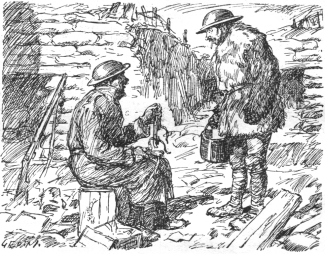
"GOD BLESS THE OLD WOMAN! SHE IS THOUGHTFUL. I TOLD 'ER THERE WAS ICE IN THE TRENCHES THE LARST TIME I WROTE, AND I'M BLEST IF SHE 'ASN'T SENT ME A PAIR OF SKATES!"
A Great Problem Solved.
Some carry their season tickets in their hat-bands, others fasten them on their wrists, others wear them attached to cords. A correspondent writes:—
"In my own overcoat I find an ingenious arrangement excellently suited for the purpose of carrying a season ticket, so that it shall be at once secure and easily accessible. The tailor has made a horizontal slit, about two-and-a-half inches wide, in the right side of the coat, and cunningly inserted a small rectangular bag or pouch of linen, the whole thing being strongly stitched and neatly finished off with a flap. It makes an admirable receptacle for a season ticket of ordinary dimensions, and I recommend this contrivance to those who may not be acquainted with it."
"Well-fed as we are at home, and conscious that the men who are fighting our battles are the best provisioned forces who ever took the field, we can contemplate the continuance of the coldest weather for twenty years with equanimity."—Daily Chronicle.
Or even for the duration of the War.