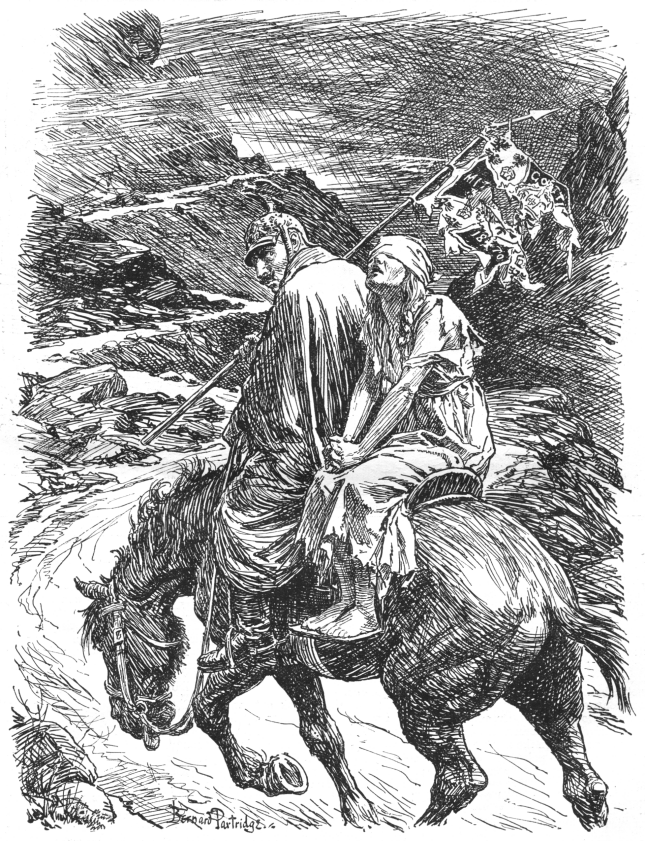
Volume 152 — A PLAIN DUTY.
Reading edition
"WELL, GOODBYE, OLD CHAP, AND GOOD LUCK! I'M GOING IN HERE TO DO MY BIT, THE BEST WAY I CAN. THE MORE EVERYBODY SCRAPES TOGETHER FOR THE WAR LOAN, THE SOONER YOU'LL BE BACK FROM THE TRENCHES."
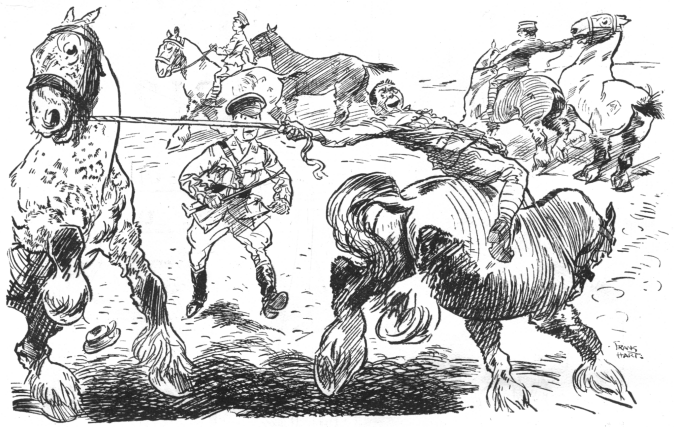
"STICK TO HIM—STICK TO HIM!"
"I'LL STICK TO HIM, SIR. BUT WHICH ONE DO YOU MEAN?"
LETTERS FROM MACEDONIA.
IV.
MY DEAR JERRY,—I am writing this from my position on top of a small hill, while my devoted band of followers sits round me and waits for me to speak. I always sit here, because if I wanted to go somewhere else I should have to climb down this hill and then up another one. I hate hills. So does the devoted band.
Behind another little hill a hundred yards away we believe there lurks an army corps of Bulgars, but we are afraid to look and see. Instead, we fix and unfix bayonets every ten minutes and make martial noises. This, we hope, affects the enemy's moral, and having your moral affected every ten minutes is no joke, I can tell you.
The spirit of our troops remains excellent. You can see that this is true from the fact that my joke still works. Every night for the last three months, while administering quinine to my army, I have exhorted them not to be greedy and not to take too much. They still laugh heartily, nay uproariously. We are a wonderful nation.
Our chief source of combined instruction and amusement is still the antheap beside us, and in this connection, Jeremiah, I must introduce to you Herbert, a young officer in the ant A.S.C.
When we first knew Herbert (or "'Erb" as he was known in those days), he was an impudent and pushful private. When his corps were engaged in removing the larger pieces of straw out of their hole in the hill, many a time I have seen him staggering manfully towards the entrance with an enormous piece on his slender shoulders, against the tide of his comrades; for he never could resist the temptation to replace the really big stalks in the hole. As he knocked against one and another the older ants would step aside, lay down their loads, and expostulate with him, always ending by giving him a good clip on the ear; but 'Erb was never dismayed.
Now and again, during a temporary slackness in the stream, he would disappear triumphantly into the hole, his log trailing behind him; but his triumph was always short-lived. I would seem to hear a scuffle and two bumps, and 'Erb would shoot gracefully upwards, followed by his burden, and fall in a heap beside the door. However, as soon as he recovered he would try again. On one sultry afternoon I noticed he succeeded in effecting an entrance after twenty-three successive chuck-outs.
His persistence piqued my curiosity. I wondered why he should so obstinately try to do a thing which was obviously distasteful to all his seniors. And then, yesterday, there was a change.
'Erb was resting after his eighth chuck-out under a plank when a venerable ant, heavy with the accumulated wisdom and weakness of years, approached the exit from within and tried to get out, but in vain. He swore and struggled in a futile sort of way, while his attendant subordinates stood about helplessly. 'Erb saw his opportunity. He seized his plank, dashed forward—you may not believe me, Jerry, but it is the gospel truth—saluted smartly, and laid down his plank as a sort of ladder. Supporting himself upon it the veteran crawled out. Then he spoke to 'Erb, and I think I saw him asking someone the lad's name.
That is why Second Lieutenant Herbert is to-day in charge of a working party. He is now engaged in clipping the ear of a larger ant. I imagine there must have been some lack of discipline. Possibly his inferior had addressed him as "Erb."
Well, all our prospects are pleasing and only Bulgar vile. I must now make a martial noise, so au revoir.
Thine, PETER.
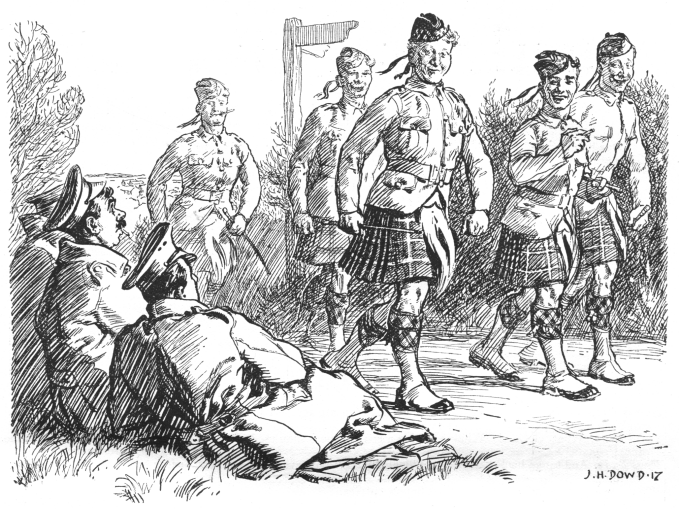
DISTRACTIONS OF CAMP LIFE.
Tommy (by roadside). "OUT ON THE SPREE AGAIN? GOING TO THE PICTURES?"
Highlander. "NO. WE'RE AWA' TO SEE YOUR LOT CHANGE GUARD."
"The Motor Cycle says over 165,000 magnates have been made in Britain for war purposes."—Provincial Paper.
And the New Year Honours List (political services) has yet to appear.
"We owed all this more to our splendid navy and its silent virgil than to anything else."—Provincial Paper.
We suppose the CENSOR won't let him narrate the epic exploits of the Fleet, but he might have allowed him a capital initial.
"Surbiton residents have supplied for British prisoners in Germany 800 waistcoats made from 2,100 old kid gloves." Manchester Evening News.
A notable instance of large-handed generosity.
SIX VILE VERBS.
(To the makers of journalese, and others, from a fastidious reader.)
When I see on a poster A programme which "features" CHARLIE CHAPLIN and other Delectable creatures, I feel just as if Someone hit me a slam Or a strenuous biff On the mid diaphragm. When I read in a story, Though void of offences, That somebody "glimpses" Or somebody "senses," The chord that is struck Fills my bosom with ire, And I'm ready to chuck The whole book in the fire. When against any writer It's urged that he "stresses" His points, or that something His fancy "obsesses," In awarding his blame Though the critic be right, Yet I feel all the same I could shoot him at sight. But (worst of these horrors) Whenever I read That somebody "voices" A national need, As the Bulgars and Greeks Are abhorred by the Serb, So I feel toward the freaks Who employ this vile verb.
"Some of the public men of Rawmarsh have high ambitions for their township, and at the Council meeting on Wednesday there was considerable industrial developments immediately after the war." Botherham Advertiser.
Happy Rawmarsh! In our part of the country it is not over yet.
"NAVY Pram. for Sale, good condition." Provincial Paper.
Just the thing to prepare baby for being "rocked in the cradle of the deep."
THE SUPER-CHAR.
SCENE.—A square in Kensington. At every other door is seen the lady of the house at work with pail, broom, scrubbing-brush, rags, metal-polish, etc.
Chorus of Ladies. In days before the War Had turned the world to Hades We did not soil Our hands with toil— We all were perfect ladies; To scrub the kitchen floor Was infra dig.—disgusting; We'd cook, at most, A slice of toast Or do a bit of dusting. But those old days are flown, And now we ply our labours: We cook and scrub, We scour and rub, Regardless of our neighbours; The steps we bravely stone, Nor care a straw who passes The while we clean With shameless mien Quite brazenly the brasses. First Lady. Lo! Who approaches? Some great dame of state? Second Lady. Rather I think some walking fashion-plate. Third Lady. What clothes! What furs! First Lady. And tango boots! How thrilling! They must have cost five guineas if a shilling. Second Lady. Sh, dears! It eyes us hard. What can it be? Third Lady. It would be spoke to. Second Lady. Would it? First Lady. Let us see! Enter the Super-Char. Super-char. My friend the butcher told me 'e'd 'eard say You 'adn't got no servants round this way, And as I've time on 'and—more than I wish, Seein' as all the kids is in munish— I thought as 'ow, pervided that the wige Should suit, I might be willin' to oblige. Chorus of Ladies. O joy! O rapture! If we capture Such a prize as this! Then we may become once more Ladies, as in days of yore, Lay aside the brooms and pails, Manicure our broken nails, Try the last complexion cream— What a dream Of bliss! Super-Char. 'Old on! Let's get to business, and no kidding! I'm up for auction; 'oo will start the bidding? First Lady. I want a charlady from ten to four, To cook the lunch and scrub the basement floor. Super-Char. Cook? Scrub? Thanks! Nothink doin'! Next, please! You, Mum, What are the dooties you would 'ave me do, Mum? Second Lady. I want a lady who will kindly call And help me dust the dining-room and hall; At tea, if need be, bring an extra cup, And sometimes do a little washing up. Super-Char. A little bit of dusting I might lump, But washing up—it gives me fair the 'ump! Next, please! Third Lady. My foremost thought would always be The comfort of the lady helping me. We have a cask of beer that's solely for Your use—we are teetotal for the War. I am a cook of more than moderate skill; I'll gladly cook whatever dish you will— Soups, entrées. Super-Char. Now you're talkin'! That's some sense! So kindly let me 'ave your reference, And if I finds it satisfact'ry, Mum, Why, s'elp me, I 'ave arf a mind to come. Third Lady. My last good lady left six months ago Because she said I'd singed the soufflé so; She gave me no address to write to— Super-Char. What! You've got no reference? Third Lady. Alas, I've not! Super-Char. Of course I could not dream of taking you Without one, so there's nothing more to do. These women—'ow they spoil one's temper! Pah! Hi! (she hails a passing taxi) Drive me to the nearest cinema. [She steps into the taxi and is whirled off. Chorus of Ladies. Not yet the consolation Of manicure and cream; Not yet the barber dresses Our dusty tousled tresses; The thought of titivation Is still a distant dream; Not yet the consolation Of manicure and cream. Still, still, with vim and vigour, 'Tis ours to scour and scrub; With rag and metal polish The dirt we must demolish; Still, still, with toil-bowed figure, Among the grates we grub; Still, still, with vim and vigour, 'Tis ours to scour and scrub. CURTAIN.
A TALE OF A COINCIDENCE.
"Coincidences," said the ordinary seaman, "are rum things. Now I can tell you of a rum un that happened to me."
It said Royal Naval Reserve round his cap, but he looked as if he ought to be wearing gold earrings and a gaudy handkerchief.
"When I was a young feller I made a voyage or two in an old hooker called the Pearl of Asia. Her old man at that time was old Captain Gillson, him that had the gold tooth an' the swell ma'ogany fist in place o' the one that got blowed off by a rocket in Falmouth Roads. Well, I was walkin' out with a young woman at Liverpool—nice young thing—an' she give me a ring to keep to remember 'er by, the day before we sailed. Nice thing it was; it had 'Mizpah' wrote on it.
"We 'ad two or three fellers in the crowd for'ard that voyage as would 'andle anything as wasn't too 'ot or too 'eavy which explains why I got into a 'abit of slippin' my bits o' vallybles, such as joolery, into a bit of a cache I found all nice and 'andy in the planking' back o' my bunk.
"We 'ad a long passage of it 'ome, a 'undred-and-sixty days from Portland, Oregon, to London River, an' what with thinkin' of the thumpin' lump o' pay I'd have to draw an' one thing an' another, I clean forgot all about the ring I'd left cached in the little place back o' my bunk yonder.
"Well, I drew my pay all right, and after a bit I tramped it to Liverpool, to look out for another ship. An' the first person I met in Liverpool was the young woman I 'ad the ring of.
"'Where's my ring?' she says, before I'd time to look round.
"Now, I never was one as liked 'avin' words with a woman, so I pitched her a nice yarn about the cache I 'ad at the back o' my bunk, an' 'ow I vallied 'er ring that 'igh I stowed it there to keep it safe, an' 'ow I'd slid down the anchor cable an' swum ashore an' left everything I 'ad behind me, I was that red-'ot for a sight of 'er.
"'Ye didn't,' she says quite ratty, 'ye gave it to one o' them nasty yaller gals ye sing about.'
"'I didn't,' I says; 'Ye did,' she says; 'I didn't,' says I. An' we went on like that for a bit until I says at last, 'If I can get aboard the old Pearl again,' I says, 'I'll get the ring,' I says, 'an' send it you in a letter,' I says, 'an' then per'aps you'll be sorry for the nasty way you've spoke to me,' I says.
"'Ho, yes,' she says, sniffy-like, 'per'aps I will, per'aps I won't,' an' off she goes with 'er nose in the air.
"My next ship was for Frisco to load grain; and I made sure of droppin' acrost the Pearl there, for she was bound the same way. But I never did. She was dismasted in the South Pacific on the outward passage, and had to put in to one of them Chile ports for repairs. So she never got to Frisco until after we sailed for 'ome. An' that was the way it went on. She kep' dodgin' me all over the seven seas, an' the nearest I got to 'er was when we give 'er a cheer off Sydney Heads, outward bound, when we was just pickin' up our pilot. The last I 'eard of 'er after that was from a feller that 'ad seen 'er knockin' round the South Pacific, sailin' out o' Carrizal or Antofagasta or one o' them places. I was in the Western Ocean mail-boat service at the time, and so o' course she was off my run altogether.
"I was still in the same mail-boat when she give up the passenger business an' went on the North Sea patrol.
"Well, one day we boarded a Chile barque in the ordinary course o' duty, and I was one o' those as went on board with the lootenant. They generally takes me on them jobs, the reason bein' that I know a deal o' foreign languages. I don't believe there's a country in the world where I couldn't make myself understood, partic'lar when I'm wantin' a drink bad.
"I wasn't takin' that much notice of this 'ere ship at the time (there was a bit of a nasty jobble on the water, for one thing, and we 'ad our work cut out gettin' alongside), except that 'er name was the Maria de Somethink-or-other—some Dago name. But while we was waitin' for the lootenant to finish 'is business with Old Monkey Brand, which was the black-faced Chileno captain she 'ad, it come over me all of a suddent.
"'Strike me pink!' I says, 'may my name be Dennis if I 'aven't seen that there bit o' fancy-work on the poop ladder rails before;' which so I 'ad, for I done it myself in the doldrums, an' a nice bit o' work it was, too.
"You'll 'ave guessed by now that she was none other than the Pearl of Asia; an' no wonder I 'adn't reckernised 'er, what with the mess she was in alow and aloft, an' allyminian paint all over the poop railin's as would 'ave made our old blue-nose mate die o' rage.
"'You carry on 'ere,' I says to the feller that was with me; 'I'm goin' for'ard a minute.'
"'Arf a minute, an' I was in my old bunk; an' there was the cache all right, just like I left it."
He paused dramatically; I supposed it was for histrionic effect, but it lasted so long that I said, "And so I suppose you sent the ring to the girl after all?"
"Oh! 'er!" he said, with an air of surprise, "I've forgot 'er name and all about 'er, only that she 'ad a brother in one o' them monkey-boats of ELDER DEMPSTER'S—'e 'ad the biggest thirst I ever struck."
"But the ring?" I said. "I suppose it was there all right?"
He stopped his pipe down with his thumb, with an enigmatical expression.
"That's where the bloomin' coincidence come in," he said; "it weren't."
C.F.S.
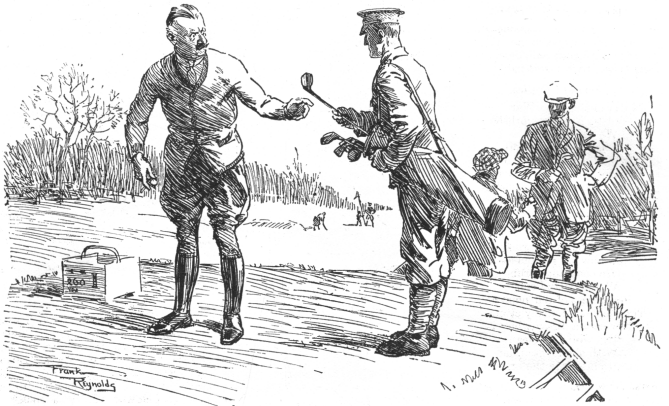
Colonel (to private told off to act as caddie). "NOW I HOPE YOU KNOW SOMETHING ABOUT IT. THE LAST MAN I HAD PUT ME RIGHT OFF. HAVE YOU EVER HANDLED CLUBS BEFORE?"
Private. "NOT SINCE I PLAYED IN THE AMATEUR CHAMPIONSHIP, SIR." (Colonel is put off again.)
"Miss ——, the World-renounced Teacher of Dancing."—Southern Standard.
Another victim of the War.
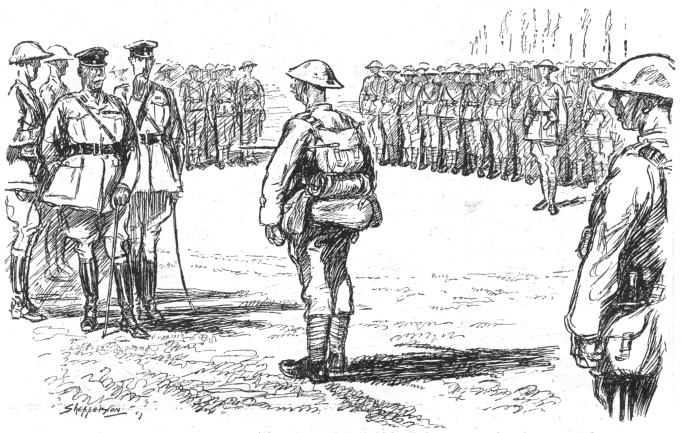
Major-General (addressing the men before practising an attack behind the lines). "I WANT YOU TO UNDERSTAND THAT THERE IS A DIFFERENCE BETWEEN A REHEARSAL, AND THE REAL THING. THERE ARE THREE ESSENTIAL DIFFERENCES: FIRST, THE ABSENCE OF THE ENEMY. NOW (turning to the Regimental Sergeant-Major) WHAT IS THE SECOND DIFFERENCE?"
Sergeant-Major. "THE ABSENCE OF THE GENERAL, SIR."
TO TOWSER.
No pampered pound of peevish fluff That goggles from a lady's muff Art thou, my Towser. In the Park Thy form occasions no remark Unless it be a friendly call From soldiers walking in the Mall, Or the impertinence of pugs Stretched at their ease on carriage rugs. For thou art sturdy and thy fur Is rougher than the prickly burr, Thy manners brusque, thy deep "bow wow" (Inherited, but Lord knows how!) Far other than the frenzied yaps That emanate from ladies' laps, Thou art, in fact, of doggy size And hast the brown and faithful eyes, So full of love, so void of blame, That fill a master's heart with shame Because he knows he never can Be more a dog and less a man. No champion of a hundred shows, The prey of every draught that blows, Art thou; in fact thy charms present The earmarks of a mixed descent. And, though too proud to start a fight With every cur that looms in sight, None ever saw thee quail beneath A foeman worthy of thy teeth. Thou art, in brief, a model hound, Not so much beautiful as sound In heart and limb; not always strong When nose and eyes impel to wrong, Nor always doing just as bid, But sterling as the minted quid. And I have loved thee in my fashion, Shared with thy face my frugal ration, Squandered my balance at the bank When thou didst chew the postman's shank, And gone in debt replacing stocks Of private cats and Plymouth Rocks. And, when they claimed the annual fee That seals the bond twixt thee and me, Against harsh Circumstance's edge Did I not put my fob in pledge And cheat the minions of excise Who otherwise had ta'en thee prize? And thou with leaps of lightsome mood Didst bark eternal gratitude And seek my feelings to assail With agitations of the tail. Yet are there beings lost to grace Who claim that thou art out of place, That when the dogs of war are loose Domestic kinds are void of use, And that a chicken or a hog Should take the place of every dog, Which, though with appetite endued, Is not itself a source of food. What! shall we part? Nay, rather we'll Renounce the cheap but wholesome meal That men begrudge us, and we'll take Our leave of bones and puppy cake. Back to the woods we'll hie, and there Thou'lt hunt the fleet but fearful hare, Pursue the hedge's prickly pig, Dine upon rabbits' eggs and dig With practised paw and eager snuffle The shy but oh! so toothsome truffle. ALGOL.
"A landslide in Monmouthshire threatens to close the natural course of the River Ebbw, seriously interfering with its ffllww."—Star.
It certainly sounds rather diverting.
From a list of gramophone records:—
"Nothing could seem easier in the wide world than the emission of the cascade of notes that falls from the mouth of the horn—which might indeed be Tetrazzini's own mouth."
"The diameter of my own gramophone horn is eighteen inches," writes the sender of the extract.