Volume 152 — THE MOST IMPORTANT THING.
Reading edition
I.
Lewis Gun Officer.—... So let me repeat and impress upon you, men, that the rifle is an effete weapon—extinct as the—what-you-call-it bird. It played its part, a good part, in the South African War, but we who observed what the machine gun did then and foretold its immense development [he was just nine years old at that time] knew that the rifle would soon be in the museums along with the bows and arrows. Pay attention, Private Jones. The Lewis Gun, the weapon of opportunity, is a platoon in itself. I don't know what the Government want to worry about men for. The Germans don't fill up their front trenches with a lot of soldiers to be killed with shrapnel. No, a machine gun every twenty or thirty yards is quite enough to hold any defensive line. So just bear these things in mind; and don't forget what we have learnt to-day. All right. Nine o'clock to-morrow.
II.
Physical Training Sergeant-Instructor.—Forward be—end. Ster—retch. Be—end. Ster—retch. Feet together—place. 'Ands—down. Stan—zee. Squad —'shun. Fingers straight, that man. Wotjer say? WOT? I can't 'elp wot the drill-sergeant tells yer. When I sez "'Shun" I want fingers straight down. On the command "Sitting—down" every man sits down tailor-fashion. Sitting—down. [This is the position in which Swedish drill squads hear words of wisdom.] Listen. An' look at me over there—not that I likes the look of yer—'as to put up with that, but when I torks I wants attention. Let me arsk yer this. Wot sort of men do we want in France? Why, fit men. 'Ow do yer get fit? I makes yer fit. 'Ow? Why, physical. Wot's the good of a bloke in the trenches if he's sick parade every bloomin' day? Arsk any of the serjents who is it wakes blokes up and makes 'em live men? Me. In about six weeks you will be able to run ten miles before brekfast in full marchin' order, carryin' 120 rounds, gettin' over six-foot walls and jumpin' eight-foot ditches. Don't look frightened, Private West. I 'ave seen weedier and uglier-lookin' blokes than you do it when I've done with 'em. One more thing....
III.
Musketry Officer.—... Therefore you see an infantry soldier has one weapon and one only—the rifle. You fellows will be out at the Front pretty soon. Now, if a man gets up the line, no matter how strong he is, how well drilled, if he can't use his rifle he might just as well not be there for all the good he is to his country. All the money that's been spent on his trainin', food, clothin'—absolutely wasted; might as well have been thrown into the sea. Why, the other day a party of our fellows were heavin' bombs at about twenty Bosches—threw hundreds; couldn't reach 'em. And one sniper went out and killed the lot in two minutes. And so ...
IV.
Sergeant-Instructor of Bayonet-Fighting.—On guard. Long point. Withdraw. On guard. Rest. Now, when I snap my fingers I want to see you come to the high port and get roun' me like lightning. Some of you men seem to be treatin' this bizness in a light-'earted way. We don't do this work to prevent you gettin' into mischief. Not much. Wotjer join the army for? To fight. Right. I shows yer how to fight. 'Ow many Fritzes jer think I've killed, by teachin' rookies the proper use of the baynit? This is the goods. 'Ow are we goin' to win this bloomin' war? With the rifle? No. With bombs? No. With machine guns? No. 'Ow then? By turnin' 'em out with the baynit. Cold steel. That's it. An' I'll show yer where to pop it in, me lads—three inches of it. That's all you want—three inches ... (For sheer bloodthirstiness there is no patter like that of the Bayonet Department.)
V.
Bombing Officer.—Sit down. Smoke if you want to—and listen. My job is to teach you fellers all about what has turned out to be of the highest importance in this trench warfare, namely, bombs and grenades. This is a trench war; has been for three years. The nature of the fighting may alter, of course. We all hope it will. But we must think of trenches at the moment. Now, the German is a clever feller, and he soon saw that you'd never kill off the enemy if you just sat down behind a parapet with a rifle in your hand. So he started inventing and developing these things. But we're catching him up. We've caught him up. Now, this is a Mills ...
VI.
The Adjutant (after two hours' extended order drill and attack practice).—Just sit down. Close in a bit. Light your pipes if you wish. Let me tell you that the sort of work we've been doing this afternoon is the only way we're ever going to finish off the Hun—absolutely. You can never win a war by squatting down in a hole and lookin' at the other fellow. No, open fighting—that's what the new armies have got to learn. I fear it's been badly neglected; but not in this battalion. Now, with regard to the screen of skirmishers, I want ...
VII.
Drill Sergeant.—On 'er left, form—squad. For—erd, by the ri.' Mark—time. For—erd. Wake up, Thomson; we don't want no blinkin' dreamers in the Army. Pick up the step there, Number Three, fron' rank. 'Ep, ri'; 'ep, ri'; 'ep, ri. Sker-wad—'alt. Stan' still. 'Alt means 'alt. No movin' at all; just 'alt. Right—dress. Eyes—front. 'Swer. Eyes—front. Stanat—'ipe. 'Swer. Stanat—'ipe. Stan' easy. Now listen to me, me lads. The chiefest dooty of a soljer is O-bedience. Drill an' discipline is 'ow you gets that. Stop chewin, 'Arris. You'll be losin' your name again, me lad. Don't pay to lose your name twice—not in this regiment it don't. You'll learn a deal of other stuff 'ere; but take it from me it's the barrick-square work wot makes a soljer. Wot is a soljer? Why, a drilled man. 'Ow jer think I 'ave turned some 'undreds of blankety militiamen into the real thing? If a bloke can't stan' still on parade I don't want to hear about his doin's on the range or 'ow he can chuck a Mills. Sker-wad—'shun. Dis—miss. 'Swer. No call to go salootin' me, Private McKenzie. I ain't an orficer—yet. Dis—miss.
Private Jones (young and keen, and a trifle confused).—Good 'evins, Bill; they carn't all be bloomin' well right, can they?
Lance-Corporal Smith.—No, boy. It's the 'appy mejium we gets wiv 'em all, yer see. That's it—the happy mejium.
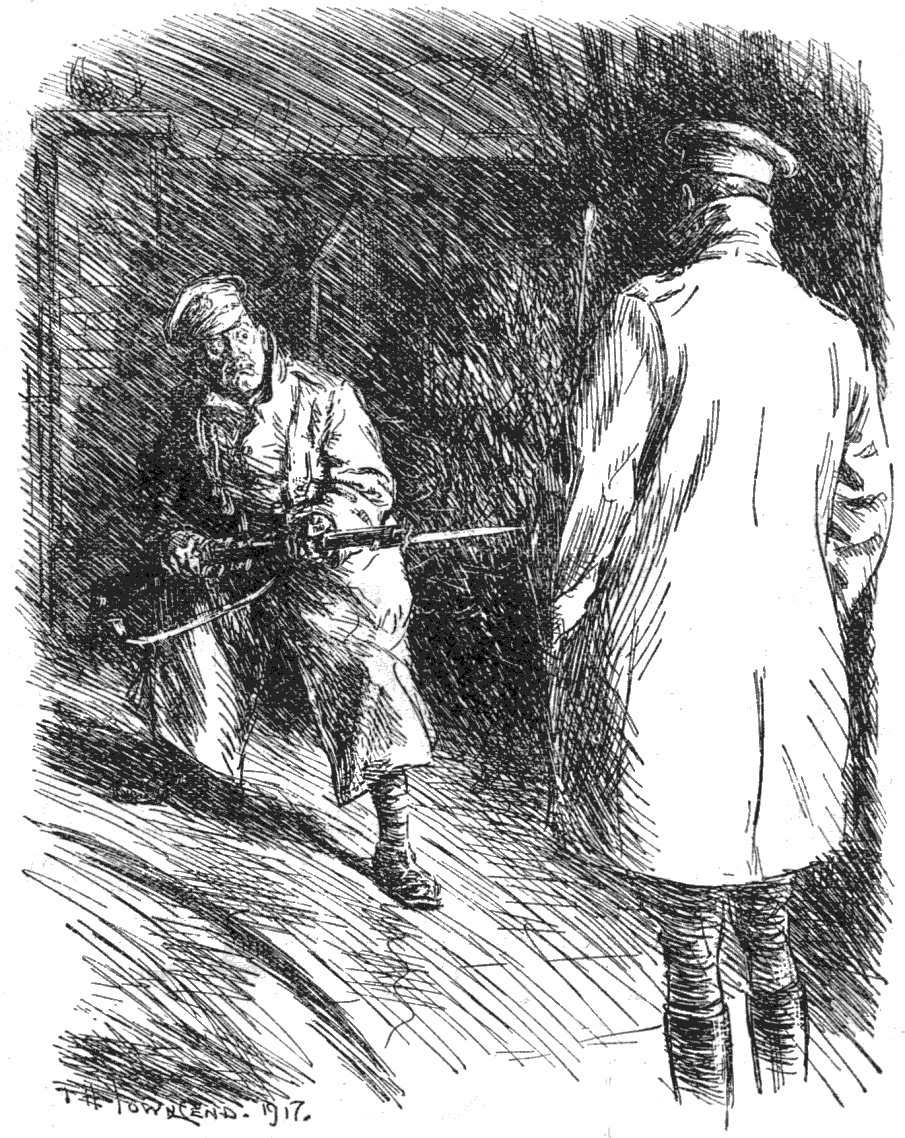
Sentry. "HALT! WHO GOES THERE?"
Officer. "VISITING ROUNDS."
Sentry. "ADVANCE ONE AND RECOGNISE YERSELF."
THE NEW NOTE IN THEATRICAL ADVERTISING.
(The sort of thing we are now getting in the daily papers in place of the antique boastings of expenditure and magnificence.)
FRIVOLITY THEATRE.
On Monday next, at 8 o'clock, will be produced
THE BELLE OF BELLONA,
A NEW MUSICAL ECONOMANZA IN TWO ACTS.
Largely reduced Orchestra.
Cheap Jokes. Old Scenery.
DUST OF BABYLON
AT THE EMPEROR'S THEATRE.
AN UNSPECTACULAR TALE OF THE EAST.
Practically no Costumes.
Support the production that saves money on wardrobe expenses.
We understand that Miss Taka Topnote, the well-known revue artiste, is bringing an action for defamation against the dramatic editor of The Morning Chatterbox, who recently published a statement that her salary was fifteen hundred a week. The lady informs us that as a matter of fact she is now drawing thirty-five shillings, with half fees for matinées.
Mr. Buckram, the famous actor-manager, writes: "A great deal of nonsense has been published about the so-called stupendous sums supposed to be expended on my shows. How such stories get about I am at a loss to imagine. Thus my present entertainment is reported to have cost me £25,000 before the curtain rose. All I can say is that, were this the case, the curtain would never have risen at all. To speak by the book (which anyone is at full liberty to inspect) I find my total initial outlay to have been £43 11s. 5d., inclusive of free drinks at the dress-rehearsal. All the members of my cast are paid as little as possible, usually in postage-stamps."
It is stated that the new problem play shortly to be produced at the Vegeterion Theatre will be unique in the matter of economy. It will be played throughout upon a bare stage, the scene represented being "A Theatre during Rehearsal." The cast will be entirely composed of stage hands and dramatic students; moreover, as both the dialogue and situations have been gratuitously borrowed from other works of a similar character, there will be no author's fees. The very gratifying result of these measures is that the management is enabled to present to the public an entertainment that has cost nothing at all. Patriotism could no further go.
"Meanwhile, the turnip trade is booming, and prices going higher: People seem to be talking to them in place of potatoes."—Newcastle Evening Chronicle.
Yes, and their language is often very regrettable.
TO FRANCE.
If so it be for every generous thought Spring scents are sweeter yet. For every task with high endeavour wrought Earth's gems are fairer set— Primrose and violet; If for each noble dream in dormant seed The life-spark stirs and glows; If for the fame of each heroic deed Some bloom the lovelier grows— White lily or red rose; Then, France, thou shouldst be lavish of thy flowers For all our dead and thine, And for all women's tears, or thine or ours, Put forth some tender sign— Heartsease or eglantine.
CHILDREN'S TALES FOR GROWN-UPS.
THE JUDGMENT OF THE ASS.
VII.
It was in the year that the donkey was elected judge, because only he and the mule came to vote and the mule spoiled his voting-paper.
The weasel came before the court to make a serious complaint against the rat.
"Most learned judge," said the weasel, "the rat came to me for advice. 'Tell me,' he said, 'how I can obtain a delicious piece of cheese I have seen.' I showed him how he could get it. He ate the cheese, and since then he has not ceased to revile me."
"Most unjust," said the judge. "What has the rat to say?"
"The rat does not appear," said the mule, who was usher.
"And why not?" asked the judge.
"He is still in the trap," said the usher.
"I showed him the way in," said the weasel proudly.
"But not the way out," said the rat's prospective widow.
"He only asked me how he could get the cheese, and I showed him," said the weasel.
"The weasel shall have the reward of virtue," said the judge. "As for the rat I shall fine him for contempt of court in not appearing."
"Justice!" cried the rat's prospective widow. "I demand my husband."
"You shall have him," said the ass. "I order the weasel to show you the way into the trap."
An Indian Circus handbill:—
"Programme of the Bengal Grand Cirkcus Co: Performings begin P.P.M.
PART I.
1. Some horses will make very good tricks.
2. The Klown will come and talk with the horses therefore audience will laugh itself very much.
3. The lady will walk on horses back when horses jumping very much.
4. The Klown will make a joking word and lady will become too angry, then Klown will run himself away.
5. The boy he will throw a ball to upside and he will catch the ball in downward journey.
6. This is very jumping tricks.
PART II.
1. One man will make so tricks on trapees that audience will fraid himself very much.
2. Some dogs will play and role himself in the mud.
3. This is the grand display of tricks.
4. The lady will make himself so bend that everyone he will think that he is rubber lady.
5. The man will walk on wire tight. He is doing so nicely because he is professor of that.
6. Then will come grand dramatic.
NOTICE.
No stick will be allowed in the spectators and he shall not smoke also."
EXCELSIOR.
"Our ascent to the sun makes our enemy envious."—Kölnische Zeitung.
The night fell fast, but faster still A youth came down the darkening hill, A super-youth, whose super-flag Flaunted the strange but hackneyed brag, "Excelsior!" His eyes betrayed through gold-rimmed prism Myopia and astigmatism; But, head in air, he proudly strode, Declaiming down the fatal road, "Excelsior!" The sign-posts clustered left and right And waved their arms towards the height; He heeded not, but through the mist Plunged steeply down and fiercely hissed, "Excelsior!" "Put on the brake!" Experience said; "The stars, my boy, are overhead; The pit of Tophet's deep and wide." A sudden snarl of hate replied, "Excelsior!" "O stay," cried Sanity, "and cool Thy fevered head in yonder pool!" The balefire smouldered in his eye, And still he muttered, hurtling by, "Excelsior!" "Beware the awful precipice! Beware the bottomless abyss!" This was Discretion's last Good-night. He gurgled, as he dropped from sight, "Excelsior!" At day-break, when the punctual sun Explored the hill-tops one by one, And scoured the solitary steep, An echo rose from out the deep, "Excelsior!" And, from the deeper depths that lay Beyond the farthest reach of day, A thin voice wailed, and, mocking it, Crackled the laughter of the pit, "Excelsior!"
Some Jumbo.
"Jumbo, the giant elephant of the Stosch-Parasani Circus in Berlin, has been killed for food, telegraphs the Amsterdam correspondent of The Daily Express. He yielded fifty-five tons of flesh."—Evening Paper (Glasgow).
If this statement had not come from Amsterdam we should have found some difficulty in believing it.
"At a meeting of the King George High School, Kasauli: 'Resolved, that the school be closed for to-day to commemorate the recapture of Kut, for which permission has been so kindly accorded by Pundit Hari Das Sahib, M.A.'"—Indian Paper.
We are all, General MAUDE included, very much obliged to the Pundit.
A MISNOMER.
Once upon a time, in the midst of the most detestable Spring ever known—a Spring consisting entirely of hopes of better weather, raised for no other purpose than to be so thwarted and dashed that the spirits of that brave and much harassed creature, man, might sink still lower—once upon a time, even in this Spring, there was a fine evening. It was more than fine, it was tender, and, owing to a North wind, wonderfully luminous, and I walked slowly along the hedges—which were still bare, although April was far advanced—and listened to the blackbirds, and marvelled at the light that made everything so beautiful, and was filled with gratitude to the late WILLIAM WILLETT for re-arranging our foolish hours.
I soon reached a favourite meadow, with a view of the hills and clumps of gorse in it, and, since there were clumps of gorse, many, many of those alluring little creatures which live in the ground and provide man with numbers of benefits—such as sweet flesh to put into pies; and cheap, soft, warm fur to wrap Baby Buntings in; and stubby tails, or scuts, to be used in hot-houses for transferring pollen that peach-blossoms may be fertilised, and (latterly) symbols for Government clerks who prefer civilian clothes and comfort to khaki and warfare; and (in Wales) toasted cheese. I refer to rabbits.
As I stood motionless in this meadow watching the yellowing sky, I was aware of an Homeric contest quite close to me. Two rabbits wore engaged in a terrific battle. They kicked and they scratched and made the most furious attacks on each other. The fur flew and the ground resounded to their thuds. First one seemed to be winning and then the other, but there was no flinching.
I had heard of rabbits fighting, but I had never seen it before. "Very unfair to have called them Cuthberts," I said to myself.
"The —— Company have several second-hand cars for sale, starter and non-starter models; petrol consumption low."—The Autocar.
Particularly that of the non-starters.
"Good General: sold cheap if taken over this week; good reasons for leaving."—Liverpool Paper.
Can this be HINDENBURG?
"The Rev. Stuart Holden, on behalf of the Strength of Britain Movement, spoke of the enthusiasm for prohibition of audiences throughout the country."—The Times.
We understand, however, that this enthusiasm for the prohibition of audiences has not yet extended to the theatrical profession.
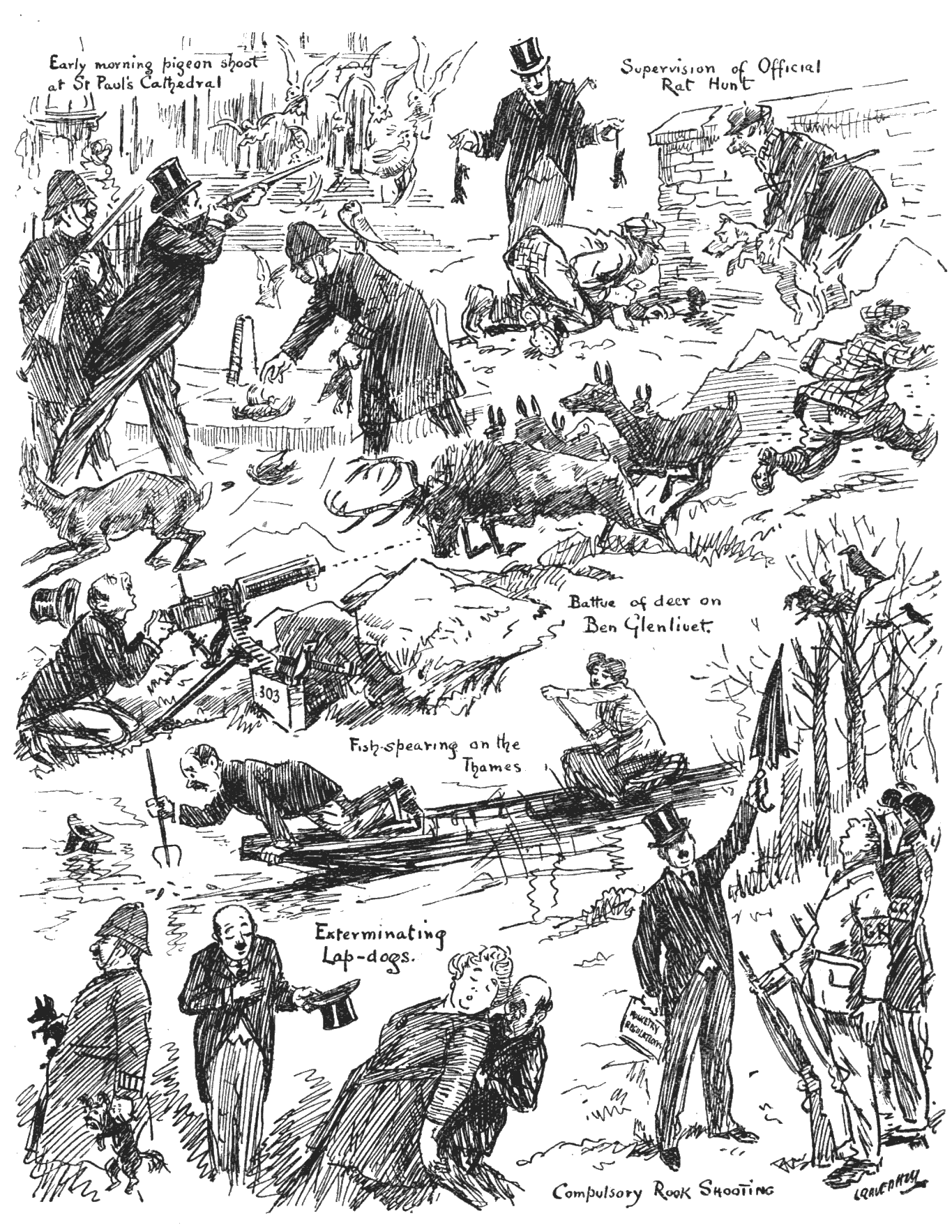
SPORTING DAYS WITH THE FOOD-PRODUCER'S STAFF
.
THE FOOD QUESTION.
RATIONING AT THE ZOO.
"In the Northern area," says a despatch from Mr. POCOCK, "a period of inactivity has set in which is partly due to the fact that the dromedary has been placed on a vegetarian diet. There has been a cold snap in the crocodile house. Three of our keepers have disappeared."
An attempt to substitute salsify for bloaters in the dietary of the sea-lion was not successful.
Complaints have been received from the elephant-house to the effect that buns sold for the benefit of the occupants have not reached their destination. Should this abuse continue it will be necessary to make arrangements to have every child under the age of twelve submitted to an X-ray examination before leaving the Gardens.
The use of human food for the nourishment of animals is, however, being discouraged; and for the future guinea-pigs and broken glass will be the staple diet of boa-constrictors and ostriches respectively. Peppermint-balls for grizzly bears are to be discontinued; also egg-nogg for anthropoid apes.
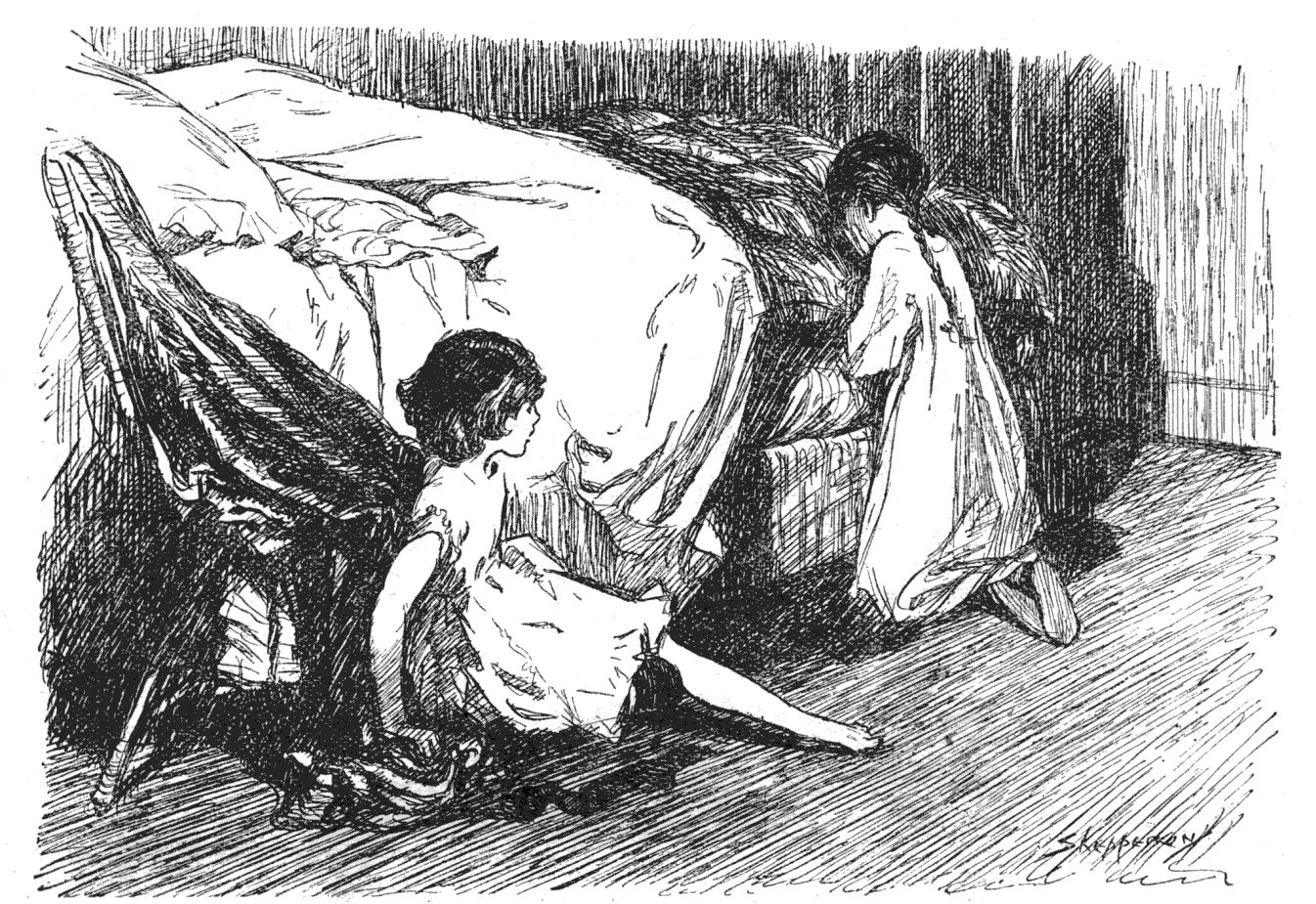
Alice (saying her prayers, after a quarrel with her sister). "AND, PLEASE GOD, BLESS BETTY."
Betty. "DON'T YOU DARE TO PRAY FOR ME!"
HINTS TO YOUNG FOOD-PRODUCERS.
Jugged Hare.—A well-known firm of hare-raisers in Carmelite Street informs us that young rabbits fed on sponge-cake soaked in port wine have a flavour which renders them indistinguishable from hare.
Celeriac.—-This appetising vegetable has been little cultivated owing to a general but erroneous belief that it was the name of a new kind of motor-car. "Celeriac" is of course a compound of the word "celery" and the Arabic suffix "ac," which means "bearing a resemblance to" or "a small imitation of." Thus it would be correct for the writer to speak of the salariac he earns by writing this sort of thing.
[Note.—"Earns" would not be correct.—ED.]
Navigation Extraordinary.
"Although the stern and screws of the vessel were well out of the water she was able to make the port under her own steam."—Daily Mail.
"Portatoes in the usual forms have disappeared this week.—LORNA."—British Weekly.
These must be the Devonportatoes of which we have heard so much.
AT BEST.
[Baron MORITZ FERDINAND VON BISSING, the German Military Governor-General of Belgium, the murderer of Nurse CAVELL and instigator of the infamous Belgian deportations, after being granted a rest from his labours, is reported to have died "of overwork."]
Tired of pillaging and sacking, Tired of bludgeoning and whacking, Tired of torturing and racking, BISSING takes his "rest." For the sport of shooting nurses, Gloating o'er his victims' hearses, Answering appeals with curses, He had lost his zest. All his diabolic striving To intensify slave-driving Could not slay the soul surviving In a Nation's breast. Still the flame burns ever brighter Underneath the blouse or mitre; Still the smitten greets the smiter With undaunted crest; While the arch-tormentor, flying From the hell about him lying, Mid the fire and worm undying Takes his endless rest.
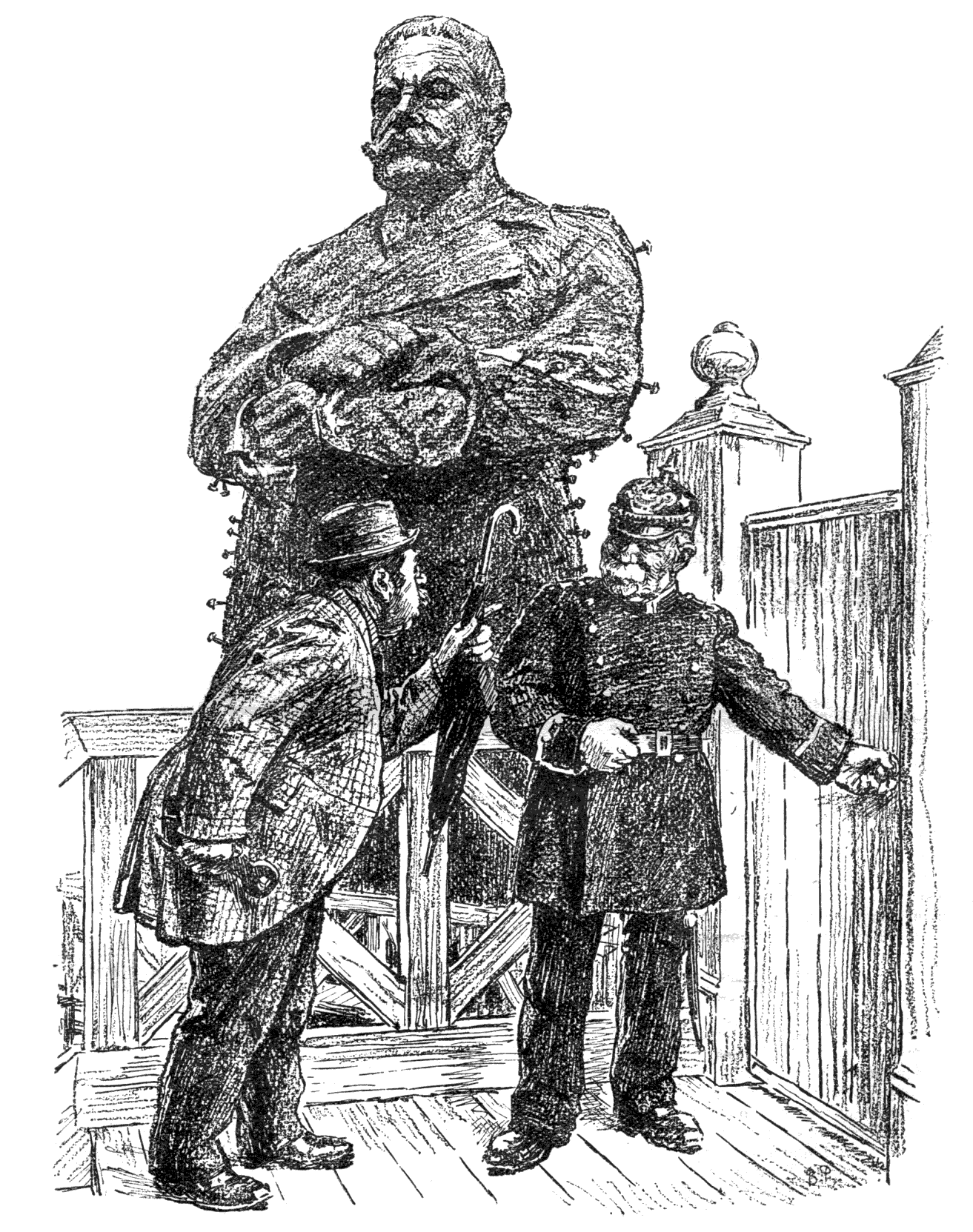
THE WANING OF FAITH.
GUARDIAN OF STATUE. "YOU WISH TO HAMMER ANOTHER NAIL INTO THE COLOSSUS OF OUR HINDENBURG?"
EX-ENTHUSIAST. "NO; I WANT MY OLD ONE BACK."