Volume 152 — ESSENCE OF PARLIAMENT.
Reading edition
Tuesday, April 17th.—The re-opening of the House of Commons found Lord FISHER in his accustomed place over the clock. What is the lure that brings him so often to the Peers' Gallery? I think it must be his strong sense of duty. As Chairman of the Inventions Board he feels he ought to lose no opportunity of adding to his stock.
Quite the most striking feature of the afternoon was the pink shirt worn by a well-known Scottish Member, whose name I refrain from mentioning to spare him any additional blushes. It was of such an inflammatory hue that his brother-legislators at first took it for a well-developed case of measles (probably German) and sheered off accordingly. Nobody knows what caused him to indulge in the rash act, but it is hoped in the interests of coherent debate that he will not do it again.
Mr. DILLON was so much disturbed by the apparition that, having started out to demand an immediate General Election unless the Government at once granted Home Rule to the whole of Ireland, he finished by declaring that he would be satisfied if they would promise to reform the franchise on the lines proposed by the SPEAKER'S Conference. Incidentally he drew a fancy picture of himself and his colleagues striving consistently for thirty-five years to convert their brother-Irishmen to constitutional methods; from which I infer that Mr. DILLON, very wisely, does not make a study of his own old speeches.
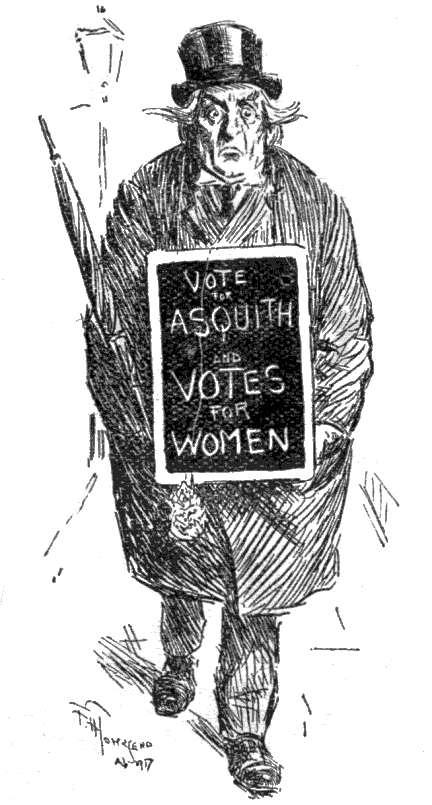
PAPER SHORTAGE AT A GENERAL ELECTION.
[The Political Slate (with Sponge) has its obvious compensations.]
As the engineer of two successive extensions of the life of Parliament Mr. ASQUITH offered whole-souled support to the proposal to give a third renewal to its lease. Apart from anything else, how could a General Election be satisfactorily conducted when there was a shortage of paper and posters were prohibited? "What's the matter with slates?" whispered a Member from Wales. If every Candidate paraded his constituency sandwiched between a couple of slates showing the details of his political programme, it would certainly add to the gaiety of the nation, besides providing an easy method of expunging such items as in the course of the contest might prove unpopular.
A good many silly things have been said in the last month or two about HINDENBURG and his imaginary "line," but the silliest of all perhaps was the remark of The Nation that the German retreat on the Somme "has found our soldiers wanting." This article naturally gave great comfort to the enemy, who possibly overestimates the importance of Mr. MASSINGHAM and the significance of the title of his paper. It also found its way to the British trenches, and caused so great an increase in the habit traditionally ascribed to the British Army when in Flanders that Sir DOUGLAS HAIG is understood to have suggested that an embargo should be placed upon the further export of such literature.
What most strikes the imagination is that amid the most stirring events of the greatest war in history British Legislators should devote three of their precious hours to so trumpery an affair. Was this what the old jurist had in mind when he called the House of Commons "The Great Inquest of the Nation"?
Wednesday, April 18th.—On the motion introduced in both Houses to express the welcome of Parliament to our new Ally, Mr. BONAR LAW, paraphrasing CANNING, declared that the New World had stepped in to redress the balance of the Old; Mr. ASQUITH, with a fellow-feeling no doubt, lauded the patience which had enabled President WILSON to carry with him a united nation; and Lord CURZON quoted BRET HARTE.
A fresh injustice to Ireland was revealed at Question-time. England and Scotland are to enjoy an educational campaign, in which hundreds of speakers all over the country will dilate upon the necessity of reducing the consumption and preventing the waste of foodstuffs. But like most other patriotic schemes it is not to apply to John Bull's other island, though I gather that it is at least as much wanted there as here.
On the third reading of the Parliament Bill the debate was confined to Irish Members. Mr. FIELD, who is in the live-stock trade, led one particularly fine bull into the Parliamentary arena. After complaining that Members had no longer any power in the House, he went on to say, "We are simply ciphers behind the leading figures on the Front Bench." Surely that, arithmetically speaking, is the position in which ciphers are most powerful.
Thursday, April 19th.—The mental processes of Sir WILLIAM BYLES are normally so mysterious that his suggestion that, with the Americans coming in and the Germans making off, this was the psychological moment for the British Government to initiate proposals for peace, did not strike the House at large as specially absurd. It was, however, both surprised and delighted when Mr. SWIFT MACNEILL interposed with an inquiry whether it would not be time enough to talk about peace when the Germans ceased to blow up hospital ships. When Mr. BONAR LAW tactfully observed that the Supplementary Question was better than the answer he had prepared, one felt that the prospects of an Anglo-Irish entente had appreciably improved.
When the new MINISTER FOR EDUCATION deposited upon the Table a vast packet of manuscript, and craved the indulgence of the House if he exceeded the usual limits of a maiden speech, I thought of the days when the headline, "The Duke of Devonshire on Technical Education," used to strike on my fevered spirit with a touch of infinite prose. Mr. FISHER began in rather professorial style, but he soon revealed a glowing enthusiasm for his subject which thawed the House. His ambition is to transform the teachers in our elementary schools from ill-paid drudges into members of a liberal and liberally remunerated profession. Our record in the War has shown that, as a Naval Officer wrote to him, "there is something in your d——d Board School education after all."
"The bride, who was given away by her father, was attended by Miss —— as demonsoille d'honneur."—Hawkes Bay Herald (New Zealand).
We fear this marriage was not made in heaven.
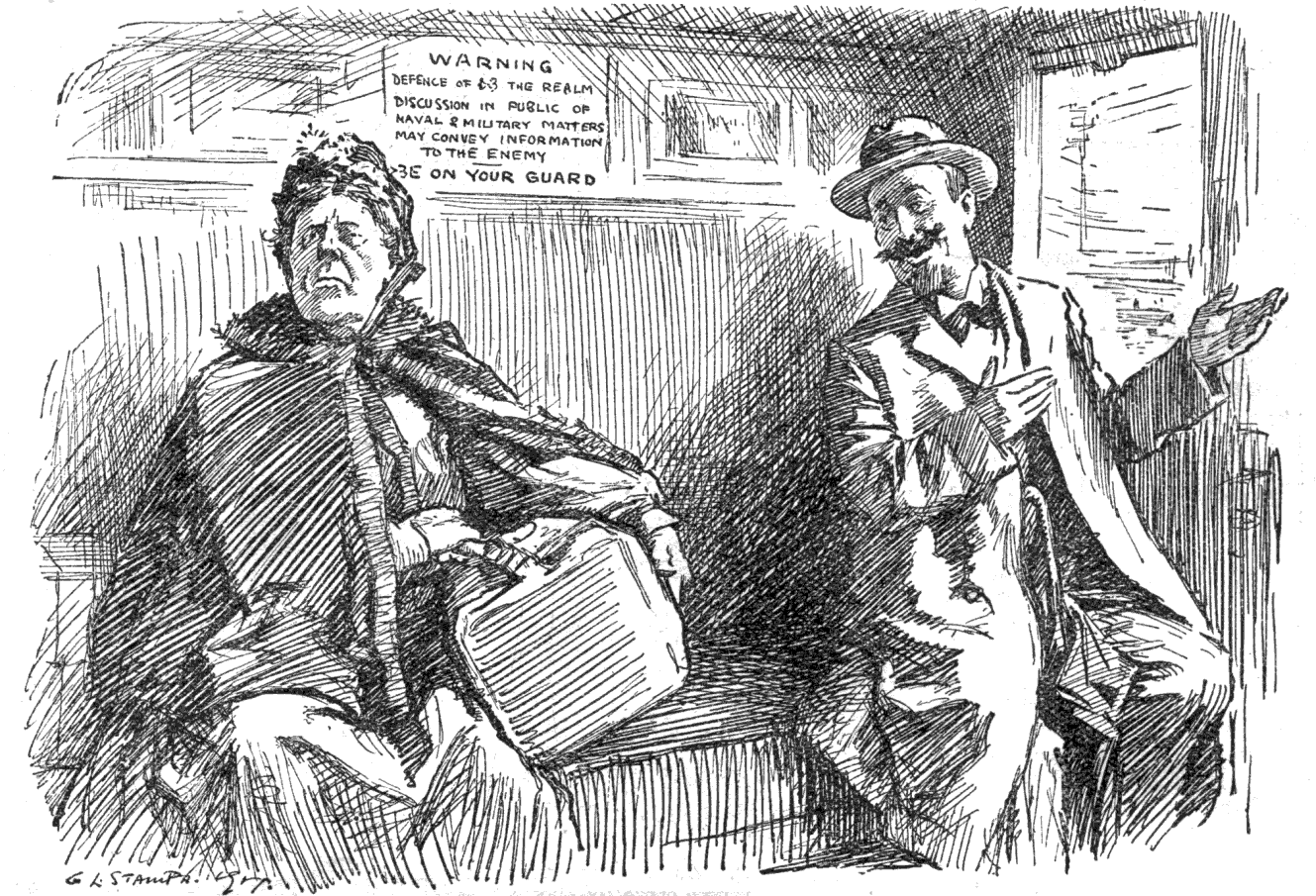
Polite Foreigner. "IS ZAT YOUR BEAUTIFUL ENGLISH THAMES—YES?"
London Dame ("on her guard"). "I HAVEN'T THE SLIGHTEST IDEA."
A PAPER PROBLEM.
Copy of a letter from the Reverend Laurence Longwind to the Archbishop of CANTERBURY:—
The Rectory, Little Pottering, April 1st, 1917.
My LORD ARCHBISHOP,—I am writing to ask whether Your Grace would be so kind as to assist me in resolving a case of conscience which, I feel sure, must be exercising the minds and hearts of many of my brother clergy at the present time.
The matter to which I refer is closely connected with the sad shortage of paper. It is no doubt known to Your Grace that many ministers of the Gospel, though capable of eloquence of a high order, write their sermons. Old sermons tend to increase and multiply at an alarming rate. I myself have a chest of drawers literally stuffed with them. What, in Your Grace's opinion, should be done with these?
Would it be right, in view of the purpose for which they were written, to tear them up and send them away to be pulped? Long and earnestly as I have considered the problem in all its bearings I am still utterly unable to arrive at a solution.
No doubt I could sell them and devote the proceeds to charitable purposes. There is, I am informed, a large and steady demand for old sermons amongst the younger clergy who have not that ripe experience of life which sixty years in a rural parish cannot fail to provide. But I am informed that the dealers do not always offer appropriate prices. And I should hesitate to make a traffic in holy things unless I could make quite certain that no breath of scandal could result from inadequate remuneration.
I have sounded my churchwardens on the subject, but without reaping any benefit from the advice given. "Do you see any harm in selling them simply as paper?" I asked one of them, a Mr. Bloggs. "Not a rap! Not a rap! Get rid of 'em!" was his reply. Naturally I felt hurt. It was not so much what he said as the way he said it. The mere mention of my sermons always seems to make him irritable. Why I cannot imagine.
My dear wife advises me to send them down to the schoolhouse. The children, she thinks, might use the backs (I write on one side of the paper only) for their sums. But I fear such an expedient might give rise to a spirit of irreverence.
Would Your Grace hold me greatly to blame were I to raffle them at our next rummage sale? I feel sure they would fetch a good price. Only yesterday Miss Tabitha Gingham remarked to her sister, Miss Mary, "We had a good long sermon from the Rector this morning." I was passing behind their laurel hedge at the moment, and could not fail to overhear this meed of praise. Miss Tabitha is, I should explain, very hard to please, and if she thinks them good there must be others in the parish of the same opinion. I might be able to raise quite a nice sum for our local Seed Potato Committee by a Spring raffle of my longer and more elaborate compositions. And since everybody is beginning to take a modern view of Bonus Bonds I do not think that a raffle for such a purpose need arouse serious opposition.
Trusting that Your Grace will be able to give me your considered opinion in this matter, which is arousing so much attention at the present time,
I am, Your Grace's humble and obedient Servant, LAURENCE LONGWIND.
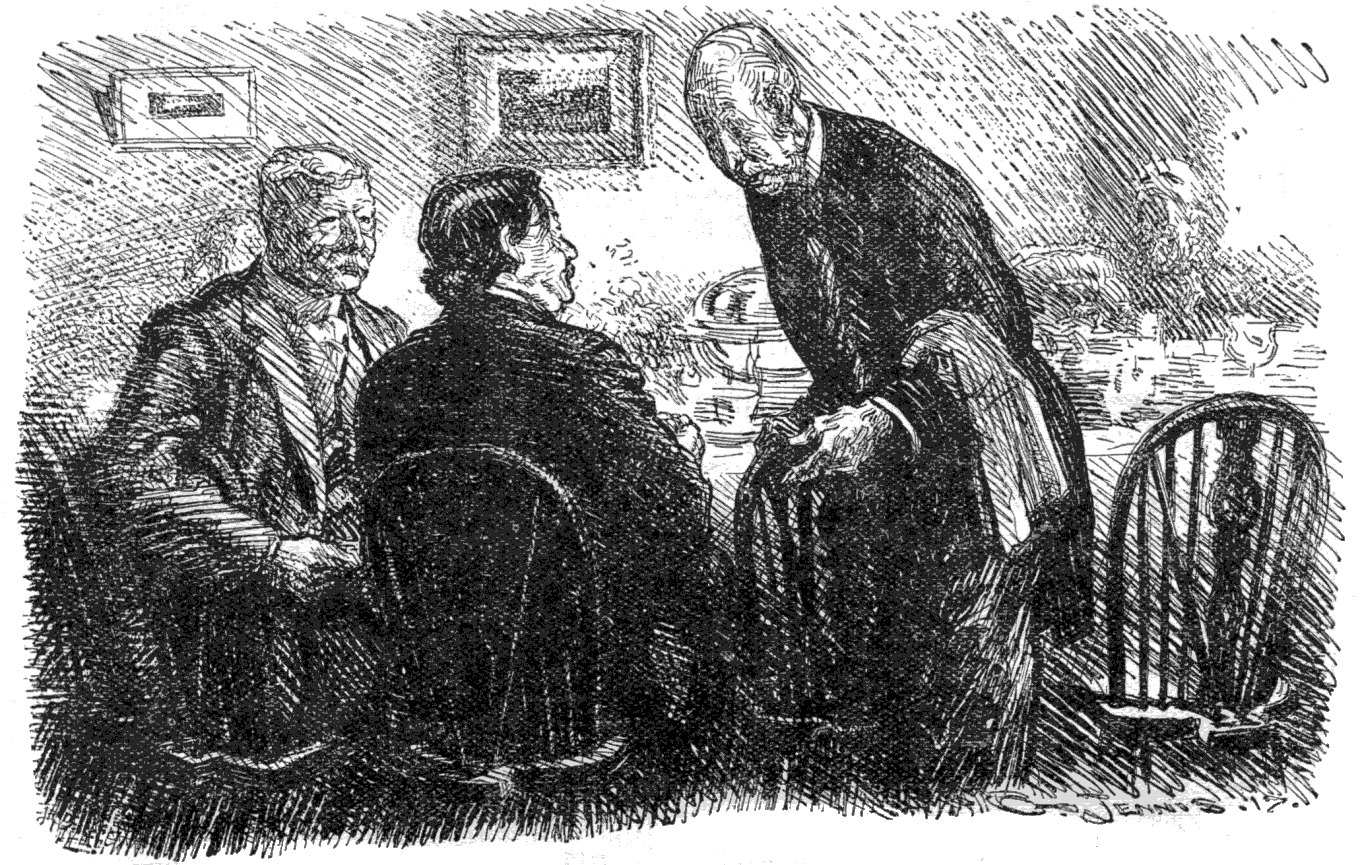
Resident at Boarding House (to waiter). "DO YOU CALL THIS STUFF MARGARINE OR MARJARINE?"
Mike. "SURE, SORR, IT'S HERSELF WOULD SLING ME OUT IF I CALLED IT ANNYTHING BUT BUTTHER."
FORE AND AFT.
The A.S.C.'s a nobleman; 'e rides a motor-car, 'E is not forced to 'ump a pack, as we footsloggers are; 'E drives 'is lorry through the towns and 'alts for fags and beer; We infantry, we does without, there ain't no shops up 'ere; And then for splashin' us with mud 'e draws six bob a day, For the further away from the line you go the 'igher your rate of pay. My shirt is rather chatty and my socks 'ud make you larf; It's just a week o' Sundays since they sent us for a barf; But them that 'as the cushy jobs they lives in style and state, With a basin in their bedrooms and their dinners on a plate; For 'tis a law o' nachur with the bloomin' infantry— The nearer up to the line you go the dirtier will you be. Blokes at the base, they gets their leave when they've bin out three munse; I 'aven't seen my wife and kids for more 'n a year, not once; The missus writes, "About that pass, you'd better ask again; I think you must 'ave been forgot." Old girl, the reason's plain: We are the bloomin' infantry, and you must just believe That the nearer up to the line you go the less is your chance of leave.
"We cussed at Grosvenor House and some steps in this direction may be expected if the demands of retailers become more rapacious."—Daily Mail.
It is no good abusing the FOOD CONTROLLER, however, or prices would long ago have been down to zero.
MAB DREAMS OF MAY.
The day-dim torches of chestnut trees stand dreamily, dreamily; In myriad jewels of glad young green, smooth black are the broad beech boles; The fragrant foam of the cherry trees hangs creamily, creamily, And the purpling lilacs and the blackthorn brakes are singing with all their souls! The pinky petals of lady's-smocks peer maidenly, maidenly; Meadow-sweet, donning her fragrant lace, is daintiest friend of the breeze; Hyacinths wild, blue-misting the woods, hang ladenly, ladenly, And tiniest bird's-eye burns deep blue in thickets of tall grass trees! Daylong I lie, daylong I dream, swung swooningly, swooningly, In an old-time tulip of flaming gold, red-flaunted and streaked with green, While song of the birds, of water and bees comes crooningly, crooningly, And Summer brings me her swift mad months with scent and colour and sheen. Winter is gone, I ween, As it had never been! Dance! dance! Delicately dance! Revel with the delicatest stamp and go! Dance! dance! Circle and advance, Curtsey, twirl about, Shatter the dew and whirl about, Stamp upon the moonbeams—heel and toe!
MORE NEWS FROM THE AIR.
THE ALLIES.
The other day I was in a country house whose owners are so lost to shame as still to keep pets. There is a dog there which is actually allowed to eat, in defiance of all those Times' correspondents whose sole idea of this stimulating and unfailingly devoted animal is that it is personified greed on four legs. There are two or three horses of unusual intelligence, which no doubt our friend the Hun would long since have devoured, but which, even though hunting is over, are by some odd freak of sentiment or even of loyalty still kept alive. There are rabbits. And there is a bird in a cage against the wall of a small yard. This bird is a chaffinch, which a friend had brought over from France.
After I had fraternised shamefully with all these deplorable drones, my hostess drew my attention to the French chaffinch, a fine big fellow, very tame and cheerful. "We will feed him," she said, "and then you will see something that happens every day. Something very interesting."
So saying she poured into a receptacle for the purpose enough seed, no doubt, to make, mixed with other things, several admirable thimble-loaves of bread substitute, and told me to watch.
I watched, and very soon the French chaffinch, having eaten a certain amount of the seed, dashed his beak amid the rest with such violence that it was spilt over the pan, out of the bars and down to the ground below.
"That's very wasteful," I said. "Lord DEVONPORT wouldn't like that—Lord DEVONPORT wouldn't;" this being the kind of facetious thing we are all saying just now, and something facetious being in this particular house always, for some reason or other, expected of me.
"Wait a minute," my hostess replied. "There's more reason in it than you think."
And there was.
The whole point of this mediocre narrative consists in the fact that within a few seconds some dozen sparrows had descended to the yard and were feeding busily while the chaffinch watched from above. And this happens at every mealtime.
To what extent we are contributing to the French Commissariat I cannot say; but with my own eyes I have seen a French citizen being systematically generous to his English cousins.
"The sale [of potatoes] started at 6 a.m., and the first omnibus from London brought over 200 buyers down."—Weekly Dispatch.
A gross case of overcrowding.
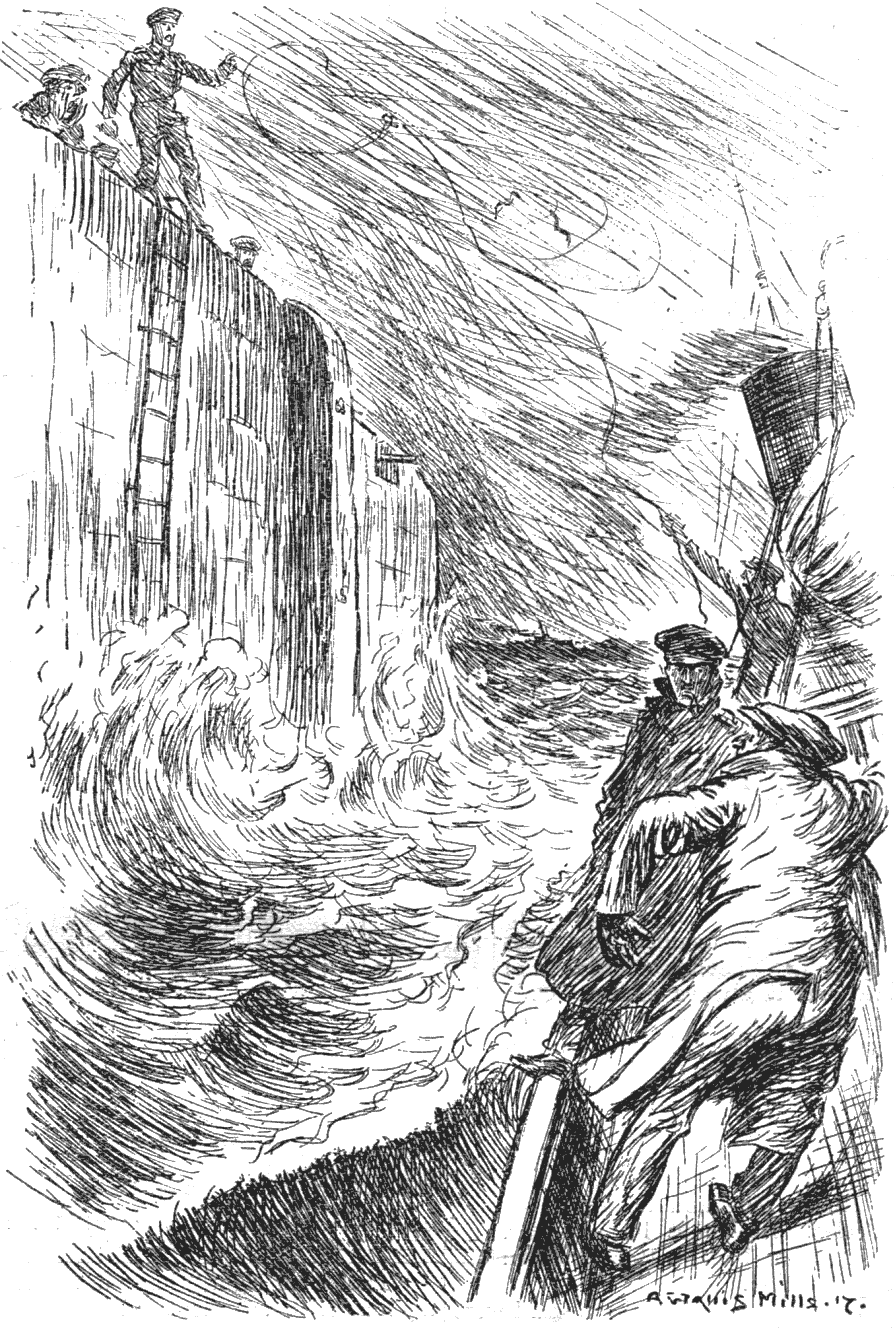
Civilian (who has been asked to luncheon at outlying fort). "I SAY, YOU KNOW, I CAN'T POSSIBLY LAND BY THAT ABSURD LITTLE LADDER."
Host. "ROT, OLD CHAP. I'VE HAD THE VERY DICKENS OF A JOB TO GET YOU A PASS—AND, BESIDES, PEOPLE DON'T OFTEN FALL IN."
DOUBLE ENTENTE.
["In view of the fact that M.C. is also the abbreviation for 'Military Cross' ... it has been recommended that the abbreviations for the degrees of Bachelor of Surgery and Master of Surgery be altered from B.C. and M.C. to B.Ch. and M.Ch."]
In view of the fact that P.M. is also the abbreviation for Prime Minister and Post-Mortem, the London and North-Western Railway recommend that in future the abbreviation for afternoon be A.L. (After Luncheon).
In view of the fact that (as every schoolboy knows) D.D. is also the abbreviation for Double Donkey, the Upper House of Convocation recommend that in future the abbreviation for Doctor of Divinity be Doc. Div.
In view of the fact that Q.S. is also the abbreviation for Quarter Sessions, the Committee of the Pharmaceutical Society recommend that in future the abbreviation for Quantum Suff. be S.W. (Say When).
"Herbert Spencer made a rough outline of his 'Sympathetic Philosophy' when forty years old."—Weekly Paper.
Alas! he never lived to fill in the details.
A PERSONAL TRIUMPH.
Always at the same point of my railway journey North I drop my paper and wait till a certain trim red-roofed ivy-clad cottage comes into view across the fields to the right. Till yesterday there were two reasons why I should hail this cottage with delight. First of all, it stands where trim cottages are rarer than pit-heads and slag heaps; and, secondly, GEORGE STEPHENSON once lived there. From now onwards, however, I have a third and more compelling reason for respecting the old building. You shall hear.
Know, then, that I have a friend called Smithson. The Athenians would have had a short way with him; and I admit that there have been times in the course of our relationship when hemlock would really have been the only thing to meet the case. Our conversations (it is no fault of mine) are always dialectical. They take the following form. Light-heartedly I enunciate a proposition. Smithson is interested and asks for a clearer statement. I modify my original position. Smithson purrs. Seeing trouble imminent, I modify my modification, and from that point onwards I make a foredoomed but not (as I flatter myself) an unplucky fight against relentless logic. The elenchus comes soon or late, but it always comes. Only in dreams am I ever one up on Smithson. The old trick of cramming up hard parts of the Encyclopædia overnight is no good. I tried it once with "Hegesippus" and "The Hegira." You don't know what either of these words mean? Smithson did—and he knew the articles. No doubt he and Mr. GLADSTONE had written them in collaboration.
Well, yesterday, Smithson and I were in the neighbourhood of the cottage which I have told you of. Having an hour to spare from work of national importance, we took our sandwiches and were eating them in view of the jolly old house.
"What's that thing over the door?" I said.
"That I take to be a sun-dial," said Smithson with his accustomed reserve of strength.
"What a delightful stile," I said. (You always have stiles on sun-dials. I knew that).
"Quâ stile it is perfect. What do you make of the inscription?"
I went at it bald-headed. "Percunt et imputantur," I said.
"You may be right, of course," replied Smithson, "though it certainly begins with an A."
"True," I corrected. "Anno Domini."
"Conceivably—but the second letter is a U."
I left Smithson painfully to reconstruct A-U-G-U-S-T from among the ivy. He had got to the M of a long date when a burst of sun cast a crisp shadow across the dial.
"I don't think much of GEORGE STEPHENSON after all," I said. "His beastly clock doesn't know the right time."
Smithson snorted. Here was a challenge to the omniscient.
"That's all right," he said, recovering himself in a moment "All properly constructed dials have a compensating table; we shall find one no doubt behind the ivy; there! I see it, to the left—a compensating table by which you have to correct the actual record of the shadow. For example, we are now in Lat. 55 N. The month is April. At Greenwich—"
But I wasn't listening. A bright truth had flashed into my mind, and I couldn't hold myself back any longer. "It's just about an hour slow," I said. "You don't think that Daylight Saving has anything to do with it, do you?"
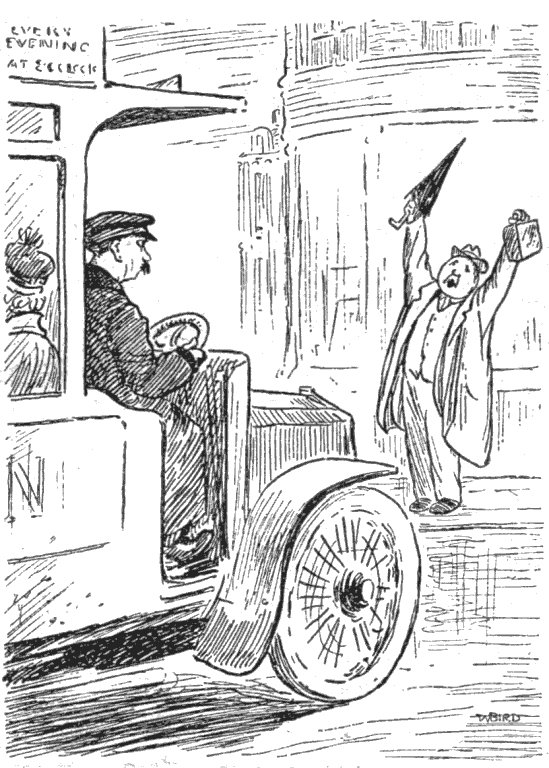
Busdriver.—"ALL RIGHT—ALL RIGHT! I SEE YER, YER NEEDN'T KEEP ON SURRENDERING."
"About twenty-four hours later one of the ship's officers saw something bobbing on the water a few hundred years dead ahead."—New York Evening Post.
America evidently foresees a long war.
THE STRIFE OF TONGUES.
(Lines suggested by the recent demise of the inventor of Esperanto.)
As a patriotic Briton I am naturally smitten With disgust When some universal lingo By a zealous anti-Jingo Is discussed. Some there are who hold that Spanish In the end is bound to banish Other tongues; Some again regard Slavonic As a stimulating tonic For the lungs. I would sooner bank on Tuscan, Ay, or even on Etruscan, Than on Erse; But fanatical campaigners, Gaelic Leaguers and Sinn Feiners Find it terse. Some are moved to have a shy at Persian, thanks to the Rubáiyát, And its ease; But it's quite another matter If you're anxious for to chatter In Chinese. To instruct a brainy brat in Canine or colloquial Latin May be wise; But it's not an education As a fruitful speculation I'd advise. French? All elegance equips it, But how oft on foreign lips it Runs awry; German, tainted, execrated, Is for ages relegated To the sty. As for brand-new tongues invented By professors discontented With the old, Well, the prospect of a "panto" Played and sung in Esperanto Leaves me cold.
"One of the most striking—and satisfactory—features of the new restaurant régime is the disappearance of the bread-basket."—Daily Telegraph.
Or, at any rate, a considerable shrinkage in its contour.
"If there must be duplication of electric light installations, the apparati might, at least, be made uniform. And it would not be expecting too much if they were made in some way to harmonise with the telephone service."—Australian Paper.
Or even with the Latin Grammar?
"5-Seater Car for Sale; must sell; chauffeur at the Front; own body cost over £73. What offers?—RECTOR."—Times.
These personal details seem to us a little out of place in a commercial transaction.
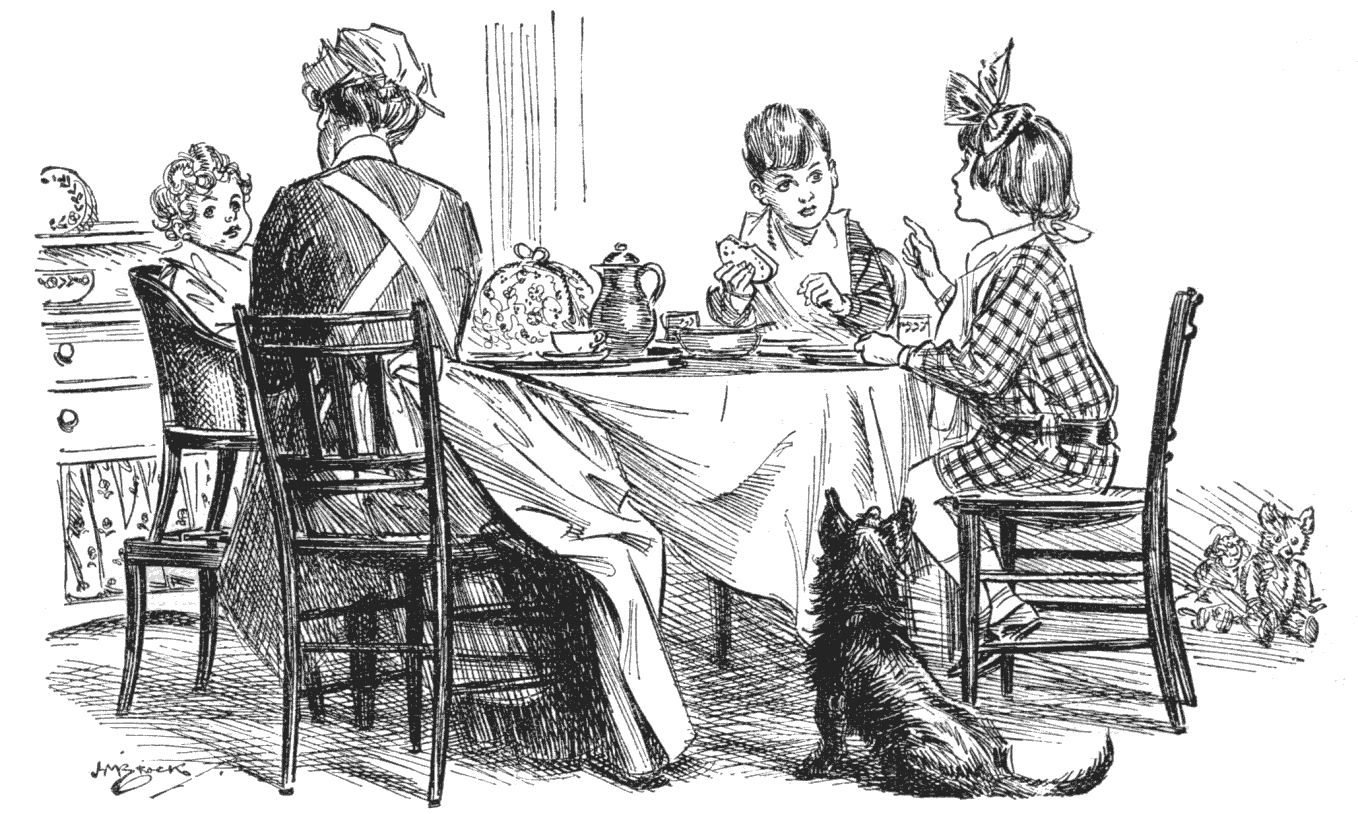
John. "BUT WHY MUSTN'T WE HAVE NEW BREAD ANY MORE?"
Joan. "WHY, DON'T YOU SEE, SILLY? IF WE EAT YESTERDAY'S AND SAVE UP TO-DAY'S THERE'LL ALWAYS BE SOME FOR TO-MORROW. THEN THE GERMANS CAN'T STARVE US."