Volume 146 — THE MARRIED MAN'S ADVANTAGE.
Reading edition
Personally I think too much respect is paid to age. There is nothing clever in being old—nothing at all. On the other hand, youth has a charm of its own. Besides, twenty-two is not young; you wouldn't think me so if you really knew me. The doubt arises, I suppose, from a certain innate light-heartedness. It is really rather pathetic.
Daphne chooses to see humour in the situation, which is very absurd of her, and, as I point out, merely reflects on herself. Surely she doesn't wish to admit that it is foolish to love her.
And that, to make a clean breast of it, is exactly what I do, and do madly.
I follow her about, reverently watching her every movement, hanging on her every word—no light task. And my reward? A scant unceremonious "Hallo!" when we meet; a scanter "Night" or "Morning," according to the circumstances, when we part. A brave smile from me and she is gone, an unwitting spectator of a real tragedy.
Up to a few days ago I was content to bear with my lot, but last week I rebelled. It was at a dance, after supper. Daphne had certainly shown a sort of affection for me, motherly rather than otherwise, I think; nevertheless an affection. But then, and not for the first time, I had seen her flirting with another.
I decided to lose my temper. I went into the smoke-room and deliberated very close to the fire. In five minutes I left the room heated.
I found Daphne at once.
"Our dance," I said. "We will sit out."
My manner must have been rather terrifying. At any rate we sat out.
"Daphne," I began, "I am in a mood that brooks no trifling. For weeks I have loved you. You spurn me."
"Oh, Billy, do be sensible," Daphne murmured.
I moderated my tone. "Well, look here," I said, "why are you so cold to me and yet flirt with my cousin? I saw you putting his tie straight and patting his arm just now; and you won't let me even hold your hand. It's pretty hard, Daphne."
She laughed. "My dear Billy—"
"Many thanks for yours of yesterday. I am having a very good time and it is really kind of me to write."
"If you won't be sensible—"
"I am. It's just because I'm so serious that I jest. All the wittiest men are broken-hearted. Go on."
"Well, my dear Billy, you mustn't be foolish. I'm very fond of you, but you're so ridiculously young."
"You haven't a revolver about you?" I enquired.
Daphne sighed. "Billy, you're quite hopeless. Do let me try to explain. You see, I can't—well—flirt with you, because I don't really flirt, of course, and besides your cousin's different—he's married."
I got up quickly. "Good-bye," I said. "You must excuse my leaving you."
Daphne looked surprised. "Where are you going?" she enquired.
"To get married." I walked away with my head in the air.
A week later I wrote Daphne a letter. It ran as follows:—
"MY DEAR DAPHNE,—I am going to get married. Tina is nineteen, the same as you, and is in the chorus of a musical comedy. She has real jet black hair, so I am quite lucky. I hope you are fonder of me already.
Yours devotedly, BILLY."
In reply, and by return of post, I received an invitation to tea at Daphne's. Daphne, looking beautiful, was awaiting me.
"How d'you do?" I said gravely.
"Billy," Daphne began, "will you be really serious with me?"
I immediately assumed a business manner and coughed.
"Well?" I said.
The word was sharp and incisive, a regular lawyer's question.
"Of course, you're joking about this chorus girl?"
"Joking! Daphne, you know I'd do anything for you."
Daphne smiled. "But, Billy, I shan't like you any better if you marry her."
I bit a piece of cake coldly. "I don't understand you, Daphne," I said. "When I ask you to show me a little affection, only just what you show others, you tell me I'm young and married men are different. I arrange to be different at considerable personal sacrifice, and you tell me you won't like me any better." I swallowed convulsively.
"But, Billy—dear—you're not actually engaged?"
"I'm not so sure," I replied. "These girls are wonderfully sharp; and then, of course, I'm so young." (A good touch.)
There was a silence.
"I shall hate you if you marry a chorus girl," said Daphne.
"Then why did you tell me married men were different?"
"Because most of them are." Daphne smiled slowly. "I think I might like you better if you were married to some really nice girl."
I laughed bitterly. "To you, for instance?"
"Yes, to me," said Daphne very sweetly.
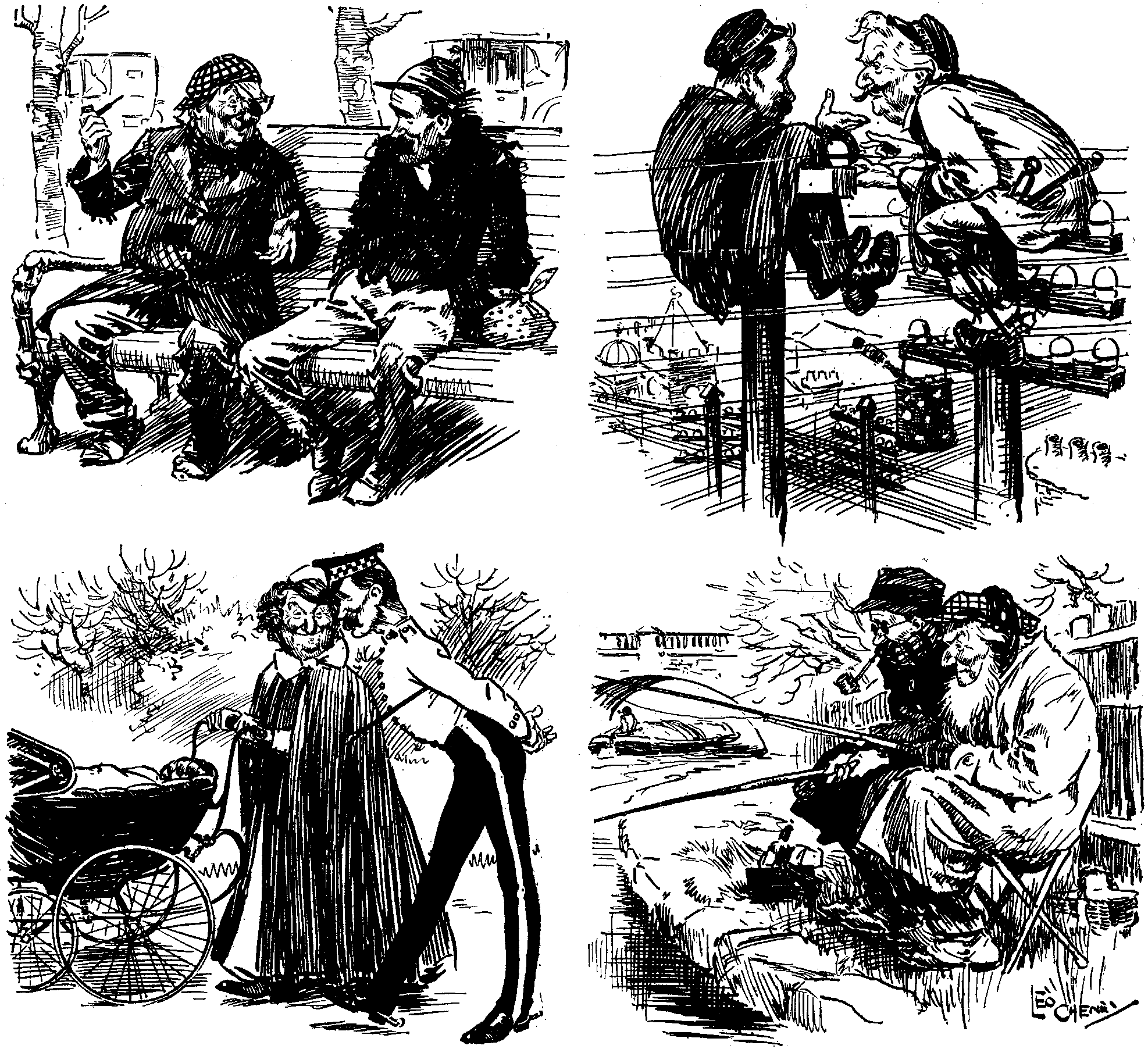
IN VIEW OF THE EXAGGERATED AND MISLEADING REPORTS OF WHAT OCCURS AT THE CONVERSATIONS BETWEEN MR. ASQUITH AND MR. BONAR LAW ON THE ULSTER QUESTION WE VENTURE TO THINK THAT A LITTLE MAKE-UP AND CAREFUL CHOICE OF RENDEZVOUS WOULD ENABLE THE LEADERS TO HAVE MANY A LONG CHAT ON THE SUBJECT WITHOUT ANYONE BEING AWARE OF THEIR HAVING MET.
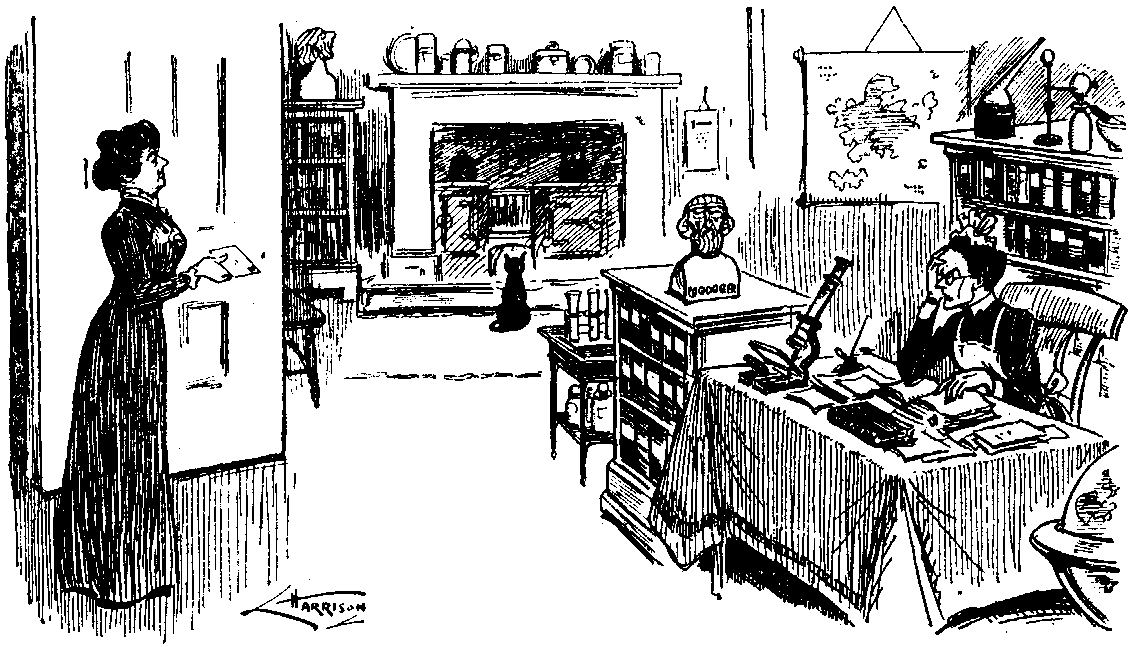
SPREAD OF THE SERVANT-GIRL GRADUATE IDEA.
(
Interior of a super-kitchen.
)
Mistress
. "WOULD YOU MIND LEAVING YOUR SOPHOCLES FOR A MOMENT, MARY, AND RUNNING TO THE POST?"