Volume 146 — OLD FRIENDS.
Reading edition
I was in the train because I had to go to Birmingham; I was in the dining car because I had to dine. With all respect to the Company I cannot pretend that I regarded myself as doing anything remarkable or distinguished. The little man opposite me, however, felt differently. I have since been told that they of Birmingham are very proud of their non-stop train service by both routes.
"This, Sir," said the stranger, as I lowered my paper to help myself to a proffered roll—"this is one of the Two-Hour trains."
"You don't say," said I politely but not encouragingly.
"Two hours," he repeated impressively.
"Indeed? Two whole hours and not a moment less?" and I returned to my paper pending the soup's arrival.
"Is it not wonderful," he resumed when I was at his mercy again, "to be travelling at sixty miles an hour and eating soup at the same time?"
"Some people eat soup," said I, "and some drink it. For myself, I give it a miss;" and I returned to the news.
With the fish: "I came up by the breakfast train this morning," said he, "and I now return by the dining train." He meant by this to give credit to the Company rather than to himself, but even so it seemed to fall short of the complete ideal. There was something wanting. It was luncheon, of course.
"They run luncheon cars too," said he.
"Then there seems to be no reason why you should ever leave the train at all," I remarked, seeking refuge again in my paper. In spite, however, of my coldness, he continued to assail me with similar facts every time I emerged. Finally he took a sheet of slightly soiled paper and pencilled on it a schedule of our movements. It ran:—
Mileage. Place. Time.
— Euston 6.55 P.M.
5½ Willesden [7.4] "
17½ Watford [7.18] "
46¾ Bletchley [7.50] "
82¼ Rugby [8.24] "
94¼ Coventry [8.36] "
113 Birmingham 8.55 "
"To give this the very careful consideration it deserves," said I, "I must be left absolutely to myself."
Later on, feeling that I had perhaps been rude, I offered the man a cigar by way of compensation. He accepted it as a mark of esteem and burst forth into more conversation. By now a little fed up with trains himself he suggested, for the sake of something new to say, that he had met me before somewhere. At first I had some idea of asking for my cigar to be returned, but instead I gave in to his persistence. More, I joined in the conversation with an energy which surprised him.
"Now I come to think of it we have seen each other before; but where?" I said.
He thought promiscuously, disconnectedly and aloud. I could accept none of his suggestions because all referred to commercial rooms in provincial hotels, places to which I have not the entrée. "But I know now," I declared brightly; "it was at a place just this side of London that I saw you first."
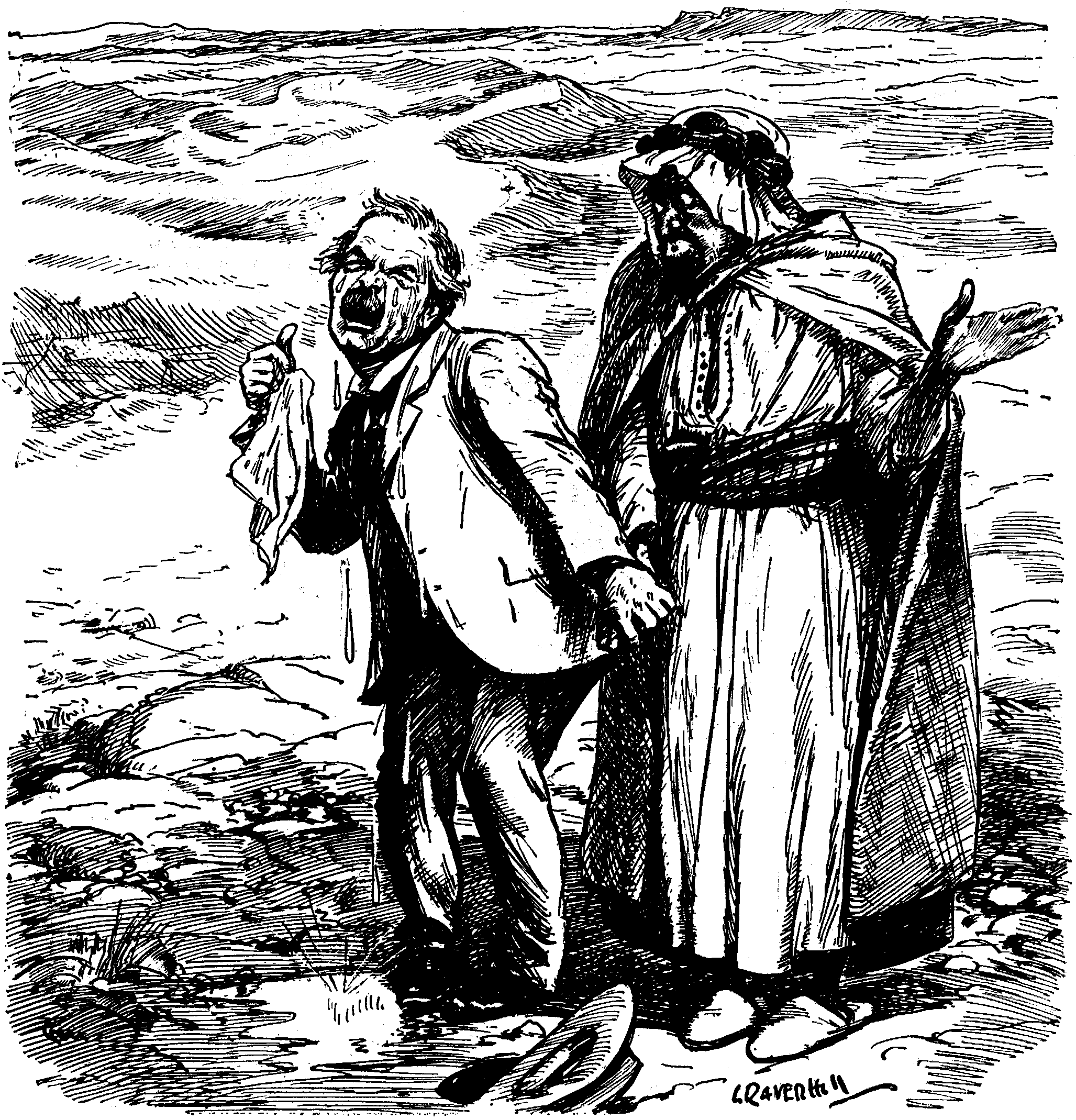
THE SAND CAMPAIGN.
SCENE—
Algeria, on the border of the desert
.
THE ARAB AND THE CHANCELLOR WERE WALKING HAND-IN-HAND; THE LATTER WEPT A LOT TO SEE SUCH QUANTITIES OF SAND; "WHY ARE YOU HOLDING UP," HE SAID, "THIS VERY FERTILE LAND?"
"First?" he asked.
"Oh yes," said I. "I have seen you more than once. Surely you haven't forgotten that time at Watford?"
He felt that I had the advantage of him. "When was that?" he asked.
"Not very long after the first time; and the next occasion I remember seeing you was at a place called—called—something beginning with a B."
He was quite unable to cope with the situation.
"And the next time," I continued, "I happened to be passing through that town where the school is—you know, Rugby. I distinctly recollect noticing then that you hadn't changed in the least since I last saw you."
He couldn't decide whether to be more flattered at my remembering or more annoyed at his own forgetting.
"Come, come," I exclaimed, "you surely cannot have forgotten that little chat we had at Coventry?"
"Coventry?" he asked. "But how long ago was that?"
"Quite recently," I asserted.
"But I haven't set foot in Coventry for years," said he.
"Nor have I, ever," said I.
I could understand his feelings thoroughly. It might be that I was a liar; it might be that I was a lunatic. In either case he did not wish to converse further with me. Happily, I had two newspapers available.
As the speed of our train, in which of old he had taken such a pride, began to slacken: "And I shouldn't be surprised," I said from behind my paper, "if you and I saw each other again quite soon. The world is a small place and these things soon develop into a habit."
He made no answer from behind his paper.
"If you ask me when and where" (as in fact he didn't), "I should say it is just as likely as not to happen at Birmingham at about 8.55 P.M.," I estimated, relying upon his own schedule.
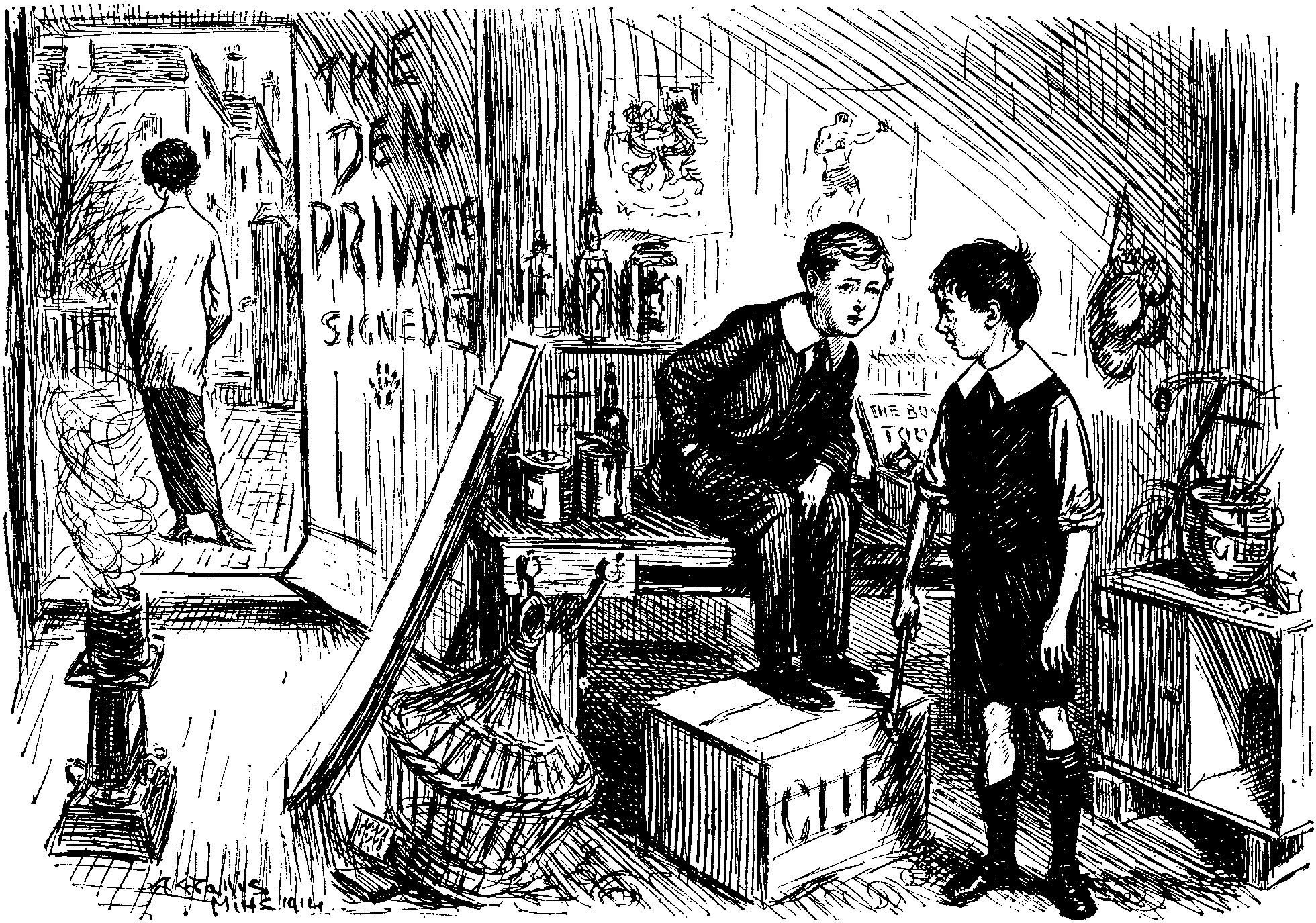
Harold (who has just been kissed by his sister). "I SAY, I WONDER WHAT SHE'S UP TO?"
Friend. "SIGN OF AFFECTION, ISN'T IT?"
Harold. "AFFECTION, YOU GOAT! SHE NEVER DOES THAT TILL THE LAST DAY OF THE HOLS, AND THERE'S A WEEK TO GO YET."
"The play was preceded by 'The £12 Hook,' another Barrie comedy of more recent date."—Sydney Morning Herald.
We should prefer to call it "The £12 Eye."
"LABOUR IN SOUTH AFRICA. BLACK OUTLOOK." Morning Post.
Let us hear both sides. What is the White Outlook?
"The grievance of the men is in regard to the rate of pay. They are paid 5½d. per hair."—Glasgow News.
And then when they are old and bald they have to starve.
"TANGO RAPIDLY DYING. DANCE UPHELD BY MR. MAX PEMBERTON." Daily Chronicle.
This is the sort of thing that the Revue King has to put up with. Truly the lot of royalty is not an enviable one.
From an advertisement of Tango matinées in The Lyceum:—
"RESERVED TAUTENILS (4 first rows) 10/—
TAUTENILS (tea included) 7/6
TAUTENILS (tea not included) 6/—"
Gourmet (planking down his seven-and-six). "Tea and tautenils, please."
Seen on a Liverpool hoarding:—
"Quo Vadis: Whither goest thou in eight reels?"
Answer. "Anywhere in reason, but not home."