THE FRENCH AMNESTY.
Reading edition
Bruxelles, le 31. Janvier.
Monsieur,—I write to you, M. Punch, these some words, which I essay to write in english. I come of to receive—how say you la nouvelle?—the new of the amnesty in France. The government which banished the descendant of the great Napoléon has recalled some exileds. But he has not recalled me, ce gouvernement infâme! He has left to languish the heir of the crown imperial in this droll of little town. Nom d'une pipe, quelle ville! Rien qu'un Palais de Justice et quelques rues désertes! But I go to write in english. I rest here, at five hours of Paris, alldays ready, alldays vigilant. Mais que c'est triste! Tiens, it is not perhaps so sad as that—how write you the name?—that Stove, in your département of the Bukkinhammshir. At least one speak french in this country. It is not the french of Paris, or the french of Touraine, but all of same it values better than english—a language so difficult. Thus I rest here, I walk myself to horse in their Wood of Cambre, I visit of time in time the Palace of Justice and Ste. Gudule, et voilà c'est fini! Then I recommence and I see, encore une fois, the Bois, the Palais, and the Cathédrale. I go not to Waterloo, for people say my Great Ancestor there was conquered by your Duc of Welintong. One has wrong, the historians have wrong, mais enfin, que faire? I may not to write the history of new. A l'avenir nous verrons. En attendant j'attends. And I stand, like my Great Ancestor, the arms folded, and frown towards the frontier of the France, la patrie ingrate. It is a fine attitude, and I study it all the days.
Agréez, &c. N.
Stowe, the 31. January.
Sir,—I tell you my thoughts as calmly as possibly, but my heart burns! Heaven, what injustice! To France—ah, I say not her name without emotion!—to France I offered my sword, my service, my life! She refused them! Ingrateful country! Me who—but I go to be calm! When Casimir-Périer resigns I voyage without to lose an instant to Dover, I wait, I receive each instant some despatch, I regard the coast of France and weep, I am photographed! Me, the descendant of St. Louis, I am photographed! But in vain! I desire even to die for France, but I may not! By blue, what ingratitude! And now she proclaims the amnesty and I am forgotten! Me, the descendant of St. Louis! Me who desire the struggle, the efforts of a life of soldier, of a life of king, me I rest here in simple renter of province! Me who wish to die for France, I am obliged to live in England! To live, just heaven! And in England, which I despise, though she shelters me! Perhaps she is not worse than Belgium, Buckingham or Bruxelles! It is equal to me! Nor the one nor the other is France! Again I weep! Ah, if I could shed tears of blood! I can not! Heaven, that I should not have even that consolation there! And Rochefort returns! He may die for his country, for France! Once more I weep bitterly! But me I may not! I conclude, and my last word shall be a word of order! It shall be, though she spurns me, though she mock herself of me, "Live France!" Again I weep! Receive, &c. P.
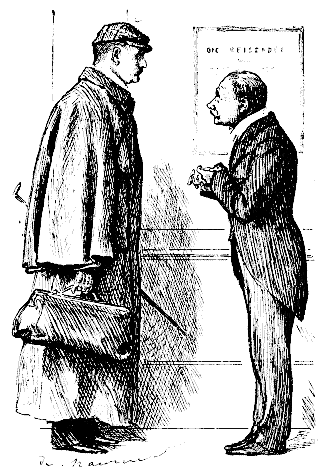
SUCCESSFUL SANITATION.
Anxious Tourist. "Since your Town has been newly drained, I suppose there is less Fever here?"
Hotel-Keeper (reassuringly). "Ach, yes, Sir! Ze Teefoose (Typhus) is now quite ze exception!"
"VOICI LE SABRE DE MON PÈRE!"
["Let all know that, in devoting all my strength to the welfare of the people, I intend to protect the principle of autocracy as firmly and unswervingly as did my late and never-to-be-forgotten father."
The Czar to the assembled Deputies and Delegates in the Winter Palace.]
"It was my father's custom, and so it shall be mine!"— One seems to hear those simple words 'midst all the show and shine Of the great, gay, white-pillared hall. The gold and silver chains Of deputies and delegates from distant steppes and plains Gleam in the winter daylight. The tall white-tunic'd Guards Stand with drawn swords, Autocracy's serene and stalwart wards. All in the Winter Palace; from regions vast and far They come of many a race and creed to welcome their young Czar. The nobles and the Zemstros, too, are represented here. With tribes of the wild Caucasus, the hosts who love—and fear— The monarch of one hundred and twenty million souls. And through thine Hall, St. Nicholas, in full firm accents rolls The Voice of armed Autocracy, unbending and unchanged. Unfaltering the youthful eye that boldly roved and ranged Over that motley muster. He lifts his sire's great sword, This youthful heir to power supreme, by freemen much abhorred, But dear to bowing myriads of Slavdom's loyal hosts; And with that calm cold dignity which despotism boasts Establishes the Ego of Autocracy once more. Voici le sabre de mon sire! What Alexander bore Shall Nicholas not wear and wield? The appanage of our line! "It was my father's custom, and so it shall be mine!" Old rustic song, your refrain long shall echo round our world, Until all burdens from the back of toiling men are hurled. Far, far off day! Now proud and gay Autocracy's strong thralls Muster to-day in fine array in those white-pillared halls. To be—not snubbed, say reassured, that Autocrats, still strong, Still give small heed to serfs who plead, to freedom's siren song, Or to "absurd illusions," which, slipped from mouth to mouth, Must still be silenced in the North, if heeded in the South. Those Zemstros voices must be hushed. Autocracy's sole hand Must wield the sabre of his sire, and sway a silent land; The Bear from the new Bearward gentler treatment well may hope, But hardly loosening of the chain or slackening of the rope. The patient Northern Bruin stands and rubs a dubious ear. Amnesty means not Liberty. Autocracy is clear In "firmly and unswervingly," with strength that doth not tire, Holding the mastery of its race, the Sabre of its Sire!
"Mr. Pepys's Parish Church."—The Rev. Alfred Povah's interesting work gives us the origin of the "Navy pew" in St. Olave's. In such a church how appropriate was the old "three-decker," as this structure, which contained clerk below, parson in the middle, and preacher in the topmost compartment, used to be termed.
A Just Correction.—In Macmillan's for this month there is an interesting article entitled "In the Wake of Captain Cook." An Irish member of the club threw the number down, exclaiming, "The man who wrote that can't write English! 'Tis not 'in the wake' at all. Sure it ought to be 'at the wake.'"
Legal Clockwork.—Towards the end of last week, the key of the difficulty having been found, the Justice-Vaughan-Williams'-winding-up business was wound up, and J. V. W., being wound up, was set going again. There is, however, still some difficulty, and a little oil on the troubled works will be necessary. Mem. to the Lord Chancellor.—"Please not to touch the figures."
Q. What is the best sort of cigar to smoke in a Hansom? A. A Cab-ana.