ESSENCE OF PARLIAMENT.
Reading edition
EXTRACTED FROM THE DIARY OF TOBY, M.P.
Tuesday, February 5.—House filled once more with bustle of new Session. Lobby crowded. Corridors, long silent, burst into bustling life. "Seems to me," says Jemmy Lowther, looking on with his juvenile-veteran air, "that the happiest day in a member's life is the first of a Session, if indeed the cup of his joy isn't fuller on the day of prorogation."
For some the jubilation of the hour is toned down by saddened thought. There is one step that will never more be heard in the lobby, one familiar face seen here no more, one voice, wont to sway the passions of the House, that now is still. Lycidas is dead, not quite ere his prime, but in what, had fate been kinder, should have been the fulness of his rich gifts.
The House knew Grandolph, as he presented himself to its notice from various points of view. First, an unknown new Member, rising from bench immediately behind Ministers, a situation which, deliberately chosen, seemed to observant Whips to indicate pleasurable prospect of docility. Next, whilst his Party was still in office, he popped up from front bench below gangway, and pricked at ponderous hide of Sclater-Booth, pink of respectability, sublimation of county-gentry-Toryism. Then, with sudden brilliancy and sustained force, he rose on the firmament below the gangway in Opposition, tilting almost single-handed at the panoplied host, a majority over a hundred strong, that seemed to make Mr. G.'s second Administration invulnerable. For a moment in a famous night in June he was seen standing jubilant on his seat at the corner of the bench, waving his hat, shouting himself hoarse with cries of victory. From this elevation he sprang lightly on to the Treasury Bench, and astonished Members who, with him, had heard the chimes at midnight and after, by the quiet dignity of his manner, his unerring tact, his unfailing skill of management. Never since the time Prince Hal, boon companion of Falstaff, became King Henry the Fifth, has there been seen such transformation.
Never was such a sudden scholar made; Never came reformation in a flood, With such a heady currance, scouring faults; Nor never Hydra-headed wilfulness So soon did lose his seat, and all at once, As in this king.
The succeeding Session had a fresh surprise. It found our Grandolph, self-reduced to the ranks, caressing his moustache on the corner seat behind the Treasury Bench. After a while he wearied of the invidious position, and went off to the races, to Norway a-fishing, to South Africa to observe the ways of lions from precarious proximity. But his heart was, after all, at Westminster. He came back broken in health, undaunted in spirit. Nothing pluckier, nothing more pathetic seen in the House than his long stubborn fight against the paralysis that crept over him even as he stood at the table and tried to weave again the magic spell by which he once held the House.
He died as he lived, fighting, keeping Death at arm's length for a full month after the highest authorities had said it was a mistake to be such an unconscionably long time in dying.
The House of Commons will know Grandolph no more. But it will never forget one who will through all time rank among the most brilliant of its sons.
Something decidedly hysterical about jubilation of the hour. Prevalent hilarity suggests case of crowded passenger ship, having been in imminent danger of shipwreck, suddenly steams into comparatively placid seas.
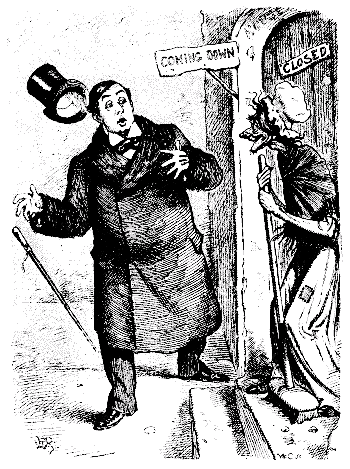
"MR. R-S-B-RY'S" DREAM.
Mr. R-s-b-ry. "Hullo! Where's the House of Lords?"
Spectral Caretaker. "''Ouse o' Lords,' Sir? Why, it's GONE!!"
"If," says Wilfrid Lawson, an authority on Church matters, "it were customary to commence the Session by singing a hymn I know what Squire of Malwood would give out. It's the one beginning
And are we still alive And see each other's face?
Thought it was to be all over before Christmas; Cabinet broken up; everybody retiring; Parliament dissolved; demoralised Party finally smashed up at polls; the other side left to settle who was to be who in best of all Governments. 'Instead of which,' as the Judge said, here we are in for a long Session, with, as usual, more work on hand than could be done in two."
"So you haven't resigned after all?" I remarked, getting up on a chair to have a chat with the Squire of Malwood.
"Et tu, Toby!" he cried. "I thought better of your intelligence. I welcome re-opening of Session for one thing. Obliged to be in my place every night. Whilst House is sitting people will see I haven't resigned. That should—don't know that it will—check to certain extent what at Derby I ventured distantly to allude to as mendacious inventions. I have, as you know, had a somewhat troublesome time during recess. Rarely got up in morning but found by newspapers I had resigned overnight. Seldom went to bed without conviction derived from glancing over evening papers that I had upset the Ministerial coach—I, the mildest mannered man that ever sat in Cabinet Council. Daresay you remember incident in almost equally troubled career of Louis the Sixteenth. When he was brought back to Paris and lodged in Tuileries after his flight to Varennes, the sans-culottes, Messieurs et Madames, could not sleep in their beds at night from apprehension that king had again escaped. They used to make up little family parties, stroll down to Tuileries, mass themselves before the King's bedroom window, and call upon Louis Capet to show himself. The King thereupon got out of bed, put on red Cap of Liberty and showed himself at the window. 'Mes enfants,' he said, 'you see I am here.' 'Tres bien,' said Monsieur, Madame, et le Bébé, and trudged back content to the Faubourg St. Antoine. Now that was all very well for a King. But you know, Toby, it can't be expected of me in so-called holiday times to be constantly attending knocks at the front door, or even getting up in the dead of night, showing myself at the window, and saying, 'My good newspaper friends, I have not resigned.'"
Business done.—Just commenced.
"The Portrait of Nobody."—When the signature "Oυτις" first appeared to a pamphlet or an article, people wondered "who 'tis?" and "'ow 'tis he knows all about it?" The signature appearing again to an article in The New Review, No. 69, suggests that though the author has an anti-scriptural objection to a single-eyed individual, perhaps 'Oυτις' simply indicates a person who, with the majority of us, detests an egotist. Only one would hardly gather this explanation of the assumption of this classic and poetic signature from the style of the article.
Not a Gilt-edged Security.—The investment of Wei-hai-wei.