"MEAT! MEAT!"
Reading edition
["We do not profess to assault every fortress and monopoly at the same moment. If we did we should get well thrashed for our pains. We take them one by one.... It must be left to those who have the responsibility of determining what is to be done, when it is to be done, and how it is to be done."—Sir William Harcourt at Derby.]
Much-worried Cat's-meat Merchant loquitur:—
Confound the cats and drat the dogs! Sc-a-a-t, Mungo! Down, Grimalkin! Ye jest carn't be all sarved at onst, an' so 'taint no use talkin'. I've lots o' stuff, ah! quite enough to give ye all yer dinners, If ye'll but kindly bide yer time, ye scurry-funging sinners! But not a mite! It's bark, yelp, bite; it's flurry, scurry, worry. Carn't use my knife upon my life! Where's yer infarnal 'urry? At the big lump ye'd like to jump, each one o' ye, full gobble. If ye don't stop I'll shut up shop, and leave ye in a 'obble! No time, I'm sure to slice and skewer. Ye're greedy, fierce, and narrer. Each wants fust glut, and the best cut. Who'd keep a cat's-meat barrer? Bah! cat or dog, they're all agog, a-squabble and a-quiver For the best paunch, fust cut of haunch, or slice of shin or liver. Ye greedy brutes, beware my boots! Your yelping and your yow-ing, You scrub-haired pup, won't hurry me up; nor yet your shrill mol-rowing, You wild Welsh cat. What are you at, you lurcher? Think you Labour Will benefit when you have bit or worried every neighbour? Bless my old bones! your snarling tones, my angry Irish tarrier, Between you and the grub you'd grab will only raise a barrier. Your quarrelsome temper is your cuss, if you could only know it. You snap all round like some mad 'ound. Bite your own tail—ah! go it! All cat-and-dog arter the prog, all savage, snappy, yappy, Upset the lot, and then I 'ope you'll all be bloomin' 'appy! Yah! bust the pack o' ye, I says. Your shindy gives me dizziness. I'm arf inclined to chuck my "round," or else retire from bizziness. It's aggrawacious, that it is, arter such long years sarving ye, Picking ye out the chicest lumps, the primest slices carving ye, To be a-chivvied like this here! Here's lot o' fust-rate wittles, And with your chance of a blow-out you're jest a-playing skittles. Won't even give me time to carve, much less a chance to skewer. More 'aste less speed! You will not find a maxim wot's much truer, For dog, or cat. Jack, Sandy, Pat, or Taffy—whose first turn it is To-day by rights—your spitfire fights may go on for eternities, And bring no good, nor yet no food. Wait, and ye'll all 'ave suthink, But if you will not take your turns, you'll none o' you get nothink!
"Abbey Thought!"—"The Quest of the Holy Grail.". These pictures are being exhibited just at the right time, when the Arthurian legend is attracting at the Lyceum. Mr. Edwin A. Abbey has been five years at work upon this most striking series. Their beauties are many: their faults very few, and when these are pointed out to the Anglo-American artist, he gaily replies, "What's the odds as long as I'm Abbey!" Which is true; as none but himself can be his parallel.
A WILDE "IDEAL HUSBAND."
Mr. Oscar Wilde's Ideal Husband, at the Haymarket, is an interesting play up to the end of the Third Act; and if this climax had been contrived more artistically, and less conventionally, the situation at the fall of thecurtain in this act would have been a very powerful one. As it is it is frittered away in conventional dialogue, and the Fourth Act is decidedly weak. It is throughout excellently played by Miss Julia Neilson and Mr. Waller in the two principal characters. Mr. Hawtrey's performance, in spite of his curious habit of raising his voice to such a pitch as to suggest his playing to the cab-rank outside, is admirable. There are here and there sharp bits of dialogue in it, though scarcely a line in the lighter vein that rises above farcical comedy.
Mr. Bishop's Earl of Caversham is a thoroughly natural piece of acting, and Mr. Brookfield's Phipps, the Butler, a bit of character so perfectly rendered that, like Sam Weller's Valentine, it makes you "wish as there was more in it." Miss Fanny Brough, having plenty to say, but not much worth listening to, does her best with a poor part. Miss Maude Millett is nice, and Miss Florence West as unsympathetic as her part was intended to be. That when Sir Robert Chiltern proposed to retire from Parliamentary life no one suggested to him that he should take "the Chiltern Hundreds" is evidently an oversight of the author's, which no doubt he now deeply regrets. The play, though in sharp dialogue not up to Mr. Wilde's high spirits-and-water mark, is an unmistakable success.
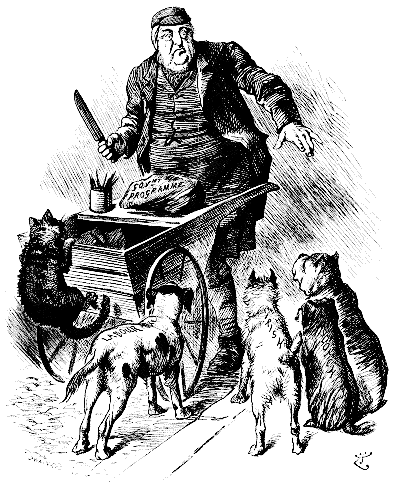
"MEAT! MEAT!"
H-rc-urt. "NOW LOOK 'ERE—YOU JUST WAIT YOUR TURNS—OR YOU'LL NONE OF YOU GET NOTHINK!"