A STUDY IN PRESS-LAND.
Reading edition
(An Actuality, in one short Scene, at the service of the Institute of Journalists.)
Scene—An Editor's Room. Editor discovered in conversation with Would-be Reporter.
Editor (preparing to resume his work). Well, from all you tell me, I imagine you must be a most accomplished person.
Would-be Reporter (smiling). Well, I believe I am up to the standard required by the Institute of Journalists. My classics are fairly good, but I do not know as much as I should of mixed mathematics. However, I took a double first at Oxford; but then I had a particularly easy year. All the men against me were practically duffers.
Ed. (slightly interested). Do you know anything of modern languages?
W.-be Rep. Well, yes. I can speak and write European in all its branches, including Swedish and Norwegian patois, and the argot used on the borders of Turkey and Greece. I am fairly well up in Chinese, but have only a general idea of the grammar of Afghanistan. But I may add that I am spending four hours a day in completing this part of my training.
Ed. I think you said that you have passed in engineering, orchestra-playing, astronomy, naval and military tactics, and the history of the world, and the other components of the planetary system?
W.-be Rep. Certainly; I have in every way (save that I have still to pass in Roman Law) satisfied the requirements of the Institute of Journalists. I am all but qualified for the reception of an Associate's degree.
Ed. (with a view to closing the interview). Very well, then; we shall be glad to use anything you may be good enough to send us—of course, at the customary rate.
W.-be Rep. (gratefully). A thousand thanks. I know; three-half-pence a line, with a minimum of three shillings.
Ed. Precisely. (Taking up his pen.) And now, as my Sub-editor told me that there was a fire somewhere in the neighbourhood, you had better look after it.
W.-be Rep. Thank you so much. But as I have forgotten to bring my reporter's-book, perhaps you will kindly lend me some copy-paper?
Ed. Certainly; you will find some in that corner. (He approaches speaking-tube, to which he has been summoned by a whistle.) Ah! You need not trouble after the fire, for I find we have already received a report from someone on the spot.
W.-be Rep. (in a tone of disappointment). What a bore! just as I was going to report it myself! However, better luck next time.
Ed. (courteously). I hope so; good morning. (Exit Would-be Reporter.) What a nuisance these fellows are! Highly educated, of course, and all that sort of thing; but I am not sure that the rough-and-ready school was not the better.
W.-be Rep. (re-entering hurriedly). My good Sir! Fancy! the man who has sent you the report of the local fire was educated at a small grammar-school, and never even entered a university!
Ed. Well, what of that?
W.-be Rep. (surprised). You surely won't use his copy?
Ed. (decisively). I surely shall. First come, first served. And now you must allow me. (Returns to his work, to the surprise and disgust of Would-be Reporter. Curtain.)
"PIECE AND WAR!" AT DRURY LANE.
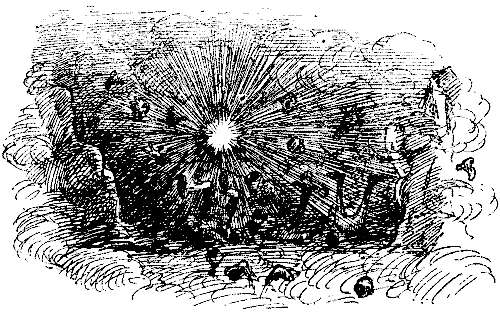
"Victory sits on our helms!" cries Sir Druriolanus Auctor to Henricus Parvus etiam Auctor, as they drive back to "The Helms, Regent's Park," after the curtain has descended on the last scene of the last act of A Life of Pleasure at Drury Lane. Twice has Sir Druriolanus appeared before the footlights at the end of the Fourth Act, when some battle in Burmah is gallantly won by the united dramatic forces under the heroic but comic Captain Harry Nicholls, Colonel Lord Frank Fenton Avondale, Sergeant Clarence Holt, and a handful of the bravest soldiers that ever marched to glory over the boards of old Drury Lane. What the story is, and how these heroes got into the jungle and out again, and how the right man married the right woman, and how the wronged woman would have saved the villain from the vengeance of Henry Desmond O'Neville,—who, alas, had to stay in the green-room while the others were distinguishing themselves in Burmah,—is known to the clever collaborators and a few of their trusted confidants. Of that strange history I, a mere civilian, had every detail blown clean out of my head by the din of the great battle. In fact, never have I heard of any "theatrical engagement" equal to this.
"The Action of the Piece."
That Miss Lily Hanbury looked lovely, and touched my heart; that Mrs. Bernard-Beere suddenly developed a brogue that, on occasion, betrayed her nationality; that Miss Le Thière was a villainous matron; that Miss Laura Linden was sprightly and pretty; that Mr. Arthur Dacre was the best representative of lop-sided villainy ever seen on the stage; and that Mr. Robert Soutar reappeared as an elderly masher about town; all this, I am ready to admit, would have been good enough for me, without any attempt on my part at stringing them together in a consecutive story. Didn't I know from the very moment she appeared in deep black, and with a very pale face, that Miss Le Thière was a villain of the deepest dye in petticoats? Could I have trusted Mr. Arthur Dacre, in his neat grey suit, with a sixpence, much less with my life? As for Mr. Elton, representing the Hebraic money-lender—indispensable of late years to all Drury Lane dramas—wasn't I well aware that he was to be the comic villain, only set up to be knocked down again, and to be finally bowled out by the apparently simple Harry Nicholls? Then there is the scene at the Empire, admirably stage-managed, but the ladies should try to take just a trifle more interest in the strange proceedings of that eventful night, as they should also do when re-appearing as wedding guests in the last act. But these fair ladies are heartless; all's one to them, happen what may. Then there was the House-boat, equally well-arranged; but everything is entirely eclipsed by the Military Act, in three scenes, which contains "the action of the piece," and leaves the audience half-deafened by mitrailleuses, and half-choked by the gunpowder. But as the smoke gradually cleared away, the stalwart figure of the Commander-in-Chief, yclept Druriolanus himself, was seen bowing his acknowledgments.
But what was it all about? "'Why, that I cannot tell,' quoth Old Caspar, 'but 'twas a famous victory!'" And if you, my non-combatant readers, wish to know how the Burmese War was undertaken for the special benefit of Harry Nicholls, you just go and see for yourself the new drama, mysteriously entitled A Life of Pleasure, at T. R. Drury Lane, and for this advice you will thank
"Old Caspar."
A Moot Point.—The G. O. M. is reported to have been engaged in translating Horace. Is this a picturesque way of referring to the recent elevation of Sir Horace Davey?
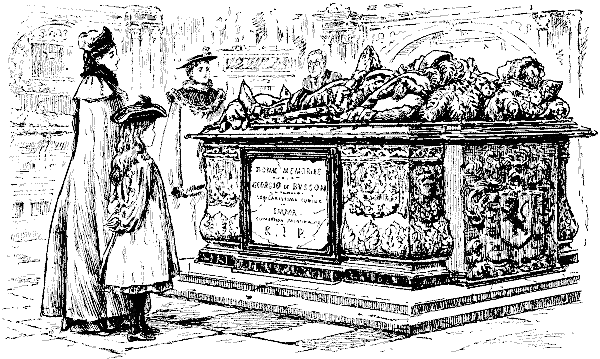
UNHAPPY INFLUENCE OF MODERN MUSIC-HALL MELODIES.
"There lies the brave Knight, Darling, with his faithful Dog at his feet, and his Wife by his side!"
"And has she got a Dog, too, Mummy?"
"No, Darling, only a Cushion!"
"Ah, I suppose her Daddy wouldn't buy her a Bow-wow-wow!"
THE "FORLORN HOPE."
["It is understood (says the Daily News) that Mr. Gladstone will speak in Edinburgh on Wednesday, September 27, on the action of the House of Lords in rejecting the Home-Rule Bill. His followers are expecting him to give the word of command for an attack on the Upper House."]
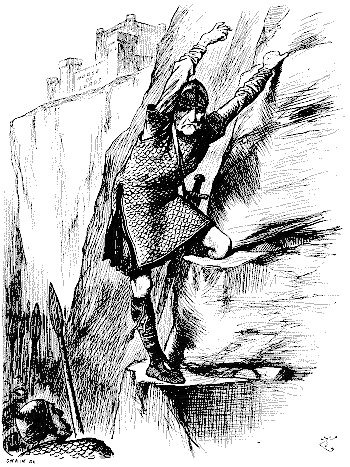
"Childe Roland to the Dark Tower came!" So runs The boding refrain Browning visioned out. Childe Roland valiant was, and wondrous stout; But that Dark Tower, which never noonday suns, Full-garrisoned by feudal myrmidons, Might strike to Roland's heart the chill of doubt. Four-square to the four winds the fortress stands, Pinnacled high upon a frowning rock. It hath survived the many-centuried shock Of elements, the assault of myriad hands, And to the attack will you now lead your bands, Whose rage crag-crowning battlements seem to mock? True from those battlements they've hung, in scorn, Your herald, whose torn trappings wildly wave In the rough wind. Though 'tis too late to save You'd fain avenge. Such flouts are hardly borne By Leaders whilst old lips can sound a horn And hands, though ancient, yet can lift a glaive. Sound an alarm! Let the fierce war-cry sound! Your followers listen for it. They will cheer When its defiant shrill salutes their ear. Down with the Fortress! Raze it to the ground! End it, not mend it! So they rattle round, The shoutings and the floutings far and near. And you, the new Childe Roland, what think you, At heart, behind that bold and fluent tongue? Lead a Forlorn Hope? Yes, though Death's self flung Its form of bony shape and grisly hue Athwart your path! But—is here aught to do That's worth the venture, when all's said and sung? "If, at their counsel, I should turn aside Into that ominous tract which all agree Hides the Dark Tower? If acquiescingly I do turn as they've pointed! Neither pride Nor hope rekindling at the end descried So much in gladness that some end should be. "Thus, I have so long suffered in this quest Heard failure prophesied so oft, been writ So many times among 'The Band'—to wit The knights who to the Dark Tower's search addressed Their steps—that just to fail as they, seemed best And all the doubt is now—shall I be fit? "What in the mist lies but the Tower itself? The square squat turrets, blind as the fool's heart, Built of grey stone, without a counterpart In the whole world. The tempest's mocking elf Points to the shipman thus the unseen shelf He strikes on, only when the timbers start." So mused Childe Roland! Chief of the white crest, With thine adventure doth the strain not fit Most strangely? Looms the Dark Tower turret-lit By autumn rays low, chilly, from the west, So waterishly wan. Oh! crowning test Of mortal valour and of human wit! Lead the Forlorn Hope on! E'en Hopes Forlorn Do not fail always. Scale the craggy height! Cheer on your clamorous followers to the fight. Citadels deemed impregnable, in scorn Have mocked their rash beleaguerers at morn To see them swarm their battlements ere night. And you, your courage seems to master Fate And mock at Time. Yet Time and Fate, at last, In the greatest life-game have the latest cast. Heroic 'tis to see you, strong, elate, Heading the onset, and in Punch's pate Rings the old rhyme of the romantic past. "There they stood, ranged along the hillsides—met To view the last of me, a living frame For one more picture! in a sheet of flame I saw them and I knew them all. And yet Dauntless the slug-horn to my lips I set And blew. 'Childe Roland to the Dark Tower came.'"
Contributed by One "in Statu Pupillari."—Great changes are expected in Egypt. It is said that a certain well-known oculist, no, we beg his pardon, we should have described him as "Ophthalmic Surgeon," whose name is something between "Crotchet" and "Cricket," and whose recent evidence in a police-court was quite "an eye-opener" to the worthy magistrate and the prisoners, is going out to remove the First Cataract. We wish him every possible success. He will be returned for the next Parliament as the Member for Eye.