Volume 103 — CONVERSATIONAL HINTS FOR YOUNG SHOOTERS.
Reading edition
(By Mr. Punch's own Grouse in the Gun-room.)
Many manuals have been published for the edification of beginners in the art of shooting. If that art can indeed be acquired by reading, there is no reason why any youth, whose education has been properly attended to, should not be perfectly proficient in it without having fired a single shot. But, Mr. Punch has noticed in all these volumes a grave defect. In none of them is any instruction given which shall enable a man to obtain a conversational as well as a merely shooting success. Every pursuit has its proper conversational complement. The Farmer must know how to speak of crops and the weather in picturesque and inflammatory language; the Barrister must note, for use at the dinner-table, the subtle jests of his colleagues, the perplexity of stumbling witnesses, and the soul-stirring jokes of Judges; the Clergyman must babble of Sunday-schools and Choir-practices. Similarly, a Shooter must be able to speak of his sport and its varied incidents. To be merely a good shot is nothing. Many dull men can be that. The great thing, surely, is to be both a good shot and a cheerful light-hearted companion, with a fund of anecdotes and a rich store of allusions appropriate to every phase of shooting. Mr. Punch ventures to hope that the hints he has here put together, may be of value to all who propose to go out and "kill something" with a gun.
The Gun.
No subject offers a greater variety of conversation than this. But, of course, the occasion counts for a good deal. It would be foolish to discharge it (metaphorically speaking) at the head of the first comer. You must watch for your opportunity. For instance, guns ought not to be talked about directly after breakfast, before a shot has been fired. Better wait till after the shooting-lunch, when a fresh start is being made, say for the High Covert half a mile away. You can then begin after this fashion to your host:—"That's a nice gun of yours, CHALMERS. I saw you doing rare work with it at the corner of the new plantation this morning." CHALMERS is sure to be pleased. You not only call attention to his skill, but you praise his gun, and a man's gun is, as a rule, as sacred to him as his pipe, his political prejudices, his taste in wine, or his wife's jewels. Therefore, CHALMERS is pleased. He smiles in a deprecating way, and says, "Yes, it's not a bad gun, one of a pair I bought last year."
"Would you mind letting me feel it?"
"Certainly not, my dear fellow here you are."
You then interchange guns, having, of course, assured one another that they are not loaded. Having received CHALMERS's gun, you first appear to weigh it critically. Then, with an air of great resolution, you bring it to your shoulder two or three times in rapid succession, and fire imaginary shots at a cloud, or a tuft of grass. You now hand it back to CHALMERS, observing, "By Jove, old chap, it's beautifully balanced! It comes up splendidly. Suits me better than my own." CHALMERS, who will have been going through a similar pantomime with your gun, will make some decently complimentary remark about it, and each of you will think the other a devilish knowing and agreeable fellow.
From this point you can diverge into a discussion of the latest improvements, as, e.g., "Are ejectors really valuable?" This is sure to bring out the man who has tried ejectors, and has given them up, because last year, at one of the hottest corners he ever knew, when the sky was simply black with pheasants, the ejectors of both his guns got stuck. He will talk of this incident as another man might talk of the loss of a friend or a fortune. Here you may say,—"By gad, what frightful luck! What did you do?" He will then narrate his comminatory interview with his gun-maker; others will burst in, and defend ejectors, or praise their own gun-makers, and the ball, once set rolling, will not be stopped until you take your places for the first beat of the afternoon, just as MARKHAM is telling you that his old Governor never shoots with anything but an old muzzle-loader by MANTON, and makes deuced good practice with it too.
"Choke" is not a very good topic; it doesn't last long. After you have asked your neighbour if his gun is choked, and told him that your left barrel has a modified choke, the subject is pretty well exhausted.
"Cast-off." Not to be recommended. There is very little to be made of it.
Something may be done with the price of guns. There's sure to be someone who has done all his best and straightest shooting with a gun that cost him only £15. Everybody else will say, "It's perfect rot giving such high prices for guns. You only pay for the name. Mere robbery." But there isn't one of them who would consent not to be robbed.
It sometimes creates a pretty effect to call your gun "My old fire-iron," or "my bundook," or "this old gas-pipe of mine."
"Bore." Never pun on this word. It is never done in really good sporting society. But you can make a few remarks, here and there, about the comparative merits of twelve-bore and sixteen-bore. Choose a good opening for telling your story of the man who shot with a fourteen-bore gun, ran short of cartridges on a big day, and was, of course, unable to borrow from anyone else. Hence you can deduce the superiority of twelve-bores, as being the more common size.
All these subjects, like all others connected with shooting, can be resumed and continued after dinner, and in the smoking-room. Talk of the staleness of smoke! It's nothing to the staleness of the stories to which four self-respecting smoking-room walls have to listen in the course of an evening.
(To be continued.)
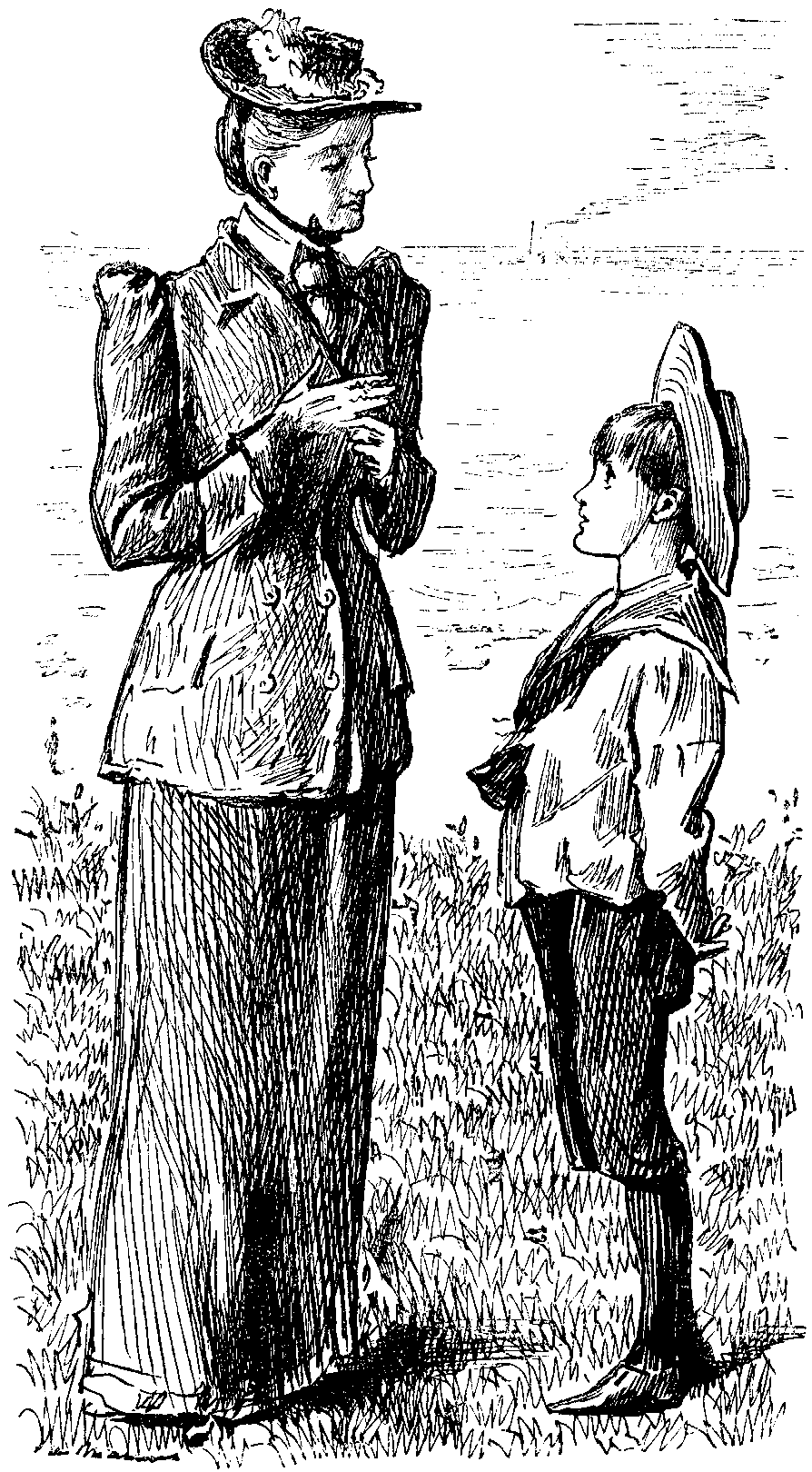
A PIS-ALLER.
"ARE THERE ANY NIGGERS ON THE BEACH THIS MORNING, MAMMIE?"
"NO, DEAR; IT'S SUNDAY MORNING."
"OH, THEN I MAY AS WELL GO TO CHURCH WITH YOU!"
BY-AND-BY LAWS FOR TRAFALGAR SQUARE.
(When Meetings are held in "Times of Political or Social Crises.")
1. Cabs, omnibuses, carriages, and pedestrians will be expected to keep clear of the space occupied by the Demonstrators.
2. To prevent destruction of glass and removal of property from shop windows, tradesmen will be expected to put up their shutters several hours before the holding of the meeting.
3. No particular notice will be paid to the transference of property from one leader of labour to another. If done by stealth, it will be accepted as a proof of secret Socialism.
4. No objection will be raised to combats amongst the Demonstrators, with the restriction that no Government property is injured.
5. As the maintaining of the road is a matter of contract, Demonstrators wishing to emphasise their opinions, must bring their own stones.
6. As a good deal of property is expected to change hands during the various proceedings, an application with a description of lost goods, and photograph of supposed thief, can be addressed to the Chief Inspector of Police, Scotland Yard.
7. These regulations (which are tentative) will be in force until after the next General Election, when a fresh series will be published, to be followed by others as occasion may require.