Volume 102 — RICH V. POOR.
Reading edition
(A Note kindly contributed by Our Own Graphic Reporter.)
Nothing could have been more impressive than the closing scene of a trial that was one of the features of the present Sessions. The Counsel for the Prisoner made no pretence of hiding his emotion, and freely used his pocket-handkerchief. Many ladies who had until now been occupied in using opera-glasses, at this point relinquished those assistants to the eyesight, to fall back upon the restorative properties of bottles filled with smelling-salts. Even his Lordship on the Bench was seemingly touched to the very quick by the Prisoner's dignified appeal for mercy. Before passing sentence, the Judge glanced for a moment at the number of titled and other highly respectable witnesses who had testified to the integrity of the accused. Then he addressed the Prisoner:—
"You have pleaded guilty to an indictment which charges you with having misappropriated trust moneys. You have reduced a fortune of £28,000 to £7,000. This means a wretched pittance to beneficiaries who, before your fraud, were enjoying a fairly decent income. I am aware that you are a distinguished Magistrate,—that you have belonged to many Clubs,—that there is not a slur upon the cooking that used to distinguish your dinner-parties. I know the severity of the sentence I am about to pass, and I wish my conscience would permit me to give you a lighter punishment. But I cannot."
The accused was then sentenced to five years' penal servitude.
A little later another prisoner was put in the dock for stealing twenty shillings. The prisoner (who was a sailor) was sentenced to ten years' penal servitude, and seven years' police supervision. The case was of no public interest.
The Modesty of Genius.
When TRAILL his list of Minor Poets drew, SPRUGGE's friends exclaimed, "Why, SPRUGGE, he's left out you!" To which SPRUGGE calmly answered, "Yes, I know it; And he is right. I'm not a Minor Poet."

FROM AN IRISH REPORTER IN A TROUBLED DISTRICT.—"The Police patrolled the street all night, but for all that there was no disturbance."
NEW SONG OF TRIUMPH FOR SALVATIONISTS AT EASTBOURNE, ACCOMPANIED BY DRUM AND IRRELIGIOUS CYMBALS.—"Tra-la-la-Booth-te-ray!"
DEMEANING THEMSELVES so!—Mrs. R. cannot understand our aristocracy being constantly Chairmen at public dinners. She wouldn't be a Chairwoman for anything.
WHERE "GHOSTS" OUGHT TO EXIST.—"Haunt 'un Street, W." It's an artistic quarter. [Is this Hornton Street? Possibly.—ED.]
PEOPLE WHO WOULD BE ALL THE BETTER FOR BECOMING TEMPERANCE MEN.—"The Lushais."
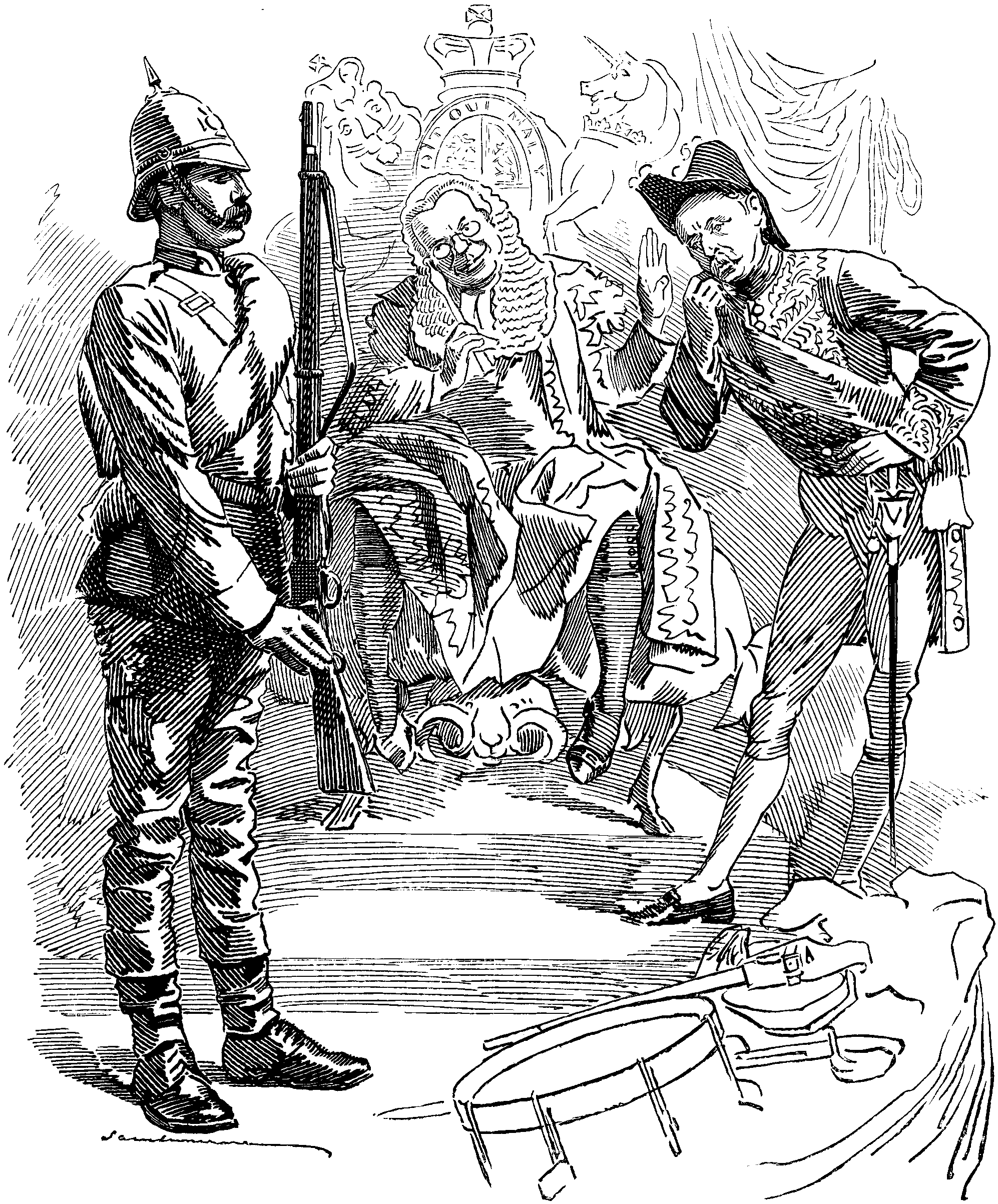
"DIVIDED DUTY."
Right Hon. the Minister for War. "SURELY, MY LORD CHANCELLOR, YOU CAN EXEMPT HIM FROM JURIES. THE 'REGULARS'—"
Lord Chancellor. "WELL, NO, MR. STANHOPE, I THINK NOT." (Aside.) "WE MUST MAKE SOME USE OF HIM!"
LIVING AND LEARNING.
MISS SYMPEL, who has never been out of London, saw an advertisement headed "Salmon Flies" in a shop window. "Well!" she exclaimed, "I never knew till now that Salmon was a flying fish!"
"A cabinet Minister in the Casual Ward," was the heading of an article in the D.T. last Friday, and it turned out to be all about the Richie and the Poorie.
THE BEHRING SEA QUESTION.—Some delay at present, but immediately after signing we shall commence "sealing."