Volume 102 — AFTER DINNER—AT THE CLOSE OF THE YEAR.
Reading edition
SCENE—A Private Room in a well-known Dining Hotel. Eminent Politicians discussing "shop" over their walnuts before dispersing for the Christmas holidays.
First Eminent Politician. I say that recent speech of yours at Skegness was a little strong. Preferring the Navy to the Army! Although the Army is of course the "Best possible Army," and all that! Eh? I say it was a little too thick!
Second Em. Pol. (quickly). Not a bit of it! You don't know how well we are getting on at Pall Mall. I give you my word everything's first-rate. Department working splendidly. You can't say that at Whitehall and Somerset House?
First Em. Pol. (warmly). Not say it! We do! Everything's most satisfactory. Discipline splendid. Never had such a fine Fleet. And the fireworks we had at the Royal Naval Exhibition all through the Summer! Well you ought to have seen them!
Second Em. Pol. (carelessly). Yes, I daresay. But what have fireworks got to do with the Navy?
First Em. Pol. Why they increased our recruiting awfully. Fellows went to the Royal Naval Exhibition and saw all sorts of good things, automatic weighing machine, a fishing-smack, and Nelson wax-works—and—and that kind of thing you know, and joined the Navy! Precious good thing for the Service, I can tell you.
Second Em. Pol. Well, to go back to an old story—you can't defend the bullying on board The Britannia.
First Em. Pol. Oh, that's all bosh. Those newspaper fellows got hold of it for the Silly Season and ran it to death, but it's the best possible place in the world. No end of good training for a fellow to command other fellows.
Second Em. Pol. Well, they were down upon you pretty smartly.
First Em. Pol. (airily). May be. But it's because they didn't know what they were writing about. How can a fellow become a good naval officer unless he has been robbed of his pocket-money, and taught how to lie for his seniors. Thing's too ridiculous! Hallo, JIMMY, they tell me things are in a dreadful mess at St. Martin's-le-Grand!
Third Em. Pol. (promptly). Then they tell you wrong. Never saw anything like it—most perfect organisation in the world! Absolutely marvellous, Sir—absolutely marvellous! And the clerks so civil and obliging. Everybody pleased with them.
Second Em. Pol. Come, that won't do. Your statement is as hard to digest as too-previous turkey and premature plum-pudding. The papers are full of complaints all through the Autumn, and have only stopped recently to make room for those descriptive and special law reports. You will have them again, now Term is over.
Third Em. Pol. Who cares for the papers? I tell you we are absolutely inundated with letters of thanks from Dukes and Duchesses upwards. No; if you had said that the Colonies were in a mess, why then—
Fourth Em. Pol. (angrily). What are you talking about? Why, we are absolutely romping in! Never knew the Colonies so prosperous as they are now! And we have had to put on half-a-dozen extra clerks to open and answer the letters of congratulation we receive hour by hour from every part of the Empire. Why, everything's splendid—absolutely splendid!
Second Em. Pol. Well, matters have decidedly mended since transportation was prohibited. But to return to our muttons. Waterloo was won—
Fourth Em. Pol. (interrupting). Yes, I know, by the Militia and the dregs of the population! By the way, though, the gaols have had better company than now.
Fifth Em. Pol. Hold hard! Don't you abuse my Prisons. As a matter of fact, the present convicts are the finest, cleverest, most trustworthy fellows that ever existed. It is quite an honour to get into a prison nowadays. (With a sudden burst of anger.) And if any of you doubt my word, hang me, I will have satisfaction! (Looking round for opponents.) Come now, who will tread on the tail of my coat!
Chief and Most Eminent Politician. Gentlemen! Gentlemen! Come it's getting late, and if we are to see the dress-rehearsal of the Pantomime, we must be off at once!
[The Party breaks up to meet later on in the neighbourhood of Drury Lane.
FROM OUR SPORTING CITY MAN.—"Pounded before the Start."—Mr. GOSCHEN's One-pound Note scheme.
THE CHIMES.
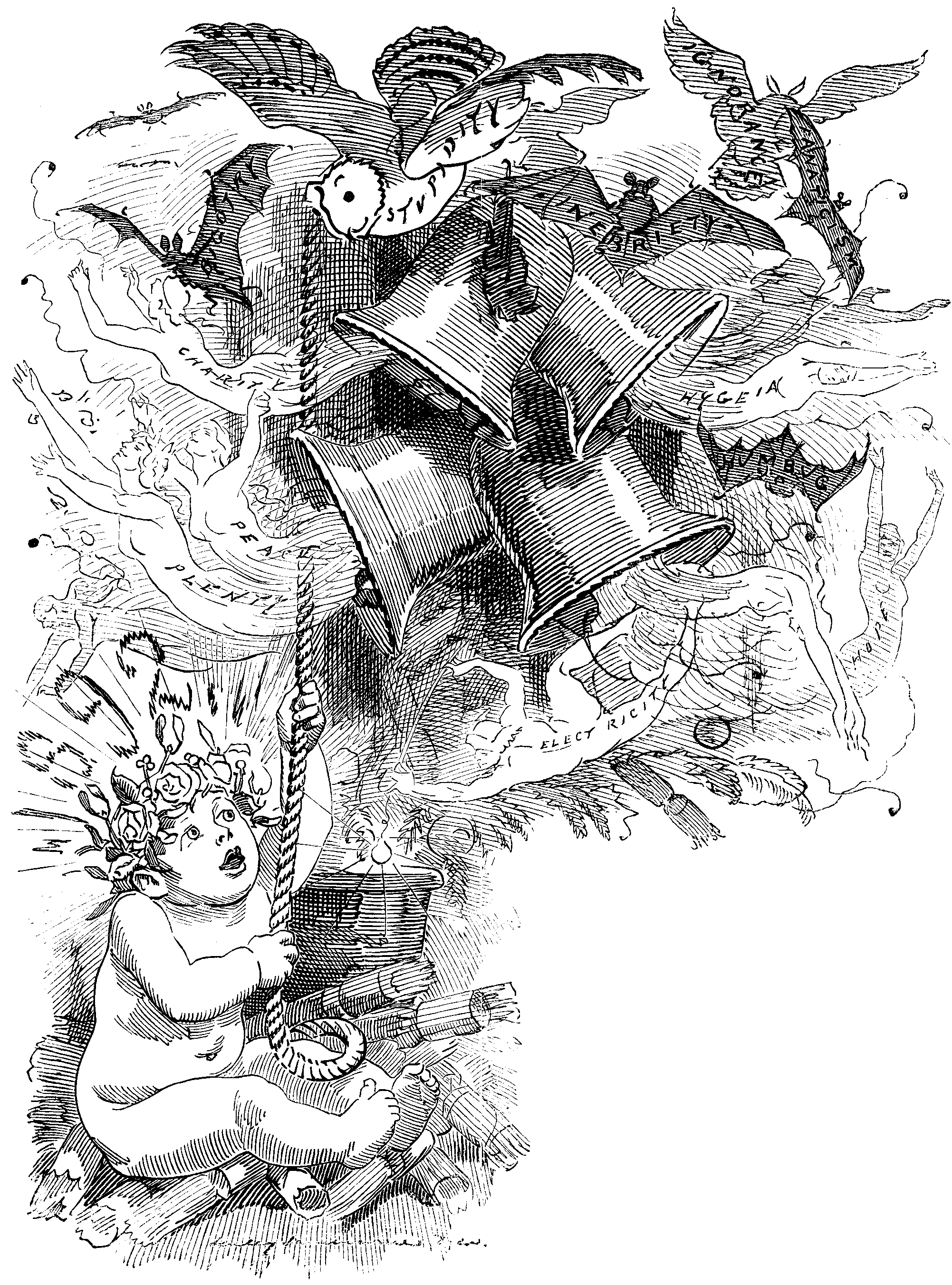
(FRAGMENTS OF A DICKENSIAN DREAM UP TO DATE.)
It was some time before the great-little old fellow could compose himself to mend the fire, and draw his chair to the warm hearth. But, when he had done so, and had trimmed his lamp, he took his "Extra Special" from his pocket, and began to read—carelessly at first, and skimming up and down the columns, but with an earnest and sad attention very soon.
For this same dreadful paper re-directed Punch's thoughts into the channel they had taken all that day; thoughts of the sufferings of the poor, the follies of the rich, the sins of the wicked, the miseries of the outcast. Seasonable thoughts, if not exactly festive. For all is not festive, even at the Festive Season.
Scandals in high life, starvation in low life; foul floods of nastiness in Law Courts; muddy tricklings of misery in lawless alleys; crimes so terrible and revolting; pains so pitiless and cureless; follies so selfish and wanton, that he let the journal drop, and fell back in his chair, appalled.
"Unnatural and cruel, Toby!" he cried. "Unnatural and cruel! None but people who were born bad at heart—born bad—who had no business on the earth, could do such deeds. We're Bad!"
The Chimes took up the words so suddenly—burst out so loud, clear, and sonorous—that the Bells seemed to strike him in his chair.
And what was it that they said?
"Punch and Toby! Toby and Punch! Waiting for you, Toby and Punch! Come and see us! Come and see us! Come and see us! Drag them to us! Haunt and hunt them! Haunt and hunt them. Break their slumbers! Break their slumbers! Punch, Toby; Toby, Punch; Toby, Punch; Punch, Toby!!" Then fiercely back to their impetuous strain again, and ringing in the very bricks and plaster on the Sanctum's walls!
Toby barked! Punch listened! Fancy, fancy! No, no! Nothing of the kind. Again, again, and yet a dozen times again. "Haunt and hunt them! Haunt and hunt them!"
"If the tower is really open," said Punch, "what's to hinder us, Toby, from going up to the steeple, and seeing for ourselves?" "Nothing," yapped Toby, or sounds to that effect.
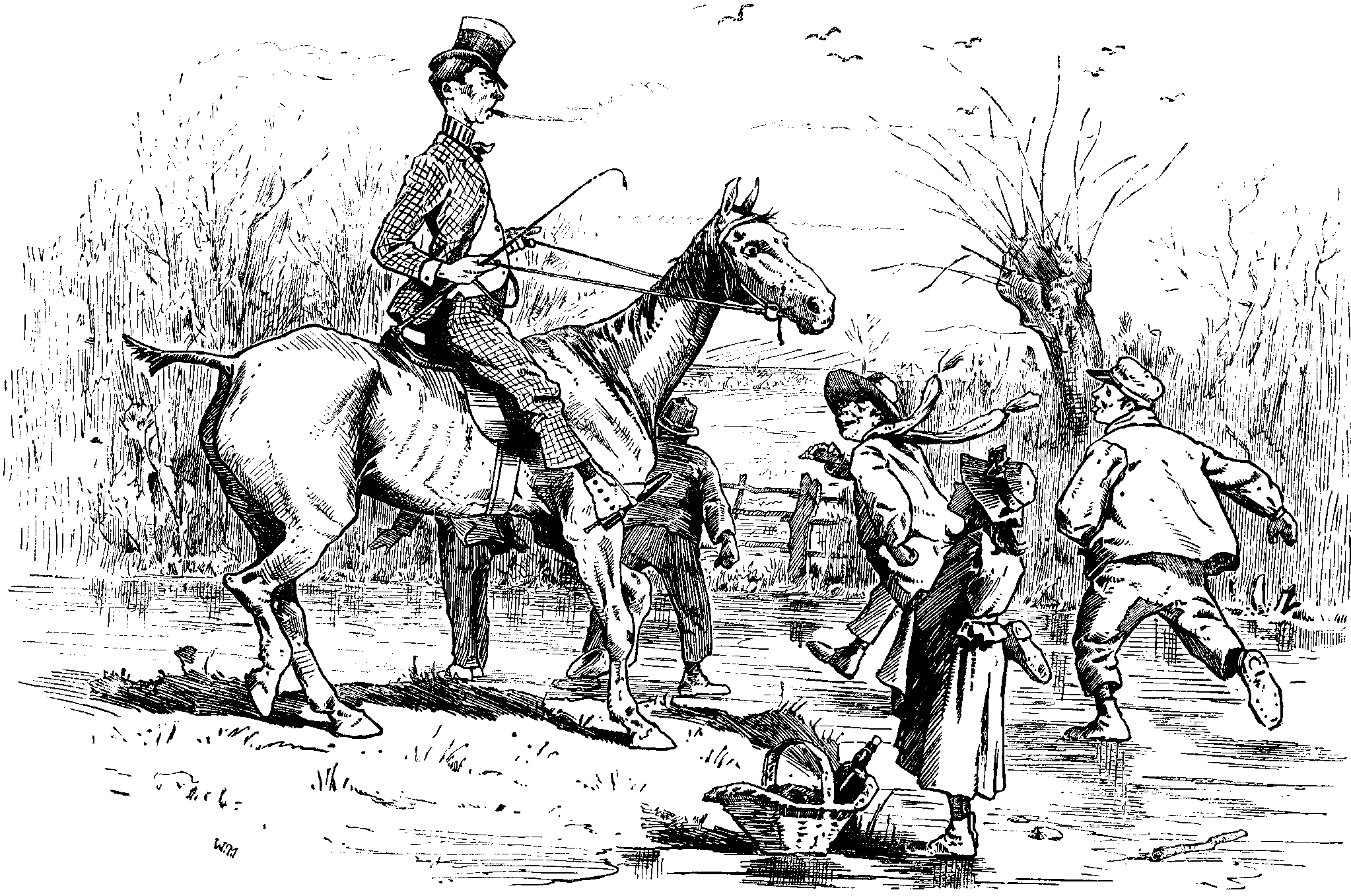
'ARRY OUT 'UNTIN'.
'Arry (who goes to the Meet in a frost). "'AVE THE 'OUNDS COME, MY LADS?"
Little Girl (respectfully). "IF YOU PLEASE, SIR, OUR 'OUNDS DON'T 'UNT IN 'ARD WEATHER!"]
Up, up, up! and round and round; and up, up, up! higher, higher, higher up!
There was the belfry where the ringers came. Punch caught hold of one of the frayed ropes which hung down through the apertures in the oaken roof. But he started; other hands seemed on it; he shrank from the thought of waking the deep Bell. The Bells themselves were higher. Higher, Punch and Toby, in their fascination, or working out the spell upon them, groped their way; until, ascending through the floor, and pausing, with his head raised just above its beams Punch came among the Bells. It was barely possible to make out their great shapes in the gloom; but there they were. Shadowy, and dark, and dumb.
He listened, and then raised a wild "Halloa!" "Halloa!" was mournfully protracted by the echoes. Giddy, confused, and out of breath, Punch looked about him vacantly, and sank down in a swoon.
He saw the tower, whither his charmed footsteps had brought him, swarming with dwarf phantoms, sprites, elfin creatures of the Bells. He saw them leaping, flying, dropping, pouring from the Bells without a pause. He saw them, round him on the ground; above him in the air; clambering from him by the ropes below; looking down upon him from the massive iron-girdered beams; peeping in upon him through the chinks and loopholes in the walls; spreading away and away from him in enlarging circles. He saw them of all aspects and all shapes. He saw them ugly, handsome, crippled, exquisitely formed. He saw them young, he saw them old; he saw them kind, he saw them cruel; he saw them merry, he saw them grim; he saw them dance, he heard them sing; he saw them tear their hair, he heard them howl. He saw the air thick with them.
Wh-o-o-o-sh! With what a wild whirr of startled wings the owls and bats scurried away, dim spectral hiding things that love the darkness and the silence of night, and shrink from light and cheerful sounds! "Well rid of you!" murmured Punch, as Toby barked at the flying phantoms.
But among the other swarming sprites, and circling elfs, and frolic phantoms of the Bells, Punch beheld brighter things. That pleasant pair, hand in hand, princely-looking both, and loving withal, bring a music as of marriage-bells "all in the wild March morning." And those other goodly and gracious presences, hint they not of Health and Home Happiness, and Benignant Art, and Humanity-serving Science, of Electric Sympathy, and Ready Rescue, of Mammon-thwarting Reform, and Misery-staying Benevolence; of all the spiritual charities and fairy graces that can bless and brighten country and hearth, Sire and citizen, master and servant, employer and employed, struggling man, suffering woman and helpless child? Punch read in their whirling forms and expressive faces the signs and promise of all the best and brightest influences of the time, happy and opportune attendants upon the auspicious hour of this the opening day of the New Year!
Bim, Bom, Boom!!! Clang, Cling, Clang!!! What are those hands tugging at the ropes, swinging the Bells big and little, evoking the stormy clashes and soothing cadences of the Chimes?
Surely those of the youthful New Year himself! An echo from the long-silent lips of the great Christmas-glorifier and lover of poor humanity seemed to ring in Punch's ears:—
"Who hears in us, the Chimes, one note bespeaking disregard, or stern regard, of any hope, or joy or pain, or sorrow, of the many-sorrowed throng; who hears us make response to any creed that gauges human passions and affections, as it gauges the amount of miserable food on which humanity may pine and wither, does us wrong!"
"Right you are!" cried Punch, cordially, Toby yapping assent.
He might have said more, but the Bells, the dear familiar Bells, his own dear constant, steady friends, the Chimes, began to ring the joy-peals for a New Year so lustily, so merrily, so happily, so gaily, that he (like poor old Trotty Veck) leapt to his feet, and broke the spell that bound him.
"Yes, that is still the true Spirit of the Chimes," mused Mr. Punch, as he took pen in hand to open up his new Volume. "And that's the spirit I hope to keep up right through the twelve months of just-born Eighteen Hundred and Ninety-two, which I trust may be—with my willing assistance,
A HAPPY NEW YEAR TO ALL OF YOU!!!"