Volume 102 — ESSENCE OF PARLIAMENT.
Reading edition
EXTRACTED FROM THE DIARY OF TOBY, M.P.
House of Commons, Monday, February 15.—A lively sitting, with an unexpected ending. Debate on Address resumed by SEXTON in excellent speech, an effect largely contributed to by comparative brevity. Only an hour long; remarkable compression. Would have been better still had it been reduced by the twenty minutes occupied in preliminary observations. At twenty-five minutes past four he rose to move Amendment condemnatory of Land Purchase Act of last year. Precisely at a quarter to five came to his amendment, and began to recommend it to House. But mustn't complain. An excellent beginning for new Session that may further develop.
"An oratorical eel," SAUNDERSON, later in sitting, likened Member for West Belfast to; charming simile, with just that mixture of graphicness and incongruity that only Irish wit could flash upon. Not meant to be uncomplimentary, for SAUNDERSON, like the rest, acknowledges capacity of SEXTON in debate; his clear insight, his capacity for grasping a subject, his aptness of illustration, his quickness of retort, and, alack! the embarrassment of the wealth of language. If he could only economise that, and guard against the fatal fluency that besets him, converting what might be a sharp direct speech of twenty minutes into a windy weariness of hour-and-a-half or two hours, he would take high rank among Parliamentary debaters.
DIZZY once said the occasions when a man addressing House of Commons need exceed twenty minutes, come to him only twice or thrice in a lifetime. He did more than preach; he carried into practice his own principle with success. Very rarely in later years, even when Leader of House of Commons, did he exceed twenty minutes, and all his most successful interpositions in debate were on that plan. When, occasionally, he felt that circumstances demanded a long and laboured address, his labour was in vain.
Capital speech, too, of quite another kind, from DUNBAR BARTON. Most promising maiden speech delivered in present Parliament; of good omen that best parts were not those prepared in leisure of study, put the earlier passages evoked by preceding debate, and necessarily impromptu. As for SAUNDERSON, he was in his best form.
"SAUNDERSON," said the SQUIRE OF MALWOOD, recognising a kindred spirit, "always reminds me of those Lifeguardsmen you see at the Military Festival, riding round Agricultural Hall slashing off heads. The heads are dummies, and no harm is done; but it's a pretty sight."
The Colonel rides well, and is a skilful swordsman.
Delight of audience crowding in after dinner completed by TIM HEALY dashing in with intent to trip up Colonel. Domestic difficulties in the Party have not smoothed down TIM's natural truculence. With JOHN REDMOND sitting behind him and SAUNDERSON in front, a porcupine in fretful mood is a ball of spun silk compared with TIM.
After this RADCLIFFE COOKE and collapse, with the prospect of proceedings droning on till midnight, then adjournment, and begin again to-morrow. Suddenly, on stroke of twelve, Closure moved. House completely taken aback. Whilst it sat gasping under shock SPEAKER declared Closure carried; bells rang through all the corridors; Members trooped in to find Division imminent. When figures declared, showing Government had been surprised into narrow majority of 21, fresh wave of excitement welled forth, amid which Address was, somehow, agreed to. Members went off into snowstorm, cheering and laughing as if there had never before been such larks.
Business done.—Address agreed to.
Tuesday Night.—GRANDOLPH turned up to-day; took his familiar corner seat; tugged at his old moustache; caressed his new beard, and listened to SEALE HAYNE recklessly attacking the sacred institution of Justiciary of the Peace.
"Nothing changed, TOBY, dear boy," he said; "not even the Ministry. When I came back from Mashonaland I was told we were on the eve of political earthquake. The House of Commons was to be transformed into a cockpit; the Benches steepled in the gore of an iniquitous Ministry. But, except for some vacant places and some further advancement of privates in the little band I once officered, it's all the same, only a little drearier. The same throng in the Lobby, the same rows of Members sitting on the Benches, the same Mace on the Table, the same stately figure in the Chair, and the same Sergeants-at-Arms relieving guard at the Cross Benches. There are not quite the same two Irish Leaders, for BRER FOX has 'gone away.' BRER RABBIT I see sitting over there with his kindly face and his friendly smile, perhaps the only Irishman in the House who, if a coat were trailed before him, would turn away from temptation. It's only Irishmen, with their inexhaustible fund of humour, who would have put JUSTIN MCCARTHY in his present place. Doesn't much matter so long as TIM HEALY's around. I'll bet my gold mine at Mashonaland against the Kennel, Barks, that TIM will make up the average of fighting even when BRER RABBIT in the scale."
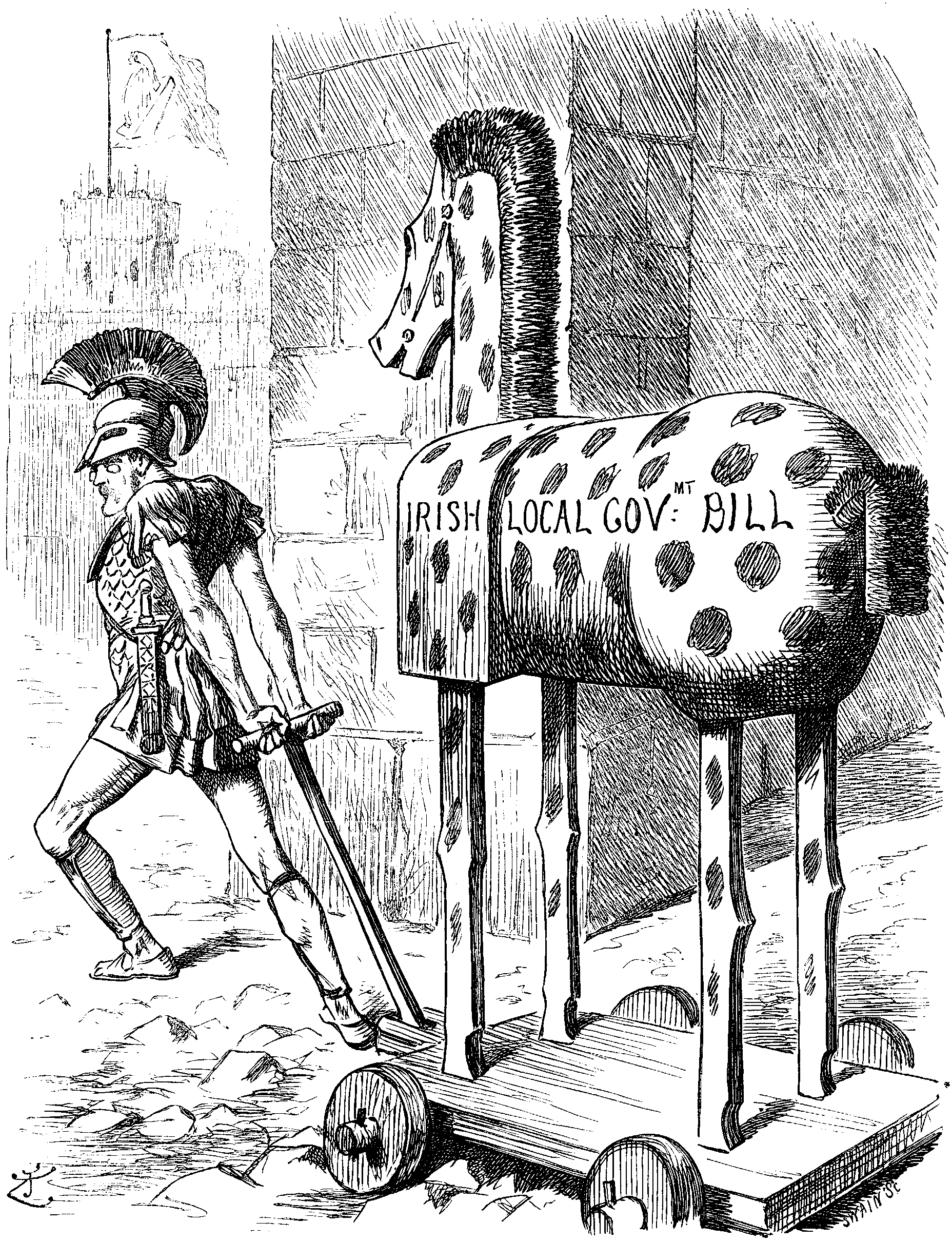
A GIFT FROM THE GREEKS.
RIGHT HON. ARTHUR. "IF I CAN ONLY GET THIS THROUGH, IT OUGHT TO SETTLE 'EM!"
There's one thing changed GRANDOLPH did not allude to; perhaps unconscious of it. 'Tis his own appearance. In addition to the beard, he has put on ruddy tint that speaks well for Mashonaland as a health resort compared with Westminster. Amongst the pale-faced legislators his visage shines like the morning sun. "Quite a Colonial look about him," says ALGERNON BORTHWICK, fretfully. "But, after a few dinners at the Amphitryon and a few nights at the House and elsewhere, he'll get over it."
Members from all parts crowd round GRANDOLPH to shake the horny hand of the intrepid explorer, the dauntless lion dompter. A cold air whistles along the row of Ministers as he sits behind.
"What's he up to?" JOKIM hoarsely whispered, all his native gaiety eclipsed.
"Come down, I suppose," said Prince ARTHUR, smiling, "to congratulate us on our great victory last night, whereby we escaped defeat in Debate on Address by triumphant majority of 21."
"Quite a stormy petrel don't you think?" JOKIM said, nervously rubbing his hands.
"Not exactly," said Prince ARTHUR; "that usually comes before the storm you know. If you must be personal and ornithological, I should say GRANDOLPH's appearance on the scene is more reminiscent of the vulture; a little hasty in his appearance perhaps, but that is none the less significant."
Business done.—Practically none, and so home to dinner at twenty minutes to eight.
Thursday Night.—Prince ARTHUR explained provisions of long-looked-for Local Government scheme. A remarkable, unexampled, scene. House crowded on every Bench, with Duke of DEVONSHIRE looking down from Peers' Gallery, thanking Heaven he is out of it. Prince ARTHUR's manner in introducing the measure in keeping with the strange surroundings. Might reasonably have been expected that he would have been at pains to recommend the Bill to acceptance of House. Not a bit of it. If people insisted upon regarding it as the most important business of Session, Prince ARTHUR couldn't help it. But he certainly would not foster the delusion. In its potentiality of beneficent effect, the Bill nothing in comparison with the Coercion Act or the Light Railways Act.
"A poor thing," he said, in effect, and did not add, "but mine own."
If it was not his, certainly no one else would own it. Irish Members received it with jeers. JOHN MORLEY denounced it as a monstrous imposture. SQUIRE OF MALWOOD benignantly affected to regard it as a little joke with which Ministers designed to vary a dull Session. But a joke may be carried too far; better drop this now, and go to business.
Oddly enough, the storm of contumely had effect of inspiring Prince ARTHUR with new affection for his unwelcomed offspring, adding to the strength of his evidently new conviction that the proposed expedient was sound, and, if accepted, would prove efficacious.
"And what do you think of the Tory scheme of Home Rule," I asked JUSTIN MCCARTHY, when it was all over.
"Timeo Danaos, et dona ferentes," he said, dropping into his native Celtic speech. "But in this case there is no room for apprehension. BALFOUR may leave this wooden horse outside the gates for a month, and the Trojans wouldn't touch it with a pair of tongs."
Prince ARTHUR grew more confident as the clouds gathered.
"I see very well," he said, "if I'm to stable this horse in the Home Rule Troy, I must drag it all the way myself. I shall get no help from either section of the garrison. But it's got to be done, and I'll buckle-to. Once through, it will settle the more than ten years' siege."
Business done.—Prince ARTHUR left tugging away at his wooden horse.
Friday Night.—House of Lords almost deserted. HALSBURY punctual in his place, making most of opportunities on Woolsack whilst they yet remain.
"Here to-day and gone to-morrow, TOBY," he remarked, with forced gaiety; "but, when I hand in the Seals of Office, I shall at least have the serene assurance to cheer me in my retirement that the whole of my family, including collateral branches, have been provided for."
Amongst the prevailing dolour, the MARKISS in high spirits.
"Things not looking well in the Commons or the country, I admit," he says; "but all is not lost yet. I have still a card to play, and I believe it will score the trick. We shall presently have to go to the country, and fight a confident Opposition. Successful Foreign Policy is played out. Free Education has brought us no support; trifling with Home Rule in Ireland will bring us enemies. Am convinced that the thing to go to the country on is the fog. MIDDLETON's our man. Been thinking over it for a week. See it now; shall take up question of London fog; devise some means of battling with it; and then let the worst come. A Government that has fought the fog will at least carry London, and, London ours, we shall be able to stem the tide of anarchy."
Business done.—The MARKISS takes a great resolution.
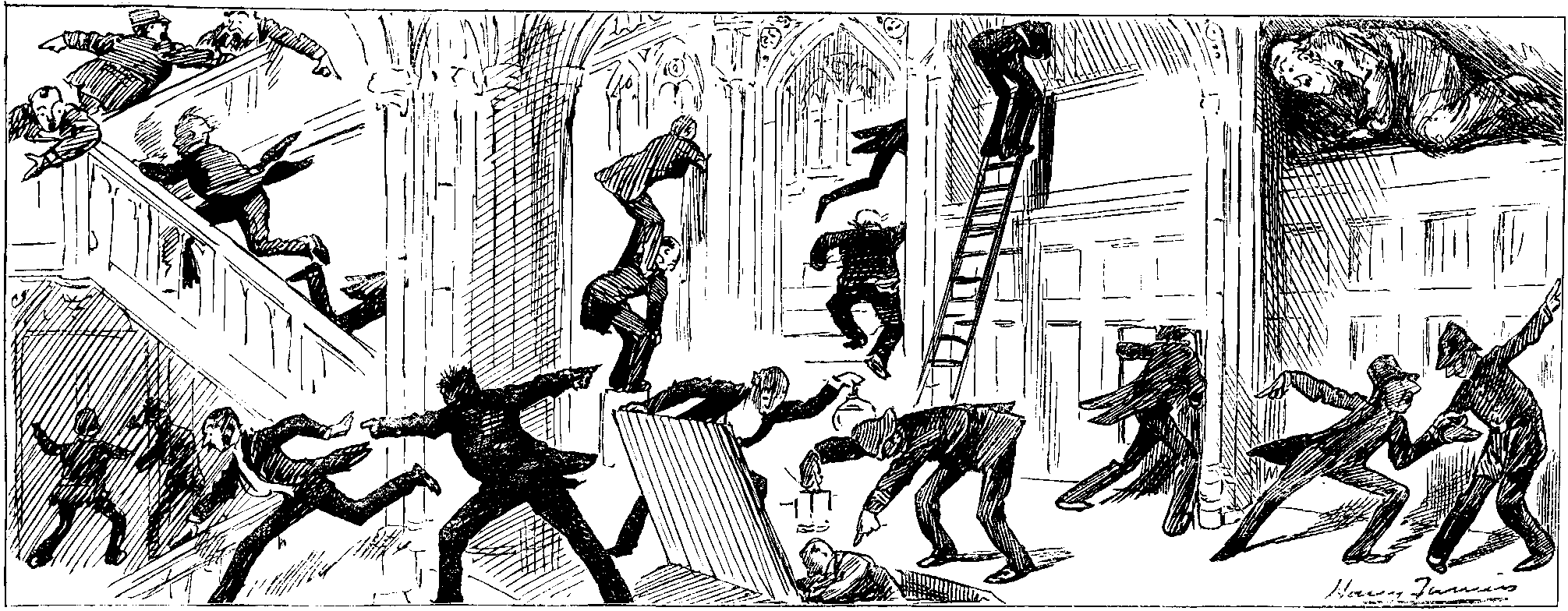
"THE HUNTING OF THE HARCOURT."
(According to Fancy Sketch by "Observer" in the "Times.") "O where and O where is our Harcourt Laddie gone?"
PADDYWHACK AND DR. BIRCH.—Everyone knows what "the Assisted Education (Ireland) Bill" is. Why should not an Assisted Education (England) Bill be brought in to enable public school-boys to secure, without payment of any additional fee beyond that included for "swishing" in the Bill sent home to the parents, the specimen of the legal instrument with which their education may have been most helpfully assisted?
"BECKY THE SECOND."—Those comparatively few who answered our query as to where "the good Becky, the very opposite of Becky in Vanity Fair, was to be found in THACKERAY's works," and have referred us to A Shabby Genteel Story, are right. The many who hit upon Rebecca in the burlesque of Ivanhoe mistook the question.
A CORRESPONDENT, signing himself "IGNORAMUS," writes to inquire "The address of a Society called 'The London French Polishers.'" He says, "I want my French polished up a bit before going to Paris."