Volume 102 — THE YOUNG GIRL'S COMPANION.
Reading edition
(By Mrs. Payley,)
II.—DINING-OUT.
I can quite understand that a young girl may not care much for the mere material dinner. The palate is a pleasure of maturity. The woman of fifty probably includes a menu or two among her most sacred memories; but the young girl is capable of dining on part of a cutlet, any pink sweetmeat, and some tea. But I must confess that I was surprised at another objection to dining-out that a young girl, only at the end of her second season, once made to me. She said that she positively could not stand any longer the conversation of the average young man of Society. I asked her why, and she then asserted that this sort of young man confined himself to flat badinage and personal brag, which he was mistaken in believing to be veiled. What she said was, of course, perfectly true. Civilisation is responsible for the flat badinage, for civilisation requires that conversation shall be light and amusing, but can provide no remedy for slow wits; on the other hand, the personal brag is a relic of the original man. The badinage is the young man's defect in art; the brag is his defect in nature. But I fail to see any objection to such conversation; on the contrary, it is charming because it is so average; you know beforehand just what you will hear and just what you will say, and everything is consequently made easy. The man puts on that kind of talk just as he puts on his dress-coat; both are part of the evening uniform. The motto of the perfect young man of Society is "I resemble." I pointed all this out to the young girl in question, and she retorted that it was a pity that silence was a lost art. However, she continued to dine-out and to take her part in the only possible conversation, and after all Society rather encourages theoretical rebellion, provided that it is accompanied by practical submission.
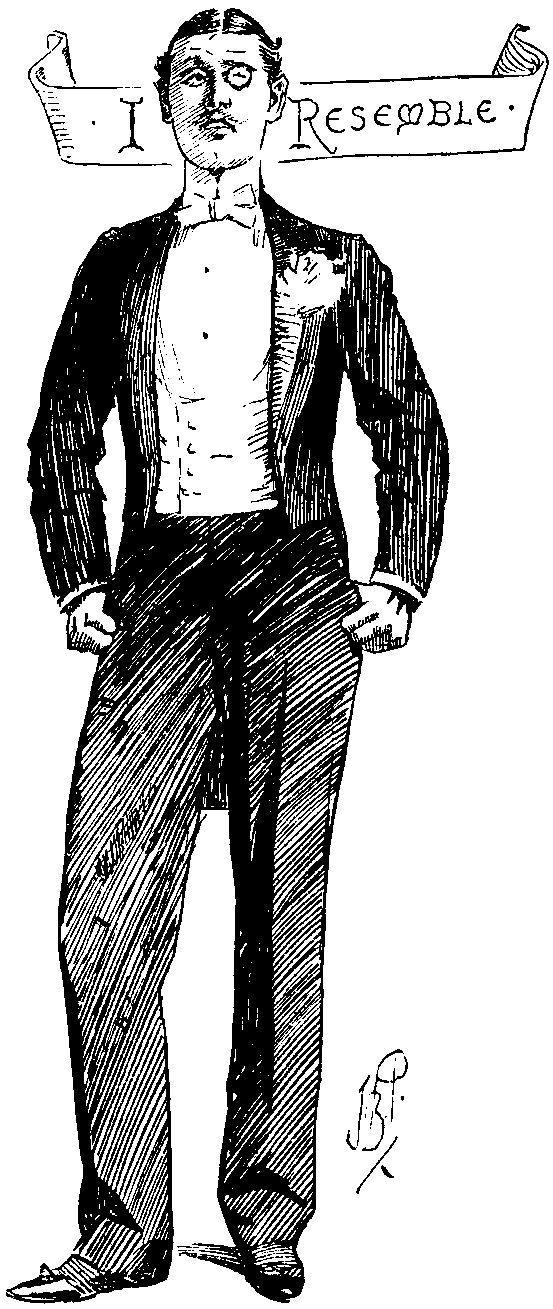
From the point of view of sentiment, a dinner has less potentialities than a dance; but the dinner may begin what the dance will end; you set light to the fuse in the dining-room, and the explosion takes place six weeks afterwards in someone-else's conservatory. Nothing much can be done on the staircase; but, if you can decently pretend that you have heard of the young man who is taking you in, he will probably like it. If, after a few minutes, you decide that it is worth while to interest the young man, discourage his flat badinage, and encourage his personal brag. The only thing in which it is quite certain that every man will be interested is, the interest someone else takes in him. Later on, he will probably be induced to illustrate the topic of conversation by telling you (if it would not bore you) of a little incident which happened to himself. The incident will be prettily coloured for dinner-table use, and he will make the story prove a merit in himself, which he will take care to disclaim vainly. When he has finished, look very meditatively at your plate, as if you saw visions in it, and then turn on him suddenly with wide eyes—with the right kind of eyelashes, this is effective.
"I suppose you don't know it, Mr. BLANK," you tell him, "but really I can't help saying it. You behaved splendidly—splendidly!"
Droop the eyelashes quickly, and become meditative again. He will deprecate your compliment a little incoherently.
"Not at all, not at all—Miss—er—ASTERISK—I really—assure you—nothing more than any—er—other man would have done. Some other people at the time told me"—(laughs nervously)—"very much—er—what you have just said, but—er—personally, I—really—could never see it, or of course I wouldn't have mentioned it to you."
Your rejoinder will depend a good deal on how far you mean to go, and how much of that kind of thing you think you can stand. If you like, you can drop your handkerchief or your glove when you rise; it will please him to pick it up for you, and he will feel, for a moment, as if he had saved your life.
If you do not want to please the man, but only to show your own superiority, it may perhaps be as well to remember that women are better than men, as a rule, in flat badinage. Men talk best when they are by themselves, but they are liable to be painfully natural at such times. I had some little difficulty in finding this out, but I thought it my duty to know, and—well, I do know.
The correspondence that I have received has not been altogether pleasant. I have had one letter from ETHEL (aged thirteen) saying that she thinks me a mean sneak for prying into other people's Diaries. I can only reply that I was acting for the public good. I have had a sweet letter, however, from "AZALEA." She has been absolutely compelled, by force of circumstances, to allow the distinct attentions of three different men. She does not give the names of the men, only descriptions, but I should advise her to keep the dark one. She can see the will at Somerset House. "JANE" writes to ask what is the best cure for freckles. I do not answer questions of that kind. I have replied to my other correspondents privately.
REPULSING THE AMAZONS.
(See Cartoon, "Arming the Amazons," Dec. 5, 1891.)
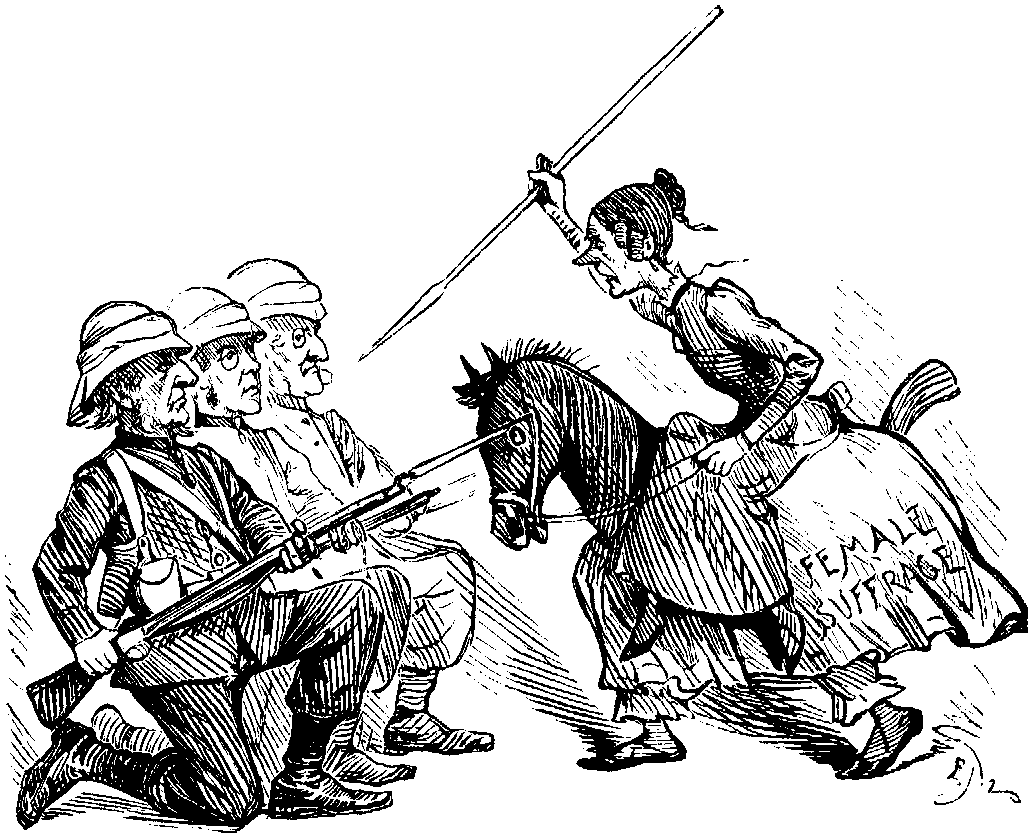
Arming the Amazons against the Greeks? That PRIAM SALISBURY tried some few short weeks Before the present fray. FAWCETTA fair Had prayed; the question then seemed "in the air," And PRIAM proffered then the Franchise-spear, (A shadowy one, that gave no grounds for fear,) To poor PENTHESILEA. Now, ah, now ROLLITTUS moves, there's going to be a row, And lo! the mingled ranks of Greece and Troy Close 'gainst the Amazons. Her steed, a toy, A hobby-horse, that any maid may mount, Is not—just now—of any great account. Her phantom spear will pierce no stout male mail; But should ROLLITTUS not—(confound him!)—fail, A female host, well armed, and not on hobbies, Might prove as dangerous as a batch of Bobbies. The fair FAWCETTA then must be thrown over; PENTHESILEA finds no hero-lover In either host. PRIAM, abroad, is dumb. Ah, maiden-hosts, man's love for you's a hum. Each fears you—in the foeman's cohorts thrown, But neither side desires you in its own! The false GLADSTONIUS first, he whom you nourish, A snake in your spare bosoms, dares to flourish Fresh arms against you; potent, though polite, He fain would bow you out of the big fight, Civilly shelve you. "Don't kick up a row, And—spoil my game! Another day, not now, There's a dear creature!" CHAMBERLAINIUS, too, Hard as a nail, and squirmy as a screw, Sides with the elder hero, just for once; CHAPLINIUS also, active for the nonce On the Greek side, makes up the Traitrous Three, One from each faction! Ah! 'tis sad to see PENTHESILEA, fierce male foes unite In keeping female warriors from the fight; Yet think, look round, and—you may find they're right!
NOTICE.—Rejected Communications or Contributions, whether MS., Printed Matter, Drawings, or Pictures of any description, will in no case be returned, not even when accompanied by a Stamped and Addressed Envelope, Cover, or Wrapper. To this rule there will be no exception.