Volume 100 / Act 2 — UPON AFRIC'S SHORE;
Reading edition
OR, THE BATTLE OF THE HEROES.
(Not by the Author of "The Battle of Limerick.")
Ye lovers of the nation, Who burn with indignation, And England's obfuscation perpetually deplore; Ye flouters of our factions, And partisan distractions, How like ye the transactions upon Afric's shore? Ye've all heard of the Lion Who a rival cast his eye on, (You'll find him in Bombastes) and thought the brute a bore. Such rival Leos flourish, And mutual hatred nourish, With a snapping almost currish, upon Afric's shore. Faith their manes are always waving, And their claws for contest craving, And their forms are always rampant, and they're ever at full roar, And in book and morning paper, They still clapperclaw and caper, And they worry, snarl and vapour about Afric's shore. There was EMIN, sage pacific, The serene and scientific, Who a wondrous reputation in a hero-patriot bore, Until "rescued" by brave STANLEY, Who declared him weak, unmanly. Oh! 'tis strange how heroes can lie about Afric's shore. Then BARTTELOT and TROUP, JEPHSON, JAMESON—a group Who each of each "made soup"—off each other tried to score; And in many a verjuiced "vollum" STANLEY's jovial "Rear Column" Was discussed in manner solemn, anent Afric's shore. Then the "foreign element" To it tooth and nail they went, And the Battle of the Heroes it grew livelier than before. Now that man, and now this man, Now DE BRAZZA and now WISSMANN, Made it hot for poor Old England upon Afric's shore. Now comes PETERS! He has slanged STANLEY awfully, and banged The "Rescue" party badly. It is getting a big bore, When, with tempers hot as Indies, Heroes smash each other's windies, Pursuing of their shindies about Afric's shore. It is doubtless "moighty fine," Being what Titmarsh called "a line," And it does Society's "sowl" good (no doubt) to hear him roar; But 'tis folly to suppose He must rush upon his foes, And hit them on the nose, upon Afric's shore.
EARLY CLOSING MOVEMENT.—When Mr. SMITH proposed shutting up shop early on Tuesdays and Fridays, SIR ROBERT FOWLER was all for singing, "We won't go home till morning (three times), Till daylight doth appear." But, as Falstaff asks, "What doth gravity out of bed after midnight?" No, Sir ROBERT, doughty knight, take good advice, and hie thee, armed Night-cap-à-pie, to thy couch. Don't get up till morning, Till (long after) daylight doth appear!
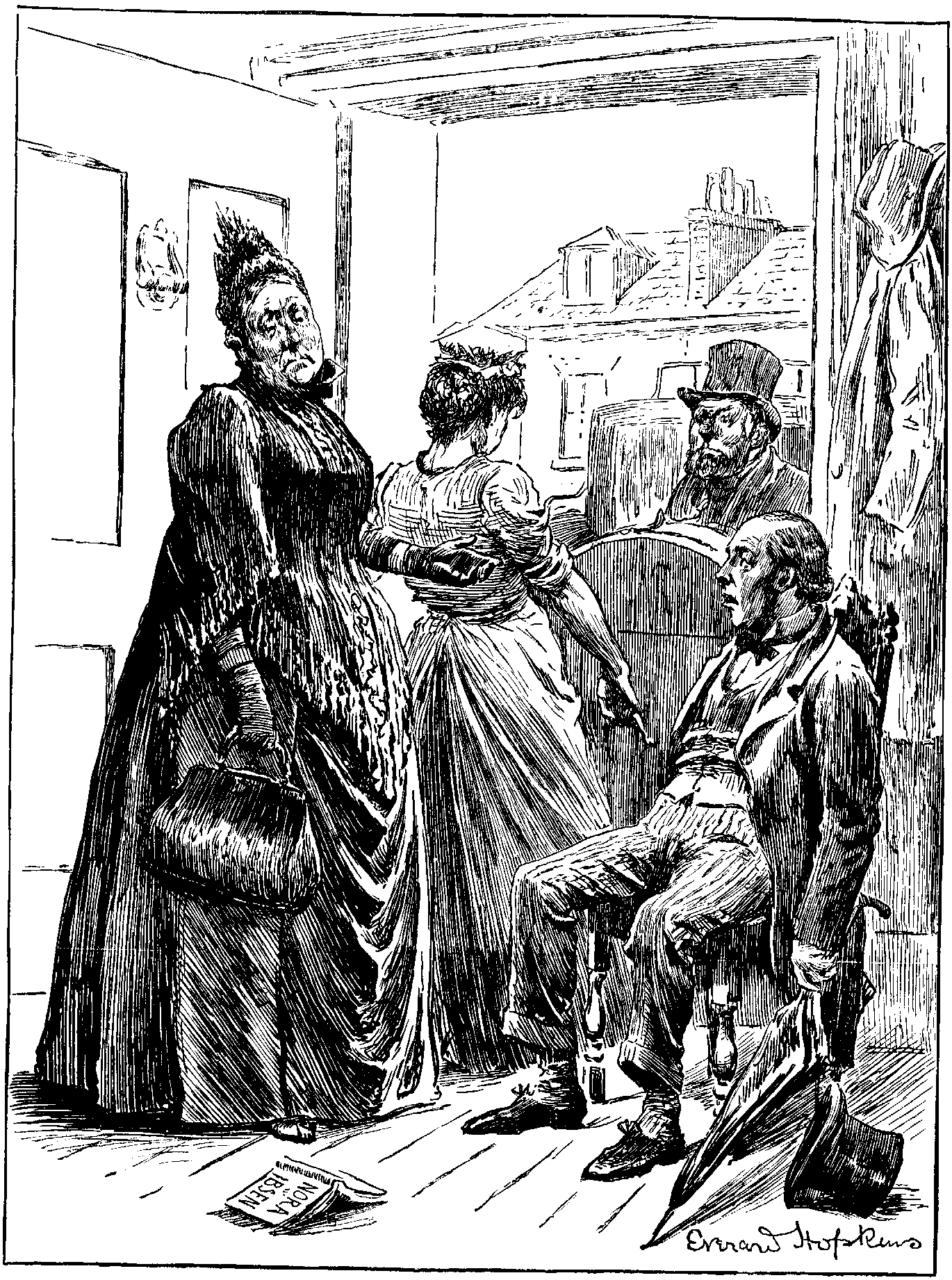
IBSEN IN BRIXTON.
Mrs. Harris
. "YES, WILLIAM, I'VE THOUGHT A DEAL ABOUT IT, AND I FIND I'M NOTHING BUT YOUR DOLL AND DICKEY-BIRD, AND SO I'M GOING!"
THE PARTY PETER BELL.
A potterer, Sir, he was by trade, A Party Potterer, much respected, And every year, when Spring appeared, The yellow blooms, to bards endeared, In swarms by PETER were collected. He roved among the vales and streams, In the green wood and hollow dell, And, upon April's nineteenth day, Big buttonholers made display Upon the heart of PETER BELL. In vain through each succeeding year Did Nature mourn her lessening store. A Primrose on the river's brim A Party emblem was to him, And it was nothing more!
DISINFECTING THE WIGS.—"L'Enfant Prodigue," which is filling the Prince of Wales's Theatre day and night, has much in it that is delightful. Perhaps there is nothing quite excels the subtle touch in the programme where it is written: "The theatre is disinfected by the Sanitas Company, Limited. The Wigs by Clarkson."
CURIOUS, AND "MORE ANON!"—The Evelyn v. Hurlbert trial was as full of literary interest as a sale of old books and manuscripts. Specially valuable were copies of Evelyn's Diary; while, in spite of the pressing demand, Murray's Memoirs were uncommonly scarce. Victorious Mr. HURLBERT! Yet for all his triumph, he will be, for some time, a "very much Murray'd man."
A SAVOY QUESTION.—The general idea of the forthcoming new Opera at the Savoy appears to be "all Dance to SOLOMON's music." Is it to be a pantomime-drama, like L'Enfant Prodigue, or simply a ballet? If neither, where do song-words and dialogue come in?