Volume 100 — VOCES POPULI.
Reading edition
AT A MUSIC HALL.
SCENE—The Auditorium of a Music Hall, the patrons of which are respectable, but in no sense "smart." The occupants of the higher-priced seats appear to have dropped in less for the purpose of enjoying the entertainment than of discussing their private affairs—though this does not prevent them from applauding everything with generous impartiality.
The Chairman. Ladies and Gentlemen, the Celebrated Character-Duettists and Variety Artistes, the Sisters SILVERTWANG, will appear next!
[They do; They have just sung a duet in praise of Nature with an interspersed step-dance. "Oh, I love to 'ear the echo on the Moun-ting!" (Tiddity-iddity-iddity-iddity-um!) "And to listen to the tinkle of the Foun-ting!" (Tiddity, &c.)
A White-capped Attendant (taking advantage of a pause, plaintively). Sengwidges, too-pence!
Voluble Lady in the Shilling Stalls (telling her Male Companion an interminable story with an evasive point). No, but you 'ear what I'm going to tell you, because I'm coming to it presently. I can't remember his name at this moment—something like BUDKIN, but it wasn't that, somewhere near Bond Street, he is, or a street off there; a Scotchman, but that doesn't matter! (Here she breaks off to hum the Chorus of "Good Ole Mother-in-Law!" which is being sung on the stage.) Well, let me see—what was I telling you? Wait a minute, excuse me, oh, yes,—well, there was this picture,—mind you, it's a lovely painting, but the frame simply nothing, not that I go by frames, myself, o' course not, but I fetched it down to show him—oh, I know what you'll say, but he must know something about such things; he knew my uncle, and I can tell you what he is—he's a florist, and married nineteen years, and his wife's forty—years older than me, but I've scarcely spoke to her, and no children, so I fetched it to show him, and as soon as he set eyes on it, he says—(Female "Character-Comic" on Stage, lugubriously. "Ritolderiddle, ol de ray, ritolderiddle, olde-ri-ido!") I can't tell you how old it is, but 'undreds of years, and Chinese, I shouldn't wonder, but we can't trace its 'istry—that's what he said, and if he don't know, nobody does, for it stands to reason he must be a judge, though nothing to me,—when I say nothing, I mean all I know of him is that he used to be—(Tenor Vocalist on Stage. "My Sweetheart when a Bo-oy!") I always like that song, don't you? Well, and this is what I was wanting to tell you, she got to know what I'd done—how is more'n I can tell you, but she did, and she come straight in to where I was, and I see in a minute she'd been drinking, for drink she does, from morning to night, but I don't mind that, and her bonnet all on the back of her head, and her voice that 'usky, she—(Tenor. "She sang a Song of Home Sweet Home—a song that reached my heart!") And I couldn't be expected to put up with that, you know, but I haven't 'alf told you yet—well, &c., &c.
IN THE RESERVED STALLS.
First Professional Lady, "resting" to Second Ditto (as Miss FLORRIE FOLJAMBE appears on Stage). New dresses, to-night.
Second Ditto. Yes. (Inspects Miss F.'s costume.) Something wrong with that boy's dress in front, though, cut too low. Is that silver bullion it's trimmed with? That silver stuff they put on my pantomime-dress has turned quite yellow!
First Ditto. It will sometimes. Did you know any of the critics when you were down at Slagtown for the Panto?
Second Ditto. I knew the Grimeshire Mercury, and he said most awfully rude things about me in his paper. I was rather rude to him at rehearsal, but we made it up afterwards. You know LILY'S married, dear?
First Ditto. What—LILY? You don't mean it!
Second Ditto. Oh, yes, she is, though. She went out to Buenos Ayres, and the other day she was taken in to dinner by the Bishop of the Friendly Isands.
First Ditto. A Bishop? Fancy! That is getting on, isn't it?
Miss Foljambe (on Stage, acknowledging an encore). Ladies and Gentlemen, I am very much obliged for your kind reception this evening, but having been lately laid up with a bad cold, and almost entirely lost my vice, and being still a little 'orse, I feel compelled to ask your kind acceptance of a few 'ornpipe steps, after which I 'ope to remain, Ladies and Gentlemen, always your obedient 'umble servant to command—FLORRIE FOLIJAMBE!
[Tumultuous applause and hornpipe.
Chairman. Professor BOODLER, the renowned Imitator of Birds, will appear next!
The Professor (on Stage). Ladies and Gentlemen, I shall commence by an attempt to give you an imitation of that popular and favourite songster, the Thrush—better known to some of you, I daresay, as the Throstle, or Mavis! (He gives the Thrush—which somehow doesn't "go.") I shall next endeavour to represent that celebrated and tuneful singing-bird—the Sky-lark. (He does it, but the Lark doesn't quite come off.) I shall next try to give you those two sweet singers, the Male and Female Canary—the gentleman in the stalls with the yellow 'air will represent the female bird on this occasion, he must not be offended, for it is a 'igh compliment I am paying him, a harmless professional joke. (The Canaries obtain but tepid acknowledgments.) I shall now conclude my illustrations of bird-life with my celebrated imitation of a waiter drawing the cork from a bottle of gingerbeer, and drinking it afterwards.
[Does so; rouses the audience to frantic enthusiasm, and retires after triple re-call.
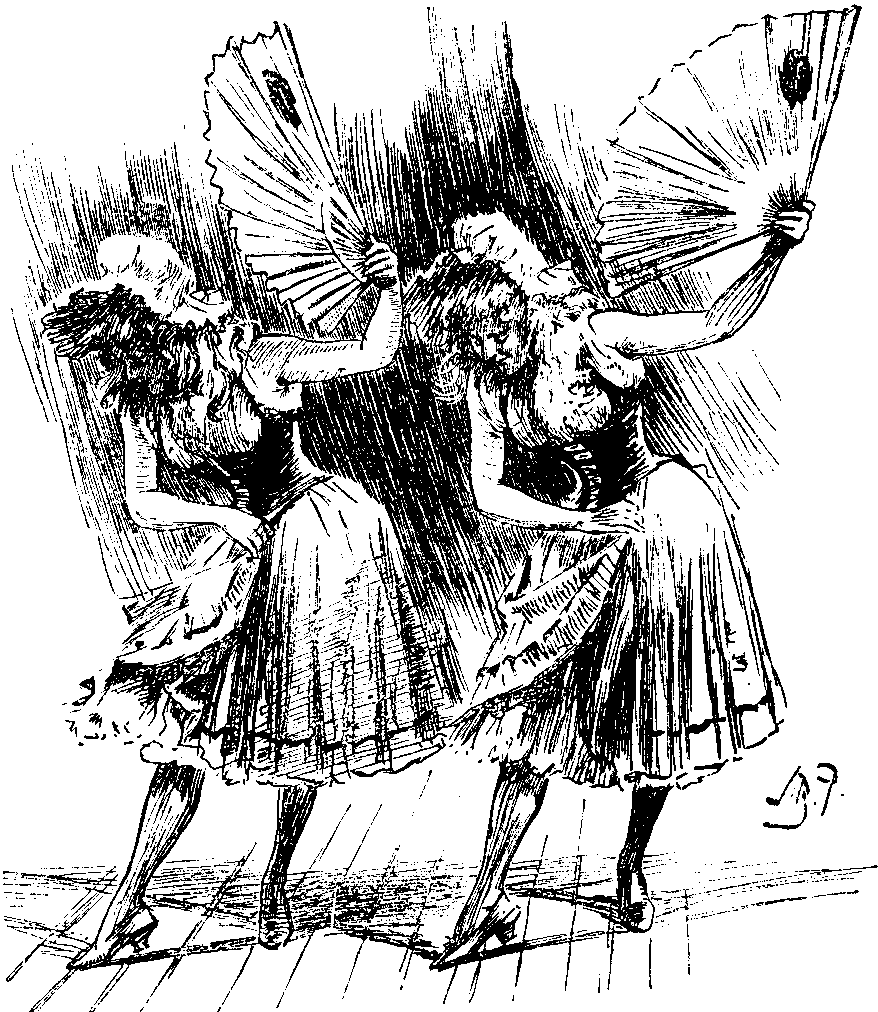
The Voluble Lady in the Shilling Stalls (during the performance of a Thrilling Melodramatic Sketch). I've nothing to say against her 'usban', a quiet, respectable man, and always treated me as a lady, with grey whiskers—but that's neither here nor there—and I speak of parties as I find them—well. That was a Thursday. On the Saturday there came a knock at my door, and I answered it, and there was she, saying, as cool as you please—(Heroine on Stage. "Ah, no, no—you would not ruin me? You will not tell my husband?") So I told her. "I'm very sorry," I says, "but I can't lend that frying-pan to nobody." So I got up. Two hours after, as I was going down-stairs, she come out of her room, and says,—"'Allo, ROSE, 'ow are yer?" as if nothing had 'appened. "Oh, jolly," I says, or somethink o' that sort—I wasn't going to take no notice of her—and she says, "Going out?" like that. I says. "Oh, yes; nothing to stay in for," I says, careless-like; so Mrs. PIPER, she never said nothing, and I didn't say nothing; and so it went on till Monday—well! Her 'usban' met me in the passage; and he said to me—good-tempered and civil enough, I must say—he said—(Villain on Stage. "Curse you! I've had enough of this fooling! Give me money, or I'll twist your neck, and fling you into yonder mill-dam, to drown!") So o' course I'd no objection to that; and all she wanted, in the way of eatables and drink, she 'ad—no, let me finish my story first. Well, just fancy 'er now! She asked me to step in; and she says, "Ow are you?" and was very nice, and I never said a word—not wishing to bring up the past, and—I didn't tell you this—they'd a kind of old easy chair in the room—and the only remark I made, not meaning anythink, was—(Hero on Stage. "You infernal, black-hearted scoundrel! this is your work, is it?") Well, I couldn't ha' put it more pleasant than that, could I? and old Mr. FITKIN, as was settin' on it, he says to me, he says—(Hero. "Courage, my darling! You shall not perish if my strong arms can save you. Heaven help me to rescue the woman I love better than my life!") but he's 'alf silly, so I took no partickler notice of 'im, when, what did that woman do, after stoopin' to me, as she 'as, times without number—but—Oh, is the play over? Well, as I was saying—oh, I'm ready to go if you are, and I can tell you the rest walking home.
[Exit, having thoroughly enjoyed her evening.
To Rose Norreys as "Nora."
Dear ROSE, in your way, you're as brimful of Art As a picture by REYNOLDS, a statue by GIBSON; And we'll never cut you, though we don't like your part, Pretty ROSE, in A Doll's House, as written by IBSEN, Yet we crowd on your track, as the hounds on the quarry's, And, though carping at Nora, delight in our NORREYS.
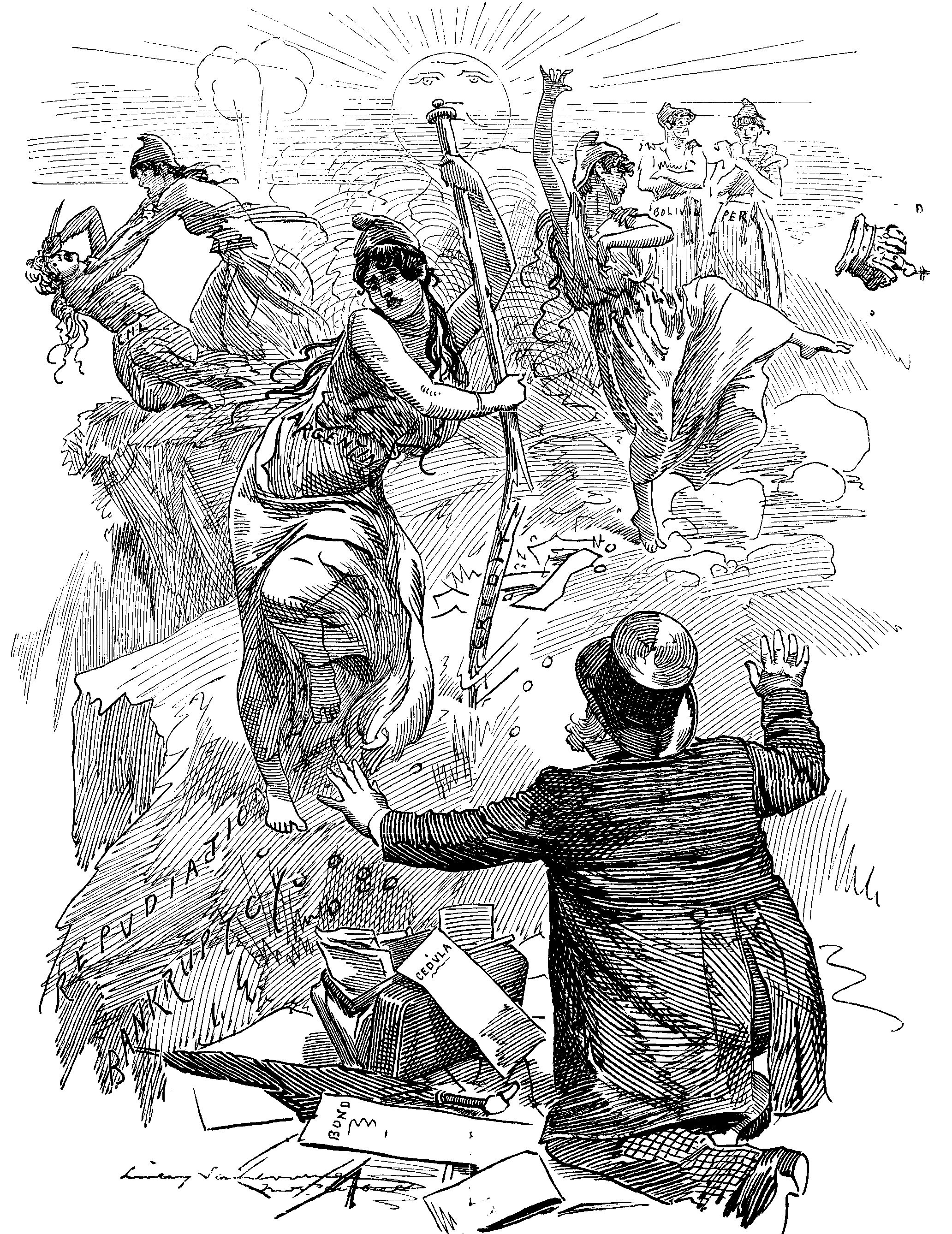
TROUBLE IN TOM TIDDLER'S GROUND.
British Tom Tiddler
. "IF THIS GOES ON, HOW ABOUT MY GOLD AND SILVER?"
A DAY IN THE LAW COURTS.
(A page from the Posthumous Diary of the late Mr. Pepys.)
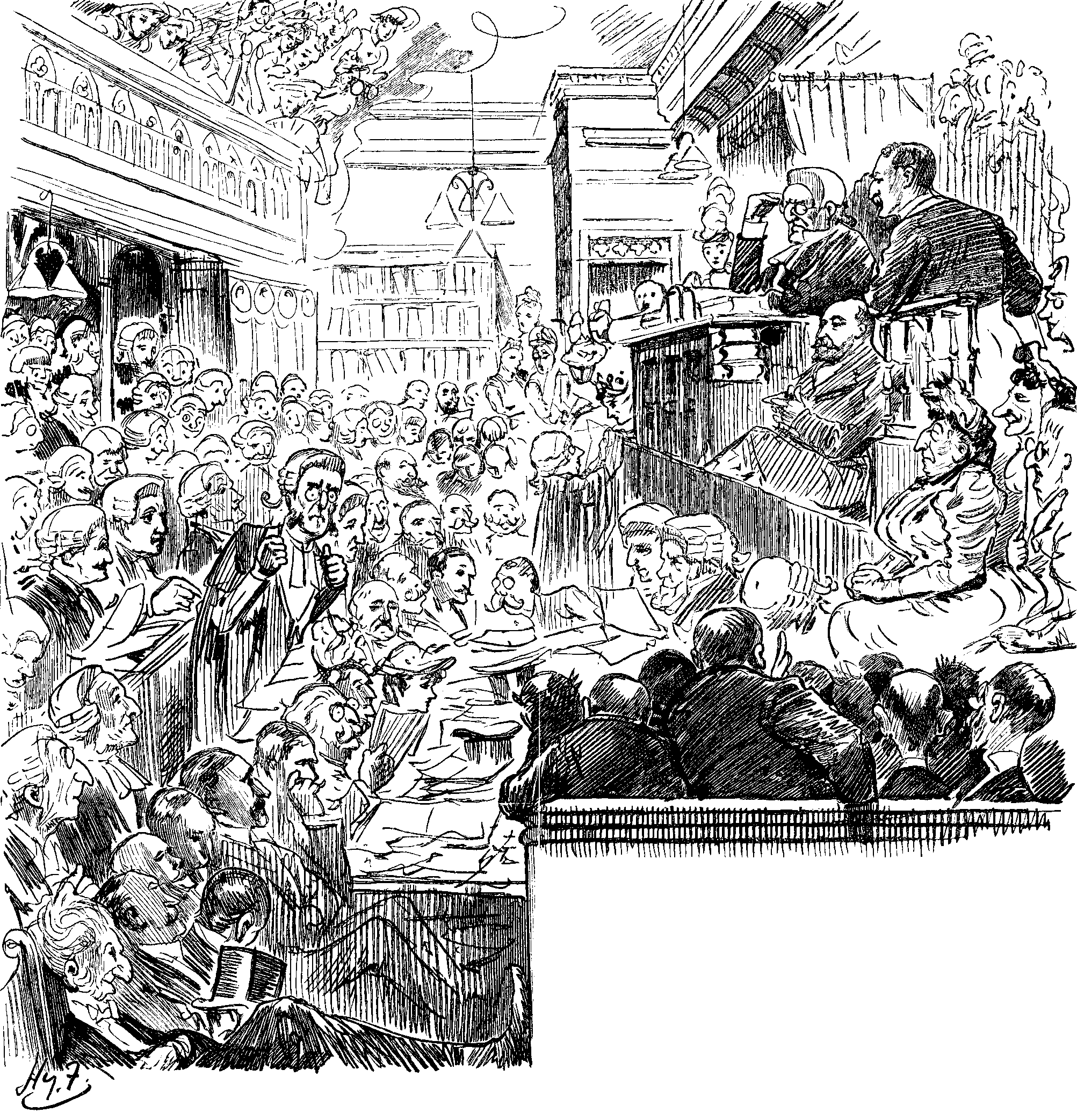
[ MR. PUNCH'S "TABLEAU." SOCIETY IN COURT. ]
Up betimes and to the Court at the New Palace of Justice hard by the Strand, and near the sign of the Griffin which has taken the place of Temple Bar, upon which did stand long ago the heads of traitors. There did I see a crowd high and low trying to get in. But the custodians and the police mighty haughty, but withal courteous, and no one to be admitted without a ticket signed by the Lord Chief Justice. And I thought it was a good job my wife was not with me. She had a great longing to see a sensation action (as the journals have it), and she being of a fiery disposition and not complacent when refused, might have made an uproar, which would have vexed me to the heart. But in truth I found no trouble. It did seem to me that they did not see me as I entered in. And plenty of room and no crowding, at which I was greatly contented, as I love not crushing. Pretty to see the crowd of fine folks! And there were those who had opera-glasses. And when the Bench was occupied by the Lord Chief Justice—a stately gentleman—and the other persons of quality, how they did gaze! And the dresses of the ladies very fine, and did make the place—which was splendid, and they tell me the largest in the building—like a piece at the play-house! And the Counsel, how they did talk! Mighty droll to hear them contradict! One would have it that Black was White; which convinced me I had fallen into error, until another had it that he who had spoken was wrong, and White was Black! Good lack! who shall decide when Counsel differ? and I was mightily content that I was not on the jury, although one of these good people did have the honour of asking a question of His Royal Highness. And it was answered most courteously, at which I was greatly pleased and contented. Then did I hear the witnesses. In a mighty dread that I might be called myself! For that which did seem plain enough when he who was in the box was asked by his Counsel, did appear all wrong when another questioned him. And the Jury, looking wise, and making notes. And it is droll to see how civil everyone is to the Jury, who, methinks, are no cleverer than any of us? The Lord Chief Justice himself smiling upon them, and mighty courteous! And met my friend, A. Briefless, Junior, who it seems, is always in the Courts, and yet doeth no business. And he did say that it was the strongest Bar in England. And he did tell me how Sir Charles was eloquent, and Sir Edward was clever at fence, and how young Master Gill was most promising. And I noticed how one fair Lady, who was seated on the Bench, did seem to arrange everything. And many beauties there, who I did gaze upon with satisfaction. To see them in such gay attire was a pretty sight, and did put my heart in a flutter. And I was pleased when the Court adjourned for luncheon; and it did divert me much to see what appetites they all had! Some had brought sandwiches, and, how they did eat them! But the Lord Chief Justice soon back again, and more witnesses examined until four of the clock, when the day was over. So home, and described to my wife what I had seen, except the damsels.
LEAVES FROM A CANDIDATE'S DIARY.
Billsbury, Sunday, May 25.—CHORKLE'S dinner came off last night. The dinner-hour was seven o'clock. CHORKLE'S house is in The Grove, a sort of avenue of detached houses shaded by trees. The Colonel himself was magnificent. He wore a most elaborately-frilled shirt-front, with three massive jewelled studs. His waistcoat was beautifully embroidered in black with a kind of vine-leaf pattern, the buttons being of silver, with the regimental badge embossed upon them. His handkerchief was a gorgeous one of blue silk. He wore it in his waistcoat, carefully arranged, so as to show all round above the opening. It looked something like the ribbon of some Order at a distance. Mrs. CHORKLE is rather a pleasant woman, with a manner which suggests that she is much trampled on by her domineering husband. How on earth she ever induced herself to marry him I can't make out. The chief guests were Sir CHARLES and Lady PENFOLD. Sir CHARLES'S father was a large Billsbury contractor, who made no end of money, and represented Billsbury in the House a good many years ago. He was eventually made a Baronet for his services to the Party. The present Sir CHARLES doesn't take much interest in politics, occupying himself chiefly in hunting, &c., but they are people of great consideration in Billsbury; in fact Lady PENFOLD is the leader of Society in Billsbury, and not to know them is to argue yourself unknown. Sir CHARLES himself is an Oxford man, and we had a good deal of talk about the old place.
"Yes," he said, "I was at the House more than thirty years ago, and to tell you the truth, it's the only House (with a capital H), that I ever wanted te be in."
The fact of the matter, so JERRAM told me, was that Sir CHARLES did once want to stand for Parliament, but somehow or other the scheme fell through, and since then he's always spoken rather bitterly of the House of Commons. Their daughter, whom I took in to dinner, is a very pretty girl of nineteen, with plenty to say for herself. She told me they were going to be in London for about three weeks in June and July, so I hope to see something of them. Besides the PENFOLDS there were Mr. and Mrs. TOLLAND; Mrs. TOLLAND in a green silk dress with more gold chains wound about various parts of her person than I ever saw on any other woman. Two officers of CHORKLE'S Volunteers were there with their wives, Major WORBOYS, an enormous, red-whiskered man who doesn't think much, privately, of CHORKLE'S ability as a soldier, and Captain YATMAN, a dapper little fellow, whose weakness it is to pretend to know all about smart Society in London.
Altogether there were twenty guests. Precisely at seven o'clock a bugle sounded on the landing outside the drawing-room to announce dinner. Everything in the CHORKLE family is done by bugle-calls. They have reveillé at 7 A.M., the sergeants' call for the servants' dinner, and lights out at eleven o'clock every night. As soon as the call was finished, CHORKLE went up to Lady PENFOLD. "Shall we march, Lady PENFOLD?" he said. "Sir CHARLES will bring up the rear with Mrs. C." And thus we went down-stairs.
The dinner was a most tremendous and wonderful entertainment, and must have lasted two hours, at the very least. There were two soups, three fishes, dozens of entrées, three or four joints—the mere memory of it is indigestive. The talk was almost entirely about local matters, the chief subject of discussion being the Mastership of the Foxhounds. The present Master is not going to keep them on, as he is a very old man, and everybody seems to want Sir CHARLES to take them, but he hangs back. Difficulties about the subscription, I fancy.
In the middle of dinner there was a fiendish row outside. I saw poor Mrs. CHORKLE turn pale, while the Colonel got purple with fury, and upset his champagne as he turned to say something to the butler. Discovered afterwards that the disturbance was caused by two of the young CHORKLES, who had got out of their bedrooms, and were lying in ambush for the dishes. HOBBES LEVIATHAN CHORKLE had carried off a dish of sweetbreads, for which STRAFFORD THOROUGH CHORKLE had expressed a liking. The result was, that HOBBES LEVIATHAN got his head punched by STRAFFORD THOROUGH, who then rubbed his face with sweetbread.
After dinner there was music, but not a whiff of tobacco.
Mother comes to open the Bazaar on Wednesday.
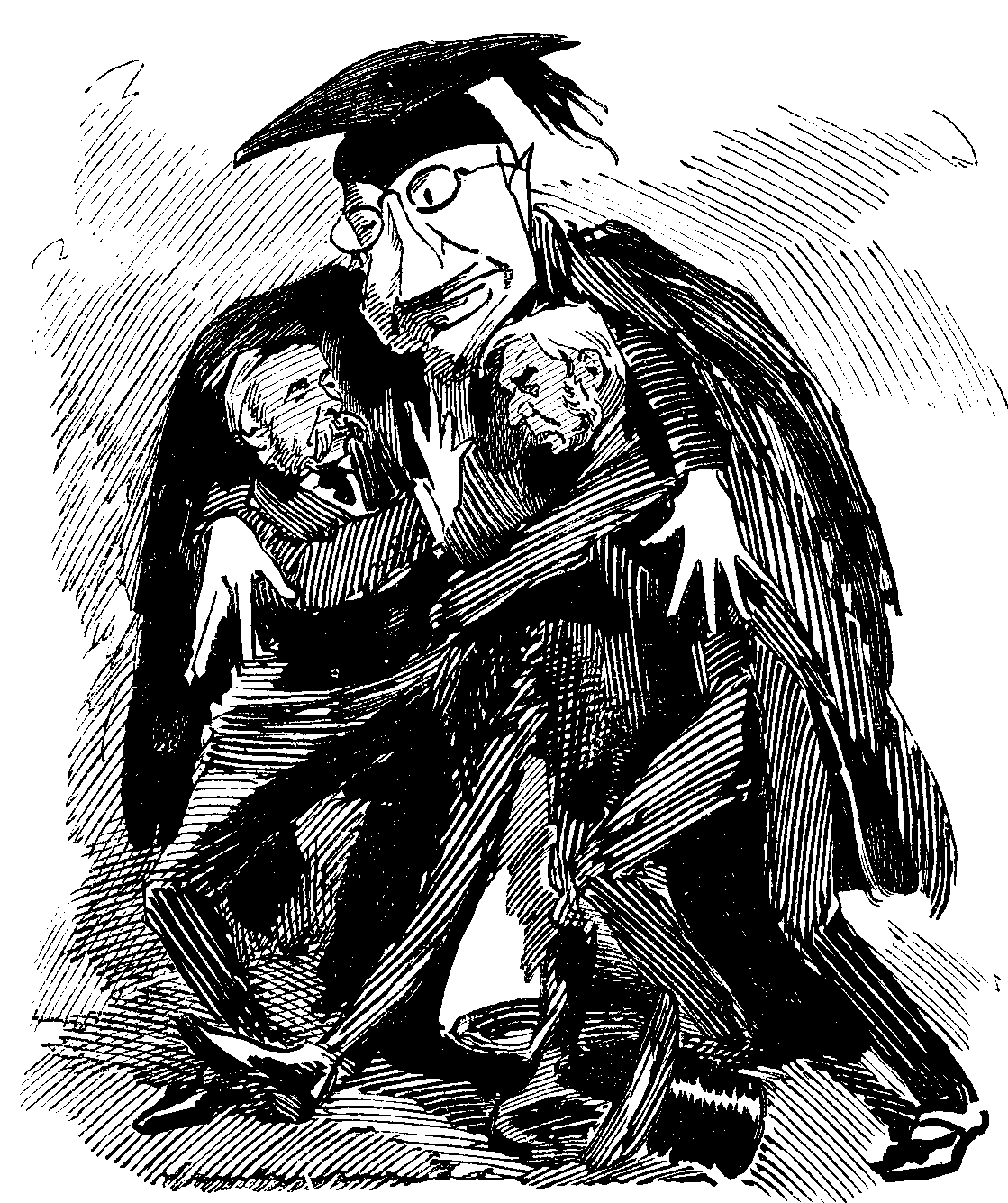
ASSISTED EDUCATION BILL.
MITRED MISERY.
June 6th.—Rather gratifying to find that my service to the Church—I don't mean Church Services—have at length been recognised. Just received intimation of my appointment to Bishopric of Richborough. How wild it will make my dear old friend, Canon STARBOTTLE, to be sure! Well—I must accept it as a call, I suppose!
July.—Had no idea being made a Bishop was such an expensive business. No end of officials connected with Cathedral, all of whom demand their fee. After spending at least £500 in this way, found there was an additional fee of a hundred guineas for "induction into the temporalities." As there are no temporalities nowadays, this is simply extortion. Remarked so to the Dean, who replied (nastily, I think), "Oh, it's for the interest of the Church not to have paupers for Prelates." I retorted at once, rather ably, that "I could not conceive a better plan for bringing Prelates to pauperism than the exaction of extortionate fees at Installation." Dean replied, sneeringly, "Oh, if you don't value the honour, I suppose there's still time for you to resign." Resign, yes; but should I get back my five or six hundred pounds?
Next year.—Strange, how I seem to be singled out for preferment. Am to be "translated," it seems, to diocese of Minchester. Can't very well refuse, but really am only just getting over drain on my purse last year owing to my accepting Bishopric here. And on inquiry, find that fees at Minchester much heavier than anywhere else! Is this really a call? Certainly a call on my pocket. And my family cost such a tremendous lot. And then I've had to do up the Palace, left by my predecessor in a perfectly shocking state of disrepair!
Later.—My worst apprehensions were realised! Fee for Consecration huge! Fee for Installation, monstrous! Fee for Investiture, a perfect swindle! Isn't there a song beginning "Promotion is vexation, Translation is as had?" Translation is worse! Shall really have to consider whether there would be anything unepiscopal in negotiating a little loan, or effecting a mortgage on the Palace.
Year Later.—Have been offered vacant Archbishopric! No, thanks! Late Archbishop almost swamped by the fees, and he was a rich man. I am a poor man—thanks to recent preferments—and can't afford it. An Archbishop in the Bankruptcy Court would not look well. "His Grace attributed his position to expenses connected with the various Installation ceremonies, and offered a composition of one-and-sixpence in the pound, which was unanimously declined by the creditors." When will they do away with gate-money in the Church?
Some savants were the other day puzzling their heads to find a convenient and familiar word for the illumination produced by the electric spark. Surely it is Edisunlight.