Volume 100 — OUR BOOKING-OFFICE.
Reading edition
Messrs. R. Osgood & Co. in advertising Miss SARAH ORME JEWETT'S book, Strangers and Wayfarers, quotes an extract from one of Mr. RUSSEL LOWELL'S letters, which runs thus:—
"I remember once at a dinner of the Royal Academy, wishing there might be a toast in honour of the Little Masters, such as TENNIEL, DU MAURIER, and their fellows."
He "wished" it, but was the wish a silent one, or did it find expression in a speech? No matter: there are the Old Masters and the Young Masters, there are the Middle-Aged Masters; there are the Great Masters; and, according to Mr. RUSSELL LOWELL, there are "the Little Masters," without any middle term at all. "The Little Masters," like children in the nursery of Art, not admitted to dinner, but who come in afterwards for dessert. May they come in for their just deserts, as no doubt they will some day. Well, according to this Lowelly estimation of merit, these would be the Lesser Masters, and after them the No Masters at all, except perhaps the Toast-Masters. But why not follow a kind of public school classification which divides one form—of course all the artists belong to the very best form, and, like Sir FREDERICK the President, show the very best form—into several compartments, so that we should have in one form say, the Fifth, Upper Fifth, Middle Fifth, subdivided into Upper and Lower Middle, then Lower Fifth, with a similar subdivision? Orders of merit to be worn in the button-hole could then be distributed, and a new Order of the "B.P.", not "British Public," but "Brush and Pencil," could be instituted, to be entitled fully, "The Masters of the Black and White Art."
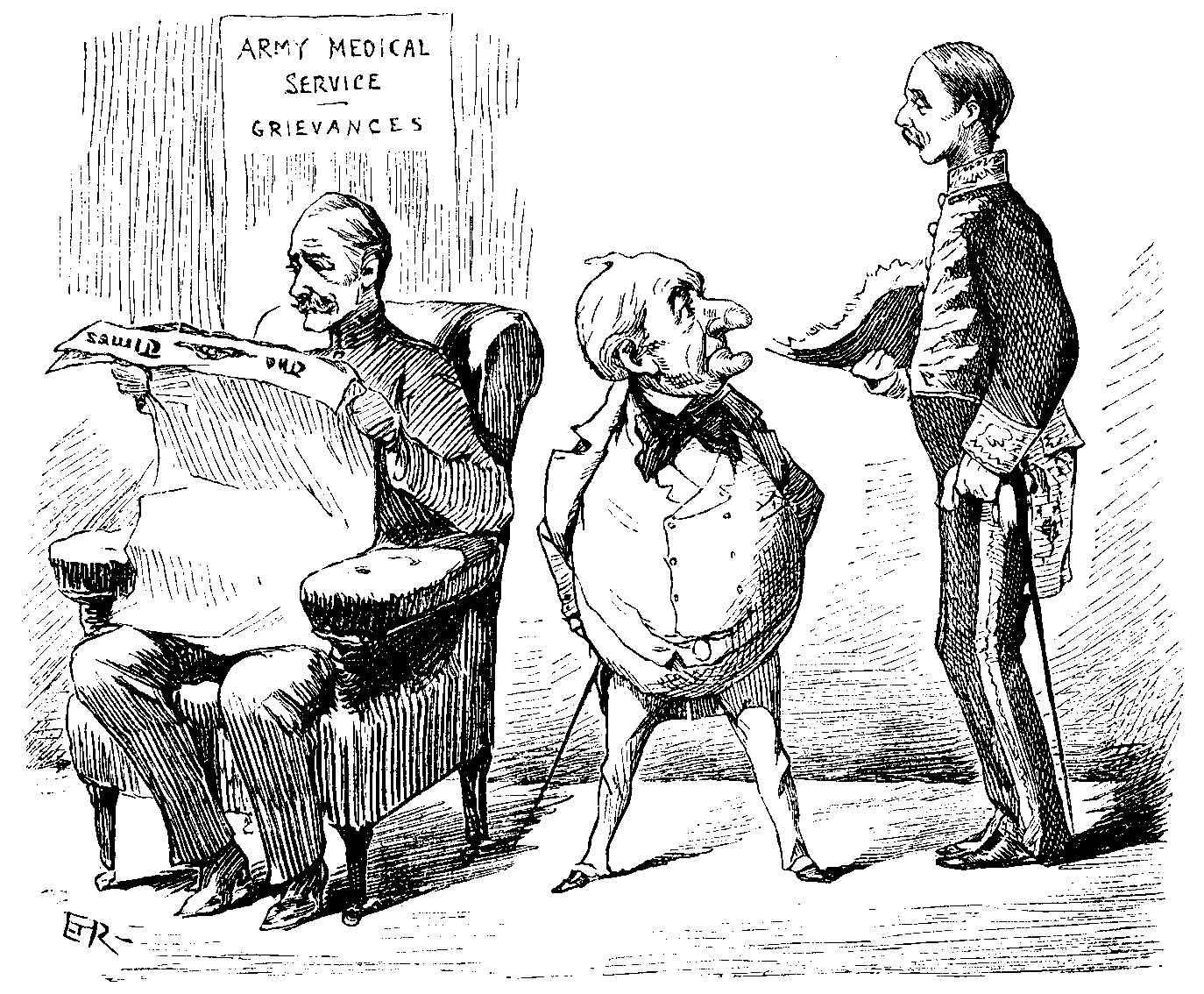
"(STAN)-HOPE TOLD A FLATTERING TALE."
Mr. Punch (to War Secretary). "VERY WELL ON ACCOUNT; BUT WHEN IS HE TO HAVE HIS REWARD IN FULL, LIKE HIS BROTHERS OF THE COMBATANT BRANCH?"
In the Fortnightly, besides an article on the prevailing epidemic, by Sir MORRELL MACKENZIE, M.D., which finishes with much the sort of general advice that was given by Mr. Justice Starleigh to Sam Weller, to the effect that "You had better be careful, Sir," whoever you are, who read this short, but generally interesting paper. There is an anonymous paper on an imaginary election at the Royal Academy, noticeable only for an excellent imitation of Mr. GEORGE MEREDITH'S style. The Novelist is supposed to look in casually, and, finding an election imminent, he offers sage words of counsel, and then begs to be allowed to "float out of their orbit by a bowshot." It seems to me that the paper was written for the sake of this one short paragraph, which, as a close parody, is inimitable. A Modern Idyll, by the Editor, Mr. FRANK HARRIS, is, as far as this deponent is concerned, like the Rule of Three in the ancient Nursery Rhyme, for it "bothers me," and, though written with considerable dramatic power, yet it seems rather the foundation for a novel which the Author felt either disinclined to continue, or unable to finish. ALTER HEGO (in the Office of the B. de B.-W.)
THE TYRANTS OF THE STRAND !
(Fragment from a Romance, Founded upon a Modern Strike.)
It was a dark and stormy night. The wind howled, the rain pelted, and the poor travellers were drenched to the skin. They shaded their eyes, and peered forth into the blackness to see if succour was at hand. Their strength was exhausted, and they felt they could go no further. Oh! what would they not have given to be once more on board the tight little craft they had abandoned! But no! it was not to be. They must seek for help from another quarter! Suddenly there emerged from the darkness a strange-looking structure, that with its lights seemed bent upon running them down. They signalled for help, and the grotesque vessel was hove to.
"What do you want?" asked a gruff voice, to their great delight, in English. "What are you a haling us for?"
"We are shipwrecked travellers," explained the spokesman of the party; "and we ask for conveyance to a place of safety."
"A place of safety—sounds like a cab-stand," muttered the other. "Well, jump in." Thus invited, the shipwrecked travellers entered what seemed to them to be a welcome harbour of refuge. But they had not proceeded far when the man who had already spoken to them again addressed them.
"Come—all of you—turn out—but first pay me," and then he mentioned a considerable sum of money.
"Have you no mercy?" cried a fair-haired girl, pointing to the white and rain-drenched locks of her ancient parents.
"Not a bit, Miss," returned the semi-savage, with a hideous grin.
"And who are you, rude man?" she asked, plucking up in her very despair some spirit. "Are you the Captain?"
"Much the same thing—I am called the Conductor."
"And what is the name of this dreadful conveyance?" again questioned the damsel, with a shuddering glance at what seemed to be a straw-strewn cabin.
"It is called," replied the man, defiantly, "the Pirate Bus!" On hearing this, the entire party uttered a despairing cry, and fainted!