Volume 100 / Act 1 — ACT I.
Reading edition
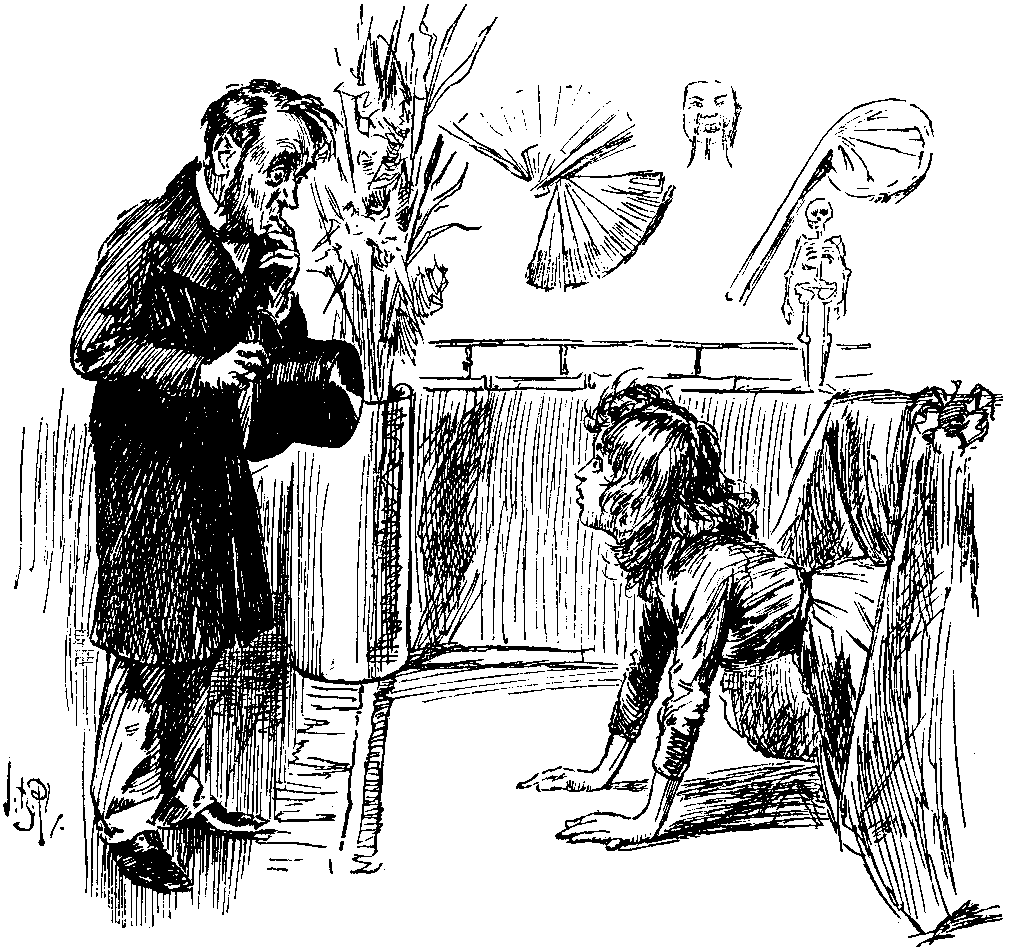
A Room tastefully filled with cheap Art-furniture. Gimcracks in an étagère; a festoon of chenille monkeys hanging from the gaselier. Japanese fans, skeletons, cotton-wool spiders, frogs, and lizards, scattered everywhere about. Drain-pipes with tall dyed grasses. A porcelain stove decorated with transferable pictures. Showily-bound books in book-case. Window. The Visitors' bell rings in the hall outside. The hall-door is heard to open, and then to shut. Presently NORA walks in with parcels; a Porter carries a large Christmas-tree after her—which he puts down. NORA gives him a shilling—and he goes out grumbling. NORA hums contentedly, and eats macaroons. Then HELMER puts his head out of his Manager's room, and NORA hides macaroons cautiously.
Helmer (playfully). Is that my little squirrel twittering—that my lark frisking in here?
Nora. Ess! (To herself.) I have only been married eight years, so these marital amenities have not yet had time to pall!
"Boo!"
Helmer (threatening with his finger). I hope the little bird has surely not been digging its beak into any macaroons, eh?
Nora (bolting one, and wiping her mouth). No, most certainly not. (To herself.) The worst of being so babyish is—one does have to tell such a lot of taradiddles! (To H.) See what I've bought—it's been such fun!
[Hums.
Helmer (inspecting parcels). H'm—rather an expensive little lark!
[Takes her playfully by the ear.
Nora. Little birds like to have a flutter occasionally. Which reminds me—(Plays with his coat-buttons.) I'm such a simple ickle sing—but if you are thinking of giving me a Christmas present, make it cash.
Helmer. Just like your poor father, he always asked me to make it cash—he never made any himself! It's heredity, I suppose. Well—well!
[Goes back to his Bank. NORA goes on humming.
Enter Mrs. LINDEN, doubtfully.
Nora. What, CHRISTINA—why, how old you look! But then you are poor. I'm not. TORVALD has just been made a Bank Manager. (Tidies the room.) Isn't it really wonderfully delicious to be well off? But, of course, you wouldn't know. We were poor once, and, do you know, when TORVALD was ill, I—(tossing her head)—though I am such a frivolous little squirrel, and all that, I actually borrowed £300 for him to go abroad. Wasn't that clever? Tra-la-la! I shan't tell you who lent it. I didn't even tell TORVALD. I am such a mere baby I don't tell him everything. I tell Dr. RANK, though. Oh, I'm so awfully happy I should like to shout, "Dash it all!"
Mrs. Linden (stroking her hair). Do—it is a natural and innocent outburst—you are such a child! But I am a widow, and want employment. Do you think your husband could find me a place as clerk in his Bank? (Proudly.) I am an excellent knitter!
Nora. That would really be awfully funny. (To HELMER, who enters.) TORVALD, this is CHRISTINA; she wants to be a clerk in your Bank—do let her! She thinks such a lot of you. (To herself.) Another taradiddle!
Helmer. She is a sensible woman, and deserves encouragement. Come along, Mrs. LINDEN, and we'll see what we can do for you.
[He goes out through the hall with Mrs. L., and the front-door is heard to slam after them.
Nora (opens door, and calls). Now, EMMY, IVAR, and BOB, come in and have a romp with Mamma—we will play hide-and-seek. (She gets under the table, smiling in quiet satisfaction; KROGSTAD enters—NORA pounces out upon him). Boo!... Oh, I beg your pardon. I don't do this kind of thing generally—though I may be a little silly!
Krogstad (politely). Don't mention it. I called because I happened to see your husband go out with MRS. LINDEN—from which, being a person of considerable penetration, I infer that he is about to give her my post at the Bank. Now, as you owe me the balance of £300, for which I hold your acknowledgment, you will see the propriety of putting a stop to this little game at once.
Nora. But I don't at all—not a little wee bit! I'm so childish, you know—why should I? [Sitting upright on carpet.
Krogs. I will try to make it plain to the meanest capacity. When you came to me for the loan, I naturally required some additional security. Your father, being a shady Government official, without a penny—for, if he had possessed one, he would, presumably, have left it to you—without a penny, then, I, as a cautious man of business, insisted upon having his signature as a surety. Oh, we Norwegians are sharp fellows!
Nora. Well, you got Papa's signature, didn't you?
Krogs. Oh, I got it right enough. Unfortunately, it was dated three days after his decease—now, how do you account for that?
Nora. How? Why, as poor Papa was dead, and couldn't sign, I signed for him, that's all! Only somehow I forgot to put the date back. That's how. Didn't I tell you I was a silly, unbusinesslike little thing? It's very simple.
Krogs. Very—but what you did amounts to forgery, notwithstanding. I happen to know, because I'm a lawyer, and have done a little in the forging way myself. So, to come to the point—if I get kicked out, I shall not go alone! [He bows, and goes out.
Nora. It can't be wrong! Why no one but KROGSTAD would have been taken in by it! If the Law says it's wrong, the Law's a goose—a bigger goose than poor little me even! (To HELMER, who enters.) Oh, TORVALD, how you made me jump!
Helmer. Has anybody called? (NORA shakes her head.) Oh, my little squirrel mustn't tell naughty whoppers! Why, I just met that fellow KROGSTAD in the hall. He's been asking you to get me to take him back—now, hasn't he?
Nora (walking about). Do just see how pretty the Christmas-tree looks!
Helmer. Never mind the tree—I want to have this out about KROGSTAD. I can't take him back, because many years ago he forged a name. As a lawyer, a close observer of human nature, and a Bank Manager, I have remarked that people who forge names seldom or never confide the fact to their children—which inevitably brings moral contagion into the entire family. From which it follows, logically, that KROGSTAD has been poisoning his children for years by acting a part, and is morally lost. (Stretches out his hands to her.) I can't bear a morally lost Bank-cashier about me!
Nora. But you never thought of dismissing him till CHRISTINA came!
Helmer. H'm! I've got some business to attend to—so good-bye, little lark! [Goes into office and shuts door.
Nora (pale with terror). If KROGSTAD poisons his children because he once forged a name, I must be poisoning EMMY, and BOB, and IVAR, because I forged Papa's signature! (Short pause; she raises her head proudly.) After all, if I am a doll, I can still draw a logical induction! I mustn't play with the children any more—(hotly)—I don't care—I shall, though! Who cares for KROGSTAD?
[She makes a face, choking with suppressed tears, as Curtain falls.
N.B.—The tremendous psychological problem of whether NORA is as much of a doll, a squirrel, and a lark, as she seems, and if so, whether it is her own fault, or HELMER's or Society's, will be solved in subsequent numbers.
BETTER LATE THAN NEVER.—At last by the authority of the L.C.C. his Grace of BEDFORD has been notified that within three months from now "Locks, bolts, and bars must fly asunder" in the parish of St. Pancras, where henceforth existence of all such obstruction is to cease. We hope that the gate-keepers, whose occupation is gone, have been amply provided for, as they will now have no gates, but only themselves to keep. Mr. Punch has persistently advocated the reform. And now, Gentlemen, how about Mud Salad Market, which, like Scotland in Macbeth's time, "stands where it did"?
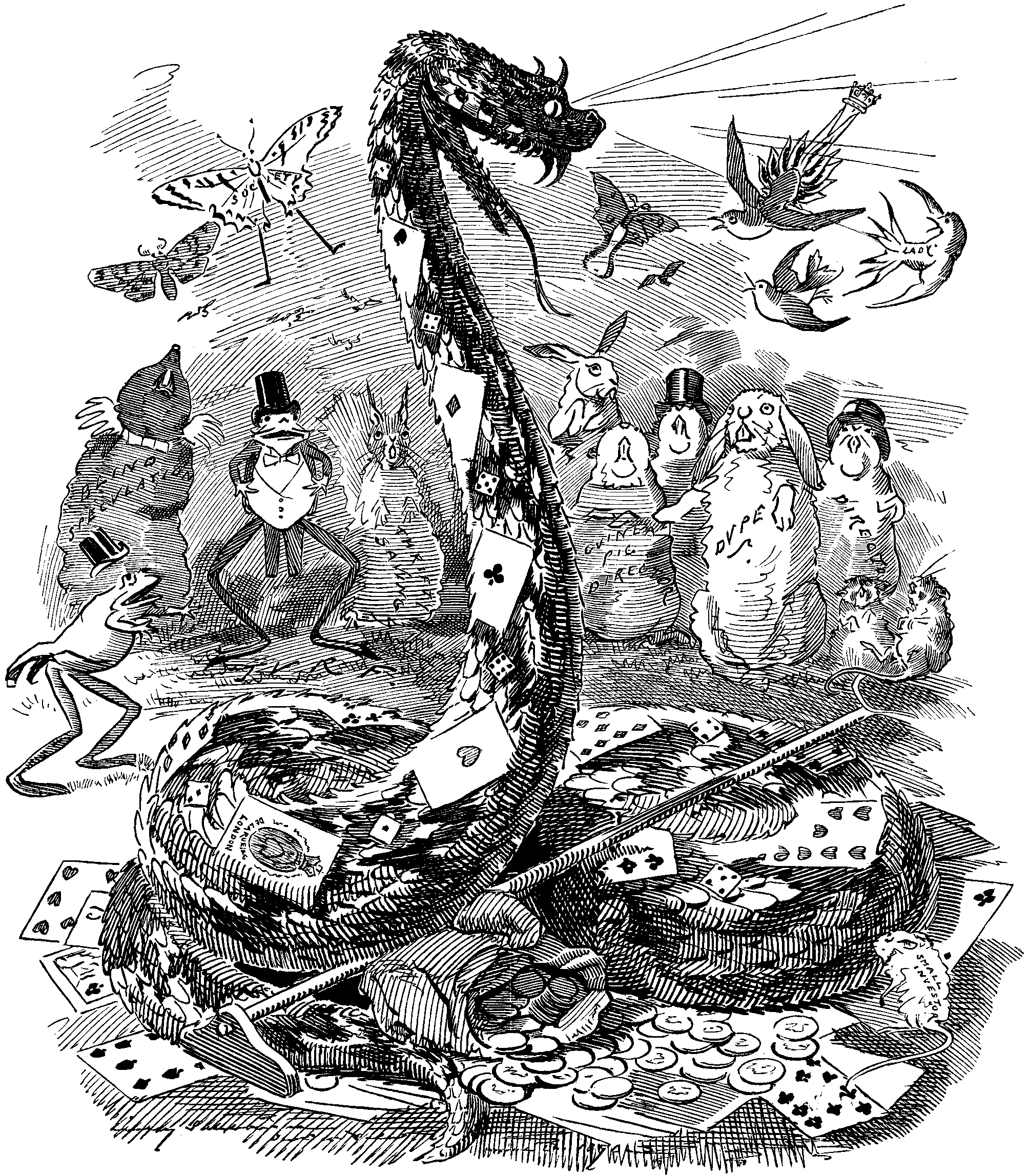
FASCINATION!
"APOLLONIUS, by some probable conjectures, found her out to be a serpent, a Lamia; and that all her furniture was, like Tantalus's gold described by HOMER, no substance, but mere illusion."—Burton's Anatomy of Melancholy.]
A LAMIA, this? Nay, obvious coil, and hiss most unequivocal, betray the Snake; As fell ophidian as in fierce meridian of Afric ever lurked in swamp or brake; And yet Corinthian LYCIUS never doted on the white-throated charmer of his soul With blinder passion than our fools of Fashion Feel for this gruesome ghoul. Poor LYCIUS had excuse. Who might refuse worship to Lamia, "now a lady bright"? But foul-fanged here, fierce-eyed, a shape of fear, the serpent stands, revealed to general sight, A loathly thing, close knotted ring on ring, of guise unlovely, and infectious breath; And yet strong witchery draws to those wide jaws Whose touch is shameful death. See how the flattering things on painted wings, foolish as gnat-swarms near the shrivelling blaze, Flock nearer, nearer! Forms, too, quainter, queerer, frog-dupes of folly, rabbit-thralls of craze, Butterfly triflers, gay-plumed would-be riflers of golden chalices, of poisoned flowers, Flitter and flutter in delirium utter, As drawn by wizard powers. Oh, "Painted Lady," Summer coverts shady, the greenwood home, the sweep of sunny fields, A butterfly befit; but where's the wit that mire-befouled to the swamp-demon yields? Oh, birds of Iris-glitter, black and bitter will be the wakening when those gaudy plumes Fall crushed and leaden, as your senses deaden In poisonous Python fumes! Ye gobemouche creatures of batrachian features, who "go a-wooing" such a fate as this, Have ye no vision of that doom's decision? Have ye no ear for rattle or for hiss? Salammbô's craving, morbid and enslaving, was sanity compared with your mad love, As well the swallow the fierce shrike might follow, Or hawk be chased by dove! Tantalus' gold is all such Lamias hold; 'tis Devil's dice such Mammon vassals throw; A sordid fever fires each fool-believer in the gross glitter, the unholy glow. Vile is your Dagon! Circe's venomed flagon embruted less than doth the Lamia's wine, Than Comus' cup more perilous to sup— As snakes are worse than swine. The poet's snake enchanted, who so flaunted her borrowed robes amidst the daffodils, Hath piteous touches. She, from Fate's clutches, free some brief space, "escaped from so sore ills," Moves our compassion. But this modern fashion of Snake Enchanter looks unlovely all. Greed's inspiration its sole fascination. Low selfishness its thrall. "A Serpent!" So the Sophist murmured low, and "LYCIUS' arms were empty of delight," LAMIA had fled! Would that some sage cool head, some modern APOLLONIUS, with the might Of sense magnanimous, would banish thus the bestial Lamia of our later day, Whose fascination draws a noble nation To sordid slow decay!
DANTE NOT "IN IT"!—The Italian language is to be excluded from the Indian Civil Service Examination. "The story is extant, and written in very choice Italian," said Hamlet, and SHAKSPEARE knew that the reference would be intelligible to his audience. But Hamlet "up to date" in this "so-called nineteenth century" would be compelled to give the speech thus, "The original story, I believe, is written in the Italian language, with which none of us here are acquainted." But, after all, the candidates may be inclined to adapt the Gilbert-Sullivan words and music to the occasion, and sing—
"So, in spite of all temptation, At the next examination They'll bar I-tal-i-an!"
Though, years hence, it may happen that they'll be sorry they weren't compelled to get up Italian as one of the subjects.
"O WOMAN, IN OUR HOUR OF EASE!"—which line would make a suitable motto for our very useful, chatty, and interesting weekly contemporary entitled Woman. À propos of "headings," the only one in the above-mentioned publication to which objection can possibly be taken "on the face of it" is "Wrinkles." Wouldn't "Whispers" be better? It is quite enough for Woman to appear with lines, but it's too bad that wrinkles should be added while she is yet so young.
"CHARLES OUR FRIEND."—Once again occurs an illustration of the applicability of Dickensian characters to modern instances. In last Thursday's Times, by special Razzle-Dalziel wire, we read of the return of another great Arctic explorer, Mr. WASHBURTON PIKE, after having braved dangers demanding the most dauntless courage. Here, then, are two single gentlemen rolled into one: it is Pike and Pluck combined.
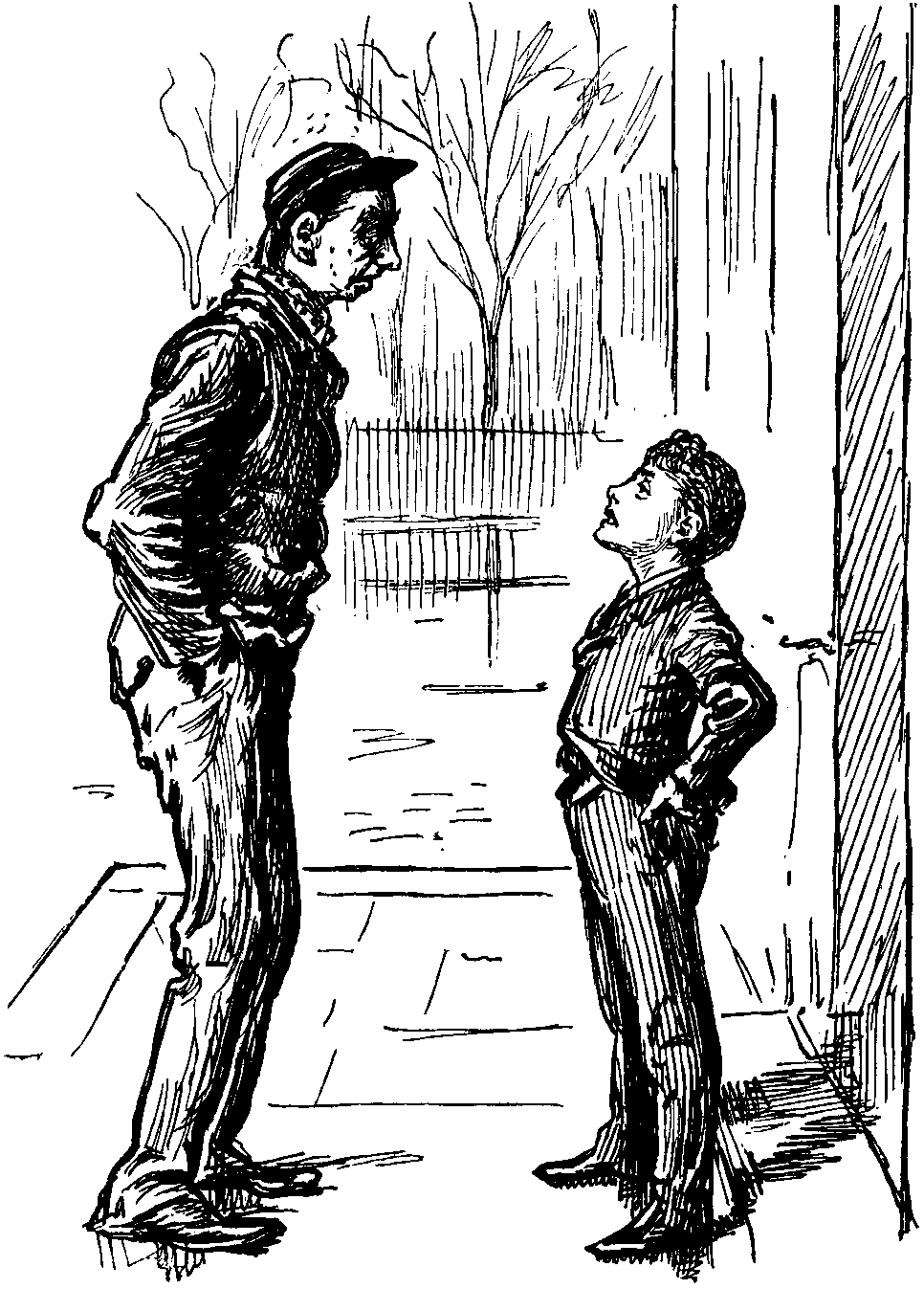
BEATUS POSSIDENS.
"I'VE COME ABOUT A JOB. I HEARD THERE WAS A BOY WANTED."
"OH, YOU 'EARD AS THERE WAS A BOY WANTED, DID YER? THEN YOU'RE JUST TOO LATE, 'COS MASTER'S SOOTED!"