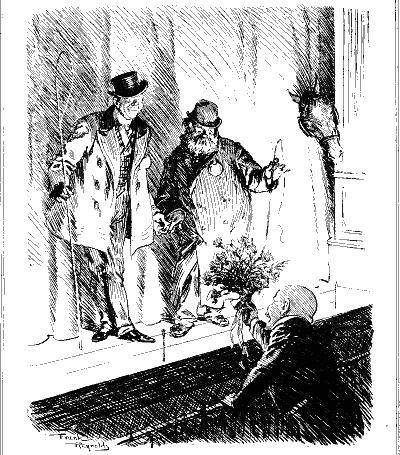
NEW WELLS FOR OLD.
Reading edition
Over the top of Part II. of The Outline of History I caught the smiling glance of the man in the opposite corner of the compartment.
"Good stuff that," he said, indicating the History with a jerk of his head.
"Quite," I agreed, maintaining my distance.
"Immense," he continued. "And it means the dawn of a new life for me. I'm Wells's hero. Every time I've appeared in his half-yearly masterpiece, ever since Tono Bungay. And look at the mess he's made of my life. Often I've had to start it under the cloud of mysterious parentage. Invariably I have been endowed with a Mind (capital M). Think of those uphill fights of mine against adverse conditions. And my unhappy marriages. He has led me into every variation of infidelity. When I did hit it off with my wife for once, he sent us to the Arctic regions as a punishment. In the depth of winter, too.
But, now he's taken up this History, I'm free. The dam has burst and strange things come floating down ..."
He sprang to his feet in his excitement. He was wearing a loose-fitting suit and what his master might call a lower middle-class hat.
"And now I'm going to do all the things I've always wanted to do. A happy marriage; well-ordered life in the suburbs; warm slippers in the fender, and all that that stands for; kinemas, perhaps, and bowls. An allotment ..."
"But," I objected, "this History won't occupy him for ever. There should be only about sixteen more parts. He'll have you out again next autumn."
"But Wells is getting the Suburban idea too." He was standing right over me, glaring horribly with excitement. The train had entered a tunnel and he was shouting bravely against the din. "Look in Part I. He acknowledges the help he has received from Mrs. Wells. And her watchful criticism. That from him! I tell you I am free—free!"
He was shaking me by the shoulders now, his face close to mine. "I shall have my allotment. Prize parsnips—giant marrows!"
"Don't be too sure," I yelled—the tunnel seemed endless. "Remember poor old Sherlock. Doyle raised him from the dead. And you"—my voice rising to a scream—"he'll have you out—out—out!"
* * * * *
As I came to I heard my dentist remark to the doctor that I always had been a bad patient under gas.
MR. PUNCH ON SILK STOCKINGS.
Dear Mr. Punch,—Your article about Christmas presents was a great success. I took your advice about the silk stockings, and sent the following verses with them, which some of your married readers may care to cut out and keep for future use:—
Your stockings once, on Christmas Eve, Would hang, your cot adorning, And Father Christmas, we believe, Would fill them ere the morning; But since he spied your dainty toes To exchange the parts he's willing: He thinks it's his to send the hose And yours to find the filling. He lays his offerings at your feet And hopes you won't deride them, For he has nothing half so neat As you to put inside them.
There! I can only repeat that the results were excellent, and express my gratitude to you for the same.
Yours obediently, Grateful Husband.
P.S.—The ties I got this time were quite all right; she too must have read your article.
NATURE AND ART.
To Betty, who can afford to defy the laws of symmetry.
[Being reflections on the old theory, recently developed before the Hellenic Society by Mr. Jay Hambridge, that certain formulæ of proportions found in nature—notably in the normal ratio between a man's height and the span of his outstretched arms (2 : √5)—constituted the basis of symmetry in the art of the Greeks and, earlier, of the Egyptians.]
Betty, I fear you don't conform Precisely to the female norm From dainty foot to charming noddle, But, closely measured, span by span, Seem built upon a private plan Not found in Annie Kellerman Or in the well-known Melos model. If you compare your width and height— Arms horizontal, left and right— With ancient types of pure perfection, The ratio may not, it's true, Be as the root of 5 to 2, But what, my dear, has that to do With laws of natural selection? Let Mr. Hambridge to your shape Apply his T-square and his tape, And wish that you were more archaic; Why should I care? I love you best For what no compasses can test, For graces not to be expressed In terms however algebraic. I love you for the lips and eyes That none may hope to standardize On any system known to Hellas; And what I like about your smile Has no relation to the style Of any pyramid of Nile Figured by mathematic fellahs. Though your proportions mayn't agree With Fechner's pedant formulæ, I don't complain of such disparity; Too flawless that perfection shows; For me a larger comfort flows From human failings (take your nose— I like its quaint irregularity). Indeed I love you best of all For those defects by which you fall Short of the pattern you should follow; As I would fain be loved for mine, Speaking as one whose own design Lacks something of the perfect line Affected by the young Apollo. O. S.
HOW TO GAIN A JOURNALISTIC POSITION.
Young aspirants are always endeavouring to secure posts on our leading newspapers, and complain bitterly that their letters of application are ignored by obtuse editors. To help them in this sad ambition Mr. Punch has composed a series of letters to divers editors which he guarantees will prove eminently satisfactory.
To the Editor of "The Daily News."
Sir,—I regard the insufferable Lloyd George as the most dangerous, the most malignant, the most incompetent politician who has ever attempted to misrule this country. The iniquity of the Coalition will make enlightened rulers like Lenin and Trotsky blush for the human race. I feel with you that till the real Liberal party returns to power England will never know peace and prosperity. Then and then only will brotherly friendship between England and Germany be renewed. Then and then only shall we see cheap milk, cheap coal, abundant housing, the Free Breakfast Table and the Large Cocoa Cup. To show my devotion to the cause you so nobly advocate I may say that I have actually read every article contributed by Mr. Masterman to your paper. I am strongly in favour of an entente with Labour, by which Labour should agree not to contest any seats where the true Asquithians stand a chance. I enclose as a specimen of my work the first of a series of articles on "How Lloyd George lost the War," which I am sure will be invaluable at by-elections.
To the Editor of "The Daily Mail."
Sir,—I am young and, if possible, growing younger daily. My motto is "Hustle and Bustle" and not "Dilly and Dally." I live on standard bread, in a wooden hut embowered, when feasible, with sweet peas. My ear is always close to the ground, and I can confidently predict what the man in the street will be thinking about the day after tomorrow. Politically, I am opposed to the Wastrels, the Wee Frees and the Bolsheviks, and am not prepared as yet to back Labour unreservedly. I can express myself brightly and briefly on any topical subject. Herewith I send specimen articles (length three hundred words) on "Poker Bridge," "Are we having Wetter Washdays?" and "The Woggle-Wiggle Dance." Should there be no vacancy on your staff I should be prepared to accept one on any other of your publications—The Weekly Dispatch, The Times or The Rainbow.
To the Editor of "The Manchester Guardian."
Sir,—I was a Conscientious Objector during the War. I conscientiously object to everything still, including the Peace Treaty. I speak and write fifteen languages and dialects, including Oxford English. I have a comprehensive knowledge of social and political life in Continental Europe, Asia, Africa, America and Polynesia. I have also resided in England. I have a deep conviction that under all conditions, everywhere and at all times, England is invariably and absolutely in the wrong. In home politics I am resolutely opposed to all the Coalition has done, is doing or will do. It is my firm opinion that the actions of England would become less deplorable, less criminal if Mr. Asquith returned to power. I enclose as specimens of my mentality two intensely human articles which I doubt not will find a home in your columns: "Proportional Representation in Jugo-Slavia" (length four thousand five hundred words) and "Futurism under Trotsky" (length five thousand words).
To the Editor of "The Spectator."
Sir,—In offering my services to you I may point out how happily my up-bringing and mental training have fitted me for a post on your staff. The child of an Archdeacon (who was also honorary chaplain to a rifle club), I was born in a house with earth-filled walls and brought up in intimate association with a large number of most intelligent animals. If desired I am prepared to relate anecdotes of the family bull-dog and a pet she-goat which will verify my description. I feel with you that England can only be saved by relying on a Free-Trading, Non-Socialist, Church Establishment. I loathe alike Mr. Asquith and Mr. Lloyd George, and think that the intellect of England, which blossoms so luxuriously in country rectories and deaneries, finds its best expression in Lord Hugh Cecil. As a specimen of my literary ability I enclose a middle article on "The Sense of Obligation in Tom-Cats."