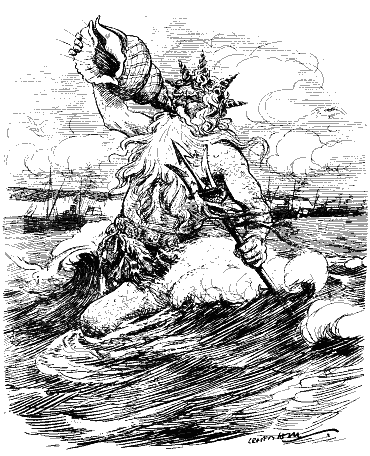
COMMERCIAL CONSCIENTIOUSNESS.
Reading edition
TRAPPING IMITATION ERMINE.
"The letter about the Bloomsbury cat that bought her own cat's meat in your issue of December 6th is interesting."
A Correspondent in "The Spectator."
The cat would, however, have shown more regard for the feelings of our justly-esteemed contemporary if it had wrapped up its purchase in some other publication.
"In his defence, —— said that he had really intended marrying the girl, but that he came to the realization that she was extremely ejaljoujs, hence his bjreach.
jThe court found that this was sufficient ground to justify jjjustify jujjjj jstjijfjy his breach of promise."—Canadian Paper.
It is evident, however, that the Court did not arrive at this decision without considerable hesitation.
More Headaches for Historians.
"The revellers passed the time in dancing and singing until St. Paul's clock struck midnight. Then 'Auld Lang Syne' was sung with enthusiasm and, after repeated cheers, the crowd dispersed."—Times.
"It was typical of the largest crowd that has watched round the cathedral the passing of the year that at the moment when midnight struck it should be engaged in one tremendous jostle and push, rough and tumble, and that no one thought to strike up the tune—traditional to the occasion—of 'Auld Lang Syne.'"—Star.
"The gigantic Hindenburg figure of Militarism in the centre of the room melted away with the appearance of the Peace Angel, reputed to be the fairest lady in Chelsea, who had climbed a ladder within his leviathan bulk."—Times.
"When twelve o'clock struck The God of War should have collapsed gracefully to give place to the most beautiful artist's model in Chelsea, draped as the Goddess of Peace. But something went wrong with the ropes, and the God of War floated a yard or two into the air, just sufficiently high to show us the feet and knees of the Goddess of Peace."—Evening Standard.
"The famous flood-test of the Parisian, the stone ouave on the Bridge of Alma, is in water up to his waist."—Provincial Paper.
Surely an understatement. The "ouave" seems to have had his Z washed away.
From a feuilleton:—
"James put his cold hands in his pockets and buttoned up his coat collar before turning out to his work."—Weekly Paper.
This is not so easy as it sounds.
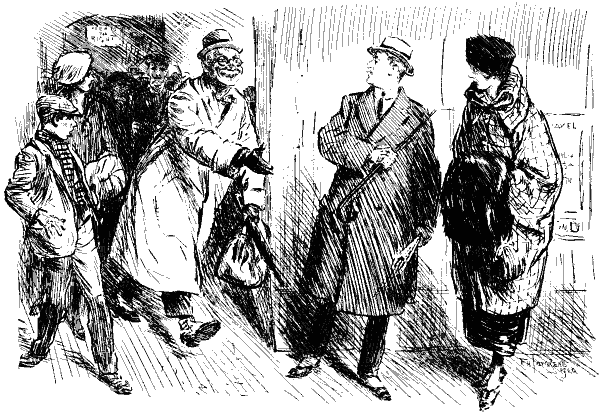
Teuton (released after internment for the duration, to old business friend who is trying to avoid him). "Well, mine frient, and where haf you peen hiding yourself the last four or fife years?"
WORDS OF WISDOM.
"Come, all you young seamen, take heed now to me, A hard-case old sailorman bred to the sea, As sailed the seas over afore you was born, An' learned 'em by heart from the Hook to the Horn. "Don't hold by the ratlines when going aloft (Which I've told you afore but can't tell you too oft), Or you'll strike one that's rotten as sure as you live, And it's too late to learn when you've once felt it give; If you don't hit the bulwarks you'll sure hit the sea, For them rotten ratlines—they're the devil," says he. "Now if you should see, as you like enough may, When tramping the docks for a ship some fine day, A spanking full-rigger just ready for sea, And think she's just all that a hooker should be, Take 'eed you don't ship with a skipper that drinks— You'd better by half play at fan-tan with Chinks!— For that'll mean nothing but muddle an' mess, It may be much more and it can't be much less, What with wrangling and jangling to drive a man daft, And rank bad dis-cip-line both forrard and aft, A ship that's ill-found and a crew out of 'and, And a touch-and-go chance she may never reach land, But go down in a squall or broach to in a sea, For them drunken skippers—they're the devil," says he. "And if you go further and pause to admire A ship that's as neat as your heart could desire, As smart as a frigate aloft and alow, Her brasswork like gold and her planking like snow, Look round for a mate by whose twang it is plain That his home port is somewhere round Boston or Maine, With a jaw that's the cut of a square block of wood, And beat it, my son, while the going is good! There'll be scraping and scouring from morning till night To keep that brass shiny and keep them decks white, And belaying-pin soup both for dinner and tea, For them smart down-easters—they're the devil," says he. "But if by good fortune you chance for to get A ship that ain't hungry or wicked or wet, That answers her hellum both a-weather and lee, Goes well on a bowline and well running free, A skipper that's neither a fool nor a brute, And mates not too free with the toe of their boot, A sails and a bo'sun that's bred to their trade, And a slush with a notion how vittles is made, And a crowd that ain't half of 'em Dagoes or Dutch, Or Mexican greasers or niggers or such, You stick to her close as you would to your wife, She's the sort that you only find once in your life; And ships is like women, you take it from me, That, if they are bad 'uns, they're the devil," says he. C. F. S.
"With regard to prison labour, it is stated that the manufacture of war stories had continued to employ every available inmate."
Christian Science Monitor.
We had wondered where some of them came from.