ESSENCE OF PARLIAMENT.
Reading edition
EXTRACTED FROM THE DIARY OF TOBY, M.P.
House of Commons, Monday, May 19.—Old Morality in new and charming mood to-night; turned over a fresh leaf in his copybook; entered upon the chapter headed "Banter;" not only enjoyed himself, but was cause of enjoyment in others. Esslemont began it; doled out, as if it were ounce of tea or yard and quarter of calico, ponderous joke about having no Holiday at Whitsuntide, and adding three days to Recess at end of Session.
"I will take a note of the Hon. Member's recommendation," said Old Morality.
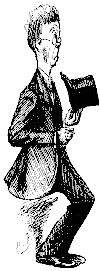
"Such badinage! such persiflage!"
Nobody laughs when I tell this; yet, remember, House roared whilst Old Morality, resuming seat, sat with pursed-up lips and furrowed brow, fearful lest he should spoil situation by smiling. Must have told the joke wrong; look up Parliamentary Reports. No, there it is, the very words; also his retort to Tim Healy; his turning the flank of Harcourt; his triumphant knocking over of Tim, when, after brief pause, he came up again.
"Such badinage!" said Charles Wilson, "such persiflage!"
So it seemed at time. Everyone roared with delight.
"Quite in Dizzy's style," said the admiring Stanhope.
"Only better," added the ecstatic Georgy Hamilton.
Thought so too at the time; but when I come to write down the jokes, the fun has gone, the flavour escaped, the bloom shed. Wonder what it was we all laughed at?
"You do your best," said the Member for Sark, always ready with kindly remark, "but you can't bring Old Morality and all he is to us on your written page. His voice, his looks, his way of getting up and of sitting down, his throwing back his head and thrusting forward his chin as he mouths his apophthegm, his nervous glance round the House, his assumption of a stern official aspect, breaking presently into a smile when the House laughs; his apologetic way of sitting on the edge of the seat when he has snubbed Harcourt; all his goodness, his littleness, his honest intention, and his occasional lapses into crooked paths; his 'Certainly, Sir,' when the thing is quite otherwise, his blush when he discovers himself dealing with facts in a Pickwickian sense, his constitutional modesty, and his spasmodic aggressiveness, the look in his eye as of a wounded hare when Courtney refuses to put the Closure he has moved,—all these are things, little in themselves, momentary in their passage, which you, dear Toby, can no more transfer to your folios than you can illuminate them with the glow of sunset, or perfume them with the scent of country lanes in this sweet spring-time. Old Morality belongs to us. He is a peculiar growth of the House of Commons, unique, unprecedented, unapproachable, never fully to be understanded of, or appreciated by, the people."
Business done.—Battling round Budget Bill; sat all night, and far into morning.
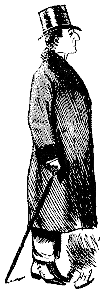
Going down to the House.
Tuesday.—Cadogan in good time at House of Lords to-day. Denman got first place with Motion for Second Reading of his Bill extending Municipal Franchise in Ireland. Cadogan to move rejection of Measure in name of Government.
"I must be firm," he said, as he turned up his trousers over his white spats. "Denman a terrible fellow when he's roused."
House pretty full when Denman appeared at table in position of Leader of Opposition. An ordinary Member not connected with either present or late Government, usually speaks from Bench on which he is accustomed to sit. Denman preferred conveniences of table. Most interesting speech, what could be heard of it. Good deal about Sir Robert Peel; occasional reference to Palmerston; some reminiscences of early journey in railway-carriage in Stephenson's time; a passing remark as to the weather, and probable state of the crops on this day six months. But, as Cadogan subsequently remarked, nothing whatever about the Bill. Lords in an awkward position. Had the scene been in the Commons, and the elderly grey-haired gentleman at the table been merely returned by a constituency, the case would have been different. Might have been howled down in a few moments. But with a Peer of the Realm, a hereditary legislator, a personage whose vote might in certain conceivable circumstances suffice to throw out a Bill which had received sanction of House of Commons, it is, as Granville says, une autre paire de manches. If anyone whispered that Denman had a tile off, whither would the admission lead us? A Peer is a man—or rather, a Being—of a special, superlative order. Admitted within that order, he becomes, ipso facto, a person of extraordinary intelligence, keen intellect, ripe judgment, irreproachable character.
A little awkward that Denman should seem to be rambling. If he were a Commoner, might even be called incoherent. Being a Peer, some forty or fifty other Peers sat through twenty minutes with polite assumption of listening. But there is a substratum of human nature even in the Peerage. When Denman, à propos of the Municipal Franchise in Ireland, began to talk about Columbus's egg, there was a murmur of impatience; when he slid into the Panama Canal the murmur grew to a shout. Awhile, amid stormy cries for the Division, the House of Lords resembled the House of Commons.
After brief struggle with unwonted elements, Denman resumed seat; Bill thrown out, and with regained equanimity noble Lords turned to next business. To their horror, Denman up again at table; forgotten to mention a particular circumstance connected with Columbus's egg. "Perhaps their Lordships——" But this too much. At whatever risk to Peerage as a body, Denman must be shouted down. So they roared at him with cries of "Order!" he standing regarding them with looks of pained surprise. Was it possible they declined to hear more about Columbus's egg? "Order! Order!" they roared, Bath leading the onslaught.
"It is you, my Lords, who are disorderly," said Denman, and with head erect, and tall figure carried with pathetic dignity, he strode back to Cross Benches, and sat down in seat of Prince Of Wales.
Business done.—Budget Bill in Commons.
Thursday.—All the blood of his great predecessor in spoliation, Henry the Eighth, just now swelled in the bosom of James Stuart Allanson Tudor Picton. Prince Arthur responsible for the flood. Question about meeting announced to be held in Mid-Tipperary next Sunday. Prince Arthur has, it seems, prohibited it. John Morley wants to know why? There was, he says, public meeting held in same place last month, addressed by English Members; that not proclaimed. What was the difference between meeting addressed by Irish Members, and another by English Members, that one should be taken and the other left?
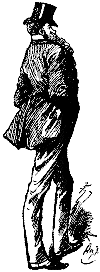
Pease (with Honour).
"The difference is," said Prince Arthur, speaking with embarrassed air, as if the distinction was dragged out of him, "that the result of the meeting addressed by Irish Members was to produce intimidation, whilst the result of the other was, I should say, nil."
If James Stuart Allanson Tudor Picton had only lived in the times of his great predecessor, and wielded his power, Prince Arthur would forthwith have been conducted to Tower Hill, and shortened by a head. Why he (James, &c.) was at this meeting at Mid-Tipperary last month! He, standing on a butter-tub, had addressed the men of Tipperary; the echo of his eloquence still filled the dales, whilst the hills reverberated with the cheers of the men of Tipperary. For this insolent hireling of a Coercionist Government to speak in tones of studied slight of such a demonstration was more than J. S. A. T. P. could stand. If our two giants, John O'Connor and Henry Pease had not joined hands and held him back, gore would have sprinkled the precincts of the Treasury Bench. As it was, the subject dropped, and House proceeded to discuss Budget Bill.
Business done.—A good lead.
Friday.—House adjourned for holidays. "When we come back," says Old Morality, "we must really begin work. Playtime up to now; left most of the work over; must buckle to. We've been in some danger, and there may be more ahead. Why are persons sometimes killed by leaning over beer-vats? Because vats, when beer has been made, contain large quantities of carbonic acid gas, produced by the vinous fermentation of the beer; and when a man incautiously leans over a beer-vat and inhales the carbonic acid, he is killed thereby. It is, of course, not quite the same in respect of spirits. Still, when a Chancellor of Exchequer has clapped on sixpence a gallon on whiskey, it is as well for his colleagues to avoid looking a Scotch hogshead or an Irish puncheon in the face. Au plaisir, cher Toby. Come along, Jackson!"
The two Right Honourables go off together, Jackson evidently turning over in his mind Old Morality's observations on the beer-vat.
"A wonderful man," he says, "his mind stored with odd bits of information, which he draws upon for enlightenment upon ordinary events of daily life. Don't exactly see, though, how he rolled in that beer-vat. Must think it over during the Recess."
Everyone glad to hail Jackson "Right Honourable." A proud title, as yet not spoiled by indiscriminate distribution. Suffices for Gladstone, as it did for Peel; suits Jackson exactly.
Business done.—Winding up for Whitsuntide. Adjourn for holidays till Monday, June 2nd.
THE OPERA-GOER'S DIARY.
From the Note-book of Mr. Pips Senior.—Monday, May 19.—To the Royal Opera House, Covent Garden. First night of the Season. The house infinite full, and the Prince of Wales and the Princess, and the Princesses their daughters, there in a box, pretty to see. Druriolanus Operaticus et Counticouncillarius mightily pleased at what I hear is the biggest subscription to this class of entertainment ever known. Many fine faces here to-day. The sight of the ladies exceeding noble.
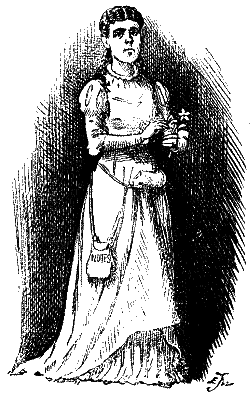
"Harmony in Black and White."
A new wench, Mlle. Nuovina, to sing for the first time, taking the part of Marguérite in the Opera of Faust, which she did prettily and quietly. Curious to see a Marguérite with jet-black hair and a white face; yet comely and with much grace.
Everyone extraordinarily content with Mons. Jean de Reszké, the best Faust that did ever sing and play this part. But vexed to see one M. Orme Darrall act Mephistopheles in the room of Edouard de Reszké, who, poor man, is sick. The scenes and the chorus all very fine indeed. All of us pretty merry at the droll mimicry of Mlle. Bauermeister as Martha, who makes this part go most rarely.
Pleased to see Madame Scalchi dressed as a boy for the part of Siebel. The house mightily content, and wishing her to sing one song twice over, which she would not. In which matter she did wisely, as also the others.
Went out before the last Act began, to find it raining heavily, and, good lack! not a Commissionnaire to be met with for a quarter of an hour. Whereat mightily troubled to get a coach, till one did fetch me a four-wheeler, which I entered, in great disorder, after much strife and contention. Cost me sixpence. To Rule's, in Maiden Lane, being mighty thirsty, where had supper on excellent lobster and fresh salad, with eggs of the plover, and a draught of the best stout, which did much content me. Comes young Silligrew, who makes merry about "sticking to Rules for supper and no exception," or some such nonsense, which I have forgot, though we laughed heartily at his manner of saying it. Drank to the success of the Italian Opera and of Druriolanus. After paying the reckoning, took cab, and so home to bed.
From Note-book of Mr. Pips Junior.—Tuesday.—Pips Senior doesn't go to Opera to-night. Pips Junior does. Think Pips Senior, as an Admiralty official, will be at the Court Ball with Madame Pips. Glad, therefore, to take his stall at the Opera. Carmen always delightful. Tuneful, melodious, and bright. Good Bizet-ness. Mlle. Zélie de Lussan as Carmen mighty difficult to beat, and she sings and plays the part with all the diabolical waywardness of this impudent Spanish baggage, as Pips Senior would call her. Pity that Maggie McIntyre is indisposed to play Michaela; she used to do it so prettily and so innocently that she shone out as just the very contrast intended by the author. Instead of Maggie, Mlle. Colombati sings the part to-night. She is very graciously received, as is also Signor Fernando Valero (from several Opera Houses abroad) who makes his début here as that vacillating tenor, Don José. Clever Mlle. Bauermeister as frisky Frasquita, and Mlle. Longhi as Mercedes, both excellent Bohemian Girls. To see them going nap was a treat! Which wins? One excellent Irish-Italian, Dan Drady, as the Toréador, first-rate. What a song it is! Encores refused all round, of course. In spite of State Ball, House very nearly as full as on first night. Brilliant effect of some ladies who are "going on," and who can't of course "go on anyhow," but are obliged to appear in their diamonds.
Pretty to see little Mlle. Palladino dancing. Very short life and a merry one has the première danseuse in this Opera. Just a few steps, and then she "steps it," and is not seen again. There is too little of Palladino at any time, and in this case, as she only comes on for five minutes at the commencement of Act II., and then "bon soir!" she may be described as "Small and Early."
Thursday.—Rentrée of Mlle. Ella Russell as Leila in Bizet's I Pescatori di Perle, another version of The Diversions of Purley, a work now more or less forgotten. Signor Valero better as Nadir (isn't this the name of a well-known photographer?) than as Don José. Not unlike the lamented Gayarre. The more like he can become to that tenor the better. M. Dufriche came from Madrid to play Zurga. A long journey; almost sorry he gave himself the trouble, but there's more than this for him to do. Lovely finish to First Act, but after that the Opera is not a stirring one, the story being so idiotically undramatic. Ella fresher than ever.
Friday.—Lohengrin. Wagnerian worshippers in their thousands. What shall she do who comes after Albani in the part of Elsa? That is the question, and Maggie McIntyre supplies the answer, which is Uncommonly well. A sweet picture in a gentle frame of mind, so Macintirely pure and simple. A trying, very trying, part. How grand are the De Reszkés—Jean and Edouard—or more familiarly as we come to know them better, Jack and Ned. Ned looking well, and singing so too, in spite of recent chill. Warmth of reception to-night would thaw any chill. But what a couple of bores are the characters of Ortruda and Telramondo, even when superbly played as to-night, by Madame Fursch-Madi—(the real Mahdi at last!)—and Signor Dan Drady, bedad! Fortunately the Opera is considerably curtailed, or we should never hear the last of it.
Saturday.—Il Trovatore. Great night for "the big, big D",—that is, for "the high D," on which the new tenor, M. Rawner, alights with a sudden bound that electrifies the house. His "high D" is quite an Eiffel tour de force. Henceforth M. Rawner must be known as "the High D-iddle-diddle" tenor, and His Highness will be expected to sustain his high reputation. Vocal effort almost eclipsed by wonderful physical force, which enables him to burst through the prison walls and bow to audience, who are enthusiastically applauding the Miserere. Unfortunately M. Rawner, being a stranger in these parts, cannot find his way back again, and so is unavoidably prevented from being present at his own execution, which, in his absence, takes place without him. Madame Tetrazzina—her first appearance here—not so great, perhaps, as she is good and graceful. Dan Drady and Madame Scalchi as "per usual," which is the highest praise. End of first week. General satisfaction.