Volume 98 — ESSENCE OF PARLIAMENT.
Reading edition
EXTRACTED FROM THE DIARY OF TOBY, M.P.
House of Commons, Monday, April 21.—House really beginning to fill up. Hartington back from the Riviera. First time he has appeared this Session; lounged in with pretty air of having been there yesterday and just looked in again. Blushed with surprise to find Members on both sides welcoming him with cheer.
"We all like Hartington," said Sage of Queen Anne's Gate. "Of course we liked him better when he agreed with our opinions; but we can't all keep straight, and he's gone wrong. Still, we bear him no malice. Sorry he was ill; glad he's better. Must encourage this benevolent attitude towards him, since it enables us, with fuller vigour to denounce Chamberlain. You see, when we howl at Chamberlain, they can't say we are simply moved by personal spite, because here we are cheering Hartington as he returns to the fray."
John Dillon back too; bronzed with Australian suns; ruddy with the breezes of lusty Colorado. Everyone glad to see John back; first because everyone likes him; next for reasons akin to those which the Sage frankly acknowledges when cheering Hartington. Even in the evil days when John Dillon used to fold his arms and flash dark glances of defiance on Speaker Brand, House didn't include him in same angry, uncompromising, denunciation as hurtled round head of William O'Brien, Tim Healy, and dear old Joseph Gillis. John Dillon sometimes suspended; occasionally sent to prison; but the honesty of his motives, the purity of his patriotism, always acknowledged. Mistaken, led astray (that is to say differed from us on matters of opinion), but meant well.
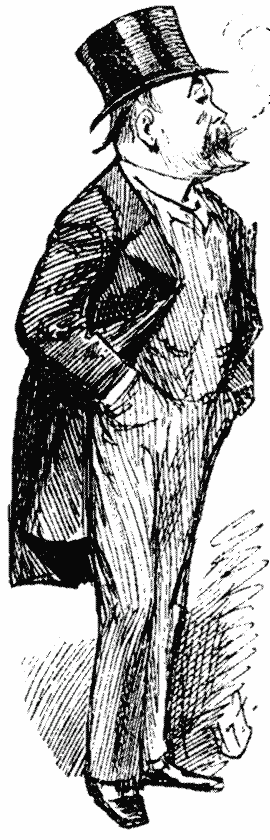
The Sage.
"Yes, Toby," said the Sage, lighting another cigarette; "always well when you're going it hot for a Party to have some individual in it whom you can omit from general implication of infamous motives. Gives one high moral standpoint, doncha know. Thus, when I want to suggest that the Markiss is a mere tool in hands of Bismarck, I extol honest purposes of Old Morality; hint, you know, that he is not so sharp of perception as he might be; but that gives him the fuller claim upon our sympathy, seeing that he is yoked with a colleague of the natural depravity, and capable of the infinite iniquity, which marks the Markiss's relations with public affairs. The great thing, dear Toby, in public controversy is to assume an attitude of impartiality. When you have to suggest that a political adversary was privy to the putting-away of his grandmother, do it rather in sorrow than in anger, and if you can find or make an opportunity of saying at the same time a kind word for one of his colleagues, seize it. That's why we cheer Hartington to-night, and why the Tories sometimes admit that John Dillon's an honest man."
Business done.—Parnell moved rejection of Land Purchase Bill.
Tuesday.—Courtney on in his famous quick-change scene. One minute he is discovered in recesses of canopied chair as Speaker; the next is seated at table as Chairman of Committees. Speaker, everyone sorry to learn, is ill in bed. So Courtney doubles his part. Proceeding watched with profound interest from Strangers' Gallery. At ten minutes and ten seconds to Seven House in Committee of Supply. Courtney in Chair at table; Mace off the table; Tanner on his legs. As hand of clock falters over the numeral ten, Courtney gets up, says never a word, wheels to right out of Chair and marches to rear. Tanner stops midway in sentence and resumes seat. Sergeant-at-Arms bowing thrice advances, lifts Mace on to table, and retires. Stranger in Gallery wondering what has become of Courtney, appalled by discovering him in Speaker's Chair, quite a new man. On these occasions marks his swiftly varying condition by altered tone of voice. As Chairman of Committees, assumes piping treble voice, as Deputy-Chairman drops occasional observations in profound bass.
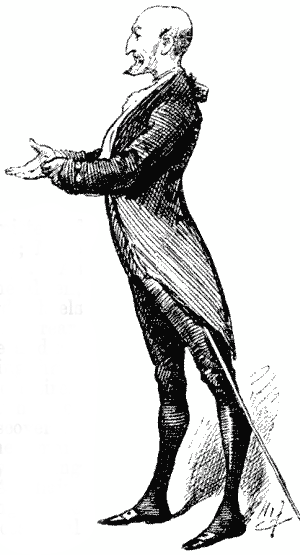
Sergeant-at-Arms (and Legs).
"Only thing left to me, dear Toby," he said, when I congratulated him on his treble. "Haven't time to change dress, even if it were permissible; must do something to mark wide gulf fixed between Chairman of Committee and Speaker; so hit upon this scheme. Glad you like the treble; a little out of my line, but practice makes perfect."
At Evening Sitting question of Labour and Capital brought on by Bartley. Cunninghame-Graham let House see what a terrible fellow he is. Doesn't look the part; but after speech to-night no question of his innate ferocity. Sim Tappertit not in it for such blood-curdling remarks. "I have," he said just now, "often interfered between Capital and Labour; but, thank Heaven! I have never interfered in the character of a conciliator."
"Ha, ha!" he cried, a little later, à propos of nothing. "You talk of inciting to violence. I have never incited to violence, and wherefore? Because, in present state of affairs, with society a vast organised conspiracy, violence would recoil on the heads of the Working Classes. But, Sir, the time will come when things will be otherwise, and the very moment that power is in the hands of the Working Classes I shall incite them to violence."
After this House took early opportunity of adjourning. Pretty to see Members stealing across Palace Yard in the dark, looking furtively right and left, not sure that moment was not come, and Simon Cunninghame Tappertit Graham was not hounding on his "United Bulldogs" against the Classes. "We must look out, Broadhurst," said James Rowlands, nervously rubbing his hand. "It's all very well of your retiring to Cromer. I think I shall practise with a revolver; shall certainly carry a sword-stick."
Business done.—Budget Resolutions through Committee.
Thursday Night.—Home Secretary came down to-day in unusually good spirits. Nothing happened of late to give enemy occasion to blaspheme. Crewe affair seems quite forgotten; nobody going to be hanged when he ought to be reprieved, or reprieved when he ought to be hanged. Seems almost as if, after all, life for Home Secretary would be worth living. Whatever embarrassments ahead belong to other Departments of Ministry. Land Purchase troubles, not the Home Secretary, nor Bi-Metallism either. Raikes been doing something at the Post Office. Goschen been tampering with tea, and sinning in the matter of currants. Something wrong with the Newfoundland Fisheries, but that Fergusson's look-out. True, Elcho wanting to know about some prisoners taken from Ipswich to Bury in chains. Sounds bad sort of thing; sure to be letters in newspapers about it. But Home Secretary able to lay hand on heart and swear the chains were light. Elcho blustered a bit. Irish Members, naturally interested in arrangements for going to prison, threateningly cheered; but after what Matthews had suffered in other times this affair lighter than the chains themselves.
Incident had passed; questions on paper disposed of; soon be debating Land Purchase Bill; all would be well for at least another day. Suddenly up gets Harcourt; wants to know who is responsible for the design of new police buildings on Thames Embankment? Flush of pride mantles brow of Matthews. This red-hot building—its gables, its roofs, its windows, its doorways, and its twisted knockers—was designed under his direction. It is his dower to London, set forth on one of its most spacious sites. What does Harcourt want to know about it? Why is Plunket so studious in repudiating all responsibility for the thing? Wherefore does crowded House cheer and laugh when Harcourt gives notice to call attention to building on Home Office Vote? Can it be possible that here is another mistake? Ought he to have hanged the architect instead of encouraging him? Always doing things for the best, and they turn out the very worst. Been occasionally misunderstood; but did, at least, think that London would be grateful for this emanation from the heated architectural mind.
"Looks so like a carbuncle suddenly developed on Embankment, with the stately Thames swirling below, that I really thought they would like it," said Home Secretary, mopping his furrowed brow. "But there are some people, Toby, who are never pleased, and prominent among them are the people of London."
Business done.—Debate on Land Purchase Bill.
Friday.—Things rather in a muddle to-day all round. At Morning Sitting didn't get Supply which everybody expected would be order of day; didn't proceed with Allotments Bill, which was first on Orders. At night, Provand on first with Dried Currants; McLaren to follow with Woman's Suffrage, neither turned up, and at half-past eleven by dint of Closure, got into Committee of Supply. George Campbell cruising up and down in New Guinea steamer; finally docked. Then Arthur Williams moved to report progress; more discussion; Old Morality pounced; Division on Closure; Courtney named Sheehy as one of tellers; Sheehy in Limerick; House couldn't wait for him to return; so Waddy brought out of Lobby to tell with Tanner. When Closure carried, it was ten minutes past one. House bound to rise at one o'clock; Chairman equally bound to put the question, which was to report progress. Motion for progress negatived, which meant that the House would go on with business; but it being a quarter past one Deputy-Speaker must needs leave Chair, and so sitting collapsed.
"Dear me!" said Bolton, "this is hard to understand. Must go off to the Garrick and think it over."
Business done.—None.

NOTICE.—Rejected Communications or Contributions, whether MS., Printed Matter, Drawings, or Pictures of any description, will in no case be returned, not even when accompanied by Stamped and Addressed Envelope, Cover, or Wrapper. To this rule there will be no exception.