Volume 98 — "RICHARDSON'S SHOW" AND A "BILL OF THE PLAY."
Reading edition
The Vaudeville, when it was opened, was devoted to all that was light and cheerful. Comedy and Burlesque went hand-in-hand, and the audience, if ever asked to weep, were begged to cry with laughter. But Mr. Robert Buchanan (with the assistance of the late Mr. Richardson) "has changed all that." Clarissa, the present attraction at the little theatre on the North-side of the Strand, is a piece of the most doleful character. The First Act is devoted to a very heartless abduction, and the last to a lingering death and a fatal duello. When it is announced that the successful fencer who "kills his man" is no less a person than that excellent Comedian, Mr. Thomas Thorne, it will be readily understood that "the New Drama" is the reverse of lively. Clarissa has scarcely a laugh in it from beginning to end. Certainly, in the last Scene but one, there is a revel, in which "pseudo-Ladies of Fashion" take part, but the merriment with which it is spiced is decidedly ghastly. Miss Winifred Emery is exceedingly clever, but her death-scene is painfully protracted. Mr. Thalberg, as Lovelace, is a sad dog in every sense—a very sad dog, indeed. The only incident in the piece ever likely to provoke a smile, is the appearance of some comic bearers of grotesque sedan-chairs. When Clarissa is carried out à la Guy Faux at the end of the Second Act, there is certainly a moment's hesitation whether the audience should cry or laugh. But the sighs have it, and pocket-handkerchiefs remain to the front. On the occasion of the initial performance, some slight amusement was caused by the introduction of Mr. Buchanan in unconventional nineteenth century morning dress amongst the old-fashioned costumes of the company; but, of course, the slight amusement was for once and away, and could not advantageously be frequently repeated. Thus, take one thing with another, the life of the Vaudeville audiences at this moment cannot be truthfully described as a merry one.
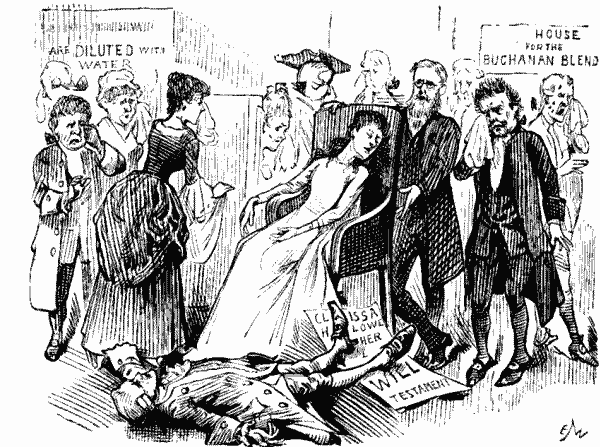
Something Lively at the Vaudeville.
At the Avenue quite a different story may be told. People who visit this pretty little house desirous of being moved even unto tears by that finest of Fausts, Mr. Alexander, will be disappointed—they had far better stay at home, or go to see Clarissa. Mr. Hamilton Aïdé has adapted from the French of Carré (a case of fetch and carry) a Farcical Comedy in Three Acts, which he calls Dr. Bill, in preference to Dr. Jojo the Gallic original. The prescription from which the Doctor concocts his mixture might have been supplied by the Criterion. Mr. Frederick Terry plays a part that would have suited Mr. Wyndham down to the ground, and Mr. Chevalier is continually suggesting the peculiarities of Mr. Maltby. Miss Fanny Brough is Miss Fanny Brough, which means that no one could play the part so well, much less better. For the rest, the company (although a new one) work together with a "go" that carries all before it. Alexander has certainly conquered the world—of Comedy. He may do less wise things if he rests satisfied, and leaves Tragedy alone for an indefinitely lengthened period.
Serjeant Cox, on behalf of Private Box.
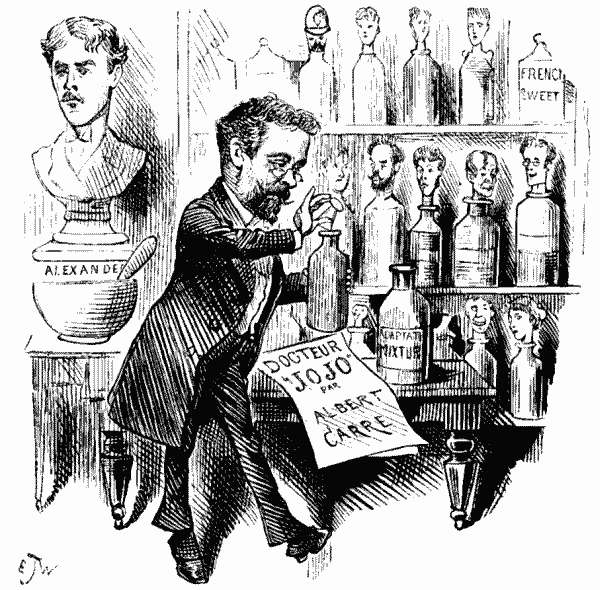
Making up Dr. Bill's Prescription.
P.S.—Mr. Jerome's new piece (which he describes as "comparatively speaking, new and original"), just produced at Terry's Theatre, is rather disappointing. Its title of New Lamps for Old strongly suggests a "Night's Entertainment." But when the poverty of the plot and the quality of the dialogue are taken into consideration, it would be almost too much to say that this pleasant idea is fully realised by the evening's performances. It must be confessed, however, that Mr. Penley, rising and descending in a dinner-lift, is (at first) funny; and Miss Cissy Grahame is ever welcome.

NOTICE.—Rejected Communications or Contributions, whether MS., Printed Matter, Drawings, or Pictures of any description, will in no case be returned, not even when accompanied by Stamped and Addressed Envelope, Cover, or Wrapper. To this rule there will be no exception.