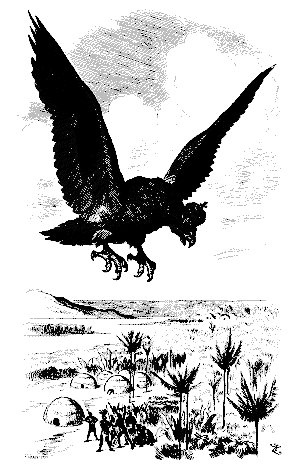
ON THE SWOOP.
Reading edition
Far from its native eyrie, high in air, Above the extended plain, The Teuton Eagle hovers. Broad and fair From Tropic main to main Stretches a virgin continent vast, and void Of man's most treasured works; No plough on those huge slopes is yet employed; The untamed tiger lurks In unfelled forest and unfooted brake; Those streams scarce know a keel; Through the rank herbage writhes the monstrous snake; Dim shapes of terror steal Unmarked and menacing from clump to clump, Whilst from the tangled scrub Is heard the trampling elephant's angry trump. The frolic tiger-cub Tumbles in jungle-shambles; in his lair The lion couches prone. What does that wingéd portent in mid-air, Hovering alert, alone? Strong-pinioned, brazen-beaked, and iron-clawed, This Eagle from the West; Adventurous, ravening for prey, unawed By perils of the quest. Beneath new clouds, above fresh fields he flies, Foraging fleet and far, With clutching talons, and with hungering eyes, Scornful of bound or bar. Winged things, he deems, may safely oversweep Landmark and mountain-post. The Forest-king may fancy he can keep His realm against a host Of such aërial harpies. Be it proved! Till late the Imperial fowl Not far from its home-pinnacles hath roved; Now Leo on the prowl Must watch his wingèd rival. Who may tell Where it shall strike or stoop? Leo, your lair must now be warded well; Aquila's on the Swoop!
THE LAST CHARGE OF THE LIGHT BRIGADE.
(Brought by the Survivors against those—who might have looked after them.)
"But we are all getting older every year, and with the lapse of time, while many have died, a good number have fallen into dire misfortune.... Lord Cardigan's words to the survivors of the Six Hundred the morning after the charge have been repeated to me, although I wasn't there to hear them. He said: 'Men, you have done a glorious deed! England will be proud of you, and grateful to you. If you live to get home, be sure you will all be provided for. Not one of you fine fellows will ever have to seek refuge in the workhouse!' Now, you perhaps know how that promise has been kept. I cannot tell you, even from my secretarial records, the full extent of the misery that has fallen upon my old comrades in the Charge of the Light Brigade; but I can give you a few details that should be made widely public."—The Secretary of the Balaclava Committee.
Forty years, Forty years, All but four—onward, Since to the Valley of Death Rode the Six Hundred; Since the whole country cried "We will for you provide,— Blazon your splendid ride, Gallant Six Hundred!" Yet now the Light Brigade Stands staring much dismayed For they can plainly see Someone has blundered. For here are they, grown old, With their grand story told, Left to the bitter cold,— Starving Six Hundred! Workhouse to right of them, Workhouse to left of them, Workhouse in front of them! Has no one wondered That British blood should cry, "Shame!" and exact reply, Asking the country why Thus it sees droop and die Those brave Six Hundred! As they drop off the stage, Want, and the weight of age— Is this their only wage?— Home rent and sundered! And is their deed sublime, Flooding all after-time, Now but a theme for rhyme, Whispered—and thundered Where, from the pit and stalls, Theatres and Music-halls, Greet their "Six Hundred!" Can thus emotion feed On the heroic deed, Yet leave the doer in need,— Of his rights plundered? "No!" the whole land declares Henceforth their load it shares, Spite those who blundered. They shall note wants decrease, Of comfort take a lease Till all their troubles cease And to their end in peace Ride the Six Hundred!
MR. PUNCH'S DICTIONARY OF PHRASES.
Social.
"How sweetly that simple costume becomes your style of beauty, dear!" i.e., "Cheap dress suits a silly dowdy."
"Ah! Here we are again! Thought I should come across you presently;" i.e., "How he must tout for it! And what a relief it would be to go somewhere where he does not turn up!"
"Yes, capital story I know,—but pardon me just a minute, old chap. I think I see Mrs. Mountcashel beckoning me;" i.e., "What an escape! Doesn't buttonhole me again to-night if I know it."
Military.
"The Mess rather prides itself upon its cellar;" i.e., The host is a little doubtful about what the Wine Committee have in hand for the benefit of the guest he has asked to dinner.
"The Regiment at the Inspection, although a trifle rusty, never did better;" i.e., The Senior Major clubbed the Battalion, and the Commanding Officer was told by the General, with an unnecessary strong expression, to "Take 'em home, Sir!"
Legal.
"The Will of the late Mr. Dash is so complicated that it is not unlikely to give employment to Gentlemen of the long robe;" i.e., Administration suit, with six sets of solicitors, ten years of chamber practice, three further considerations, and the complete exhaustion of the estate in costs.
"Mr. Nemo, as a Solicitor in his office, is a very able man;" i.e., That although Mr. Nemo, away from his profession, would shrink from doing anything calculated to get himself turned out of the West-End Club to which he belongs; in his sanctum he would cheerfully sell the bones of his grandmother by auction, and prosecute his own father and mother for petty larceny, arson, or murder, always supposing he saw his way to his costs.
Epistolatory.
"A thousand thanks for your nice long, sympathetic letter;" i.e., "Great bore to have to reply to six pages of insincere gush."
"Please excuse this hurried scrawl;" i.e., "That'll cover any mistakes in spelling, &c."
"Only too delighted;" i.e., "Can't refuse, confound it!"