IN THE KNOW.
Reading edition
(By Mr. Punch's Own Prophet.)
There was some good racing at Newmarket last week, and, as usual, every single race proved up to the hilt the extraordinary accuracy of my forecasts. I said a year ago that "Bandersnatch was a colt who hadn't a chance of winning a first-class race. Only a March hare or a Bank-holiday boozer would think of backing him." Bandersnatch's name never even appeared on the race-card last week. Mr. Jeremy says the colt is dead, as if that had anything to do with it; but of course if the gullish herd chooses to cackle after Mr. Jeremy it's no use trying to help them.
The hippopotamus-headed dolts who pinned their faith to Molly Mustard must have learnt their lesson by this time. Of course Molly Mustard defeated that overrated sham Undercut; but what of that? When Undercut was placed second to Pandriver at the North Country Second Autumn Handicap two years ago, I warned everybody that Wobbling Willie who is half-brother to Rattlepate by Spring Onion, ought to have made a certainty of the race if the gruel-brained idiots who own him had only rubbed his back with Daffy's Elixir twice a-day before going to bed. As it was Wobbling Willie rolled about like a ship at sea, and Brighton Pref passed him in a common canter. That scarcely made Molly Mustard a second Eclipse. The fact of the matter is she is a roarer, or will be before the season is over, and those who backed her will have to whistle for their money. All I can say is, that I hope they will like the trap into which their own patent-leather-headed imbecility has led them.
Corncrake is a nice, compact, long-coupled, raking-looking colt, with a fine high action that reminds me of a steam-pump at its best. He is not likely to bring back much of the £3000 given for him as a yearling by his present owner, but he might be used to make the running for his stable-companion Catsmeat, who was picked up for £5 out of a butcher's cart at Doncaster.
For the Two Thousand I should have selected Barkis if he had been entered. Failing him, there is very little in it. Sandy Sal might possibly have a chance, but she has always turned out such an arrant rogue that I hesitate to recommend her. Mr. Jeremy plumps for Old Tom, and the whole pack of brainless moon-calves goes after him in full cry as usual. If Old Tom had two sound legs he might be a decent horse, but he has only got one, and he has never used that properly.
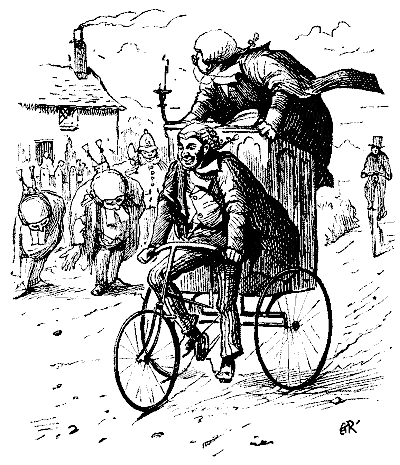
A TRAVELLING TRIBUNAL.
Why not Cyclist Judges and Clerk and Marshal going all the year round, to be met by local Barristers?
THE CHILDREN'S FANCY DRESS BALL.
All the grate Lord Mare's and the good Lady Maress's hundreds and hundreds of little frends had their annual peep into Paradice last Wensday heavening, at the good old Manshun Howse, on which most interesting ocashun all their fond Mas and their stump-upping Pas sent them into the famous Egipshun All in such a warious combenashun of hartistick loveliness and buty as ewen I myself never seed ekalled! Whether it was the rayther sewere coldness of the heavening, or the niceness of the seweral refreshments as the kind Lady Maress perwided, or whether it was that most on 'em was amost one year older than they was larst year, in course I don't know, but they suttenly kept on a pitching into the wittels and drink in a way as rayther estonished ewen my seasoned eyes, acustomed as they is to Copperashun Bankwets, and settra. One little bewty of a Faery, with her lovely silwer wand of power, amost friten'd me out of my wits by thretening to turn me into sumthink dredful if I didn't give her a strawbery hice emedeately, which she fust partly heated, and then drunk, as their custom is, I spose. Then there was a lot of all sorts—niggers and sodgers, and three young ladies as mag-pies. Which last made me think that a young gent fond of using his fists might do wus than go as a burd prize-fiter. By the way, one likes condesenshun, down to a certain xtent, but whether it should hinclude a most bewtifool Princess a dansing with a pore littel white-faced Clown, is what I must leave others to deside; I declines doing it myself.
We had Mr. Punch in the course of the heavening, and both hold and young larfed away as ushal at his rayther rum morality. Then we had two most clever gents who dressed theirselves up before a large looking-glass to look like lots of diffrent peeple. The best couple I was told was two Gents named Bizmarck and Bullanger, one was said to be a reel Ero, and the other, a mere Sham, but I don't know werry much about such Gents myself, xcept that Brown tried werry hard to make me beleeve that Bizmarck, who was the reel Ero, used to think nothink of pouring a hole Bottle of Shampain into a hole Pot of Stout and drinking it all off at one draft, like a ancient Cole Heaver! We finished up with a lot of German Chinese, who jumped about and danced about and climbed up a top of one another, and then acshally bilt theirselves up like a house, and then all tumbled to pieces, reelly quite wunderfool, and not only the lovely little children, but ewen Common Councilmen, aye and ewen ancient Deputys, all stood round and larfed away and enjoyed theirselves, recalling to my sumwhat faltering memory the words of the emortel Poet, "One touch, of Nature makes the hole World grin."
Robert.
AN ECHO FROM THE LANE.
Last week the Carl Rosa Opera Company (whose Managing Directors are Augustus Druriolanus, future Sheriff of London, with Sheriff's officers in attendance, to whom he might, on some future emergency, entrust the charge of Her Majesty's) continued its season of success with a solitary addition to the programme, L'Etoile du Nord. À propos of this novelty, it may be hinted that although the Catherine of Madame Georgina Burns does not make us entirely forget Adelina Patti in the same character, the performance is, from every other point of view, completely gratifying. As "little Peter," Mr. F. H. Celli is (as the comic songs have it) "very fine and large." Mr. John Child, whose Wilhelm, in Mignon, lacked distinction, is more in his element as Danilowitz the pastry-cook. The stage management (as might have been expected with Augustus to the fore) is admirable, the battle-scene at the end of the Second Act filling the house with a mixture one-tenth smoke to nine-tenths enthusiasm. By the time these lines are before the entire world, if all goes well, Thorgrim, by Mr. Frederick Cowen, will have been produced. As the work of a native composer, it should receive a hearty welcome, particularly on the boards of the National Theatre; but, sink or swim, the Carl Rosa Opera Company cannot possibly come to harm with its present popular repertoire. And, as good music is a boon to the London public, such a state of things is distinctly satisfactory.

"In the Name of the Law!"—It is a pity that Mr. Law, the author of Dick Venables, did not take a little more trouble in the construction of his new piece at the Shaftesbury Theatre. It just misses being an excellent drama, and deserving the valuable assistance it receives from all concerned on the stage side of the Curtain. That the wife of a convict should take a house next door to her deeply dreaded husband's prison, that a jewel-collector should keep his precious stones in a side-board, that an Archdeacon should apparently have nothing better to do than play the kleptomaniac at Dartmoor, are facts that seem largely improbable; and yet these are the salient points of the latest addition to the playgoer's repertoire. For the rest, Dick Venables is interesting, and admirably played. But whether, after the first-night criticisms, the piece will do, is a question that must be left to the future for solution.
HYPNOTIC HIGH FEEDING.
(Being some Brief Diary Notes of a Coming Little Dinner (New Style), jotted down a few years hence.)
"Your dinner is served. Sir!"
It was the Professorial Butler who made this announcement with a solemn and significant bow. He had undertaken, for the modest fee of half-a-crown, to throw my four guests,—an Epicurean Duke, a couple of noted Diners-out, and a Gourmand of a high order well known in Society,—into a profound hypnotic sleep, under the influence of which, while supplied with a few scraps of food, and slops by way of drink, they were to believe that they were assisting at a most recherché repast, provided by a cuisine, and accompanied by choice vintage wines, both of the first excellence.
I felt a little nervous as we proceeded to the dining-room, but as the Professor adroitly passed his hand over the head of each as he descended the stairs, and pointed out to me the dazed and vacant look that had settled on the features of all of them, I felt reassured, especially when they fell mechanically into their places, and began to peruse, with evident delight, the contents of the Menu, which ran as follows:—
Soup. Toast-and-water and Candle-ends. Fish. Herrings' Heads and Tails. Counter Sweepings. Entremets. Rotten Cabbage-stalks. Entrée. Odds and Ends of Shoe Leather. Roast. Cat's Meat. Sweet. Old Jam-pot Scrapings on Musty Bread.
That they didn't all rise like one man with a howl of execration on reading this was soon explained when the Professorial Butler set down a soup-plate before the Epicurean Duke and with an insinuating smile, simply announced it as Tortue claire. It was clear from this that they were under the impression that they were partaking of a first-class little dinner, and had read the Menu at the will of the Professorial Butler, as he subsequently explained to me in such fashion that the toast-and-water soup, in which the candle-ends played the part of green fat, appeared to them in the light of the finest "clear turtle." "And how about the Herrings' Heads and Tails?" I asked. "They take that for Saumon de Gloucester, sauce Pierre Le Grand," was the bland reply, a fact which at that moment the Gourmand endorsed, by smacking his lips and with an ejaculation of "Sublime salmon that! I'll take a little more," holding out his plate for a second helping. The Cabbage-stalks figured in their imagination as "Asperges d'Italie, en branches glacées à la Tour d'Amsterdam," while the pennyworth of plain cat's meat, passed more than muster as "Filet de Bœuf en Diplomat, braisée à la Prince de Pékin." The Shoe-leather and Jam-pot Scrapings brought the Menu to a triumphant close, with "Ris de Veau pralinée au boucles Menschikoff," and "Bombardes Impérials de Péru" respectively.
I confess, when I heard one of the Diners-out asking for Champagne, and saw his glass filled with Harvey's Sauce and water, with the announcement that it was Dry Monopole Cuvée Réservée, I felt some momentary misgivings, but they were speedily put to flight on my noticing the evident gusto with which he emptied his glass, at the same time pronouncing it to be "a very fine wine," which he assigned to the vintage of '76. I own too I felt a little nervous when the Professorial Butler, I think not without a sly twinkle in his eye, gave all the party a liqueur of petroleum for Green Chartreuse, but they certainly seemed to find it all right, and so my apprehensions disappeared.
Thus my "Little Dinner" came at length to a conclusion. That it was an undoubted success, from a financial point of view, there can be no sort of doubt, for fourpence more than covered the cost of the materials, to which, adding the Professorial Butler's fee of two shillings and sixpence, brings the whole cost of the entertainment up to eightpence-halfpenny a head. It is true I have not heard whether any of my guests have suffered any ill-effects from partaking of my hospitality, but I suppose if any of them had died or been seized with violent symptoms, the fact would have been notified to me. So, on the whole, I may congratulate myself. I certainly could not afford to entertain largely in any other fashion, but, with the aid of the Professorial Butler, I am already contemplating giving a series of nice "Little Dinners," and even on a more extended scale. Indeed, with the assistance of Hypnotism, it is possible, at a trifling cost, to see one's friends. And in the general interests of Society, I mean to do it.
FANCY PORTRAIT.
(After reading the Correspondence on Fruit and Birds in the "Morning Post.")
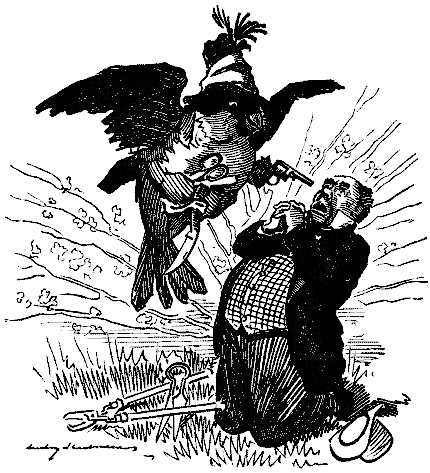
THE BRIGAND BULLFINCH.
BULLYING POOR "BULLY."
Says the Blackbird to the Bullfinch, "It is April; let us up! We will breakfast on the plum-germs, on the pear-buds we will sup." Says the Bullfinch to the Blackbird, "We'll devour them every bit, And quite ruin the fruit-growers, with some aid from the Tom-tit." Then these garden Machiavellis set to work and did not stop Till the promise of September prematurely plumped each crop. Ah! the early frost is ruthless, and the caterpillar's cruel, But, to spifflicate the plum or give the gooseberry its gruel, To confusticate the apple, or to scrumplicate the pear, Discombobulate the cherry, make the grower tear his hair, And in general play old gooseberry with the orchard and the garden, Till the Autumn crop won't fetch the grumpy farmer "a brass farden," There is nothing half so ogreish as the Bullfinch and his chums, Those imps of devastation—as regards our pears and plums. Poor "Bully," sung by Cowper in his pretty plaintive verse, It is thus thine ancient character they (let us hope) asperse. "The gardener's chief enemy," so angry scribes declare, And the cause why ribstone pippins and prime biggaroons are rare. Little birds, my pretty "Bully," should all diet upon worms, And grub on grubs, contented, not on fruit-buds and young germs Vain your pretty coat, my "Bully," beady eyes, and pleasant pipe, If you will not give our fruit-crops half a chance of getting ripe. Let us hope that they traduce you, all this angry scribbling host Of horticultural zealots who abuse you in the Post. The Reverend F. O. Morris takes the field in your defence, But they swear, though picturesquish, he's devoid of common-sense. Punch inclineth to the Parson, and he doesn't quite believe All the statements of the growers and the gardeners who grieve Over "Bully's" depredations, for he knows that, as a rule, The birds' foe is a fashionable fribble, or a fool. From the damsels who despoil them for their bonnets or their cloaks, To the farmer who exterminates the dickies, and then croaks O'er the spread of caterpillars and such-like devouring vermin, They are selfish and shortsighted. So he'll not in haste determine The case against poor "Bully," or the Blackbird, or Tom-tit. Though they put it very strongly, Punch would warn them—Wait a bit!
Sportive Captain Hawley Smart takes a somewhat new departure in Without Love or Licence. There is less racing than usual in this novel, and there is a very ingenious plot, which we are not going to spoil the pleasure of the reader by divulging. The secret is well kept, and one is put off the scent till well-nigh the final chapter. The whole story is bright and dashing, abounding with graphic sketches of such people as one meets every day. The author is in the best of spirits—he evidently has a licence for spirits—and keeps his audience thoroughly amused, from start to finish.
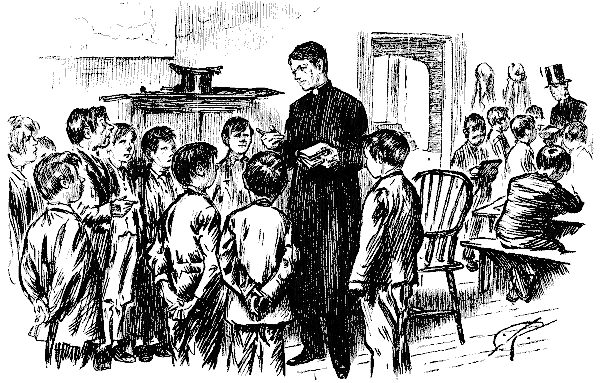
A STABLE UNDERSTANDING.
Curate (who had often explained to his Class that Heresy was "an obstinate choice"). "Now Boys, what should you say Heresy was?"
Several Boys. "'Obson's choice, Sir!"
A SHORT SONG IN SEASON.
Air—"Ballyhooley."
Phillips thinks—(you're right, my boy!) Dingy London would enjoy More music, and proposals make (which charm me) For a Great Municipal Band, Which, under wise command, Might prove a sort of music-spreading Army. The critics all declare English taste for music rare, But the "Parks and Open Spaces'" sage Committee Hold a very different view, And, to prove their judgment true, Want a Metropolitan Band for the Big City. Chorus. London-lovers high and low, Let us all enlist, you know, For the County-Councillor's schemes extremely charm me. Let us raise Twelve Hundred Pounds, And we soon shall hear the sounds Of the Music-lover's Metropolitan Army! There's a moral to my song And it wont detain ye long; To Phillips, L.C.C. send your subscription, (North Park, Eltham, S.E.), for That sagacious Council-lor Is a patriot of a practical description. When the money he has got, (And Twelve Hundred's not a lot,) Right soon he'll form a strong and sage Committee! And it will not be their fault If there's any hitch or halt In the Metropolitan Band for our Big City. Chorus. Stump up, Cockneys, high and low We must all enlist, you know, For the sum required is nothing to alarm ye. So just do as you are bid, And subscribe Twelve Hundred "quid" For the Music-lover's Metropolitan Army!
OUR BOOKING-OFFICE.
Joints in our Social Armour, by a Mr. James Runciman, has an amusing "Dedication to W. S. and G. N. S." "Gentlemen," writes this seemingly new member of the brotherhood of letters, "this little book contains many things which have already pleased you, and all that may be good in them has really come from you." After this frank confession, one naturally desires to have the "good things" of "W. S. and G. N. S." first-hand, instead of what presumably must be a rechauffé. As the "good things," however, have to be picked out of a volume of 342 pages of wearisome reading about "The Ethics of the Drink Question," "The Social Influence of the 'Bar'" (Public-house, bien entendu), "Genius and Respectability," &c., &c., it is not an easy task to find them. For the rest, to the intelligent reader, the joints of Messrs. W. S., G. N. S., and James Runciman are likely to prove veritable pieces de résistance. A cut from the joint in this instance is accordingly strongly recommended.
The Colonial Year-Book for 1890 supplies a want that has long been felt by Britons in every quarter of the globe. Mr. Trendell, C.M.G., the author of this interesting work, deserves well of the Empire.
Baron de Book-worms & Co.
A FABLE FOR FANATICS.
There was a stream, now fast, now slow, But given at times to overflow; A freakishness that played strange pranks With the poor dwellers on its banks. There came two engineers. One said, "Embank it!" Wagging a wise head In the austere impressive way Of dogmatists, as who should say, "If there's an Oracle, I am it." The other answered, "Nonsense! Dam it!" They did, and stood with hope elate, But presently there came a "spate;" The swollen torrent, swift and muddied, All the surrounding country flooded, Put a prompt stop to prosperous tillage, Drowned fifty folk, and swamped a village. Moral. Some men's sole notion of improvement Is simply to arrest all movement. This craving crass the spirit stirs Of Tsars and of Teetotallers, Eight-Hour fanatics, and the like, Friends of the dungeon and the dyke. "Dam it!" That is their counsel's staple. (Mark, Lubbock; also, Blundell-Maple!)
News from Aix-les-Bains.—"Fireworks were let off." As mercy is the Royal prerogative, we are glad to learn that it was exercised in the case of Fireworks on the birthday of the Princess Beatrice.
By Order of F.M. Commanding-in-Chief, Punch.—The Grand Military Exhibition, Chelsea Hospital, to be known as "The Sodgeries."