Volume 158 — ESSENCE OF PARLIAMENT.
Reading edition
Monday, June 21st.—While the Prime Minister was celebrating the longest—and pretty nearly the hottest—day by a vin d'honneur at Boulogne Mr. Bonar Law had to content himself with small beer in the Commons.
The Government, it seems, is to offer its services to effect a peaceful settlement between the Imam Yahya and the Said Idrissi, who are rival rulers in Arabia. There is believed to be a possibility that in return the said Said will offer his services to effect a peaceful settlement in Hibernia Infelix.
The Government is not so indifferent to economy as is sometimes suggested. The Prime Minister's famous letter to the Departments was only written in August last, yet already, Mr. Bonar Law assured the House, some progress has been made in reducing redundant staffs, and the Government has appointed—no, I beg pardon, "decided to appoint"—independent Committees to carry out investigations. The hustlers!
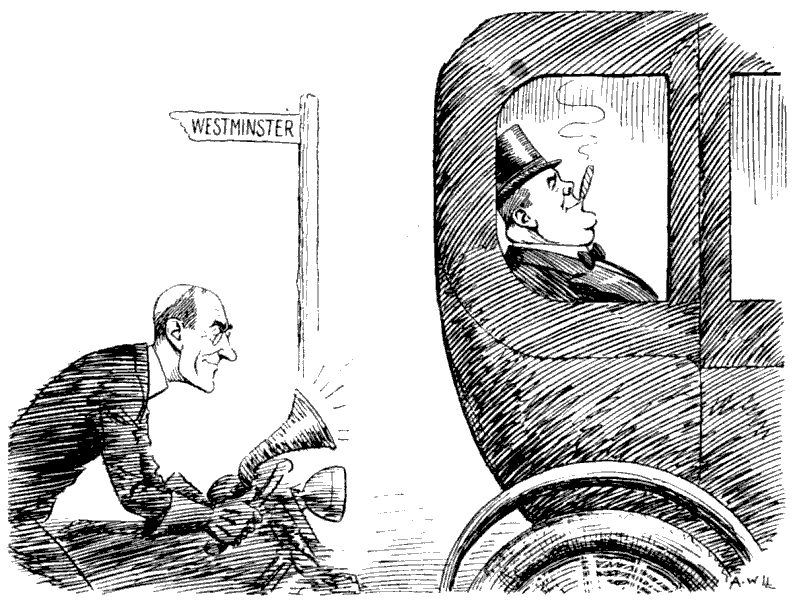
Do you expect me to send the Sergeant-at-Arms to fetch the Minister of Transport?—The Speaker.
The Member for Wood Green, who urged that the Treasury should prepare an estimate of the national income, with the view of limiting the national expenditure to a definite proportion of that amount, displayed, it seems to me, amazing temerity. The course of taxation in recent years encourages the belief that the only thing that restrains the Chancellor of the Exchequer from taking our little all is that he does not know how much it is.
Capt. Wedgewood Benn's complaint that the Minister of Transport habitually absented himself from the House met with little encouragement from the Speaker, who sarcastically inquired if he should send the Serjeant-at-Arms to fetch the delinquent. Capt. Benn then dropped the subject, and Sir Colin Keppel looked relieved.
The Government insisted on taking the Report stage and Third Reading of the Rent (Restrictions) Bill at one sitting, and kept the House up till half-past three in order to do it. Dr. Addison had need of what the Iron Duke called "two o'clock in the morning courage" to ward off attacks. Once, when Sir Arthur Fell was depicting the desperate plight of the landladies of Yarmouth, forbidden under a penalty of a hundred pounds to charge more than twenty-five per cent. in excess of their pre-war prices, it looked as if the Minister must give way; but with some difficulty he convinced his critics that the clause in question had nothing to do with seaside landladies.
Tuesday, June 22nd.—In the Lords the Bishops, reinforced by the ecclesiastically-minded lay Peers, made a last attempt to throw out the Matrimonial Causes Bill. Lord Braye moved its rejection, and was supported by Lord Halifax in a speech whose pathos was even stronger than its argument, and by the Archbishop of Canterbury, who admitted that reform of the marriage laws was required, but considered that the Bill went a great deal further than was necessary. The Lord Chancellor thereupon re-stated the case for the measure, for which be believed the Government were prepared to give facilities in the other House, and Lord Buckmaster repeated his exegesis of the vexed passage in St. Matthew's Gospel, on which the whole theological controversy turns. The Third Reading was carried by 154 votes to 107.
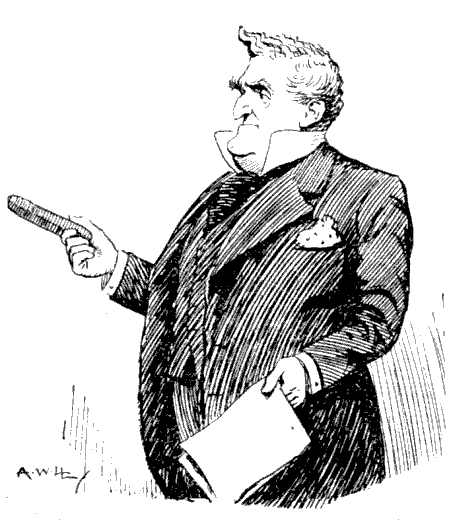
MENS ÆQUA REBUS IN ARDUIS.
Mr. Denis Henry on the Irish situation.
The Commons in the course of the Irish Debate discussed the failure of the Government to prevent the regrettable incidents in Derry and Dublin. Colonel Ashley demanded martial law; Major O'Neill was for organising the loyal population; Sir Keith Fraser approved both courses and advanced the amazing proposition that the trouble in Ireland was entirely due to the religious question, and that even the Sinn Feiners were loyal to the Empire.
The Attorney-General for Ireland pointed out that faction-fighting in Derry was endemic, and drew an amusing picture of the old city, where everyone had some kind of rabbit-hole from which he could emerge to fire a revolver. As regards the general question he denied that the Constabulary had been instructed not to shoot. On the contrary they had been told to treat attackers as "enemies in the field," and to call upon suspected persons to hold up their hands.
Lord Robert Cecil was at a loss to understand the Government that applied coercion to the very people to whom it was preparing to hand over the government of Southern Ireland, and Mr. Inskip was equally at a loss to understand the policy of the noble lord, who seemed to think that conciliation was incompatible with putting down crime.
Wednesday, June 23rd.—A large company, including the Queen and Princess Mary, attended the House of Lords to see Prince Albert take his seat as Duke of York. It was unfortunate that the new peer was unable to wait for the ensuing debate, for Lord Newton was in his best form. His theme was the absurdity of the present Parliamentary arrangement under which the Peers were kept kicking their heels in London for the best months of the year, then overwhelmed with business for a week or two, and finally despatched to the country in time for the hunting season, which nowadays most of them were too much impoverished to enjoy. Lord Curzon condescended a little from his usual Olympian heights, and declared that one of the drawbacks to conducting business in that House was the difficulty of inducing noble Lords to attend it after dinner.
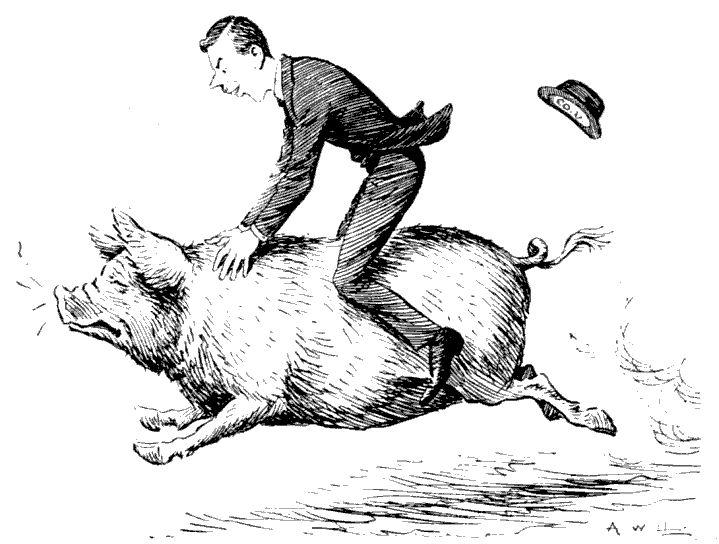
THE YOUNG UNIONIST MOVEMENT.
"If they were to have Home Rule at all they must 'go the whole hog.'"—Mr. Ormsby Gore.
To judge by Mr. Asquith's recent speeches outside he meant to have delivered a thundering philippic against our continued occupation of Mesopotamia. Some of the sting was taken out of the indictment by the publication of an official statement showing that Great Britain was remaining there at the request of the Allies. After all, as Mr. Lloyd George observed in his reply, it would not be an economical policy to withdraw to Basra if we were to be immediately requested to return to Baghdad.
The rest of the evening was devoted to a renewal of the protests against Mr. Churchill's "Red Army." Among the critics were Mr. Esmond Harmsworth and Mr. Oswald Mosley, the two "babies" of the House, and the Minister adopted quite a fatherly tone in recalling his own callow youth, when he too, just after the Boer War, denounced "the folly of gaudy and tinselled uniforms."
Thursday, June 24th.—On behalf of the Government Lord Onslow gave a rather chilly welcome to Lord Balfour of Burleigh's Bill for the regulation of advertisements. It is true that the noble author had explained that his object was to secure "publicity without offence," but I believe he had no desire to cramp the Prime Minister's style.
Sir Eric Geddes belongs to that wicked species of fauna that defends itself when attacked. He complained this afternoon that Mr. Asquith had in his recent speeches "trounced a beginner," but Sir Eric showed, for a novice, considerable aggressive power. He claimed that the Ministry of Transport had already saved a cool million by securing the abrogation of an extravagant contract entered into by Mr. Asquith's Government. The ex Premier, however, insisted that if a mistake had been made the Railway Department of the Board of Trade could have corrected it just as well as its grandiose successor and at an infinitely smaller cost.
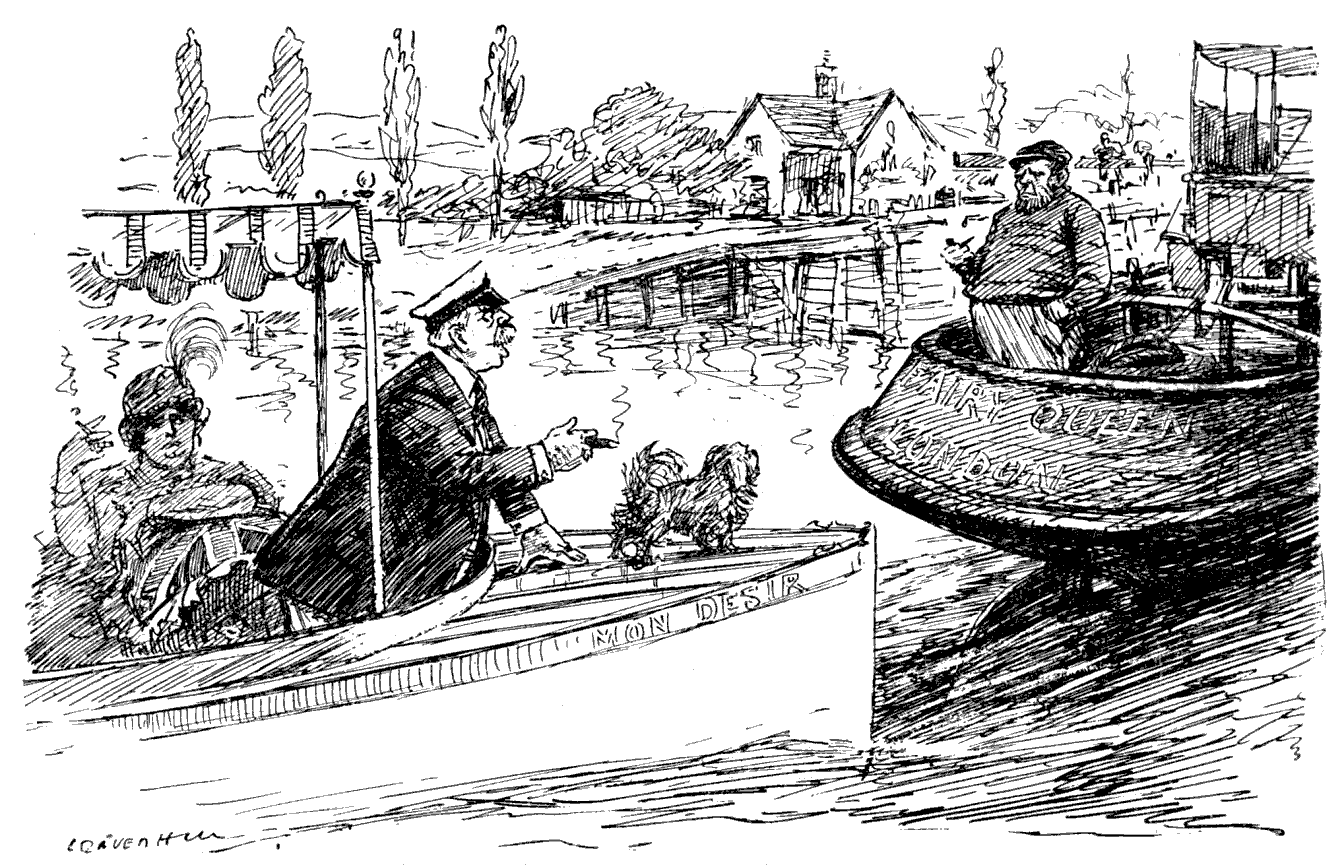
Naturalised Alien. "Vy dond you ged oud of my vay? Dond you know der rule of der river?"
Bargeman. "Which? The Rhine?"
THE NEW COURTIERSHIP.
(With profound acknowledgment to the writer of the article on "Heroine Worship" in "The Times" of June 24th.)
While thrones and dynasties have rocked or fallen in the great world upheaval of the last six years, there remains one form of monarchy which has proved impervious to all the shocks of circumstance—the monarchy of genius. If proof be demanded of this assertion we need only point to the wonderful manifestations of loyalty evoked in the last week by the advent of the Queen of the Film World and her admirable consort. The adoration of Mary Pickford has been compared with that of Mary Queen of Scots, and not without some show of reason, for the appeal which her acting, makes is always to the sense of chivalry which, in however sentimental a form, is characteristic of our race.
But the noble adulation which the latest of our royal visitors inspires is deeper and more universal than that prompted by the charm and the misfortunes of her namesake. Mary Queen of Scots, as the evidence of contemporary portraits conclusively establishes, was not conspicuous for her personal beauty. In the "Queen business" she was a failure, and her prestige is largely if not entirely posthumous. Her character has been impugned by historians; even her most faithful champions have not pronounced her impeccable.
Centuries were necessary to raise Mary Queen of Scots to her somewhat insecure pinnacle of devotion; by the alchemy of a machine centuries have been shortened to days and nights in the meteoric career of Miss Pickford. Yet merit has joined fortune in high cabal. Handicapped by a somewhat uneuphonious patronymic, Mary Pickford has established her rule without recourse to any of the disputable methods adopted by her predecessor. At home in all the "palaces" of both hemispheres, she owes her triumphs to the triple endowment of genius, loveliness and gentleness. Moreover, in the highest sense she is truly an ambassadress of our race, for the kiss which she so graciously bestowed on Mlle. Suzanne Lenglen at Wimbledon on Wednesday last has probably done even more to heal the wounds inflicted on our gallant Allies by the disastrous policy of Mr. Lloyd George than the heroic efforts of The Times to maintain the Entente in its integrity.
The parallels and contrasts with Mary Queen of Scots need not be further laboured. But far too little stress has been laid on the rare felicity of a union which links the name of Mary with that of Douglas. The annals of British chivalry contain no more romantic or splendid entries than those associated with Sir James Douglas, alternately styled the "Good" and the "Black," hero of seventy battles and the victor in fifty-seven, peerless as a raider, who crowned a glorious career by his mission to Palestine with the embalmed heart of Bruce, and his death in action against the Moors. His illustrious namesake is now conducting a "raid" on our shores of a purely educational and humanitarian nature, and our welcome, while it expresses the rare and momentous influence of the film, is no mere gratitude for pleasure afforded; it is rather the recognition of a human touch tending to make the whole English-speaking world kin.
The visit is not unattended by risks, for the ardour of enthusiasm imposes a corresponding strain on the endurance of this august and inimitable pair. But there can be no doubt as to the absolute sincerity and spontaneity of these marvellous demonstrations of loyal affection. We can only hope that, to borrow the noble phrase of the Roman Senate in their address to Nero on the death of Agrippina, Queen Pickford the First may "endure her felicity with fortitude." Conspicuous grandeur has its penalties as well as its privileges, but the chivalric instinct is still alive in our midst; and all of us who are not perverted or debased by the malign "wizardry" of the Prime Minister will spring to the defence of Mary "the Sweetheart of the World," and Douglas "tender and true," in their hours of peril. In that high emprise the gentlemen of the world, however humble, stand, as of old time, side by side and shoulder to shoulder.
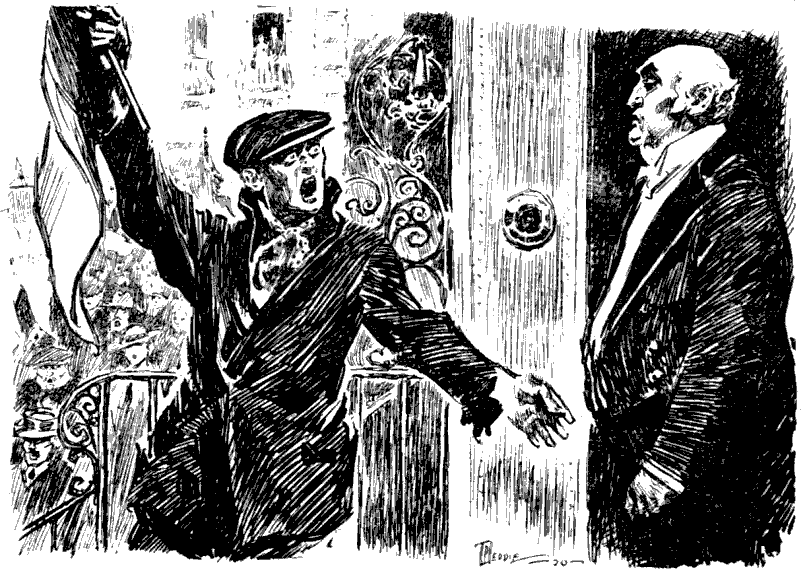
THE IRRESISTIBLE MEETS THE IMMOVABLE.
Scene: Exclusive West-End Square, with passing procession of "Reds."
The Flag-bearer. "Comrade, the Revolution is 'ere!"
The Complete Butler. "Ar! Will you kindly deliver it at the harea hentrance?"
THE BATTLE OF THE MOTHERS.
We were sitting in the smoking-room when the Venerable Archdeacon entered. He had been so long absent that we asked him the reason.
Had he been ill?
Ill? Not he. He never was better in his life. He had merely been on a motor tour with his mother.
"Do you mean to say," someone inquired—an equally elderly member—almost with anger, certainly with a kind of outraged surprise, "that you have a mother still living?"
"Of course I have," said the Man of God. "My mother is not only living but is in the pink of condition."
"And how old is she?" the questioner continued.
"She is ninety-one," said the Archdeacon proudly.
Most of us looked at him with wonder and respect—even a touch of awe.
"And still motoring!" I commented.
"She delights in motoring."
"Well," said the angry man, "you needn't be so conceited about it. You are not the only person with an aged mother. I have a mother too."
We switched round to this new centre of surprise. It was more incredible that this man should have a mother even than the Archdeacon. No one had ever suspected him of anything so extreme, for he had a long white beard and hobbled with a stick.
"And how old may your mother be?" the Archdeacon inquired.
"My mother is ninety-two."
"And is she well and hearty?"
"My mother," he replied, "is in rude health—or, as you would say, full of beans."
The Archdeacon made a deprecatory movement, repudiating the metaphor.
"She not only motors," the layman pursued, "but she can walk. Can your mother walk?"
"I am sorry to say," said the Archdeacon, "that my mother has to be helped a good deal."
"Ha!" said the layman.
"But," the Archdeacon continued, "she has all her other faculties. Can your mother still read?"
"My mother is a most accomplished and assiduous knitter," said the bearded man.
"No doubt, no doubt," the Archdeacon agreed; "but my question was, Can she still read?"
"With glasses—yes," said the other.
"Ha!" exclaimed the Archdeacon, "I thought so. Now my dear mother can still read the smallest print without glasses."
We murmured our approval.
"And more," the Archdeacon went on, "she can thread her own needle."
We approved again.
"That's all very well," said the other, "but sight is not everything. Can your mother hear?"
"She can hear all that I say to her," replied the Archdeacon.
"Ah! but you probably raise your voice, and she is accustomed to it. Could she hear a stranger? Could she hear me?"
Remembering the tone of some of his after-lunch conversations I suggested that perhaps it would be well if on occasions she could not. He glowered down such frivolousness and proceeded with his cross-examination. "Are you trying to assure us that your mother is not in the least bit deaf?"
"Well," the Archdeacon conceded, "I could not go so far as to say that her hearing is still perfect."
The layman smiled his satisfaction. "In other words," he said, "she uses a trumpet?"
The Archdeacon was silent.
"She uses a trumpet, Sir? Admit it."
"Now and then," said the Archdeacon, "my dear mother has recourse to that aid."
"I knew it!" exclaimed the other. "My mother can hear every word. She goes to the theatre too. Now your mother would have to go to the cinema if she wished to be entertained."
"My mother," said the Archdeacon, "would not be interested in the cinema" (he pronounced it ki-nēma); "her mind is of a more serious turn."
"My mother is young enough to be interested in anything," said the other. "And there is not one of her thirty-eight grandchildren of whose progress she is not kept closely informed."
He leaned back with a gesture of triumph.
"How many grandchildren did you say?" the Archdeacon inquired. "I didn't quite catch."
"Thirty-eight," the other man replied.
Across the cleric's ascetic features a happy smile slowly and conqueringly spread. "My mother," he said, "has fifty-two grandchildren. And now," he turned to me, "which of us would you say has won this entertaining contest?"
"I should not like to decide," I said. "I am—fortunately perhaps for your mothers—no Solomon. My verdict is that both of you are wonderfully lucky men."
E.V.L.
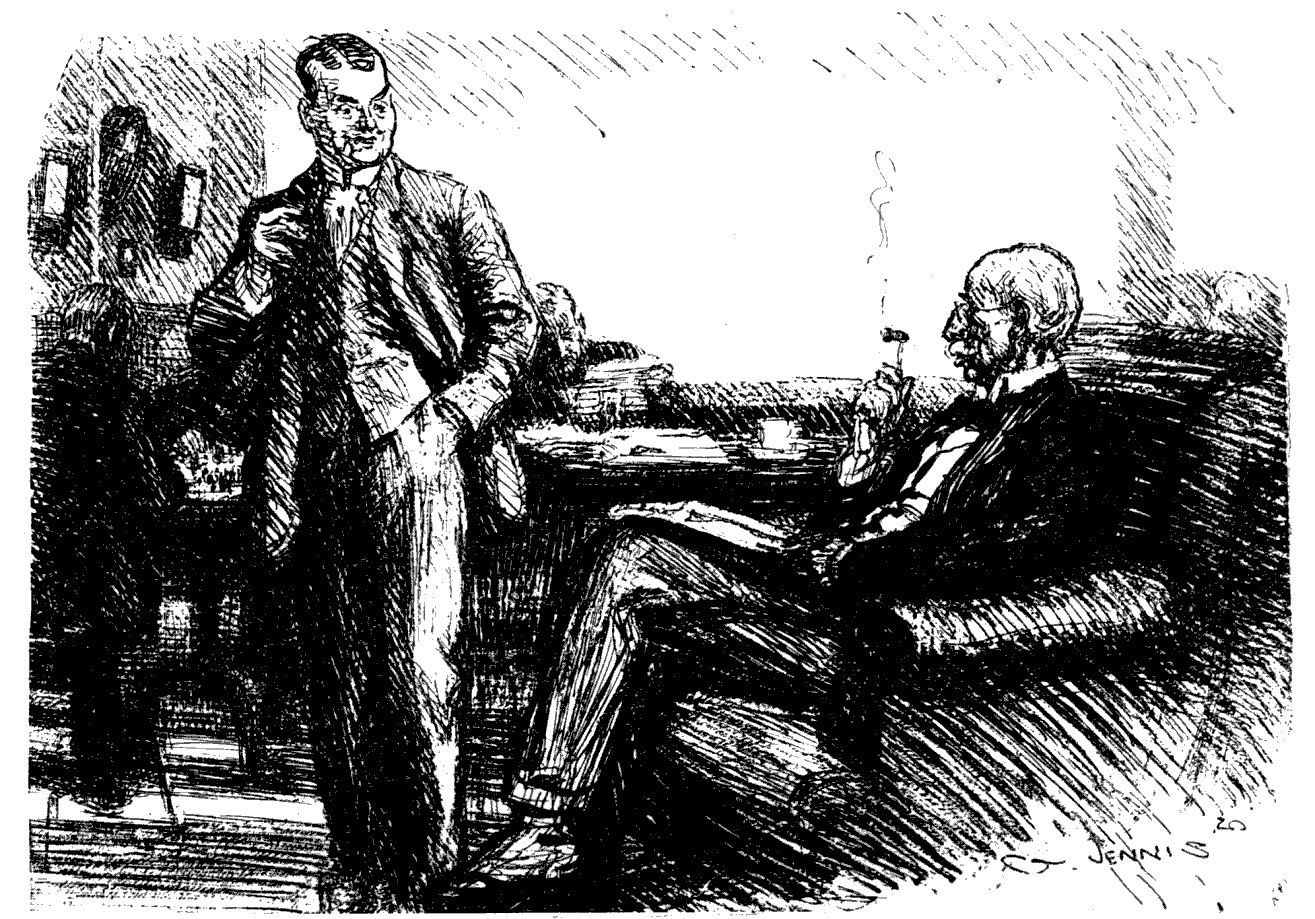
Valetudinarian. "I've got cirrhosis of the liver, an incipient carbuncle on my neck, inflammation of the duodenum, septic sore throat and general prostration."
Sympathetic Friend. "Well, and how are you?"
A Knowing Old Bird.
"Grey African Parrot ... every question fully answered; £10 or offers."—Weekly Paper.