Volume 158 — A DOG'S LIFE.
Reading edition
The life of a public man is a dog's life. I don't know why a dog's life should be the type and summit of unpleasantness in lives; for myself I should have thought it was rather a good life; no clothes to buy and no shortage of smells; but there it is. The reason is perhaps that a dog spends most of his day just finding a really good smell and being diverted from it by something else, a loud whistle in front or a motor-bicycle or another smell. He rushes off then after the whistler or the motor-bicycle or the new smell, missing all kinds of good smells on the way and never getting the cream of the old one. And that is like the day of the public man.
He sits up in bed in the morning, having his breakfast and thinking over the smells he is going to have during the day. There is an enormous choice. The whole of the bed is covered with papers; there are tables on either side of the bed covered with papers, letters and memoranda, and agenda and minutes and constituents' grievances, and charitable appeals and ordinary begs. When he moves his foot there is a great crackling, and the surface papers float off into the air and are wafted about the room. Each paper represents a different smell. He is going to make a speech to the Bottle-Washers' Union at 11 a.m. and he is reading the notes of his speech; but before that he has got to introduce a deputation of Fish-Friers to the Home Secretary at ten and he is trying to find out what the Fish-Friers are after. But the telephone-bell keeps on ringing and the papers keep on floating away, and the papers about the Fish-Friers keep mixing themselves up with the papers about the Bottle-Washers, and the valet keeps coming in to say that the bath is prepared or the hosier has come, so that it is all very difficult.
All his family ring him up, and all the people who were at the meeting last night and were not quite satisfied with the terms of the Resolution, and all the people who are interested in Fish-Frying and Bottle-Washing, and all the people who want him to make a speech at Cardiff next year, and several newspapers who would like to interview him about the Sewers and Drains Bill, and a man whose uncle has not yet been demobilised, and a lady whose first-born son would like to be President of the Board of Trade as soon as it can be arranged. Meanwhile people begin to drift into the room. The Private Secretary drifts in with a despatch-case, full of new smells and some old ones; and the valet drifts in to say that the bath is still prepared, and a haircutter and a man from the shirt-makers, and the Secretary of the Fish-Friers, who has looked in for a quiet talk about the situation.
When they are all ready for their quiet talks the public man decides that it is time he got up; he leaps out of bed and rushes out of the room and shaves and baths and does his exercises very very quickly. Then he rushes back and has a talk with the Home Secretary on the telephone while he is drying his ears. When his ears are nice and dry he rings off and ties his tie, meanwhile dictating a nasty letter to The Times about the Scavengers (Minimum Wage) (Scotland) No. 2 Bill. In the middle of this letter two new crises arise—(1) The Home Secretary's Private Secretary's Secretary rings up and says that the Fish-Friers' deputation is postponed till 11 a.m. because of a Cabinet Meeting about the new war. (2) The Assistant-Secretary to the Prime Minister's Principal Secretary's Secretary rings up and says that the Prime Minister can see the public man for ten seconds at one minute past eleven. It is now clear that the Bottle-Washers and the Fish-Friers and the Prime Minister are going to clash pretty badly, and a scene of intense confusion takes place. The public man runs about the room in his shirt-sleeves smelling distractedly at the papers on the floor and on the bed and everywhere else. Some of the papers he throws at the Private Secretary and tells him to write a memorandum about them, and go and see the War Office about them and have six copies made of them. Most of them, however, he just throws on the floor or hides away in a dressing-gown where the Private Secretary won't find them; this is the only way of making sure of a permanent supply of good crises. A crisis about a lost document is far and away the most fruitful kind of crisis.
Meanwhile the valet pursues the public man about the room with spats and tries to attach them to his person. If he can attach both spats before the Fish-Friers' man really gets hold of him he has won the game. The Fish-Friers' man keeps clearing his throat and beginning, "The position is this—"; and the Private Secretary keeps saying in a cold dispassionate voice, "Are you going to the Lord Mayor's lunch?" or "How much will you give to the Dyspeptic Postmen's Association?" or "What about this letter from Bunt?"
The public man takes no notice of any one of them, but says rapidly over and over again, "Where are my spectacles?" or "What have you done with the brown socks?" He is playing for time. If he can put them off for a little more, some new crisis may occur and he will be able to say that he is too busy to deal with them now.
The Private Secretary knows this and continues to say, "Are you going to the Lord Mayor's lunch?" The Fish-Friers' man doesn't know it, and crawls about excitedly on the floor looking for the spectacles under the bed. When he is well under the bed the public man tells the Private Secretary to ring up the Bottle-Washers and the Fish-Friers and the Prime Minister and arrange things somehow, and rushes out of the room. He is hotly pursued by the valet and the hosier and the hairdresser, but there's a taxi at the door and with any luck he will now get clear away. In the hall, however, the cook meets him in order to give notice, and by the time he has dealt with that crisis the Private Secretary has had three wrong numbers and given it up, and the Fish-Friers' man has bumped his head and given it up. They give chase together and catch the public man just as he is escaping from the front-door. The Private Secretary starts again about the Lord Mayor's lunch, and the Fish-Friers' man starts again about the position.
The public man knows now that he is done, so he drives them into the taxi and says he will talk to them on the way to the Prime Minister. The taxi dashes off, leaving the hosier and the hairdresser and the valet wringing their hands in the hall.
The only thing the public man can do now is to invent a new crisis for the Private Secretary, who is still saying in a cold dispassionate voice, "Are you going to the Lord Mayor's lunch?"
So he thinks of one of the letters he has hidden in his dressing-gown and tells the Private Secretary that he must have that letter for the Bottle-Washers' meeting. Then he stops the taxi at a place where there is no Underground and no 'bus, and pushes the Private Secretary out. He has disposed of the Private Secretary for the day.
But the Fish-Friers' man's throat is practically clear by now and he gets to work at once. The public man pays no attention but prepares in his mind his opening sentences to the Prime Minister. In the Park he sees two other public men walking and he takes them into the cab. Each of them has discovered some entirely new smells and starts talking about them at once very fast. The public man promises to go and try them all immediately. When he gets to the Prime Minister's he rings up and cancels the Fish-Friers and the Bottle-Washers. When he has done that the Assistant-Secretary to the Prime Minister's Principal Private Secretary's Secretary comes out and says that the Prime Minister has been called away suddenly to Geneva.
The public man then goes off after the new smells. A dog's life.
A.P.H.
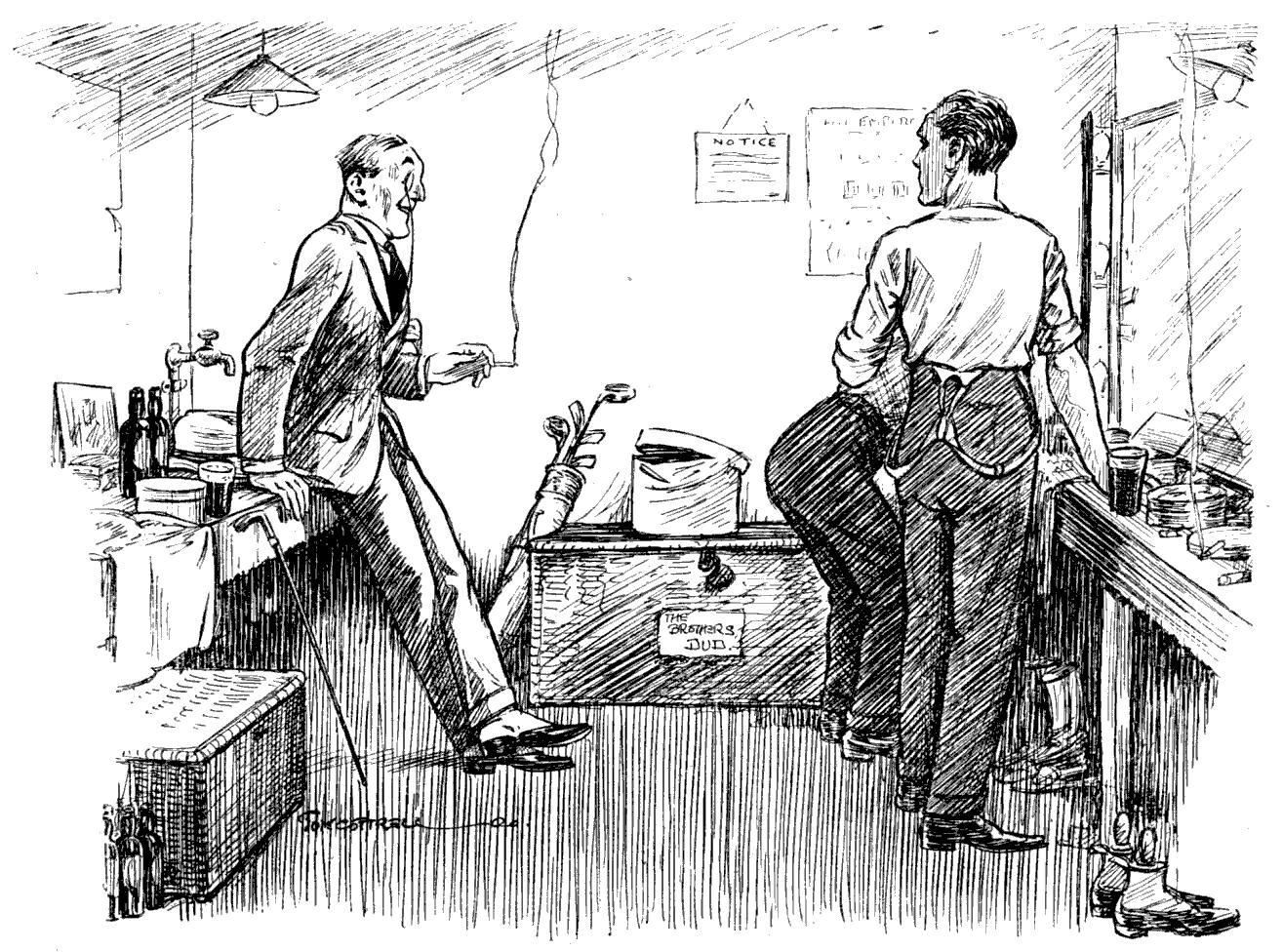
Visitor (to actor friend). "Y'know, I was goin' on the stage myself once, but my people dine so late."
A Sporting Offer.
"Rabbit trapper would take so much the couple or rent them, or give so much the couple and kill them."—Scotch Paper.
A CORNISH LULLABY.
a.d. 1760. Sleep, my little ugling, Daddy's gone a-smuggling, Daddy's gone to Roscoff in the Mevagissey Maid, A sloop of ninety tons With ten brass-carriage guns, To teach the King's ships manners and respect for honest trade. Hush, my joy and sorrow, Daddy'll come to-morrow Bringing baccy, tea and snuff and brandy home from France; And he'll run the goods ashore While the old Collectors snore And the wicked troopers gamble in the dens of Penzance. Rock-a-bye, my honey, Daddy's making money; You shall be a gentleman and sail with privateers, With a silver cup for sack And a blue coat on your back, With diamonds on your finger-bones and gold rings in your ears. Patlander.
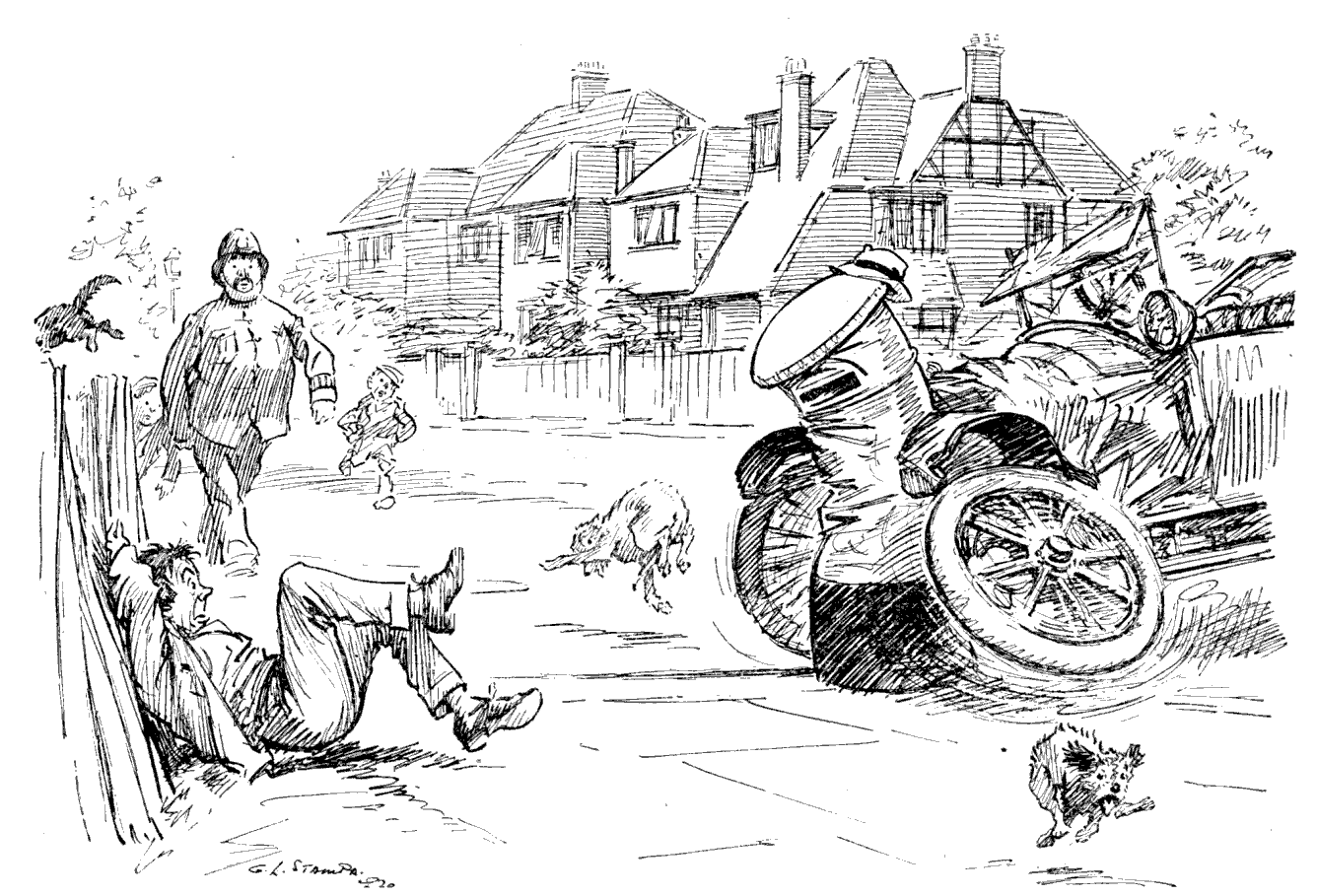
Motorist. "That reminds me—I never posted that letter."
POPULAR CRICKET.
Dear Mr. Punch,—I enclose a cut from Le Radical, one of the leading Mauritius papers, and on behalf of the lovers of our national game in the island venture to ask for information regarding the last match recorded:—
"Londres, 14 mai, 4 hres p.m.—Mary-le-bone a battu Nottingham par 5 wickets; Lancashire a battu Leichester; Sussex a battu Warrick. En second lieu un joueur du Sussex a abattu H. Wilson par 187 wickets."
We are much perturbed at the strange developments that are evidently taking place in the game at home. Was this match, we want to know, a single-wicket game between the Sussex player and H. Wilson? If so how did he beat him by 187 wickets?
An ex-captain of the Cambridge eleven living here is of the opinion that, in order to make cricket more popular, the numbers of the opposing sides are being increased, and that this match must have been between a team of, say, a couple of hundred Sussex players and one of a like number captained by H. Wilson, and that only some dozen wickets had fallen in the second innings when the match ended. If this is the correct interpretation we should be very grateful for the rules, plan of the field, etc., as we are most anxious to move with the times in this little outpost of Empire.
I fear however that we shall have some difficulty here in raising two teams of more than a hundred-a-side.
We presume that, as a match of eleven-a-side takes two or three days to finish, about six or eight weeks are allotted to this new game.
Any help that you can give us, Sir, will be much appreciated.
Yours faithfully,
M.C.C.
FROM THE FILM WORLD.
As an interesting supplement to the announcement that Sir Thomas Lipton has kindly placed his bungalows and estates in Ceylon at the disposal of the East and West Films, Limited, for the filming of The Life of Buddha, we are glad to learn that preparations are already well advanced for the presentation of the Life of Hannibal on the screen.
Messrs. Sowerly and Bitterton, the well-known vinegar manufacturers, have undertaken to provide the necessary plant for illustration of the famous exploit of splitting the rocks with that disintegrating condiment, and Messrs. Rappin and Jebb, the famous cutlers, have been approached with a view to furnish the necessary implements for the portrayal of the tragedy of the Caudine Forks. Professor Chollop, who is superintending the taking of the pictures of the battle of Cannæ and the subsequent period of repose at Capua in their proper atmosphere, states that he is receiving every support from the local condottieri, pifferari, banditti and lazzaroni, and expects to be able to complete his task by the late autumn.
A certain amount of antagonism, on humanitarian grounds, has been shown by the Italian Government to the importation of a herd of elephants, which were essential to the realistic depiction of the passage of the Alps by the Carthaginian army; but it is hoped that by the use of skis the transit may be effected without undue casualties among the elephantine fraternity.
Lord Fisher has been invited to impersonate Scipio, and the rôle of Fabius, the originator of the "Wait and See" policy, has been offered to Mr. Asquith, but authentic details are as yet lacking as to their decision.
THE BLAMELESS ACCOMPLICE.
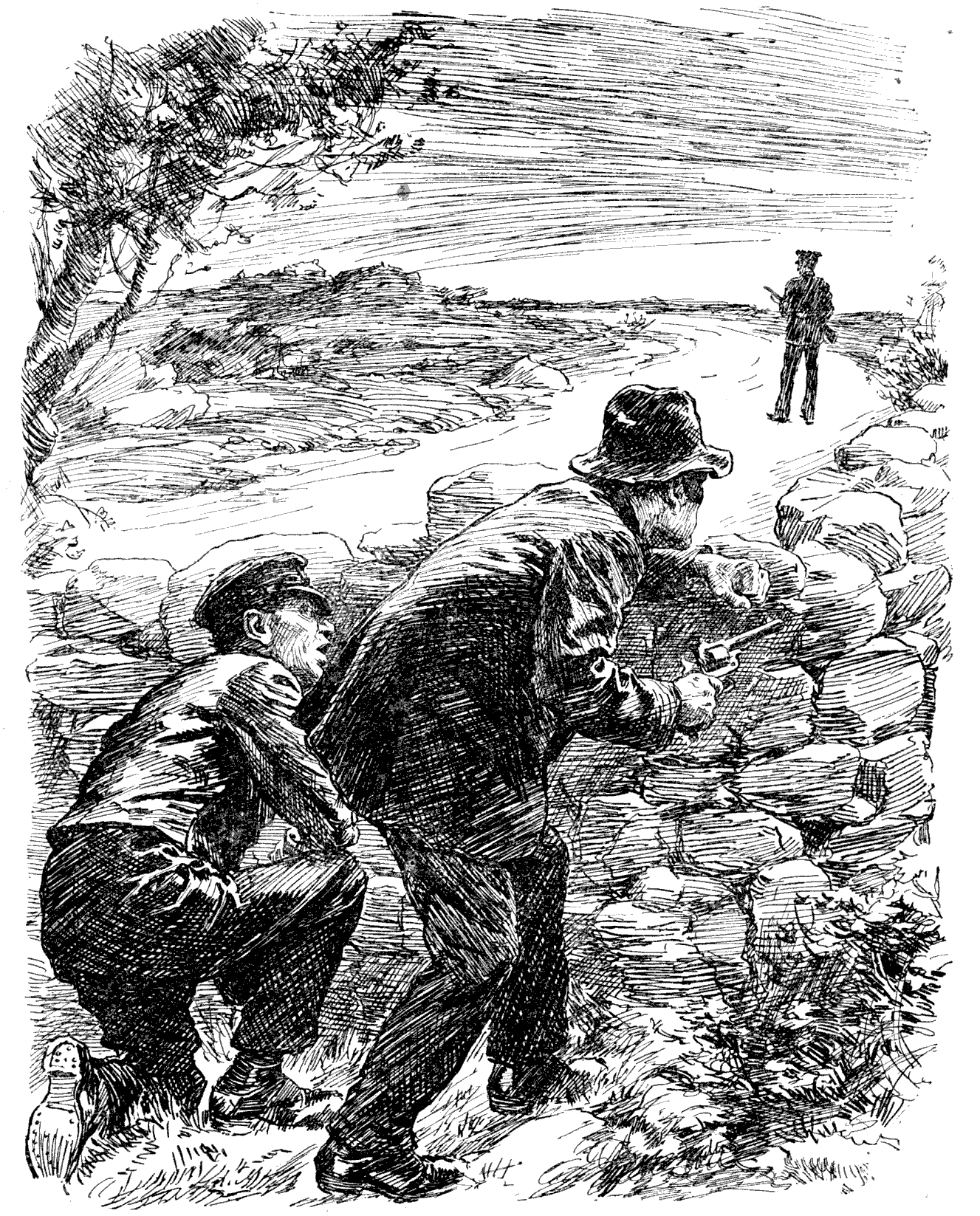
Irish Railwayman (to Sinn Fein Assassin). "YOU'LL BE ALL RIGHT. DETESTING MURDER, AS MR. THOMAS SAYS I DO, I'VE TAKEN CARE THAT THAT FELLOW SHOULD HAVE NO AMMUNITION."
["The Irish members of the N.U.R. expressed publicly their feeling of disgust at murder and outrage."—Mr. J.H. Thomas.]