Volume 158 — THE INTERNATIONALIST.
Reading edition
"What on earth," I said to the waiter, who was standing a few yards off, lost in a pensive dream of his native land—Switzerland, France, Italy?—well, anyhow, lost in a pensive dream—"what on earth is a Petrograd steak?"
The white napkin whisked like the scut of a rabbit, and he bounded to my side. "Eet is mince-up," he said melodramatically. "Ze Petrograd steak ver good. Two minute—mince-up."
"But isn't that a Vienna steak?" I asked.
A spasm of pain passed over his face. "Before ze War," he whispered, "yes, Vienna steak. Now we call it ze Petrograd. You vill have one? Yes? Two minute."
Memories came flooding back of that moment of crisis which had found so many of our trusted statesmen ill-prepared, but, terrible as it was, had not caught the managers of London restaurants napping. I remembered the immense stores of Dutch lager beer which they had so providentially and so patriotically held in anticipation of the hour of need. Dutch beer, both light and dark, so that inveterate drinkers of Munich and Pilsener were enabled to face Armageddon almost without a jerk. They had other things ready too—Danish pâté de fois gras, Swiss liver sausages, Belgian pastries and the rest. It was in that dark hour, I suppose, that the Vienna steak set its face towards the steppes. But this was in 1914, and a good deal had happened since then. It appeared to me that the restaurant was not exactly au courant with international complications and the gastronomic consequences of the Peace. I felt entitled to further illumination.
"I don't feel at all certain," I told the man, "that I ought to eat a Petrograd steak. Is it a white steak?"
"Ah, no, not vite, not vite at all," he assured me. "Eet is underdone—not much, but a little underdone. Ver good mince-up."
"I absolutely refuse to eat a Red Petrograd steak," I declared. "Have you by any chance anything Jugo-Slavian on the menu?"
"Zere is ze jugged hare—"
"I think you misunderstand me," I interrupted; "this is a point of principle with me. Supposing I consume this Czecho-Slovakian mince-up and then have a piece of Stilton; there has been no war with Stilton, I fancy—"
"Ver good, ze Stilton," interjected the chorus.
"And coffee—'
"Turkish coffee?" he said.
"There you go again," I grumbled. "Whatever my attitude may be towards Vienna and Petrograd (and, mind you, I am not feeling at all bitter towards Vienna), my relations with Turkey are most certainly strained."
"No, not strained, ze Turkish coffee," he cried eagerly; "eet has ze grounds."
"So have I," I told him; "we will call it the Macedonian coffee. It is you who insisted in obtruding these international relations on my simple lunch, and I mean to do the thing thoroughly. Better a dish of Croat Serbs where love is than a bifteck Petrograd—Never mind, go and get the thing."
When he returned with it I fell to, but my thoughts remained with the waiter. What a man! With his dispassionate judgment, his calm sane outlook on men and affairs, shaken a little perhaps in 1914, but since then undisturbed, was he not cut out above all others to settle the vexed frontier lines of Europe? I wondered whether Lord Robert Cecil might not possibly make use of him. I was tempted to try him still further.
"Have you ever heard of Mr. J.M. Keynes?" I asked him when he brought me the Bessarabian coffee.
"Mr. Keynes I not know. He not come here, I zink."
"Or the Treaty of London?"
"I vill ask ze manager."
"Or President Wilson?"
A brilliant smile of illumination lit up his features.
"American, is he not?" he said. "Ver reech, ze Americans."
This saddened me a little. He was not then absolutely complete. There was a faint tarnish on the lustre of his innocence. He was scarcely perhaps suited for the League of Nations after all. Lighting an Albanian cigarette I asked him for my bill.
THINKING ALOUD.
Lord Haldane loquitur.
"Tired of laborious days and nights Spent on the intellectual heights, I long to raise and educate The masters of the future State. Besides, the people in the plains Are lamentably short of brains, And I have even more than Keynes. Already in The Herald's page Am I acclaimed as seer and sage; Mine be it then to teach my neighbour To quit the lowly rut of Labour, And scale the heights of Pisgah, Nebo, Or some equivalent gazebo, For even Labour must afford To keep one competent Law Lord."
"WAR CRIMINALS DEMAND TO BE SUSPENDED."—Evening Paper.
Too good to be true.
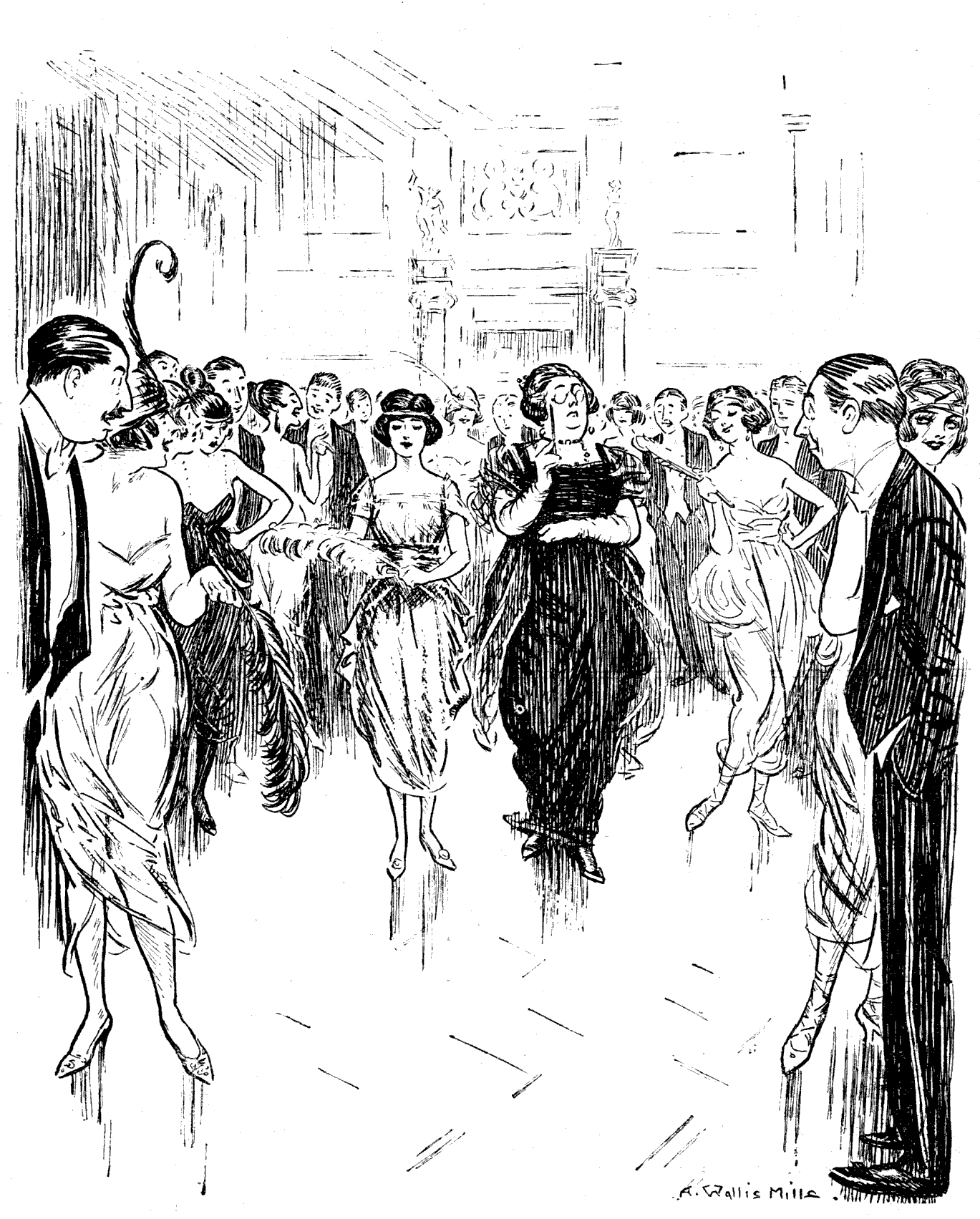
MANNERS AND MODES.
A YOUNG GIRL HAS THE TEMERITY TO BRING A CHAPERON TO A DANCE.
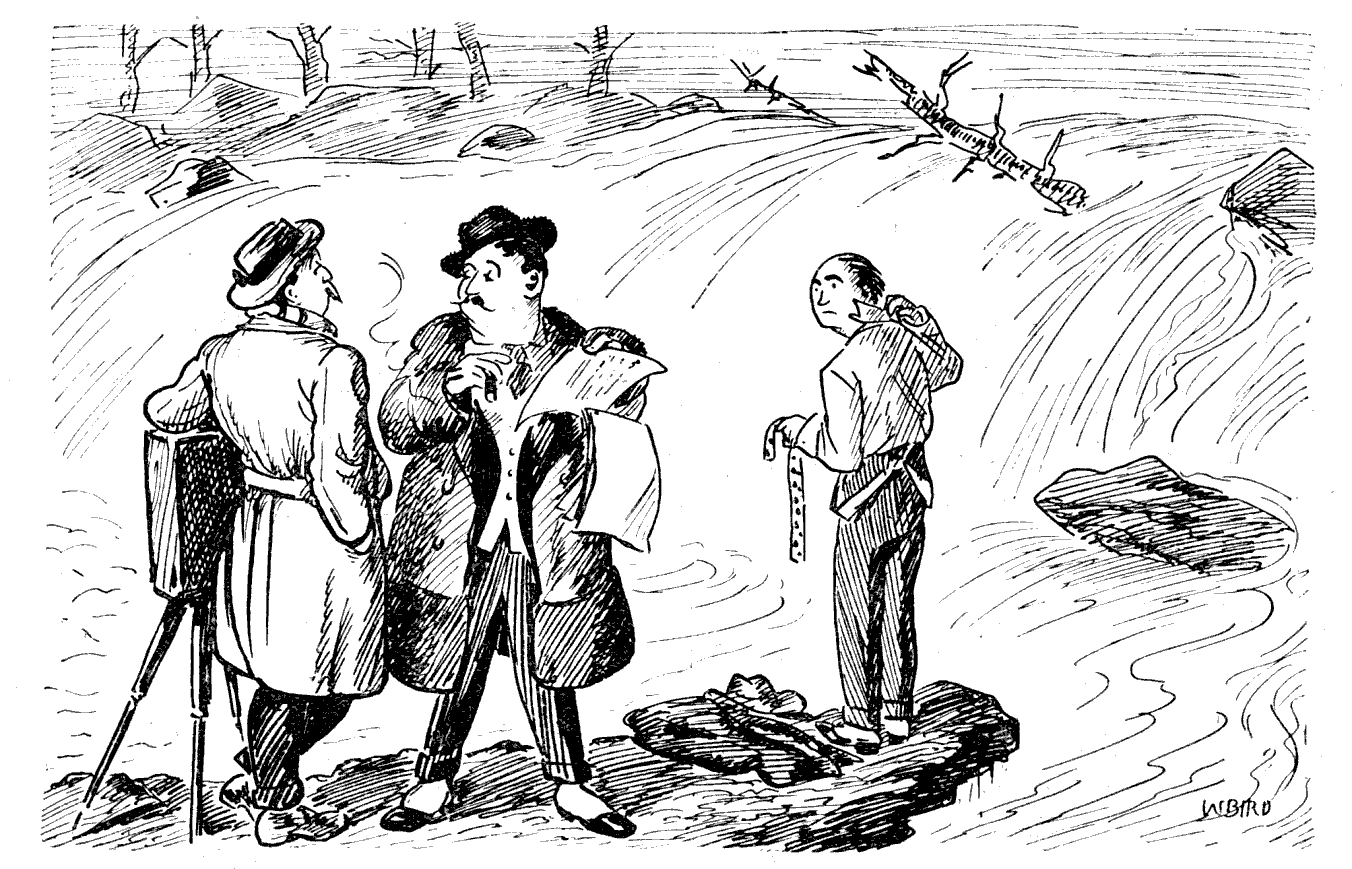
BEHIND THE SCENES IN CINEMA-LAND.
"This is where he swims the rapids. How shall we send him—up or down?"