Volume 158 — AT THE PLAY.
Reading edition
"Just Like Judy."
If the author of Just Like Judy will look into that commodious classic, Mrs. Beeton's Cookery Book, he will find a formula for light pastry. And if he will proceed to the (for him) enlivening adventure of essaying a tartlet, he will find that most fatal among a host of fatal errors will be any failure to preserve the due proportion of ingredients. I do not suggest that there is as rigid a formula for light comedy. But certainly Mr. Denny threw in too many unnecessary mystifications and crude explanations in proportion to the wit, wisdom and lively incident of his confection. In particular he was constantly making some of his characters tell the others what we of the audience either already knew or quite easily guessed. To exhaust my tedious-homely metaphor, if you put in a double measure of water the mixture will refuse to rise. And that I imagine is essentially what happened to Just Like Judy.
Irish Judy, a charmingly pretty busybody, outwardly just like Miss Iris Hoey, comes to Peter Keppel's studio and hears that this casual youth has got into a deplorable habit of putting off his marriage with her friend Milly. She (Judy) will see to that! She assumes the rôle of a notorious Chelsea model, whom proper Peter has never seen. Peter knocks his head on the mantelpiece, just where a shrapnel splinter had hit him, and is persuaded that she, Judy McCarthy, affecting to be Trixie O'Farrel, is his wife. It all seems very horrible to him, but, shell-shock or no shell-shock, he sets to work to paint her portrait in a business-like way, and at the end of four hours it doesn't seem at all horrible. And by the time it is explained that it was all a joke (some people do have such a nice sense of humour) he is all for rushing off to the registry-office, Judy agreeing.
Not that Judy is a minx. She did her level best to make two people who obviously didn't love one another fulfil their engagement, instead of, like a sensible woman, accepting the inevitable, which was, as it happens, so congenial to her. What puzzled me was Peter's indignation with poor Milly when he found that she really didn't love him (but, on the contrary, a bounder called Crauford), yet couldn't bear to cause him unhappiness, and was sacrificing herself for him. As that was his attitude precisely, I suppose he felt annoyed by this lack of originality. If we men are like that, it wasn't nice of Mr. Denny to give us away.
At any rate I am sure Mr. Donald Calthrop didn't believe in Peter all the time. When he did he was very good indeed. When he didn't he was horrid. Did Miss Iris Hoey believe in Judy? I am not so sure. I suspect not. Did I believe in either? I did not.
I was a little surprised that Miss Joan Vivian-Rees should so overplay her Trixie. Her work is certainly in general not like that, and I conjecture the influence of some baleful autocrat of a producer. It seemed to me that Miss Mildred Evelyn's Milly was, all things considered, a capable and consistent study of a desperately unsympathetic character, a more difficult and creditable feat than is commonly supposed.
T.
"Wild Geese."
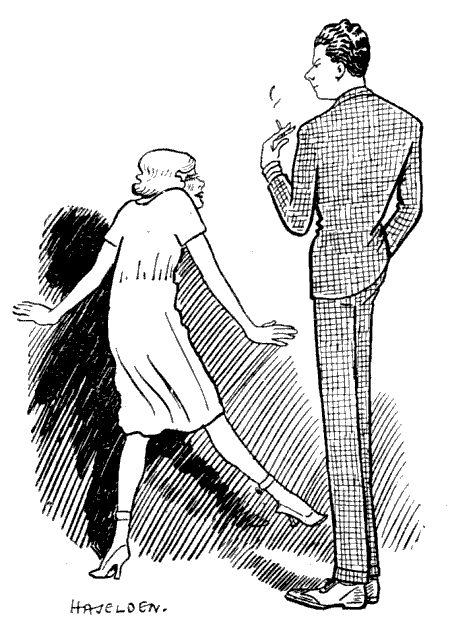
Mr. Jack Buchanan (Hon. Bill Malcolm). "What's the idea? Are you by any chance trying to give me the cold shoulder?"
Miss Phyllis Monkman (Violet Braid). "No. I just keep on doing this for the look of the thing."
I should hesitate to accuse Mr. Ronald Jeans of originality in the design of his musical trifle at the Comedy. The idea of a company of women that bans the society of men is at least as old as the Attic stage. But it is to his credit that though the theme invited suggestiveness he at least avoided the licence of The Lysistrata. Indeed there were moments when his restraint filled me with respectful wonder. Thus, though the Pacific Island to which the Junior Jumper Club retired—with no male attendant but the Club porter—clearly indicated a bathing scene, yet we had to be satisfied with an occasional glimpse of an exiguous maillot with nobody inside it.
In fact, the fun throughout had a note of reserve and was never boisterous. Mr. Jack Buchanan's quiet methods in the part of the Hon. Bill Malcolm, universal philanderer, lent themselves to this quality of understatement. In a scene where he tried to extricate himself from a number of coincident entanglements with various members of the Club he was quite amusing without the aid of italics. Mr. Gilbert Childs, again, as Weekes—Club porter and Admirable Crichton of the island—though a little broader in his style, was too clever to force the fun.
The other sex, as was natural with women who affected a serious purpose, had fewer chances, and Miss Phyllis Monkman spoilt hers by a bad trick of hunching her shoulders and waggling her arms as if she were out for a cake-walk on Montmartre.
There were touches of humour in Mr. Cuvillier's tuneful music and in the limited movements of the best-looking chorus that I have seen for a long time.
As for the plot, it had at least the merit of continuity and conformed to the logic, seldom too severe, of this kind of entertainment, as distinct from the so-called revue. Nearly everything was well within my intelligence, the chief exception being the title; for never surely did a wild-goose chase offer such easy sport. The birds were just asking to be put into the bag. I should myself have preferred, out of compliment to the chorus, to call the play "Wild Ducks," only, of course, Ibsen had been there before. Not that this would have greatly troubled an author who showed so little regard for the proprietary rights of Aristophanes and Sir James Barrie.
O.S.
WITCHES.
"Finns, they're witches," said Murphy, "'tis born in 'em maybe, The same as fits an' freckles an' follerin' the sea, An' ginger hair in some folks—an' likin' beer in me. "Finns, they're witches," said Murphy, "an' powerful strong ones too; They'll whistle a wind from nowhere an' a storm out o' the blue 'Ud sink this here old hooker an' all her bloomin' crew. "Finns, they're witches," said Murphy, rubbing his hairy chin, "An' some counts witchcraft bunkum, an' some a deadly sin, But—there ain't no harm as I see in standing well with a Finn." C.F.S.
Our Cynical Press.
"Mr. ——, M.P., is leaving home for a fortnight's rest."—Scotch Paper.
PROTECTION FROM BURGLARS.
FOR IDEAL AND OTHER HOMES.
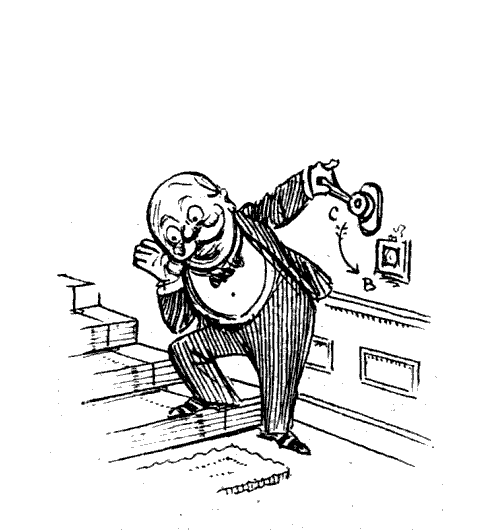
and the patent protective stair-creak recorder is set to the right key—
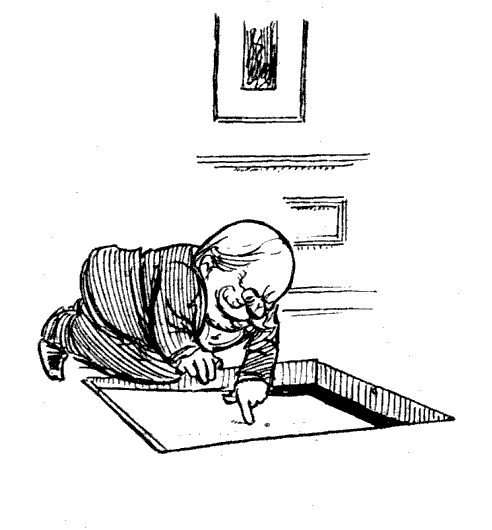
and the passage spring-trap adjusted to a nicety—
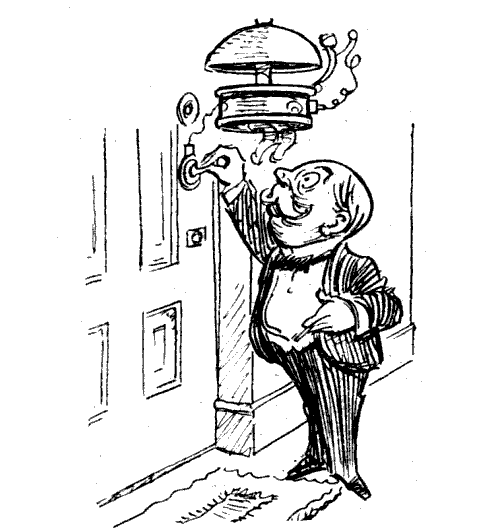
Having seen that the front-door burglar alarm-gong is in working order—
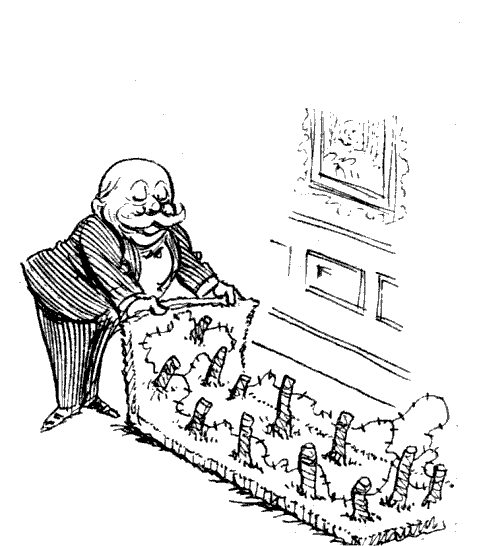
arrange your barbed-wire-entanglement rug—
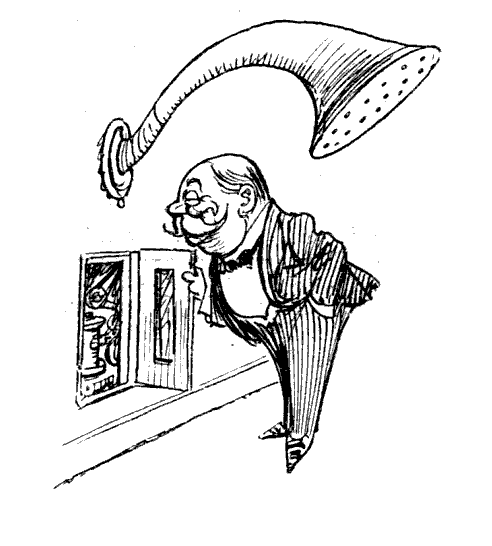
you can just give a look at the mechanism controlling the burglar chloroform shower—
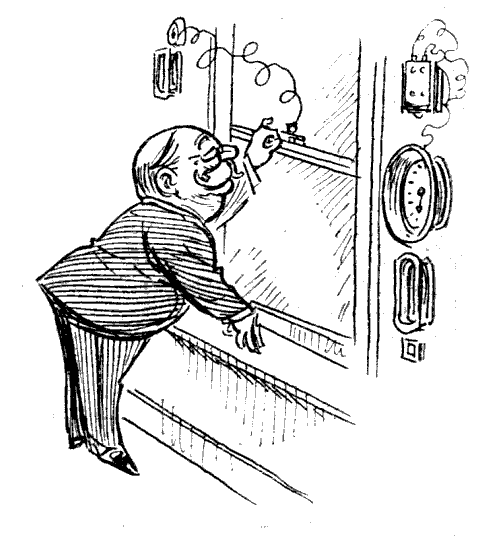
and your synchronised window-catch warning system geared properly—
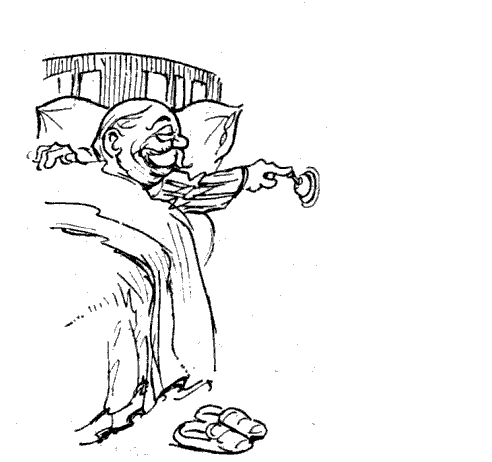
and go to bed.
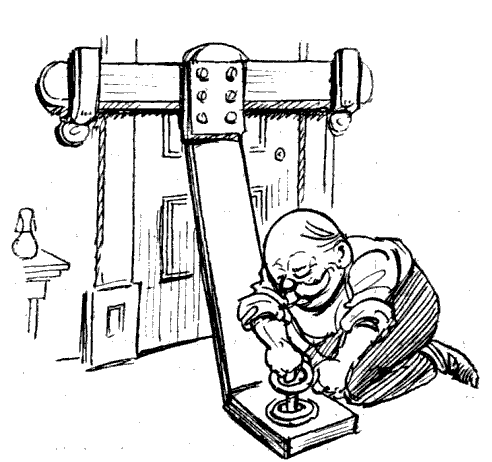
fix your interior bedroom-door defences—
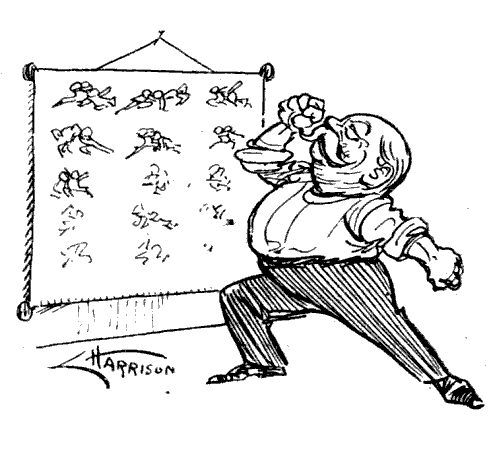
run through your jiu-jitsu exercises according to chart—
THE INCORRIGIBLE.
Ernest was a sprightly youth With a passion for the truth, Who, the other day, began His career as midshipman. 'Twas not in the least degree Vulgar curiosity Urging him to ask the reason Why, both in and out of season; 'Twas but keenness; all he lacked Was a saving sense of tact. Once the Lieut. of Ernie's watch, Dour, meticulous and Scotch, Thought he'd show the timid snotty (Newly joined) exactly what he Wanted when inspecting men. Closely Ernest watched, and then Said, saluting, "Sir, I note Several creases in your coat, And I see upon your trouser Signs of paint-work; yet just now, Sir, Did you not think fit to blame One poor man who had the same?" Ere that outraged Lieut. replied Suddenly our hero spied Coming aft, his labours done, Our benignant Number One (Most abstemious is he, And, in fact, a strict T.T., But—it shows how Fate can blunder— No one could be rubicunder. Ernest, after one swift glance, Said, "Excuse my ignorance, But, Sir, can you tell me why You are always red, while I, Even when I drink a lot, Only flush if I am hot?" Just as Number One grew pale And collapsed against the rail, Striving grimly not to choke, Ernest heard the busy Bloke Calling loudly, "Let her go!" To a seaman down below; "Fool! the cutter's bound to ram you, Push the pinnace forrard, damn you!" Ernest shook his youthful head And he very gently said Into his Commander's ear, "You forget yourself, I fear. May I ask what you would do If I used that word to you? Is it worthy, Sir, of an Officer and gentleman?" Aft ran little Ernest, only Pausing when he saw a lonely Figure bright with golden lace Who appeared to own the place. "Ah!" thought Ernie, "I know you; You're the luckless Captain who (Though you hadn't then a beard) Most unwillingly appeared But a year ago or less In the Illustrated Press." "Tell me, Sir," the youngster cried, Crossing to the Captain's side Of the sacred quarterdeck— "How did you contrive the wreck Of the cruiser you commanded When she bumped the beach and stranded?" You may say, "He is so brave he Ought some day to rule the Navy." Certainly he ought, but still I'm afraid he never will; For they talked to him so gruffly And they handled him so roughly That, when he was fit to drop And the kindly Bloke said, "Stop! Or you'll make him even madder; He is wiser now and sadder," Ernest simply answered, "Ay, Sir, You have made me sad; but why, Sir?"
ÆQUAM MEMENTO.
"I wonder," said Mary for the third time, "if we shall catch the tram at the other end."
"Calmness," I told her—this for the second time—"is the essence of comfortable travel. Meeting trouble half-way—"
"It isn't half-way," she said indignantly. "We're nearly there."
We were on a bus whose "route" terminated some five miles from home, which we proposed to reach by a tram, and, the hour being late, it was our chances of catching a car that were worrying Mary.
"Never get flurried," I went on. "If people would only go ahead calmly and steadily.... What causes half our traffic congestion? Flurry. What makes it so difficult to move quickly in the streets? Flurry. What is it clogs the wheels of progress everywhere?"
"Don't tell me," she implored. "Let me guess. Flurry."
"Exactly," I said, and at this point we reached our terminus. Two trams were waiting, one behind the other, some thirty yards away, and, as we descended the steps of the bus, the bell of the first one rang warningly. Mary would have started running, but I detained her.
"Flurrying again," I said indulgently. "Here are two trams, but of course you must have the first one, however full it is," and I led her towards the second. As I expected, it was quite empty, and I was still using it to point my moral when its conductor began juggling with the pole. It was then that I realised that, though on the down lines, this car was going no further. It was, in fact, turning round for its journey back to London, while in the distance the rear lights of our last down tram seemed to wink a derisive farewell.
There was nothing for it but to go ahead calmly and steadily, and we did so. It was somewhere about the end of the fourth mile that Mary asked suddenly:—
"What was it you said clogged the wheels of progress everywhere?"
"Flurry," I said feebly.
"Well, I think it's blisters," she said.
FILM NOTES.
Those who are still inclined to question whether the cinema is to be regarded as a serious force in the realm of Art should not only read the frequent contributions to The Times and other newspapers on this department of the drama, but should bear in mind that quite recently it has been stated that both the Rev. Silas K. Hocking and Mr. Jack Dempsey have taken part in photo-plays. It cannot be doubted that the peculiar talent required for making the heart of the people throb is being revealed in the most unlikely places.
If proof were needed that the art of the film is a dangerous rival to that of the stage, we would point to the five-reel drama, The Call of the Thug, of which a private trade view was given last week. Miss Flora Poudray, who is here featured—her name is new to us—proves to be a screen actress of superb gifts. We have seen nothing quite so subtly perfect as her gesture of dissent when the villain proposes that he and she together should strangle the infant heir to the millionaire woollen merchant on the raft during the thunder-storm. Patrons of the cinema will do well to look out for this delicate yet moving passage. The film will be released as early as November, 1921.
"MR. BALFOUR ON OUR WAR CRIMINALS LIST."—Daily Paper.
We simply can't believe it.
"The amount of coal available for home consumption last year was 4,385 tons per head of the population."—Evening Paper.
Then somebody else must have collared our share.
"Live Stock and Pets.
General, family 2; liberal wages and outings."—Liverpool Paper.
The difficulty with "pets" of this kind is that they are hard to get and almost impossible to keep.
"An Englishman usually finds it about as difficult to produce an R from his thoat as to produce a rabbit from a top-hat—both feats require practice."—Provincial Paper.
In this case we fear it can't be done, even with practice.
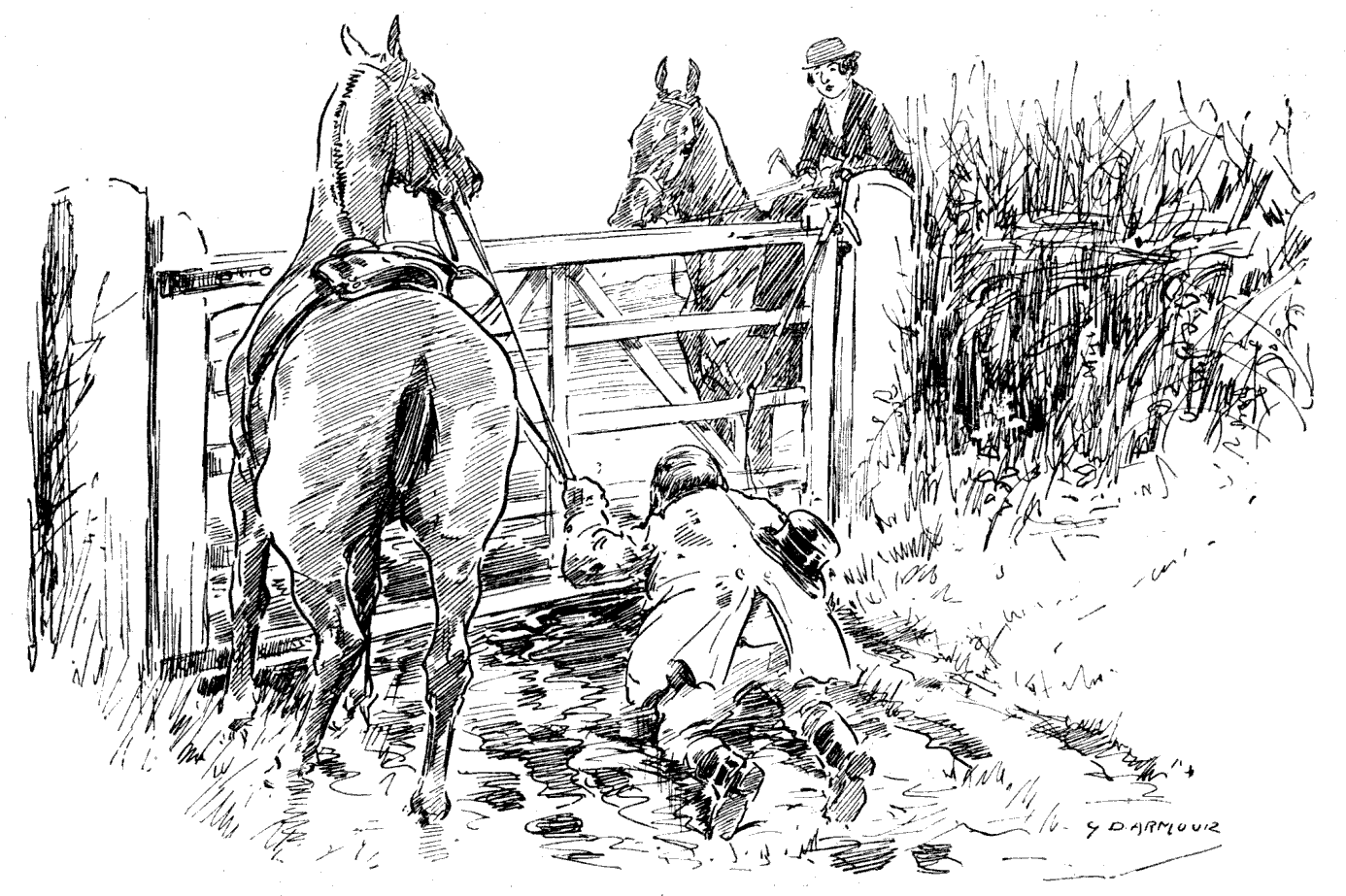
MORE ADVENTURES OF A POST-WAR SPORTSMAN.
Mrs. P.-W.S. (to P.-W.S., who has been pulled off at a gate, consolingly). "Never mind, Henry; the hunting season is nearly over, and you have the satisfaction of knowing that you have done your duty in the station to which you have been called."