Volume 158 — AT THE PLAY.
Reading edition
"Mr. Pim Passes By."
"The year's at the spring And day's at the morn... God's in His heaven— All's right with the world!"
When Pippa "passed," singing songs like that and preoccupied with the splendid fact of her one day's holiday, she unconsciously brought about a change for the better in the heart or conscience of all who overheard her. It was not so with the passing of Mr. Pim. Prior to his intrusion, there had been nothing to disturb the well-ordered existence of Geo. Marden, Esq., J.P., and his wife (late Mrs. Tellworthy), except that they did not see eye to eye on the small question of his niece's early engagement to a young artist and on the still smaller question of futuristic curtains. Then came Mr. Garraway Pim, a doddering old gentleman, with a thin falsetto voice and a loosish memory, but otherwise harmless. He arrives with an introduction from Australia and casually lets fall a tale of a fellow-passenger with the unusual name of Tellworthy, from which—and other incidental evidence—Mrs. Marden gathers that her first husband (an ex-convict) is still alive. Having dropped this thunderbolt he drifts off, leaving tragedy in his wake. End of Act I.
Marden, highly conscientious, takes the orthodox view that his lawless marriage must be nullified. His wife, though horrified at the resurrection of her impossible first husband, permits herself to recognise the humorously ironic side of things. Mr. Pim, fortunately located in the immediate neighbourhood, is sent for that he may throw further light on the painful subject of Tellworthy's revival. He now reports—what he had vaguely imagined himself to have mentioned in the first instance—that Tellworthy had met his death at Marseilles through swallowing a herring-bone. The Second Act closes with a burst of jubilant hysterics on the part of Mrs. Marden.
But the situation is only partially relieved. True, the old husband is dead all right, but the Mardens' marriage is still bigamous; they have been living all this time in what would be regarded in the eyes of Heaven (and, still worse, the county of Bucks) as sin. However, a trifling formality at a registry-office can rectify this and nobody need be any the wiser. This at least is Marden's attitude, always free from any suspicion of complexity. But his wife (if that is the word for her), being of a more subtle nature, determines to make profit out of the situation. She points out to him that she is at present the widow Tellworthy and that she must be wooed all over again, and can only be won on her own terms. These include a recognition of the niece's engagement (has not the young artist an equal right with Marden to a speedy marriage with the woman of his choice?) and a concession to her taste in futuristic curtains.
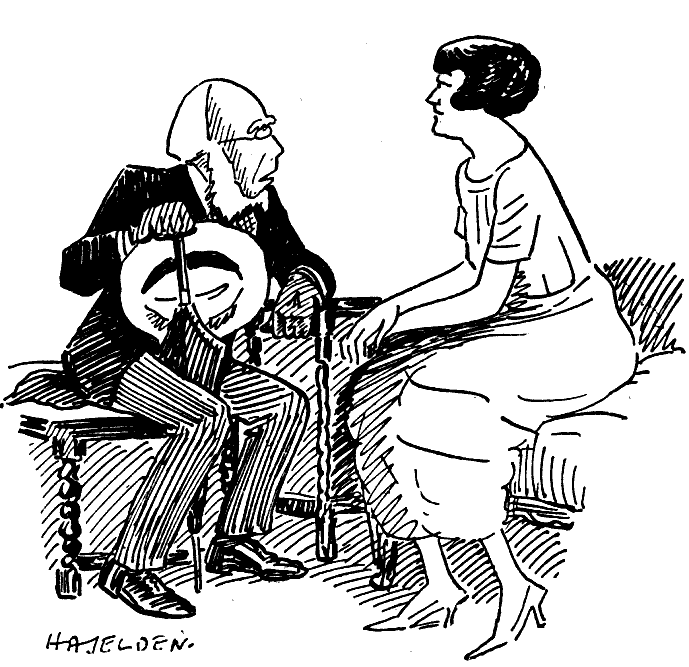
A DROPPER OF UNCONSIDERED TRIFLES.
Mr. Pim. Mr. Dion Boucicault.
Mrs Marden. Miss Irene Vanbrugh.
At this juncture Mr. Pim drifts in again to correct an error of memory. The name of the gentleman who succumbed to the herring-bone was not Tellworthy (he must have got that name into his head through hearing it mentioned as that of Mrs. Marden's first husband). It was really Polwhistle—either Henry or Ernest Polwhistle; he was not quite sure which. Everything is thus restored to the status quo ante, except that Marden, in a spasm of generous reaction, feels himself morally bound to abide by the new conditions that his wife had laid down.
Mr. Pim only passes by once more to announce his settled conviction that Polwhistle's Christian name was Ernest and not Henry.
It will be seen that the play is original in design; but it is also a true play of character revealed by circumstance. Further—and this is very rare—it owes nothing to the adventitious aid of the costumier. For the author's observation of the unities is extended to include the matter of dress; he allows his people one costume each and no more.
Miss Irene Vanbrugh played as if every one of her words had been made expressly for her, as, no doubt, they were. I have never seen her so perfect in detail, in the poise of her head, in her least gesture and intonation, in her swift changes of mood; never so quietly mistress of the finesse of her art.
As Marden, Mr. Ben Webster was a little restless in a part for which he was not constitutionally suited, but played with the greatest courage and sincerity. Mr. Dion Boucicault's study of Mr. Pim was extraordinarily effective; and the way in which he made the attenuated pipings of this futile old gentleman carry like the notes of a bell was in itself a remarkable feat.
These three were given great chances, full of colour. But in the part of Brian Strange, the boy-lover, by its nature relatively colourless, Mr. Leslie Howard was hardly less good. He never made anything like a mistake of manner. I wish I could say the same of his flapper. But Miss Cohan asserted her good spirits a little too boisterously for the picture.
I hope I shall not be suspected of partiality towards one of Mr. Punch's young men if I say that this is the best of the good things that Mr. Milne has given us. As in his unacted play, The Lucky One, he gives evidence of a desire, not unfrequent in humourists, to be taken seriously. But he knows by now that brilliant dialogue is what is expected of him, and he thinks, too modestly, that he cannot afford to dispense with it for long at a time. The result is that, after stringing us up to face a tragic situation, he is tempted to let us down with light-hearted cynicisms. He would hate me to suggest that Mr. Bernard Shaw has infected him, but perhaps he wouldn't mind my hinting at the influence of Sir James Barrie. Certainly his Mardens remind me of the Darlings in Peter Pan. Just as there we were invited alternately to weep for the bereaved mother's sorrow and roar over the bereaved father's buffooneries, so here, though not so disastrously, our hearts are torn between sympathy for the husband's real troubles and amusement at the wife's flippant attitude towards the common tragedy.
I will not deny the sneaking pleasure which this flippancy gave me at the time, but in the light of calmer reflection I feel that Mr. Milne would really have pleased himself better if he could have found the courage to keep the play on a serious note all through the interval between Mr. Pim's first and second revelations. Apart from the higher question of sincerity he would have gained something, in an artistic sense, by getting a stronger contrast out of the change of situation that followed the announcement of Tellworthy's demise.
In the First Act we seemed to have a little too much of the young couple, but this insistence was perhaps justified by the important part which their affairs subsequently played (along with the leit-motif of the futuristic curtains) in the readjustment of the relations between husband and wife.
If I have any flaw to find in a really charming play, I think it was a mistake for Mrs. Marden to let Mr. Pim into the secret of her past. As with the sweet influences of Pippa, so with the devastating havoc wrought by the inexactitudes of Mr. Pim, I think he should have been left unconscious of the effect of his passing.
For the rest,
Mr. Milne's at his best— All's right with the play!
O.S.
IT WAS UNFORTUNATE THAT BROWN HAD NOT FINISHED HIS MASTERPIECE, "THE SURRENDER OF THE GARRISON," BY THE TIME THE WAR CAME TO AN END.
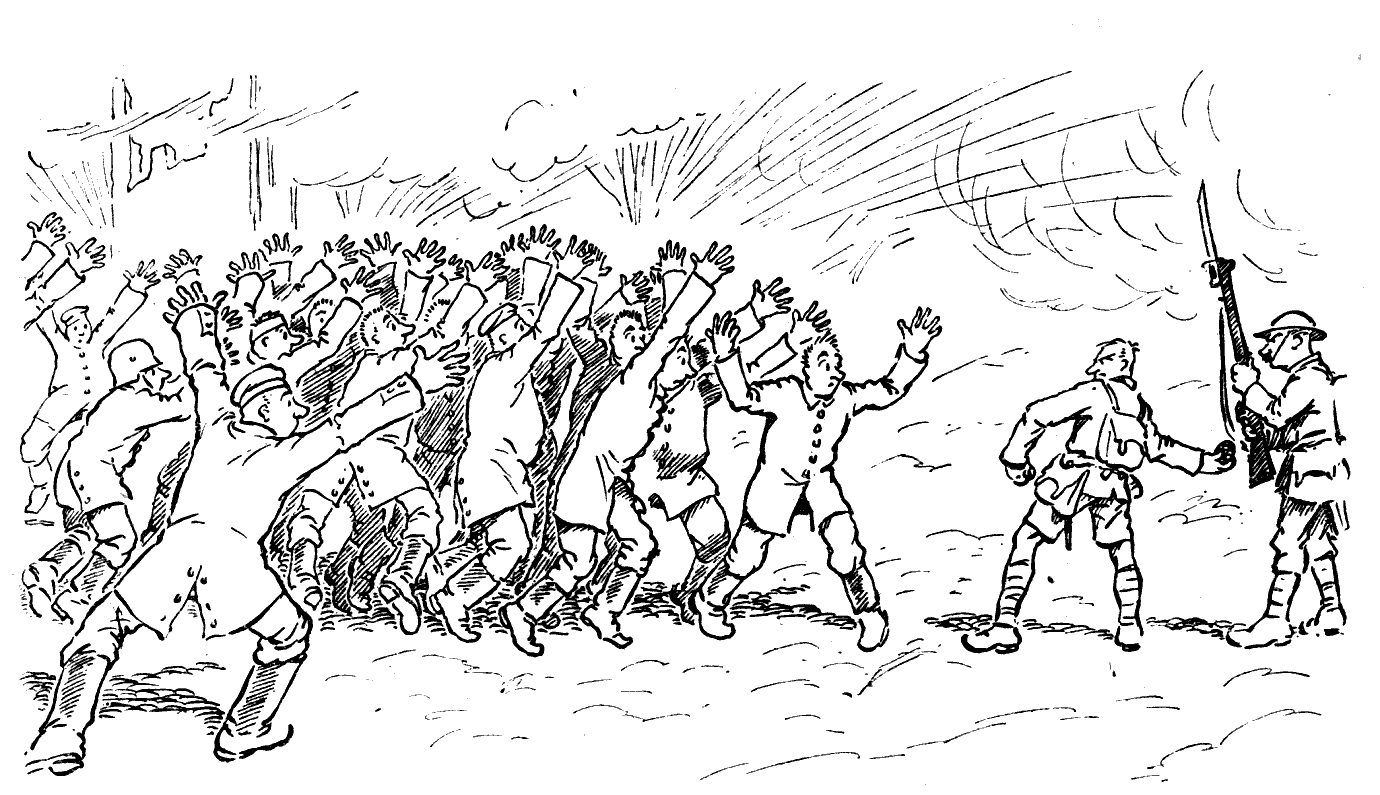
HOWEVER, IT NEEDED VERY LITTLE ALTERATION TO MAKE IT SALEABLE.
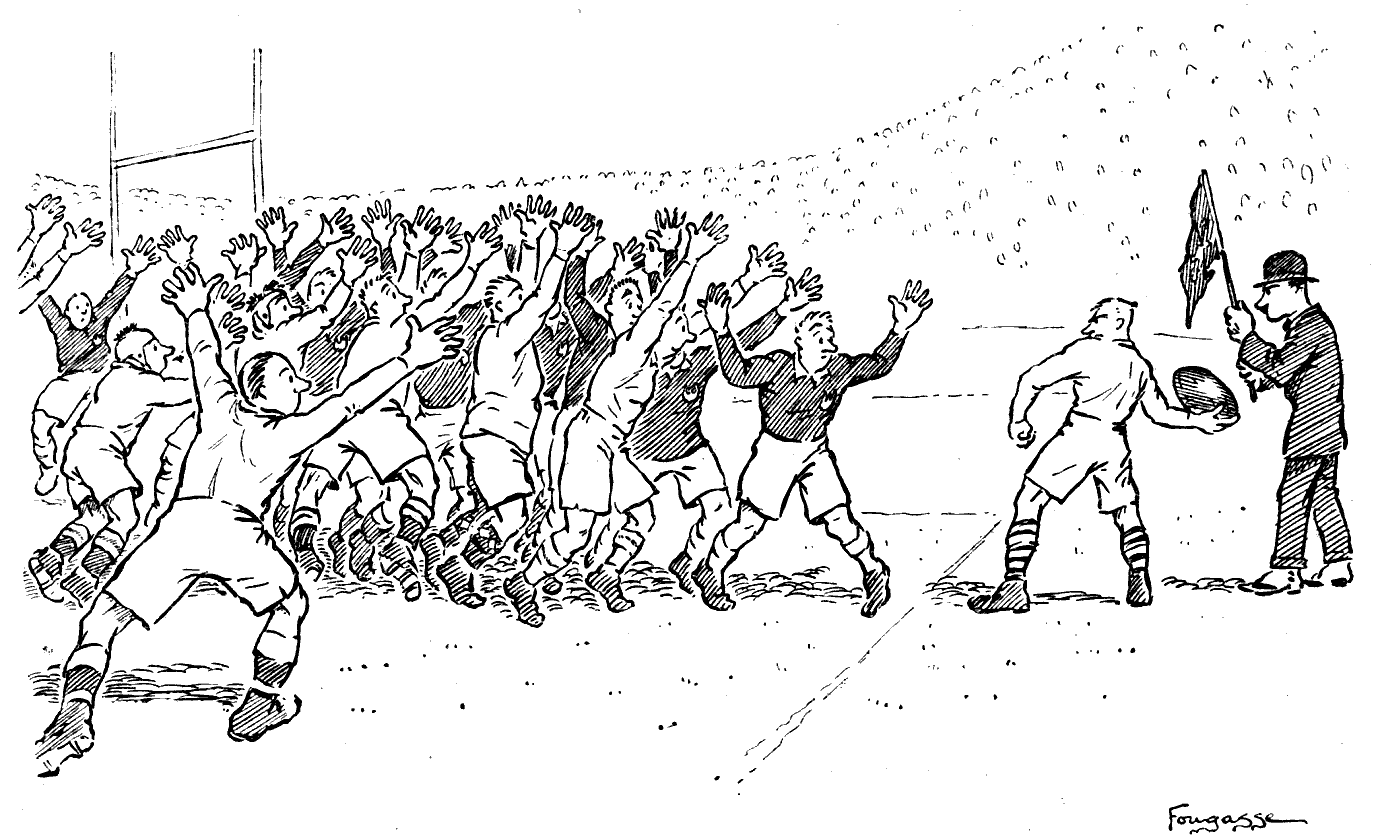
EUPHONIOUS ALIENS.
(A successful chamber concert has been given by three players, styling themselves "The Modern Trio," and named as under.)
You may search through all Europe from Nenagh to Nish For such a delightfully-named coalish As that of Mannucci and Melzak and Krish. In Melzak we note the Slavonic ambish; Mannucci suggests an Italian dish, And there's an exotic allurement in Krish. Their combined cantilena's as soothing as squish; 'Twould have banished the madness of Saul, son of Kish, Had he listened to Melzak, Mannucci and Krish. Their music, I gather, is wholly delish, But their names are the thing that I specially wish To applaud in Mannucci and Melzak and Krish.
The Struggle for Life.
"For Sale.—Entire household, $200 cash."—American Paper.
ANOTHER CRISIS.
Whether it is due to war-weariness or not the fact remains that the British public view with apparent apathy the new crises which arise day by day to threaten their happiness and maybe to change the whole course of their life.
Only a few mornings ago we read in The Daily Chronicle the following momentous statement made by that newspaper's golf correspondent: "I'm told that the thirty-one pennyweight ball is doomed." Doomed! Yet, so far as could be observed in the demeanour of the pleasure-seekers in the Strand on the afternoon of that same day, things might have been exactly as they were the day before.
We learn that the sub-committee investigating this matter of the thirty-one pennyweight ball have consulted both the manufacturers and the professionals. A ray of hope is given by the statement, made on good authority, that "the manufacturers have adopted a very reasonable attitude." The country should be grateful for this. But, on the other hand, "the professionals want full freedom in the selection of balls."
To foster a false optimism at this juncture would be criminal, and it may as well be admitted at once that negotiations are proceeding with difficulty. As we go to press we learn that a protracted meeting, lasting from 2 p.m. until after midnight, has been held. The leader of the manufacturers, on emerging from the conference hall, was seen to look pale and exhausted. Pushing his way through the pressmen and photographers he said, "Boys, for the moment we are bunkered; we must employ the niblick. No, that is all I can tell you;" and he walked quickly away with his hand to his brow and muttering words seldom heard off the course.
Equally grave, the organising secretary of the professionals was even less communicative, for he spoke in his native tongue, and the Scotsman among the reporters who undertook to translate his remarks was unfortunately unable to make himself understood.
The Prime Minister's Private Secretary has issued to the Press a statement that Mr. Lloyd George is keeping in close touch with Walton Heath and the progress of events, but that at present no useful purpose would be served by Government interference.
The Daily Chronicle correspondent also announces that representatives of American golf are to visit St. Andrews in the Spring to discuss the question. We trust their visit may not be too late. If the problem is one that can be solved by dollars no doubt they will come well-equipped for enforcing American opinion on the British public. We can only hope that international relationships will not be strained by their deliberations; let there be a spirit of toleration and a recognition of the rights of small nations, and all may yet be well.
WHY THE SPARROW LIVES IN THE TOWN.
In noisy towns, where traffic roars and rushes And where the grimy streets are dark and narrow, You never see the robins and the thrushes, Nor hear their songs. Only the City sparrow Chirps bravely and as cheerily as they, Although his home is very far away. He chirps of lanes, of far-off country places (This is the sparrows' story that I'm telling); Long, long ago they lived in sweet wide spaces; Their homes were in the hedges, gay, green-smelling; The people, though, came citywards to dwell; "Then we," the sparrows said, "must go as well. "Yes, we're the birds to go, for all our brothers Would lose their songs in cities dark and crowdy; Their hearts would break; but we're not like the others, We cannot sing, our coats are drab and dowdy; But we can chirp and chirp and chirp again; The people shan't forget a country lane." And so they came, and in all city-weathers They chirped a note of cheer to exiles weary; And still the sparrows chirp, for their brown feathers Hide now, as then, brave kindly hearts and cheery, Of lanes they've never seen nor lived among, Of country lanes they sing, the same old song.
"Sir Albert's Elevation.—'Up, Stanley, up!'—Shakespeare (amended)."—Sunday Pictorial.
Great Scott (Walter)!
"Very attractive was the interior of the —— Hall, when the Misses —— entertained a large number of their friends at an enjoyable dance. Everything was 'conteur de pose.'"—Australian Paper.
It is very clear they weren't jazzing.
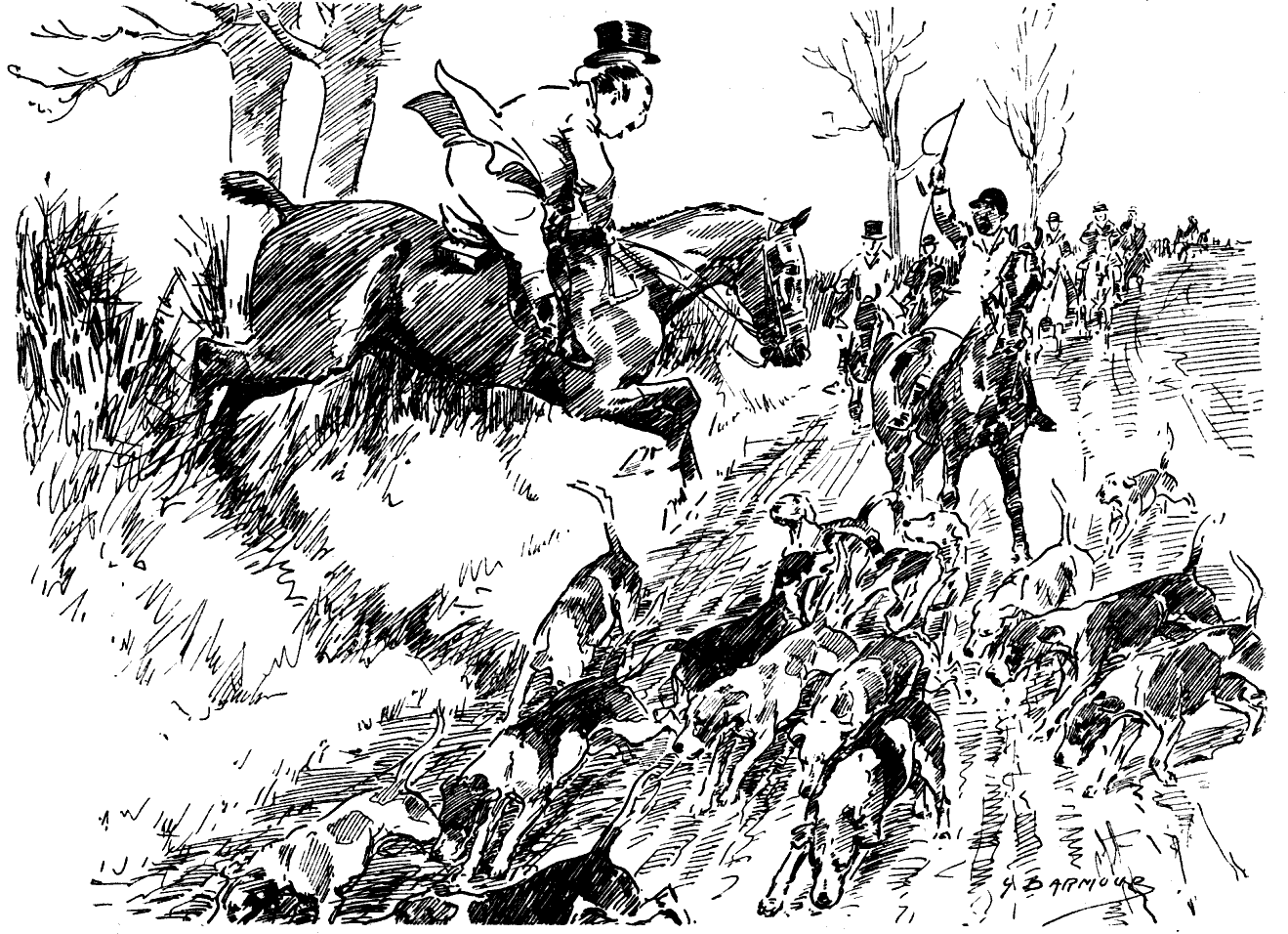
THE POST-WAR SPORTSMAN MAKES THE ACQUAINTANCE OF THE HUNTSMAN.
OUR BOOKING-OFFICE.
(By Mr. Punch's Staff of Learned Clerks.)
The Romance of Madame Tussaud's (Odhams) strikes one, in these days of universal reminiscence, almost as a libre à faire, certainly as a volume that finds its welcome waiting for it. I suppose there are few unhappy beings for whom the very name of that gifted lady does not revive something of the nursery magic that is never quite forgotten. All of which means that Mr. John T. Tussaud, who has written, vivaciously and with obvious pleasure, this history of the famous show, is (I hope) assured beforehand of his sales. It is a fat record, taking the story from the earliest wax profiles made by Dr. Curtius for the Parisian aristocracy in the days before the Revolution; through the Terror, when his niece (afterwards Madame Tussaud) was employed to model notable heads from the basket of the guillotine, which was itself subsequently to figure amongst the attractions of her collection, and finally bringing the enterprising artist and her models to England and Baker Street, whence a comparatively recent move established them (the foundress in effigy only) in their present palace. I was especially interested to trace the evidence of close attention paid to the show by Mr. Punch, and in particular to learn that the title Chamber of Horrors was first invented by that observer; though the author falls into an obvious chronological inexactitude in ascribing to these pages a cartoon by Cruikshank published "in November of Waterloo year." I have no space for the many queer stories, chiefly of encounters between the quick and the wax, with which the book abounds, nor for more than mention of its admirable photographs, of which I should have liked many more. Altogether it gives an unusual sidelight on the history of two Capitals; and incidentally, if the reading of it puts others in the same resolve as myself, an extra turn-stile will be needed in the Marylebone Road.
Mr. Harry Tighe is something of a problem to me. With the best will in the world to appreciate what looked like unusual promise I can only regard him at present as one who is neglecting the good gifts of heaven in the pursuit apparently of some Jack-o'-lanthorn idea of popularity. No doubt you recall his first novel, The Sheep Path, a sincere and well-observed study of feminine temperament. This was followed by one that (though it had its friends) marked, to my thinking, a lamentable fall from grace. He has now published a third, Day Dawn (Westall). Here, though popularity of a kind may be its reward, the work is still woefully beneath what should be Mr. Tighe's level. Certainly not one of the demands of the circulating libraries is unfulfilled. We have a fair-haired heroine (victim to cocaine), a dark and villainous foreigner, a dashing hero, a middle-aged woman who adores him despite the presence of her husband, himself called throughout Baron Brinthall, a style surely more common in pantomimic circles than in the drawing-rooms of Mayfair; and the incidents embrace both murder and suicide. Moreover there is "plenty of conversation," and the intrigue moves sufficiently quickly (if jerkily) to keep one curious about the next page. But having very willingly admitted so much I return to my contention, that for Mr. Tighe to neglect his sensitive and delicate art for the antics of these tawdry dolls is to betray both himself and the craft of which he may still become a distinguished exponent.
From the official who is interested in officialdom to the Infantry officer who is interested in tactics, from the mechanical expert who can appreciate the technical details of diagrams to the child who revels in faultless photographs of hair-raising monsters ("I may read it, mother, mayn't I, when I've unstickied my fingers?" was the way I heard it put), everybody, I think, will find plenty to attract him in Sir Albert Stern's finely illustrated Tanks 1914-1918 (Hodder and Stoughton). Tanks were born at Lincoln, and rightly so, for did not Oliver Cromwell's Ironsides mostly come from this region?—and the main theme of this book is to show how much more formidable an obstacle they found in the files and registries of Whitehall than in the trenches and wire-entanglements of Flanders and France. Parents they had and sponsors innumerable. Practical soldiers and engineers were enthusiastic about them, and the Bosch quaked in his trenches or ran; but even so late as the autumn of 1917, after General Foch (as he was then) had said, "You must make quantities and quantities; we must fight mechanically," one stout little company of obscurantists bravely defied the creed of Juggernaut until the irresistible logic of its successes in the field crushed them remorselessly under the "creeping grip." And that company, of course, according to Sir Albert Stern, was the British War Office.
Let me commend to you The Mask (Methuen) as a craftsmanlike essay in imaginative realism; ruthlessly candid and self-revealing, but free from that tiresome obsession of the ultra-realists that everything that has ever happened is equally important in retrospect. The narrator, Vanya Gombarov, a Russian Jew, discourses reflectively and detachedly, as it were from behind a mask, to an English artist friend about his early childhood in his own land and the dismal adventures of the Gombarov family in that underworld of exploited and miserable aliens which is one of the root social problems of America. Very poignantly Mr. John Cournos makes you understand the import of the phrase so constantly on the lips of such victims of their own credulous hopes of El Dorado—"Woe to Columbus!" The portrait of Vanya's stepfather, brilliant, magnanimous, pursued by an Æschylean malignity of destiny, fills much of the foreground and is a quite masterly piece of work. One cannot be wrong in assuming this to be essential autobiography; there is a passionate conviction as of things intimately seen and dreadfully suffered. Such material might well have tempted to a mere piling of squalor upon squalor. A fine discretion has given a noble dignity to a record through which shines the unquenchable human spirit. One passage, full of affectionate discernment about London, will cause a flicker of just pride in everyone who is authentic Cockney, whether by birth or adoption. A big book of its kind, I dare assert.
Star of India (Cassell) is what Mrs. Alice Perrin calls her latest novel, a title so good that I can only wonder why (or perhaps whether) it has not been used before. Inside also I found excellent entertainment. One supposes the author to have been confronted with two main problems with regard to her plot—how to make sufficiently plausible the marriage between a flapper (if you will forgive the odious word) of seventeen and a middle-ageing Anglo-Indian; and, secondly, how to impart any touch of novelty to the inevitable catastrophe that must attend this union. The first she has managed by a very cunning suggestion of the mingled jealousy, curiosity and boredom that drove Stella into the arms of her elderly suitor; the second by a variety of devices, to indicate which would be to give away the whole intrigue—one, I may say, whose climax is not nearly so visible from afar as that of most triangle tales. One point only I will reveal: Mrs. Perrin has had the courage, while vindicating her own common-sense judgment upon such folk, to introduce a second girl, daughter and pupil of one of the spoon-fed idealists who would govern India with the platitudes of ignorance, and not only to make her sympathetic, but to convince me of her attractions, which (especially just now) was not easy work. Decidedly a first-rate yarn.
We may, I think, take it that the love-story in The Gunroom (Black) is fiction pure and naively simple, but that the experiences of John Lynwood, the hero, in the Navy are given as the actual experiences of Mr. C.L. Morgan, the author. Let me then at once say that his revelations of the bullying of junior by senior midshipmen go back to a period before the War. These "shakings," we are asked to believe, were due partly to custom and partly to boredom caused by lack of leave. If Mr. Morgan is correct both in his facts and surmises it is satisfactory to think that the War must have obliterated the boredom which provoked such excesses, and one need not be a fanatical opponent of physical punishment to hope that such forms of tyranny will never again be tolerated as a matter of custom. I am obliged to conclude that these incidents in Lynwood's career are absolutely true, for certainly nothing less than absolute truth could excuse their appearance in print; but at the same time I must confess that any attack upon our Navy is apt with me to act as an irritant. The more reason that I should honestly admit Mr. Morgan's merits and say that he writes with a nice sense of style, and that his book does not derive its only interest from its revelations.
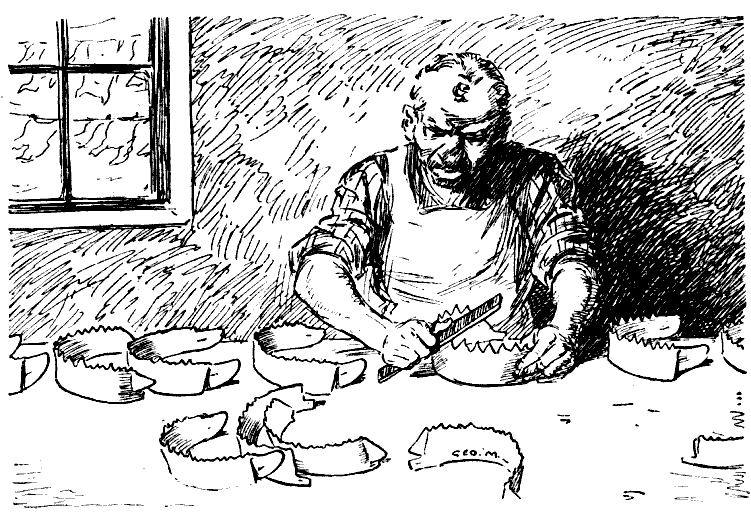
OUR LAUNDRIES: THE COLLAR-FINISHER.
Hunting Extraordinary.
"Good Sport with the Holderness.
"A stout ox led the field into Bilton village."—Provincial Paper.
Réchauffés for Cannibals.
"A company, numbering over 80, sat down to dinner, the host and hostess (Mr. and Mrs. ——) proving, as usual, a first-class menu."—Local Paper.