Volume 158 — A PAINFUL SUBJECT.
Reading edition
I do not love dentists. In this antipathy I am not unique, I fancy. One never sees photographs of family dentists standing on mantelpieces heavily framed in silver; and, though The Forceps presents a coloured supplement depicting a prominent ivory-hunter with every Christmas number, there is, I am told, no violent demand for it outside the Profession.
This is not to be wondered at. A man who spends his life climbing into people's mouths and playing "The Anvil Chorus" on their molars with a monkey-wrench, who says, "Now this won't hurt you in the least," and then deals one a smart rap on a nerve with a pickaxe—such a man cannot expect to be popular. He must console himself with his fees.
I do not love dentists, I repeat, but I am also not infatuated with toothache. It is not that I am a coward. Far from it. Arterial sclerosis, glycosuria, follicular tonsillitis and, above all, sleeping sickness I can bear with fortitude—that is, I feel sure I could—but toothache, no! I am not ashamed of it. Every brave man has at least one weakness. Lord Roberts's was cats. Achilles' was tendons. Mine is toothache (Biographers, please note). When my jaw annoys me I try to propitiate it with libations of whisky, brandy, iodine, horse-blister and patent panaceas I buy from sombreroed magicians in the Strand. If these fail I totter round to the dentist, ring the bell and run away. If the maid catches me before I can escape and turns me into the waiting-room I examine the stuffed birds and photographs of Brighton Pier until she has departed, then slither quietly down the banisters, open the street door and gallop. If I am pushed directly into the abattoir I shake the dentist warmly by the hand, ask after his wife and children, his grandfather and great-aunt, and tell him I have only dropped in to tune the piano. If that is no good I try to make an appointment for an afternoon this year, next year, some time, never. If that too is useless and he insists on putting me through it there and then, I take every anodyne he's got—cocaine, morphia, chloroform, ether, gas, also a couple of anæsthetists to hold my hand when I go off and kiss me when I come round again.
One of my chief objections to dentists is that they will never listen to reason; explanations are quite thrown away on them. They only let you talk at all in order to get your face open, and then into it they plunge their powerful antiseptic-tasting hands and you lose something. I never go near a dentist without paying the extreme penalty. (None of those cunning little gold-tipped caps or reinforced concrete suspension-bridges for me. Out it comes. Blood and iron every time). I admit they frequently appease my anguish. Almost invariably among the teeth of which they relieve me at each sitting is included the offending one. But still I maintain my right to have a say in my own afflictions. The doctors let one. I've got a physician who lets me have any disease I fancy (except German measles and Asiatic cholera; for patriotic reasons he won't hear a good word spoken for either of them; says we've got just as good diseases of our own. Damned insularity!).
If I send for this doctor he comes along, sits quietly beside my bed, eating my grapes, while I tell him where the pain isn't. The recital over he hands me a selection of ailments to pick from. I choose one. He tells me what the symptoms are, drinks my invalid port, creeps downstairs and breaks the news to the hushed and awe-stricken family. A chap like that makes suffering a pleasure and is a great comfort in a home like mine, where a sick bed is the only sort you are allowed to lie in after 10 a.m. Without the fellow's ready sympathy I doubt if I should secure any sleep at all. One gets no assistance of that kind from dentists, although they give you more pain in ten seconds than a doctor does in ten years.
No dentist ever sees me home after the slaughter, orders me a diet of chicken breast, pêche Melba and champagne, or warns my family that I am on no account to be disturbed until lunch. No, they jerk your jaw off its hinges and dump your remains on the doorstep for the L.C.C. rubbish cart to collect.
Another thing: dentists should not be allowed out loose about the streets. They exercise a blighting influence. You are strolling along in the sunshine, head high, chest expanded, telling some wide-eyed young thing what you and Haig did to Ludendorff, when suddenly you meet the dentist. You look at him, he looks at you, and his eyes seem to say, "What ho, my hero! Last week you went to ground under my sofa and couldn't be dislodged until I put the page-boy in to ferret you."
"And what happened then," inquires the wide-eyed young thing, "after you had caught the Hun tank by the tail and ripped it up with a tin-opener?"
"After that," says the eye of the dentist, "you wept, you prayed, you lay on the floor and kicked, you—"
"And did you kill all the crew yourself?" bleats the maiden, "single-handed—every one of them?"
"Oh, I—er," you stutter—"what I mean to say—that is—Oh, dash it, let's go and get tea somewhere, what?"
Patlander.
From the dramatis personæ in a Malta opera-programme:—
"Singers, Old Beans, and Abbés."
The "old beans" no doubt were drawn from the local garrison.
"The old wooden streets which survived in the more ancient parts of the capital [Petrograd] have, on account of the lack of fuel since the Bolshevists became all-powerful, been torn down and demobilished."—Daily Paper.
The last word in destructiveness.
"The standing joint committee of the Industrial Women's Organisations have passed a resolution unanimously endorsing the action of the Consumers' Council in opposing the decontrol of meat."—Daily Graphic.
The "standing joint" committee would seem to be the very one for the job.
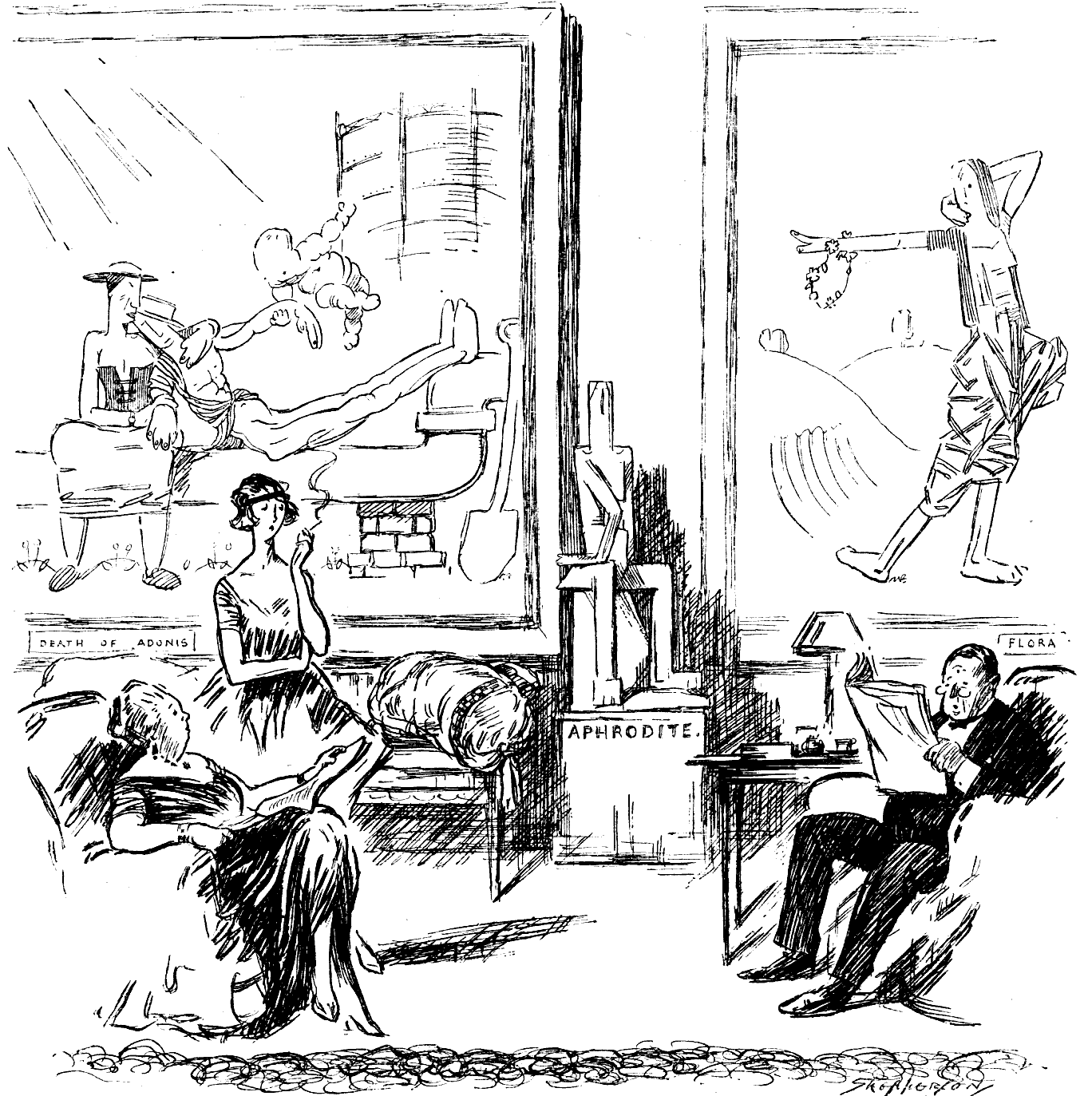
MANNERS AND MODES.
HOW TO APPEAR BEAUTIFUL THOUGH PLAIN:—SURROUND YOURSELF WITH SPECIMENS OF THE LATEST ART.
Dress of the day.
"Bathroom Toilettes.
"This season balls and dances, both private and public, are being given in greater numbers than ever."—Local Paper.
"A couple of ciphers, followed by a string of noughts, represents Germany's debt to France. And it looks as if the noughts are all France will get in the present generation."—Evening Paper.
But it is possible that under pressure Germany might throw in the ciphers as well.
"LOST AND FOUND.
"Address by the Lord Advocate.
"Will the party who took the wrong Umbrella from the Ante-Room, Music Hall, kindly return same in exchange for his own to ——, Music Hall?"—Scotch Paper.
An odd address for the Lord Advocate.
"Wells' 'History of the Universe' describes the slow disappearance of certain species, taking hundreds of thousands of years to do it."—Daily Paper.
In an age of hustle it is gratifying to find one eminent author approaching his work with due deliberation.
The Profiteer's Anthem.
"The Hymns to be sung will be: (1) 'All people that on earth do well.'..."—Rangoon Times.
From Surplus, the official organ of the Disposal Board:—
"Pork and Beans.
"16 oz. tins (15 ozs. Beans and Sauce, 1 oz. Pork); 21 oz. tins (20 ozs. Beans and Sauce, 1 oz. Pork)."
So the question which vexed many billets on the Western Front is now answered. There was pork in it.
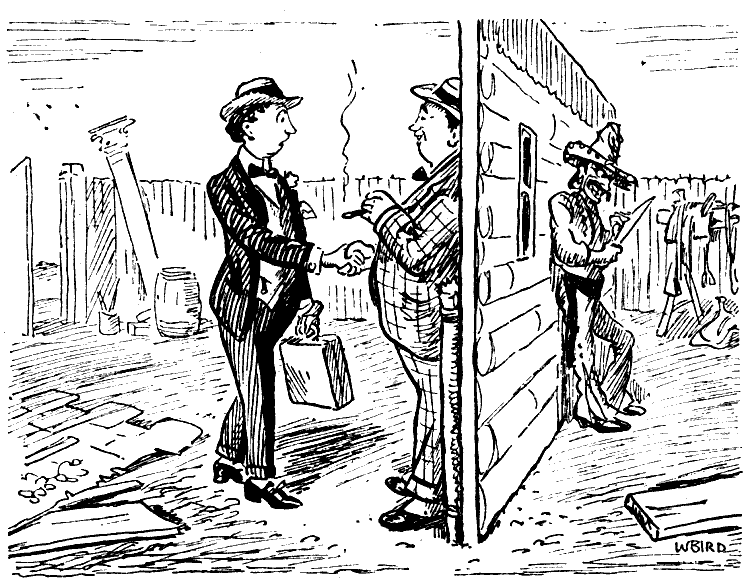
BEHIND THE SCENES IN CINEMA-LAND.
"You're in luck, my boy. They've imported a genuine Mexican bandit for your knife-fight scene in 'Bad Hat, the Half-Breed.'"
MY FIRE.
"Seventy-five per cent. of the world's accidents arise from gross carelessness!" I thundered at Suzanne, who for the fifteenth time in five years of matrimony had left her umbrella in the 'bus. Being on a month's leave, and afraid of losing by neglect the orderly-room touch, I thought fit to practise on her the arts of admonition. Admonishing, I wagged at her the match with which I was in the act of lighting my pipe. Wagging the match, I did not notice the live head drop off on to the khaki slacks which I had donned that afternoon to grace a visit to the War Office. Only when I traced Suzanne's petrified stare to its target did I discover that a ventilation hole had been created in a vital part of His Majesty's uniform.
With great presence of mind I put out the conflagration before venturing on an encounter with Suzanne's eye.
"You were discussing accidents," she observed sweetly. "What percentage of them did you say was due to gross carelessness?"
I did not bandy words. There was no escaping the fact that they were, as Suzanne reminded me, my sole surviving pair of khaki slacks, and that I should certainly have to get a new pair before returning to the Depôt; for these were obviously beyond wear or repair.
"Well, anyhow I've three weeks to get them in," I said as lightly as I could. "My leave isn't up till the end of the month."
"Men's clothes are terribly dear just now," remarked Suzanne pensively. "And I was going to ask you to give me a new hat. But now I suppose—"
This roused my pride and self-respect.
"Suzanne," I said, "the world is not coming to an end because I have to buy a pair of slacks. You shall have your new hat to-morrow."
She clapped her hands in triumph, and a moment's reflection showed me that I had been caught. If it hadn't been for the conflagration she would never have dared to ask for a new hat. Now I came to remember, I had taken her out and bought her one on the first day of my leave.
However, the damage was done (twice over, in fact), and I sat gently brooding over it in silence. Suddenly an inspiring thought struck me. Eagerly I made my way to the writing-table and drew out a long and bulky envelope from the bottom drawer. For some time I sat there carefully mastering its contents.
"What's that funny-looking thing you're reading?" asked my wife at last.
"Oh, nothing important," I answered as casually as I could. "Er—by the way, do you know we're insured?"
"Considering that I've paid the premiums regularly while you were away, I should think I ought to know."
"Of course I shall put in a claim for the slacks," I murmured.
"But how can you?" she asked, and wondering looked at me. "I read the policy once, and as far as I remember there's nothing whatever about khaki slacks in it."
"Do you know what this policy is?" I exclaimed, brandishing the document impressively. "It's a Comprehensive Householder's policy. I don't know what a Comprehensive Householder is, but I think I must be one."
"But I'm sure it says nothing about slacks," she objected.
"Comprehensive!" I shouted. "That means all-embracing. This policy embraces my slacks."
"That sounds almost indelicate."
"Listen. 'Whereas the undermentioned, hereinafter called the Accused—the Assured, I mean—has paid blank pounds, shillings and pence Premium or Consideration ... to insure him/her from loss or damage by Lightning, Explosion, Earthquake, Thunderbolts ...'"
"Oo-er," said Suzanne with a shiver.
"'... Aeroplanes, Airships, and/or other Aerial Craft, Storm, Tempest, Subterranean Fire ...'"
"Monsoon, Typhoon, Volcano, Avalanche," put in Suzanne impatiently. "Cut the cataclysms and come to the slacks."
"I'm just coming to them. '... Burglary, Housebreaking, Theft and/or Larceny'—now hold your breath, for we're getting there—'Conflagration and/or Fire....'" I paused to let it sink in. "The fact is," I continued weightily, "we've had a Fire."
"Have we? But I wasn't dressed for it. I should have worn a mauve peignoir, and been carried down to safety by a blond fireman. To have a fire without a fire-engine is like being married at a registry-office. Next time—"
"Nevertheless, we've had a Fire, within the meaning of the policy. Now I'm going to write a letter to the Insurance Company."
And I did so to the following effect:—
"77, The Supermansions, S.W.
"Dear Sirs,—I regret to inform you that a fire took place at/in the above demesne and/or flat after tea to-day and damaged one (1) pair of khaki slacks/trousers so as to render them unfit for further use. I shall therefore be glad to receive from you the sum of two guineas, the original cost price of the damaged article of apparel.
"Yours, etc."
Next day I took Suzanne out to buy the new hat. This done, we went on to my tailor's to replace the ill-starred slacks. A casual inquiry as to price elicited the statement that it would be four guineas. I cut short a rambling discourse, in which the tailor sought to saddle various remote agencies with the responsibility for the increase, and stamped out of the establishment with the blasphemous vow that I'd get a pair ready-made at the Stores.
That evening I received a reply from the Insurance people:—
"In all communications please quote Ref. No. 73856/SP/QR.
"Sir,—We note your claim for garments injured by an outbreak of fire at your residence. We await the reports of the Fire Brigade and Salvage Corps, on receipt of which we will again communicate with you. Meanwhile, will you kindly inform us what other damage was done?
"We are, yours, etc."
I at once wrote back to remove their misapprehension:—
"Dear Sirs,—My fire was not what you would call an outbreak. It was essentially a quiet affair, attended by neither Fire Brigade nor Salvage Corps, but just the family (like being married at a registry-office, don't you think?). My khaki slacks were the only articles injured. As I am now going about without them, you will realise that no time should be lost in settling the claim.
"Yours, etc.
"P.S. I nearly forgot—73856/RS/VP. There!"
A day or two later I received a request, pitched in an almost slanderously sceptical tone, for more detailed information. I humoured them, and there ensued a ding-dong correspondence, in which that wretched Ref. No. was bandied backwards and forwards with nauseating reiteration, and of which the following are the salient points:—
They. Kindly state what you estimate the total value of the contents of your residence to be.
Myself (after a searching inquiry into present prices). £1,500.
They (promptly). We beg to point out that you are only insured for a total sum of £750. In accordance with the terms of your policy you are only entitled to recover such proportion of the value of the loss or damage as the total insured bears towards the total value of the contents—i.e., one-half.
Myself. Two guineas is exactly one-half of four guineas, the present cost of slacks. Please see attached affidavit from tailor. (By a masterly stroke I had actually induced the rascal to set out his iniquity in black and white.)
At last, twenty days after the fire, when I had finally screwed myself up to the point of going out to buy a pair of reach-me-downs, I was rewarded by receiving a cheque for two guineas from the Insurance Company, "in full settlement."
By the same post I received a letter from the Adjutant of my Depôt informing me that I was not to return at the expiration of my leave, but by War Office instructions (I will spare you the Ref. No.) was to proceed instead to the Crystal Palace for immediate demobilization. (That, by the way, is part of the game of being a volunteer for the Army of Occupation.) It was Suzanne who brought the two letters into their proper correlation.
"You won't have to get a new pair of slacks now," she said.
"Bless my soul, no!" I exclaimed. "Then what ought I to do with this cheque? Send it back?"
"Certainly not," cried Suzanne as she snatched it from my wavering hand. "I've been wanting a new hat for some time."
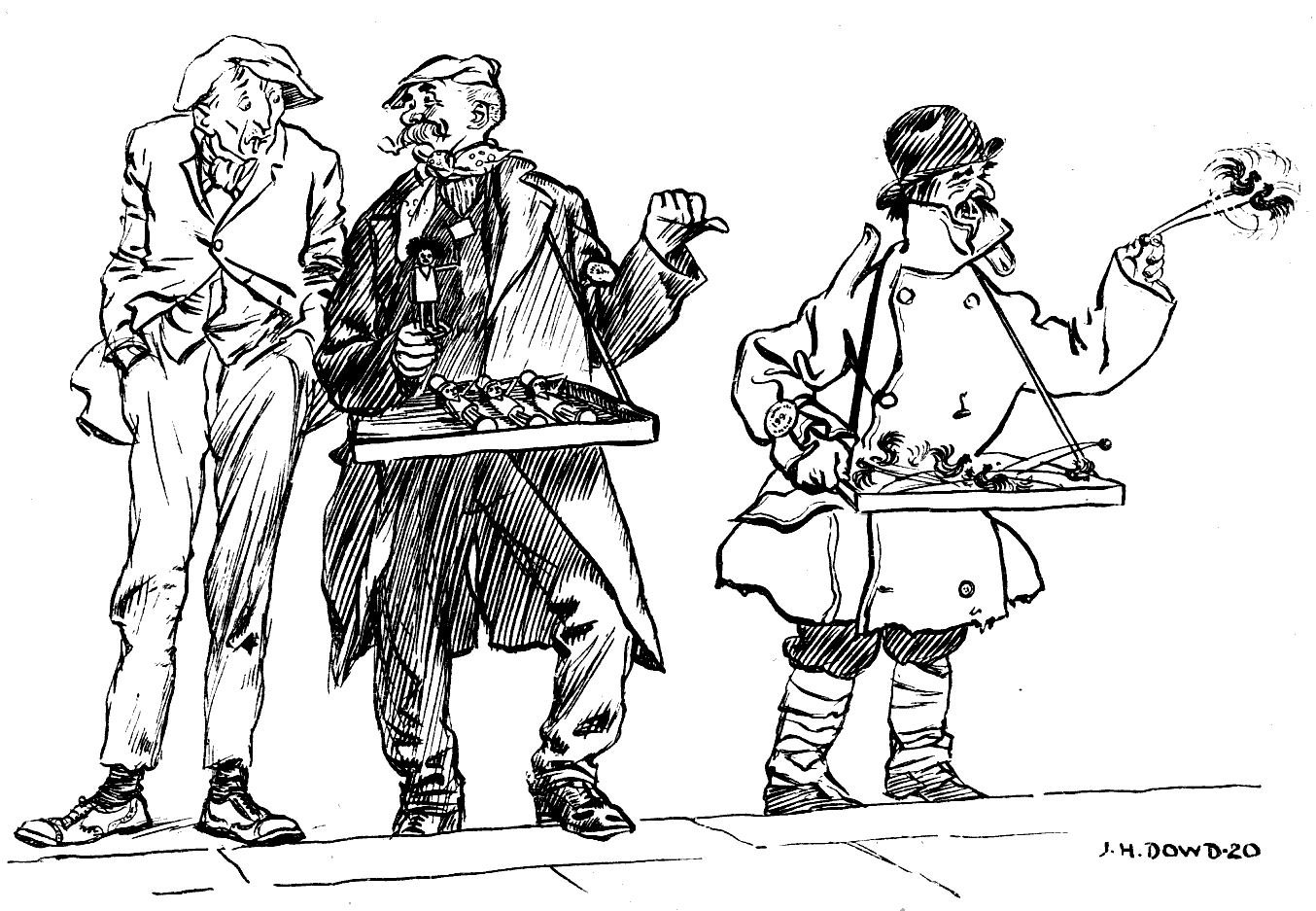
ANOTHER COMBINE.
Bystander. "'Ow yer goin', mate?"
Gutter Merchant. "Fine! I've just amalgamated with the business next door."
"Frenzied Finance."
"The guardians want more money also. What the Treasury finan-local taxations are only the be-lical taxations are only the beginning of the demand upon the citizen's pocket."—Evening Paper.
"Jumper Champion.
"The reference to a young woman living at Esher, Surrey, who has knitted 50 jumpers since August 20, which her friends claim to be a world's record for an amateur, has resulted in a challenge.
"'Jumper,' who lives at Margate, writes: 'I find it quite easy to knit in the dark and to read while knitting.'"—Daily Paper.
The Margate candidate will get our vote.
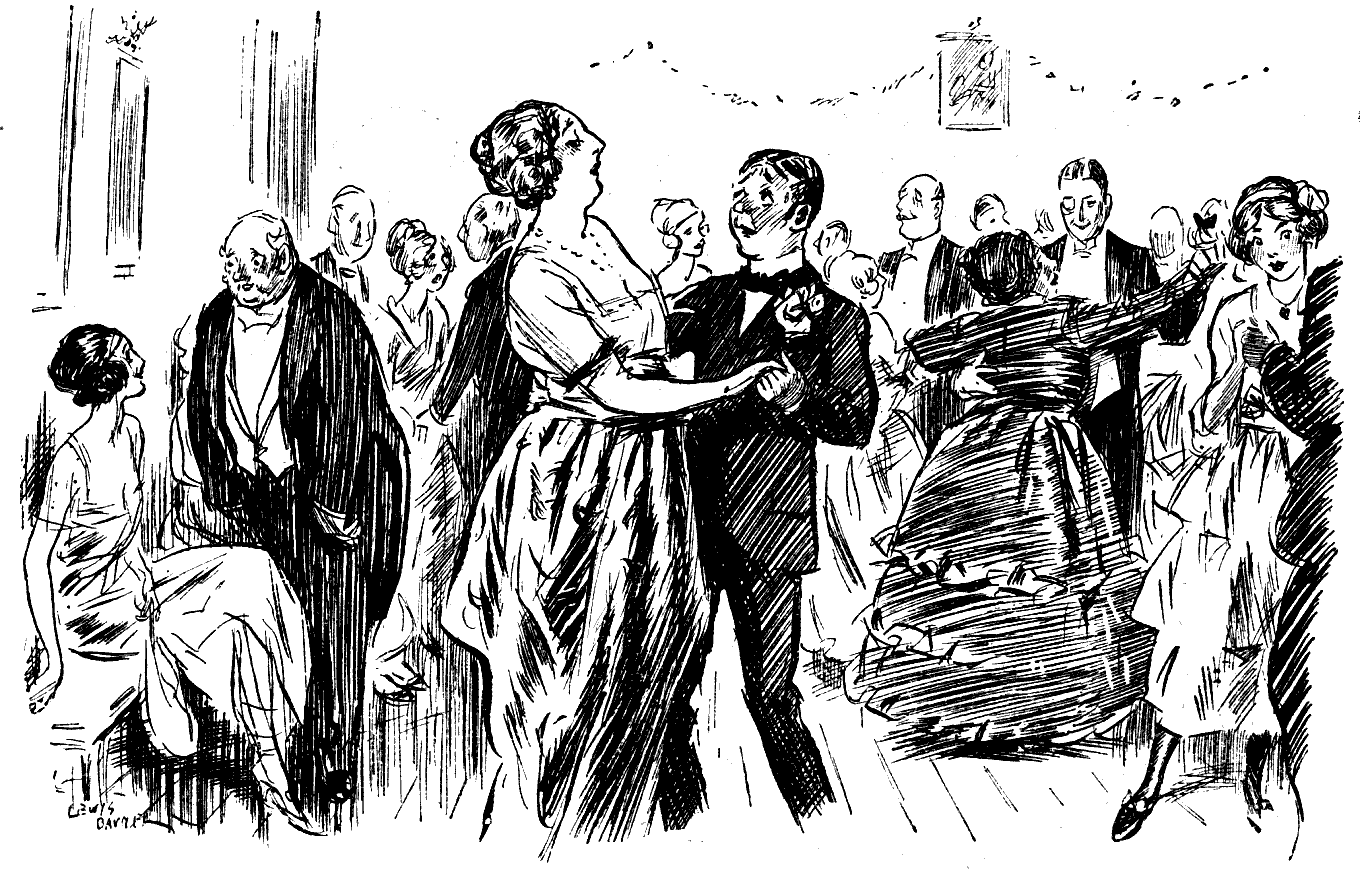
THE SERVANTS' BALL.
Groom (somewhat heated). "Care for a breather, my lady?"
MY SALES DAY.
7.0 to 8.30. Rise, breakfast, and make out shopping-list. I put down:—
Waterproof for Henry. School-frock and boots for the Kid. Replenish household linen.
9.0. Arrive at large emporium just as the doors open. Ask to be directed to gentleman's mackintoshes. Pause on the way to look at evening wraps marked down from five guineas to 98/11. It seems a sweeping reduction, but I do not require an evening wrap.
9.10 to 10.15. Try on evening wraps. Select a perfectly sweet Rose du Barri duvetyn lined gris foncé.
10.15. Continuing to head for mackintoshes. The course runs past a job-line in silk hosiery. Remember I ought to get stockings to go with the evening wrap.
10.15 to 11.5. Match stockings.
11.15. Arrive at gentlemen's mackintoshes. Find they are not being reduced in the sale. Observe however that some handsome silk shirts with broad stripes are marked half-price; get three for Henry, also a fancy waistcoat at 6/11¾ (was 25/-), only slightly soiled down front.
11.40. Ask for Children's Department. Take wrong turning and arrive at millinery.
11.40 to 1.10. Try on hats. Decide on a ducky little toque and a fascinating river hat (for next summer).
1.10 to 1.30. Still asking for Children's Department. When it is finally given to me I am told that useful school-frocks have all been sold.
1.30 to 6.30. Drift to Shoe Department; secure a pair of pink satin slippers—rather tight, but amazingly cheap. Swept by crowd into "Fancy Goods"; make several purchases. Get taken in a crush to "Evening Accessories"; am persuaded to buy.
6.35. Leave emporium. It is raining heavily.
7.15. Arrive home wet and exhausted. Have an argument, conducted affably on my side, with Henry, who flatly refuses to wear the half-price striped shirts or pay for the only-slightly-soiled waistcoat. He makes pointed remarks about the bad weather, with cynical reference to mackintoshes. Am struck afresh by the selfishness of men.
7.45. Remember that I have forgotten household linen and Kid's boots, but determine not to let this spoil my good temper.
8.0. Dine alone with Henry. Do my best to show a forgiving spirit in face of his egoism. So to bed, conscious of a day well spent.
OUR DAY OF UNREST.
["The great demand of the moment is something fresh to do on Sunday."]—Evening Paper.
At the ample shrine of pleasure You have worshipped well and long On this day of so-called leisure, Yet you feel there's something wrong. Blasé is your air and jaded; Sabbath hours have lost their zest; Utter ennui has invaded Every corner of your chest. Sport is shorn of all its glamour; Motoring proves no more a lure; So you come to me and clamour For a speedy psychic cure. Well, my friend, if fresh sensation Is the object of your search, And you want a consultation, My advice is, Go to church.
Bolshevism in the Civil Service.
"Whitley Councils are the latest development in Government offices in Whitehall. What is aimed at is a system of promotion free and uninterrupted from top to bottom."
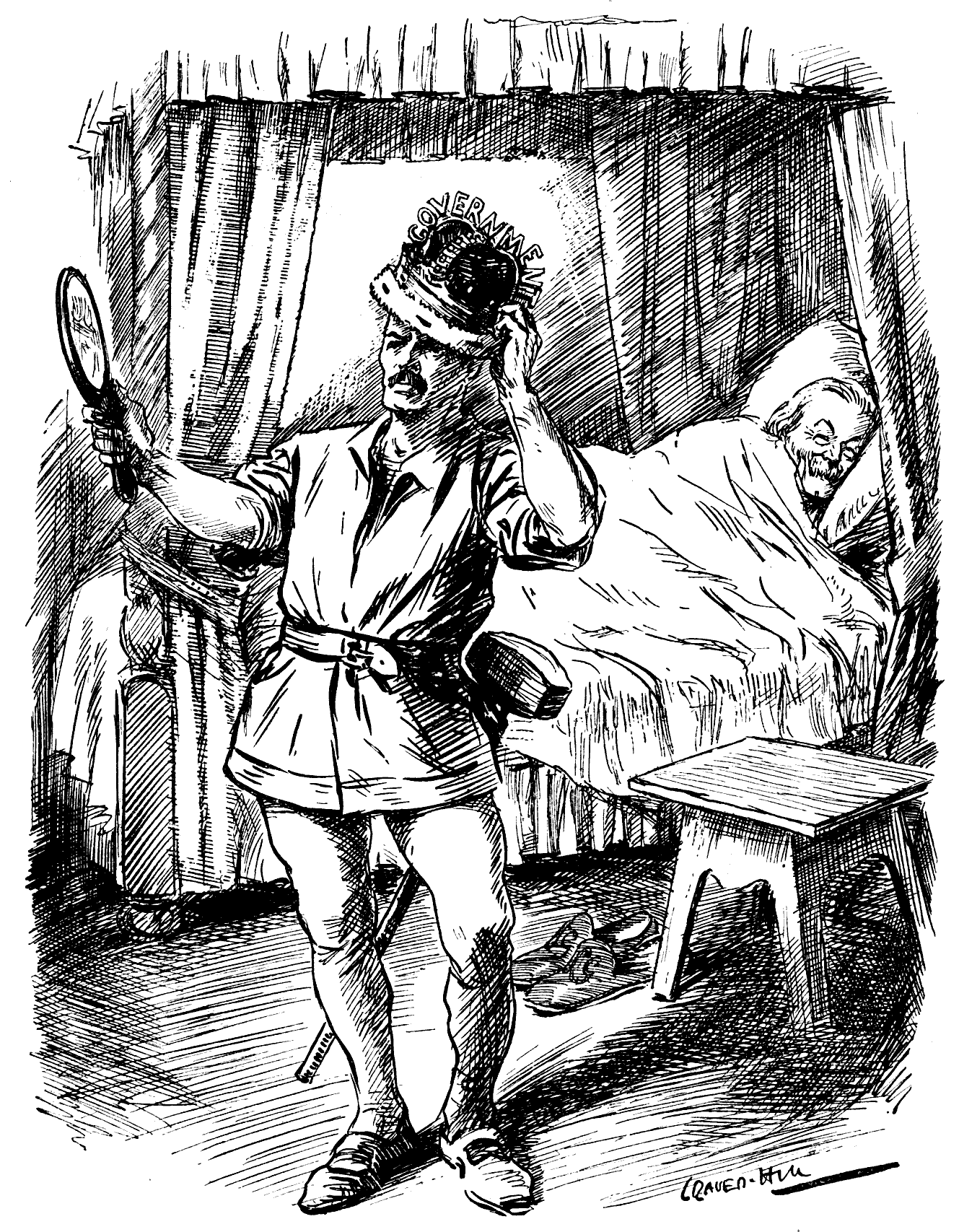
THE HEIR PRESUMPTIVE.
Labour. "PERHAPS IT'S A SIZE TOO BIG FOR ME AT PRESENT."
Coalition. "GLAD YOU FEEL LIKE THAT, AS I HAVEN'T QUITE FINISHED WITH IT."
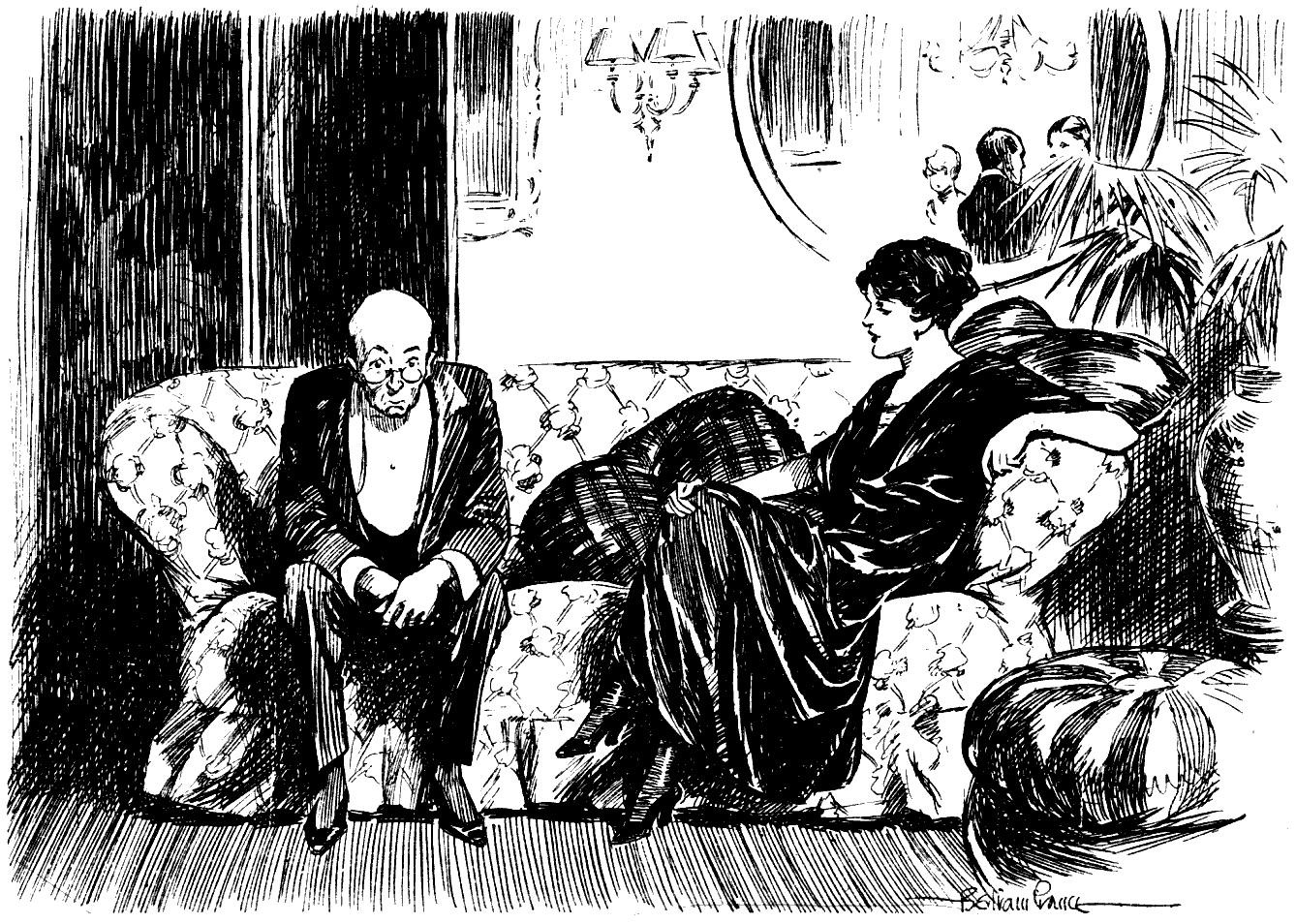
Soulful Party. "Ah, yes, the world is always so—we never strew flowers on a man's grave until after he is dead."
THE CANDOUR OF KEYNES.
(Suggested by the perusal of "The Economic Consequences of the Peace.")
There was a superior young person named Keynes Who possessed an extensive equipment of brains, And, being elected a Fellow of King's, He taught Economics and similar things. On the outbreak of war he at once made his mark As a "tempy," but Principal, Treasury Clerk, And the Permanent Staff and the Chancellor too Pronounced him a flier and well worth his screw. So he went to the Conference, not as a mute, To act as the Chancellor's chief substitute, And in this extremely responsible post He mingled with those who were ruling the roast. The Big and redoubtable Three, 'tis confessed, By his talent and zeal were immensely impressed; But, conversely, the fact, which is painful, remains That they failed to impress the redoubtable Keynes. So, after five months of progressive disgust, He shook from his feet the Parisian dust, Determined to give the chief Delegates beans And let the plain person behind the Peace scenes. Though his title is stodgy, yet all must admit That his pages are seasoned with plenty of wit; He's alert as a cat-fish; he can't be ignored; And throughout his recital we never are bored. For he's not a mere slinger of partisan ink, But a thinker who gives us profoundly to think; And his arguments cannot be lightly dismissed With cries of "Pro-Hun" or of "Pacificist." And yet there are faults to be found all the same; For example, I doubt if it's playing the game For one who is hardly unmuzzled to guy Representative statesmen who cannot reply. And while we're amused by his caustic dispraise Of President Wilson's Chadbandian ways, Of the cynical Tiger, laconic and grim, And our versatile Premier, so supple and slim— Still we feel, as he zealously damns the Allies For grudging the Germans the means to arise, That possibly some of the Ultimate Things May even be hidden from Fellows of King's.
"The —— Male Voice Choir and St. ——'s Brass Band discorded Xmas music."—Local Paper.
We shouldn't wonder.
"Another element in the industrial activity of Japan, which is brought forcibly home to the Westerner, is the obvious pleasure that the Japanese people take in doing the work which is allotted to them. It is no uncommon sight to see men laughing merrily as they drag along their heavy merchandise, or singing as they swing their anvils in a manner almost reminiscent of the historic village blacksmith."—Provincial Paper.
And "children coming home from school" know better than to "look in at the open door."
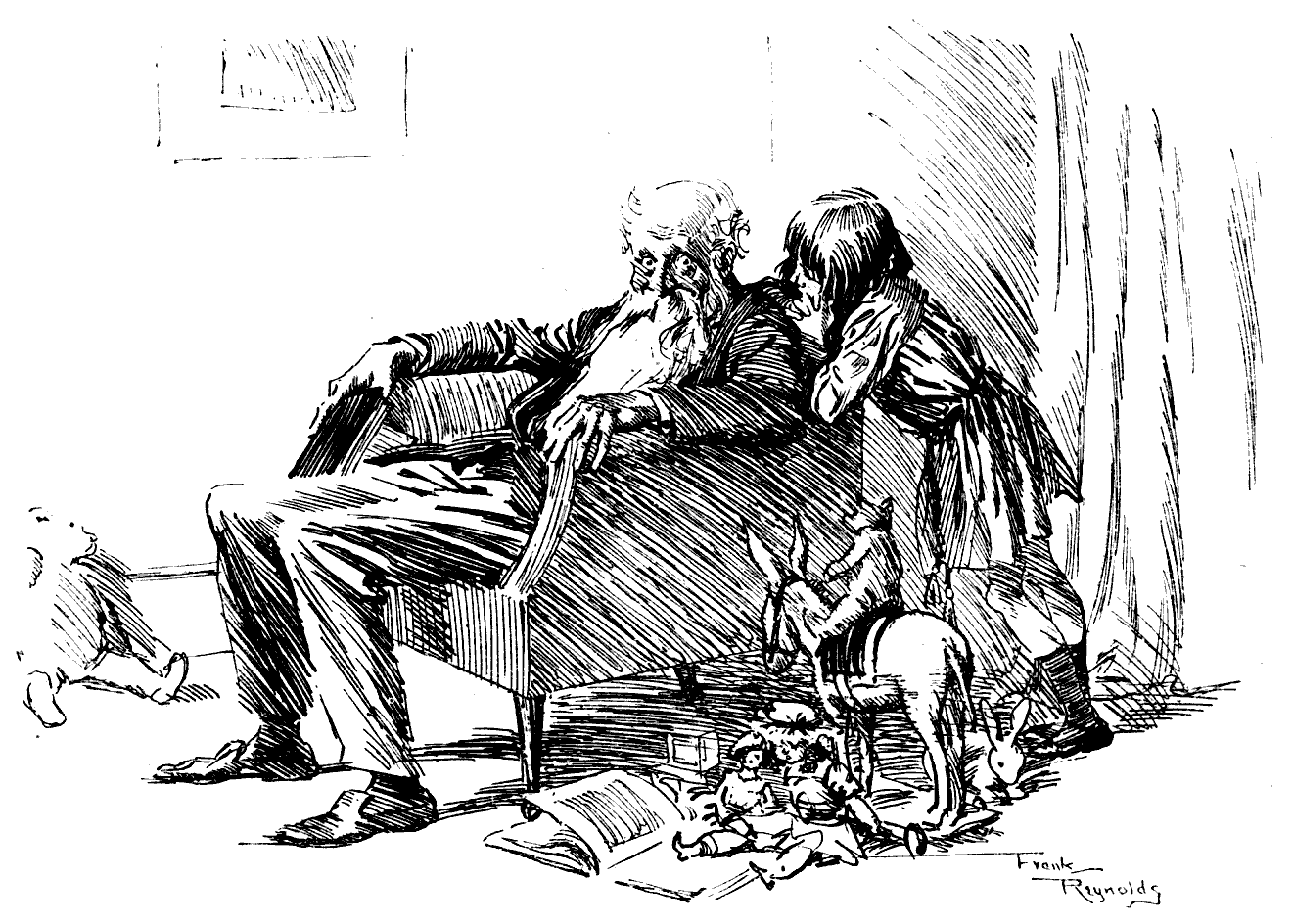
"Grandfather, I simply love your nice long beard. Promise me you'll never have it bobbed."