Volume 150 — AT THE PLAY.
Reading edition
"Kultur at Home."
Each of the authors—Mr. Rudolf Besier and Mrs. John Spottiswoode—has personal knowledge of the home-life of the Bosch; and their excellent sketch of Prussian manners might have served usefully as a warning to us if we could have seen it a few years ago. But at this time of day, after nineteen months' experience of the enemy, I doubt its utility as a source of illumination.
It would be futile to represent the Prussian officer as an angel in the house, for we have long since learned to know him as a devil in the field. And it is almost as futile to picture his prodigious self-conceit, his vile taste in dress and furniture, his conjugal infidelity, his habit of treating his women-folk as menials, since these vices are human and venial in comparison with what the War has revealed. Anyone might easily hazard the conjecture that the murderers of Belgium had never entertained too fastidious a respect for womanhood; and after the destruction of Louvain and Ypres it is mere bathos to insist that the perpetrators of these outrages against art had previously cherished a Philistine affection for antimacassars and plush sofas.
A common difficulty with me when I witness stage tragedies arising out of a marriage of uncongenial types is to understand how the couple ever came together. And so here, when the English girl, Margaret Tinworth, in face of poverty and parental disapproval, marries a Prussian officer in a small garrison town, and then finds all sorts of unbearable conditions in her surroundings, one asks oneself, and fails to discover, what kind of glamour he had cast over her that most of these conditions, already patent enough in the society in which she had moved, had contrived either to escape her notice or to appear tolerable. True, she had gone to Germany to find release from the solitude of a motherless home, where an unsympathetic father had no attention to spare from his art treasures; but, with so admirable an aunt as Lady Lushington to chaperon her in her own country, it was not easy to see why she must needs resort to exotic consolation.
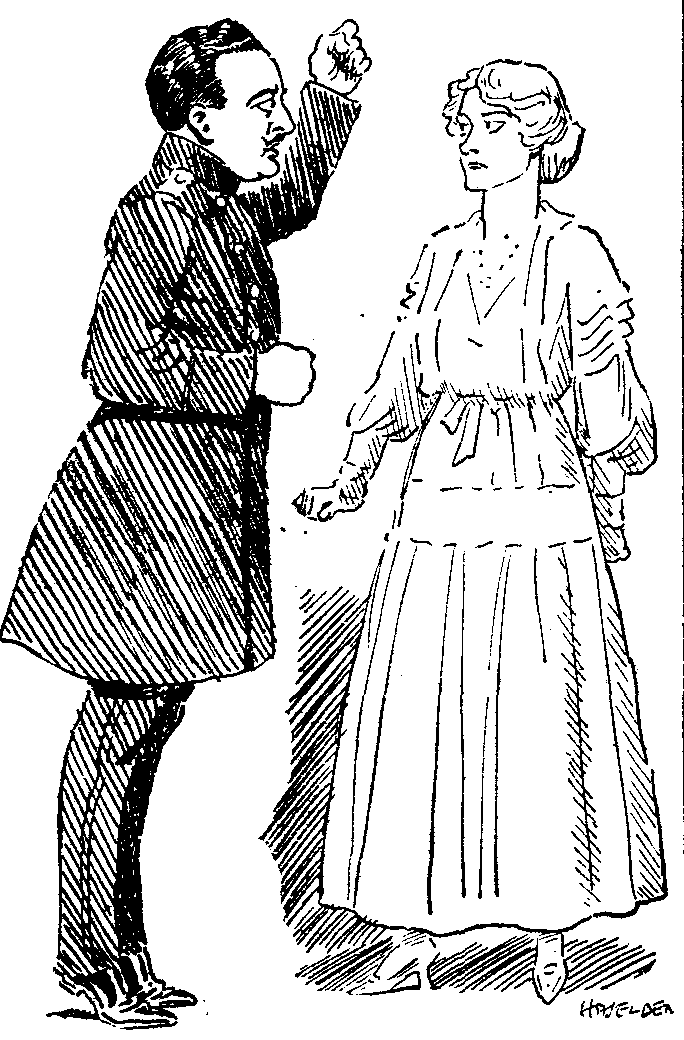
GERMAN FRIGHTFULNESS REPULSED.
Lieutenant Kurt Hartling ... Mr. Malcolm Cherry Margaret Tinworth ... Miss Rosalie Toller.
However, I do not propose to set my judgment up against that of the authors, male and female, in regard to the credibility of her taste in men, since, after all, the heart of a woman is a thing past finding out. But I do venture to dispute the reasonableness of her ultimate attitude in conditions where this enigmatic organ was not directly concerned. For you are to understand that in the Third Act the brutality of her husband and the insults hurled at England, which she was expected, as a Prussianised wife, to approve, had become more than she could bear; and in the last Act we find her in a Luxembourg hotel on her way home to England under the care of Lord and Lady Lushington. It is the 4th of August, 1914; Germany has declared war; German regiments are marching through the town; England has not yet spoken. The girl is in grievous doubt as to whether she ought not, in the changed circumstances, to return to her Prussian home. One could easily appreciate her attitude if she had argued, "I am German by marriage; though I have lost my love for my husband it is my duty, when he is risking his life for his country, the country of my adoption, to go back and watch over his home for him." But that was not her argument; her argument was that England—the England that she had so stoutly defended against German ridicule and contempt—had been false to her honour as the sworn friend of France, and that it was her business to go back to Germany and eat humble pie. Whatever the audience may have felt about these reflections on the conduct of England, they must at least have been irritated by the fantastic improbability of the girl's motive. Very fortunately at this juncture the voice of the paper-boy is heard in the street conveying the thrilling news of our tardy entry into the quarrel; and a glad Margaret, having recovered her respect for her native land, consents to return home to it.
Miss Rosalie Toller played the part with great charm and sympathy, and with a lightly-worn grace and dignity that were pure English. Serving as a foil to her in taste and deportment and social tradition, the Elsa Kolbeck of Miss Dolly Holmes-Gore was extraordinarily German—a quite remarkable performance.
Miss Marianne Caldwell as Frau Major Kolbeck, the hostess of Margaret, made a most lovable drudge; and Miss Dora Gregory had no difficulty in showing how the wife of a Prussian Colonel, though in her husband's eyes her main purpose in life may be to minister to his inner man, can wield an authority little less than that of the All-Highest over the wives of the regiment. Female society in the little garrison town was further represented by Miss May Haysack and Miss Una Venning, who played, with more than enough vivacity, a brace of giggling flappers, very curious about the more private portion of the bride's trousseau.
Miss Vane Featherston, as Lady Lushington, had too little to do, and did it most humanly; and Mr. Otho Stuart illustrated with a very natural ease the kind of simple friendship, as between a man and a woman, which it takes an Anglo-Saxon intelligence to understand.
The officers, though there might have been more of the blond beast about them, were sufficiently Prussian, and Mr. Malcolm Cherry, as Margaret's husband, indicated with much precision the change in the behaviour of a German gentleman, after marriage, towards the lady he has consented to honour with the thing he calls his heart.
Apart from the one or two doubtful points which I have referred to, the play went well, though it seems a pity that so much insistence should have been laid upon the lack of culture (English sense) in households where the strictest economy was essential. One was conscious of a rather painful note of vulgarity in the attitude of Margaret's father, where he sniffs at the sordid environment of her German home. Impecuniosity is of course a prevalent trouble among German officers in small garrison towns; but one would have preferred that if bad taste in dress and furniture had to be ridiculed the laugh should have been at the expense of a richer society. Finally, I wonder a little that the authors, who must have known better, should have helped to perpetuate the popular misconception by which the German word "Kultur" is regarded as the equivalent of our "culture."
O. S.
"A Kiss for Cinderella."
No well-fed person need ever quite expect to understand one of Sir J. M. Barrie's mystery plays at a single sitting. That's one of his best trumps, of course. But it always seems to me that, like so many writers of genius, he never quite knows what are his best and what his poorest things, and just tosses them to us to sort out for ourselves. In this new instance, to work off a piece of strictly professional criticism, it is clear that both prologue and epilogue are much too protracted. It is a sound dramatic canon, which not even our most brilliant chartered libertine of stage-land can flout with impunity, not to keep your audience in too long a suspense while preparing your salient theme, nor, after quickening their interest and firing their imagination, to chill with the obvious or distract with the irrelevant.
Sir James's Cinderella is maid-of-all-work to the housekeeper of a retired humourist turned painter (Mr. O. B. Clarence), a vague peppery sentimental old bachelor with an ideal of which a full-sized cast of the "Venus di Milo" stands for symbol in his studio. Cinderella is dumpy and plain (that is the idea which Miss Hilda Trevelyan tries loyally but without much success to suggest to us), but she has the tiniest possible feet. Regretfully admitting the superiority of Venus's "uppers" she takes heart of grace, knowing from history how important in princely eyes is her own particular endowment. She is always asking odd questions, such as "why doctors ask you to say ninety-nine" and tailors measuring gentlemen's legs call out "42-6; 38-7." She also has a queer penchant for stealing boards, betrays some connection with a firm, Celeste et Cie. of Bond Street, and knows some German words. Which concatenation of facts justifies the old bachelor in consulting a friendly policeman (Mr. Gerald du Maurier). Bond Street turns out to be a mean street, Celeste et Cie the name under which Cinderella trades, dealing in medical treatment, shaves, friendly counsel or dressmaking all at a penny fee. Also she keeps in a Wendyish sort of way a crêche for orphan babes in boxes evidently made of the borrowed boards.
Our policeman, coming to work up his case, loses his heart. But Cinderella's mind is preoccupied with her ball. Ill from overwork and underfeeding, she wanders into the street, falls faint—and dreams her ball. Whereupon our authentic magician, coming to his own, lifts a curtain of her queer little mind and gives us an all too short glimpse of the state function, with an h-dropping, strap-hanging King and Queen out of a pack of cards; their disdainful Prince, who is none other, of course, than our policeman done into a bewigged Monsieur Beaucaire; a moody and peremptory Peer, Lord Times; the Censor (black-visored, with an axe); a grotesquely informal Lord Mayor; a bevy of preposterous revue beauties with their caps set at the Prince, against an all-gold background with the orphans babbling in a royal box above the throne. Of course you have the heroine's belated entry, her triumph and her abrupt flight, and the voice of the distraught Prince crying after her, which is of course the voice of her own policeman, who finds her and takes her to hospital. Then convalescence in a cottage (alleged, really a palace) by the sea and the final declaration of "romantical" policeman's love.
Sir James banked heavily on Miss Hilda Trevelyan as his Cinderella. The English tradition of manufacturing parts to fit your players, instead of training players to create your parts, was never more shrewdly followed. She was most adorable in the exquisite business of arranging the offer of her policeman's hand. Mr. du Maurier's bobby was as delightfully honest, plain-witted, heavy-booted and friendly a fellow as ever held up a bus or convoyed a covey of children across a street. But as the Prince, who was "so blasted particular," he had a chance of showing that rare talent for the grotesque which no part has given him since his inimitable Captain Hook, I wish indeed we could see more of him in this rich vein. Mr. Clarence was the vague old gentleman (or the vague old gentleman, Mr. Clarence) to the life. Miss Henrietta Watson, as the hospital doctor, bullied her patients and probationers in the approved manner of medical autocrats of the gentler sex. An excellent Lord Mayor (Mr. Liston Lyle), an irrepressible wounded Tommy by Mr. A. E. George and an aristocratic probationer by Miss Elizabeth Pollock, were notable performances. Many others also ran—and ran well. The piece should do the same.
T.
Kennel Companions.
"Lady wishes join another in dogs' boarding home; trial first as paying guest."
Bournemouth Daily Echo.
"The wedding was a quiet one. The bridegroom's party, who motored from Colombo, were met some distance away from the Walauwa by a procession of forty-five elephants, dancers, etc., and was conducted to the bride's residence, where they were welcomed. Shortly after the arrival of the bridegroom's party, a wedding breakfast was served, seventy-five sitting down to a sumptuous repast."—Ceylon Observer.
We wonder how many elephants, dancers and guests are required for a noisy wedding, This, we note, was a quiet one.