Volume 150 — ROOSEVELT IN THE RING.
Reading edition
Every Englishman who has taken even a very humble part in the consideration and discussion of public affairs is or ought to be aware that the most gratuitous error he can commit is to take a side in American politics and to criticise American public men from the British point of view. From that error I propose to abstain most rigorously. It is the right of Americans to criticise their own Government and the public acts of their statesmen, and on that right I shall not infringe. It cannot, however, be improper for an Englishman to set out before his fellow-countrymen the utterances of a great American on matters which vitally affect not only America but the whole civilised world. Mr. Roosevelt—for Mr. Roosevelt is the great American of whom I speak—has done more than give utterance to his opinions; he has deliberately collected them into a book, Fear God and Take Your Own Part (Hodder and Stoughton), and has thus invited us to read and consider his views. I accept his invitation and trust I shall not abuse the privilege.
It is a refreshment to go about with Mr. Roosevelt through the pages of this book. Here are no doubts and no hesitations, no timidity and no blurred outlines. Everything is clear cut and well defined. Where Mr. Roosevelt blames he blames with a vigour which is overwhelming; where he approves he approves with a resonant zeal and enjoyment. He has no drop of English blood in his veins—he himself has said it more than once—yet he is strong in his praise of our conduct and even stronger in his denunciation of the faithlessness and inhumanity of Germany. The contemplation of German atrocities and of what he considers to be America's weak compliance with them fills him with a rage which is fortunately articulate. His indictment of Germany is as vigorous as the most ardent pro-Ally can desire. It would be agreeable to watch the Kaiser's face if he should happen to take up this book in an idle moment between one front and another.
Mr. Roosevelt's position can be best defined in his own words. "We Americans," he says, "must pay to the great truths set forth by Lincoln a loyalty of the heart and not of the lips only. In this crisis I hold that we have signally failed in our duty to Belgium and Armenia, and in our duty to ourselves. In this crisis I hold that the Allies are standing for the principles to which Abraham Lincoln said this country was dedicated; and the rulers of Germany have, in practical fashion, shown this to be the case by conducting a campaign against Americans on the ocean, which has resulted in the wholesale murder of American men, women and children, and by conducting within our own borders a campaign of the bomb and the torch against American industries. They have carried on war against our people; for wholesale and repeated killing is war, even though the killing takes the shape of assassination of non-combatants, instead of battle against armed men."
Here again is a passage which is not lacking in emphasis: "Of course, incidentally, we have earned contempt and derision by our conduct in connection with the hundreds of Americans thus killed in time of peace without action on our part. The United States Senator or Governor of a State or other public representative who takes the position that our citizens should not, in accordance with their lawful rights, travel on such ships, and that we need not take action about their deaths, occupies a position precisely and exactly as base and as cowardly (and I use those words with scientific precision) as if his wife's face were slapped on the public streets and the only action he took was to tell her to stay in the house."
This, too, on the hyphenated is good: "As regards the German-Americans who assail me in this contest because they are really mere transported Germans, hostile to this country and to human rights, I feel, not sorrow, but stern disapproval. I am not interested in their attitude toward me, but I am greatly interested in their attitude toward this nation. I am standing for the larger Americanism, for true Americanism; and as regards my attitude in this matter I do not ask as a favour, but challenge as a right, the support of all good American citizens, no matter where born and no matter of what creed or national origin." That puts the matter in a nutshell.
I might continue with pithy extracts until the columns of Punch were filled to overflowing, and even then I should not have exhausted the interest of this virile and timely book. The reading of it can only serve to confirm an Englishman's faith in his country's cause. Thank you, Mr. Roosevelt, for your admirable tonic.
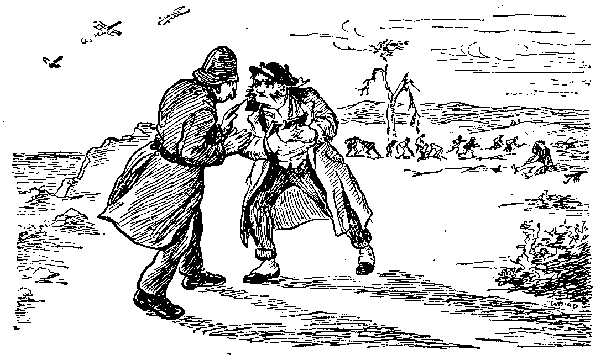
AFTER THE AIR RAID. "Are you hurt, Sir?" "Yes, but not half so badly as the chap who tried to pinch my souvenir."
VICTORIA.
He entered the train at St. James' Park—a dark-eyed young Belgian wearing the new khaki uniform of King Albert's heroic Army. I had watched him hobbling along the platform, and my own boots and puttees being coated with mud after a day's trench-digging in Surrey I drew them in as he took the corner seat opposite mine, stretching out rather stiffly before him the leg which had no doubt stopped a Bosch's bullet. Here was the opportunity for an interesting exchange of views. I was mentally rehearsing a few bright opening sentences in French when the train again stopped. Half twisting in his seat he peered uncertainly out of window.
"Victoria," I informed him; but he obviously didn't understand. I raised my voice.
"Victoria Station," I told him again. "Er—er, Victoire."
His stick fell clattering to the floor, his mouth broadened into a fraternal smile and, seizing both my hands, he worked them like pump-handles.
"Ah, bon, bon! À la victoire! Vivent les Alliés!"
"Brazil.—The British Consul at Porto Alegre states that there appears to be a prospect of the work of repaying the town being carried out in the near future. The contract provides for the repaving of an area of 500,000 square miles at a total cost of £223,200." Morning Paper.
If these figures are correct Porto Alegre must have the record for cheap paving, always excepting an even warmer place where good intentions are the material employed.
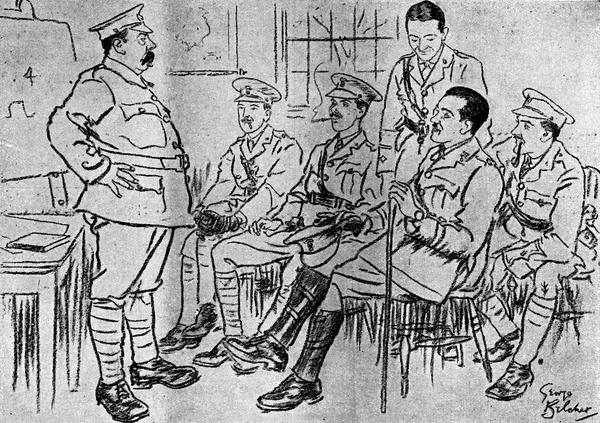
Sergeant-Major (lecturing the young officers of a new battalion of an old regiment). "You 'aven't got to make traditions; you've only got to keep 'em. You was the Blankshire Regiment in 1810. You are the Blankshire Regiment in 1916. Never more clearly 'as 'istory repeated itself.".
"CONKY'S" UNCLE.
There are some men whose patronymics are swallowed up in their nicknames, and my friend "Conky" is one of these. He has quite a decorative surname of his own, but it never counted. For the rest he is the possessor of a big booming bass voice, which he uses with more gusto than art. He is, apart from a certain pride in his musical accomplishments, a very good fellow; and so is Mrs. "Conky"—an amiable and agreeable woman, whose only fault is an excessive anxiety for the comfort of her guests, leading her at times to forget, in the words of the Chinese proverb, that "inattention is often the highest form of civility."
They are a devoted couple, and the only cloud on their happiness was caused by Conky's expectations from a mysterious and eccentric uncle. For a long time I was inclined to disbelieve in his existence, as he never "materialised." But I was converted from my scepticism, some three years ago, when, on meeting Conky, I was informed that Uncle Joseph had invited himself on a short visit. My friend betrayed a certain agitation. "You know," he said, "it is twenty years since I saw him last, when he came to look me up at school, and rather frightened me."
"Frightened you! But how?"
"Well, you see, he's got a way of thinking aloud, and it's rather embarrassing. I don't mind being called 'Conky,' as you know, but it was rather trying to hear him say, 'I hope his nose has stopped growing.' However, I couldn't very well put him off now. I'm his only nephew; he's an old man, and said to be very rich." Conky sighed, but added more hopefully, "Anyhow, I'm sure Marjorie will rise to the occasion." Personally I was by no means so sure. I felt that Marjorie might overdo it: also that Conky, who loved the sound of his voice, might be tempted to soothe the old man with intempestive gusts of song.
Unhappily my misgivings were realised. A few weeks later, on my way home from the club, I called in late one afternoon on the Conkys. They greeted me cordially as usual, but I could see something was amiss, and soon it all came out. The visit had been a fiasco. Uncle Joseph had been very friendly and even courteous, but at intervals he thought aloud with devastating frankness. Marjorie had exhausted herself in the labours of hospitality, but all in vain. Conky had sung, but the voice of the charmer had failed. And just as Uncle Joseph was going he observed in a final burst of candour, "Goo-ood people, very goo-ood people; but she's a second-rate Martha, and he sings like a bank-holiday trombone-player on Blackpool sands."
From that day till a week ago I never heard Conky or his wife allude to Uncle Joseph. The memory was too painful. And yet it is impossible to deny that the experience was salutary. Marjorie is certainly less overwhelming in her hospitality, and Conky less prodigal of song. And when Conky told me last week that Uncle Joseph had died and left him £10,000, I felt that the old man had atoned handsomely for his unconscious indulgence in a habit for which, after all, a good deal was to be said.