Volume 147 — TOO MUCH CHAMPIONSHIP.
Reading edition
Once life was an easy thing.
Yorkshire or Surrey or Kent were cricket champions. Ranji or W. G. headed the batting averages; Rhodes or Richardson the bowling. The office boy who knew these details plus the Boat Race winner and the English Cup-holders could keep his end up in conversation. He even found time to do a little work.
But now! That poor brain must know that McGinty of Fulham fetched £1,000 when put up for auction, that the front line of Blackburn Rovers represents an expense of £11,321 13s. 4d., and that Chelsea have played before 71,935 spectators. He must know the champions of the First, Second, Southern, Midland, and Scottish Leagues, and the teams that gained promotion.
Then there is cricket—all worked out to "those damned dots," as Lord Randolph said in an inspired moment. Think of the strain of remembering that Middlesex stands at 78.66 and Surrey at 72.94. And the sporting papers are publishing lists of catches made; and lists of catches missed are sure to follow. Think of it—you may have to name the Champion Butterfingers in 1915!
Come to tennis. You must know the names of the Australian Terror, the New Zealand Cyclone, the American Whirlwind. You must at a glance be able to pronounce on the nationality of Mavrogordato or Froitzheim. You have the strain of proving that the victory of a New Zealander over a German proves the vitality of the dear old country.
Or boxing. How can an ordinary mind retain the names of all the White Hopes or Black Despairs. At any moment some Terrible Magyar may wrest the bantam championship from us. You must learn to distinguish between Wells, the reconstructor of the universe, and Knock-out Wells. You must be acquainted with the doings and prospects of Dreadnought Brown and Mulekick Jones. You must know the F. E. Smithian repartees of Jack Johnson.
Let us talk of golf. No, on second thoughts, let us notably refrain from talking about golf. Only if you don't know who defeated Travers (plus lumbago) and who eclipsed America's Bright Boy, you must hide your head in shame.
We come to rowing. Once one could stay, "Ah, Leander," and with an easy shrug of the shoulders pass from the subject. But when international issues are involved, and the win of a Canadian or American or German crew may cause The Daily Mail to declare (for the hundredth time) that England is played out, a man simply has to keep abreast of the results.
There are a score of other things. Name for me, if you can, the Great American Four, the hydro-aeroplane champion, the M.P. champion pigeon-flyer, and the motor-bike hill-climbing champion.
And the Olympic games are coming! Who are England's hopes in the discus-throwing and the fancy diving? What Britisher must we rely on in the javelin hop-skip-and-jump?
Your brain reels at the prospect. We must decide to ignore all future championships. We must decline to be aggravated if a Japanese Badminton champion appears. We must cease to be interested if Britain's Hope beats the Horrible Peruvian at Tiddly-winks.
There are three admirable reasons for this.
The first is that we must play some games ourselves.
The second, that, unless a check be put to championships, the Parliamentary news will be crowded out of the papers and we shall find ourselves in an unnatural state of peace and goodwill.
The third, which one puts forward with diffidence, is that somebody, somewhere, somehow, sometime must do a little work.
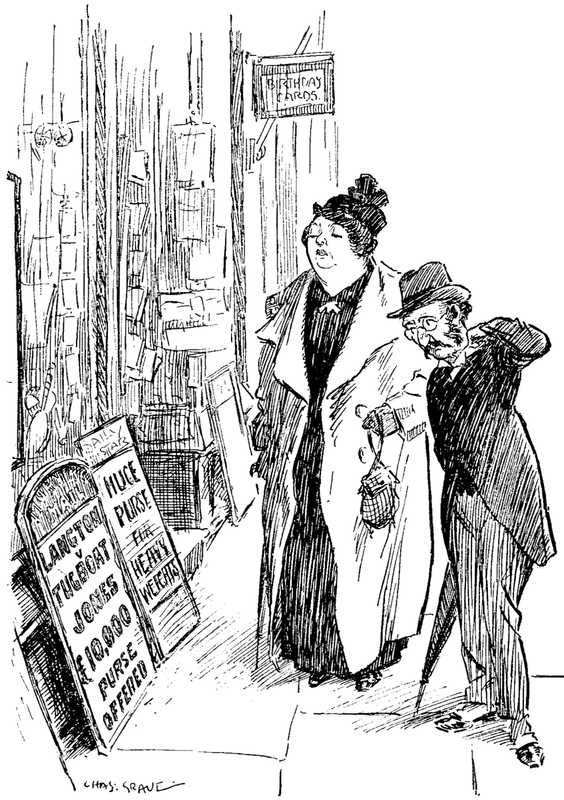
Wife (with some sadness). "Ah, well, Henry, I suppose it's a bit too late for you to think of that now."
To the Memory of Joseph Chamberlain.
Born 1836. Died July 2nd, 1914. Ere warmth of Spring had stirred the wintry lands— Spring that for him had no renewing breath— He went apart to wait with folded hands The lingering feet of Death. Long had he laid his burnished armour by, But still we flew his banner for a sign, Still felt his spirit like a rallying-cry Hearten the fighting line. But he—ah, none could know the heavy strain, Patiently to accept the watcher's part While yet no weakness sapped the virile brain Nor dulled the eager heart. He should have died with all his harness on, As those the Valkyr bore from out the fight, In ringing mail that still unrusted shone, Up to Valhalla's height. Yet solace flowed from that surcease of strife: Love found occasion in his need of care, And time was ours to prove how dear the life An Empire ill could spare. And generous foes confessed the magic spell Of greatness gone, that left the common store Poor by his loss who loved his party well, But loved his country more. And ancient rivalries seemed very small Beside that courage constant to the end; And even Death, last enemy of all, Came to him like a friend. O. S.
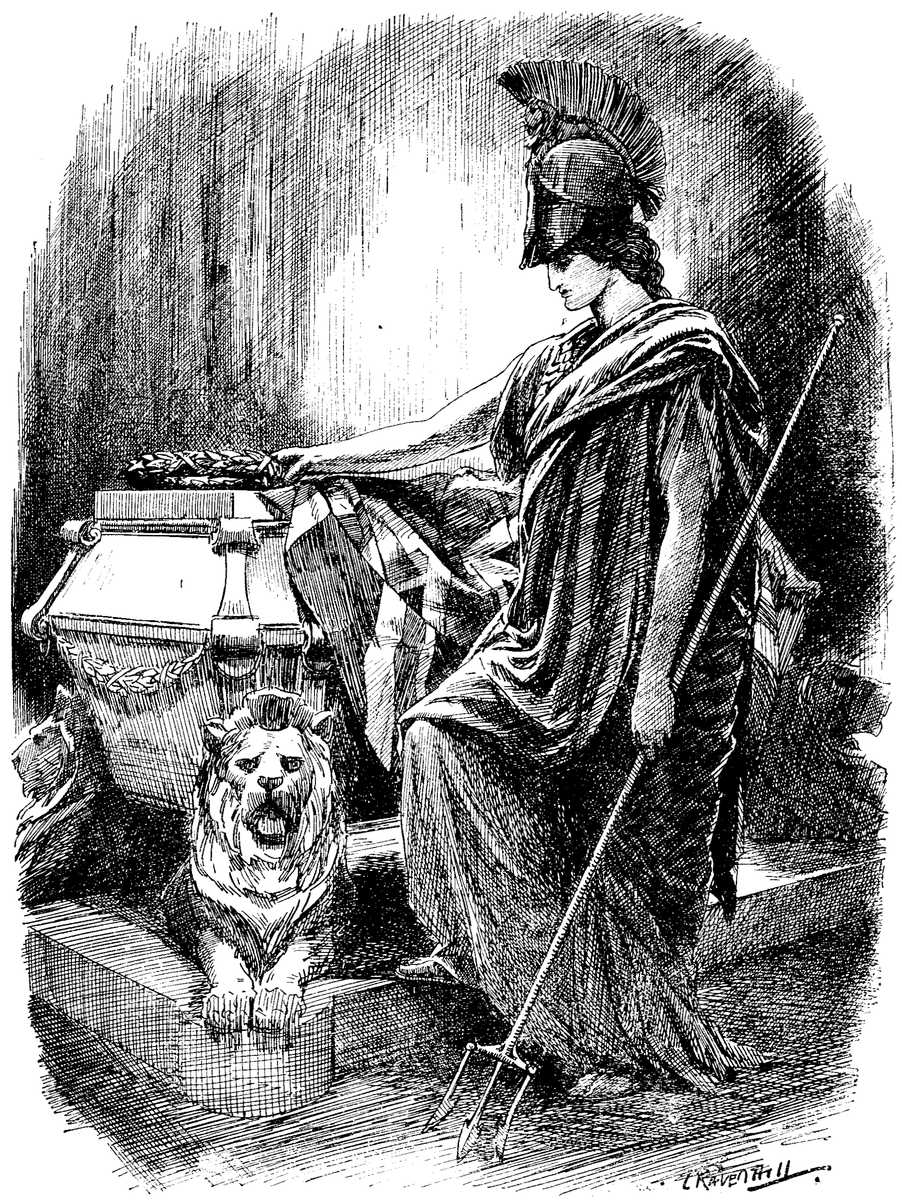
JOSEPH CHAMBERLAIN.
July 2nd, 1914.