Volume 146 — ESSENCE OF PARLIAMENT.
Reading edition
(Extracted From the Diary of Toby, M.P.)
House of Commons, Monday, May 11.—For a while Prime Minister's protest against inordinate questioning, his announcement of determination not to take part in further shorter catechism more or less distantly related to the "plot" and the "coup," had wholesome effect. As he stated, since the plot was discovered he had made seven hundred replies to friendly inquiries. A Member below Gangway to his right added the seven hundred and first. Wanted to know whether it is true that the argumentative questions crowding the notice paper are the product of a factory in the neighbourhood of Parliament Street, presided over by an official whose name suggests that he has been "made in Germany." Expeditiously turned out, as from a sausage machine, is it true that they are nicely sorted and distributed among Members of the Opposition, who in turn pelt the Premier with them?
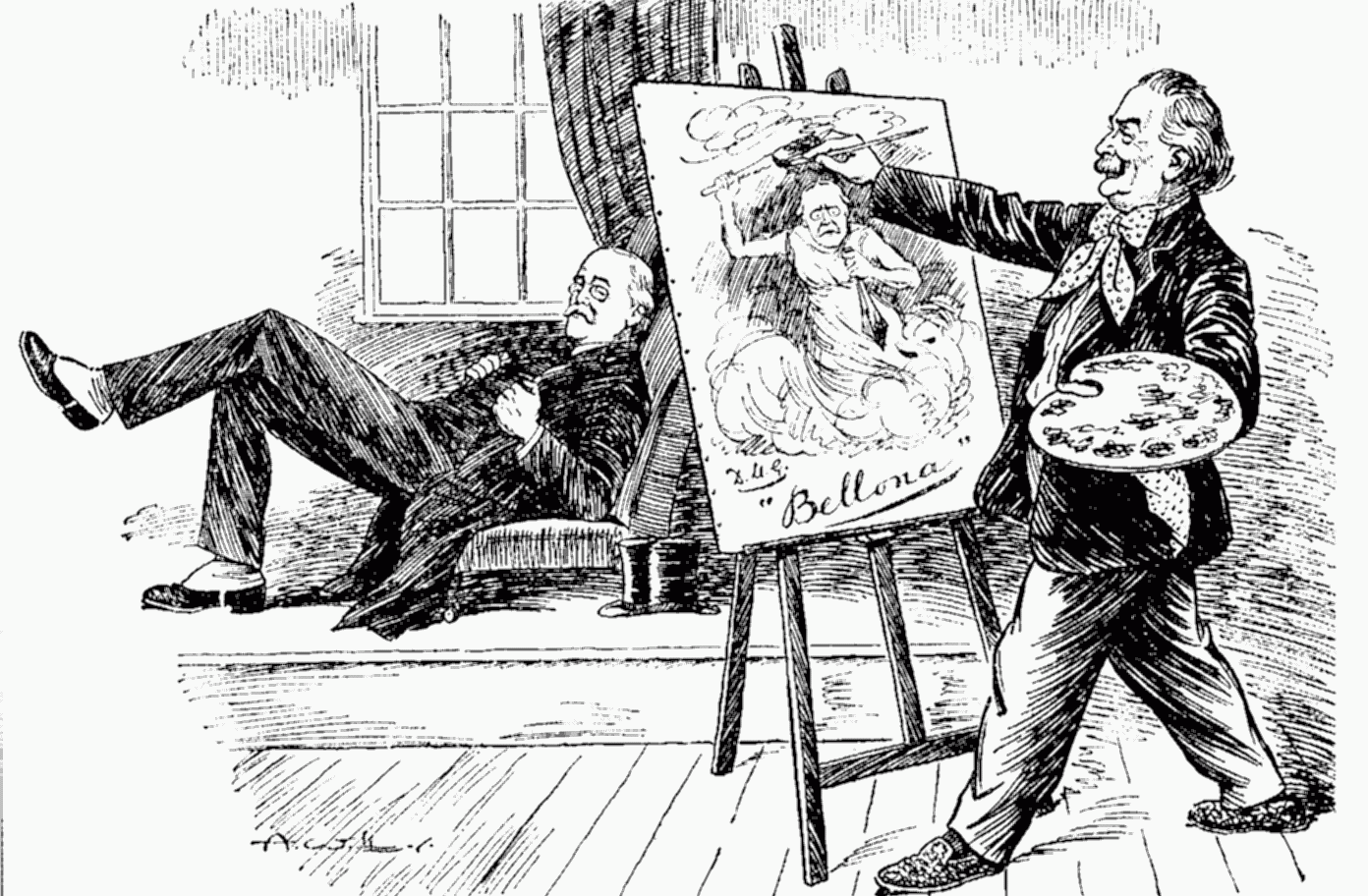
Mr. Lloyd George Regards Mr. Balfour's Attitude as Bellicose.
"If every conciliatory offer put forward by the Government is to be treated in the spirit displayed by the right hon. gentleman, that is the way to promote civil war."
Mr.
Lloyd George
.
After brief lull epidemic breaks out afresh. Twenty-three Questions addressed to Prime Minister to-day appear on printed paper. As each, with the aid of semi-colons, represents two, three, occasionally five distinct queries they reach aggregate of half a hundred. This not counting Supplementaries.
Happily the Premier is incomparable master of the rare art of brief reply, wherein he presents pleasing contrast to the manner of his old master, Gladstone. Had he chanced to be Premier when the Fourth Party were struggling into notoriety their task would have been more difficult, their triumph delayed if not unattainable.
When Grandolph, Wolff and Gorst, with Prince Arthur looking on, set themselves to "draw Gladstone," as was their custom of an afternoon, that astute personage became as a child in their hands. Grandolph led off with a question, to which long reply was made. Wolff, profusely grateful for the right hon. gentleman's courtesy, shunted the Premier on to another track, along which he cheerfully sprinted. Then came John o' Gorst. With the subtlety of a trained but not practising barrister he put a third question, drawing a third speech. Thus merrily sped a quarter of an hour or twenty minutes, deferring by so much the progress of public business.
Asquith's share in the conversation at the Question hour is based on a familiar Biblical injunction. It is largely composed of "Yea, yea," and "Nay, nay." In the case alluded to, wherein the Fourth Party gave play to their insatiable desire for information, he would have replied to Grandolph, "Yes, Sir;" to Wolff, "No, Sir." Had he been exceptionally lured into verbosity he might have gone as far as to say, "The answer is in the negative," or "in the affirmative," as the case might be. As for John o' Gorst, he would have referred him to a speech made on a particular preceding date, "to which I have nothing to add."
Business done.—Lloyd George further explains his Budget. Resolutions founded thereupon agreed to.
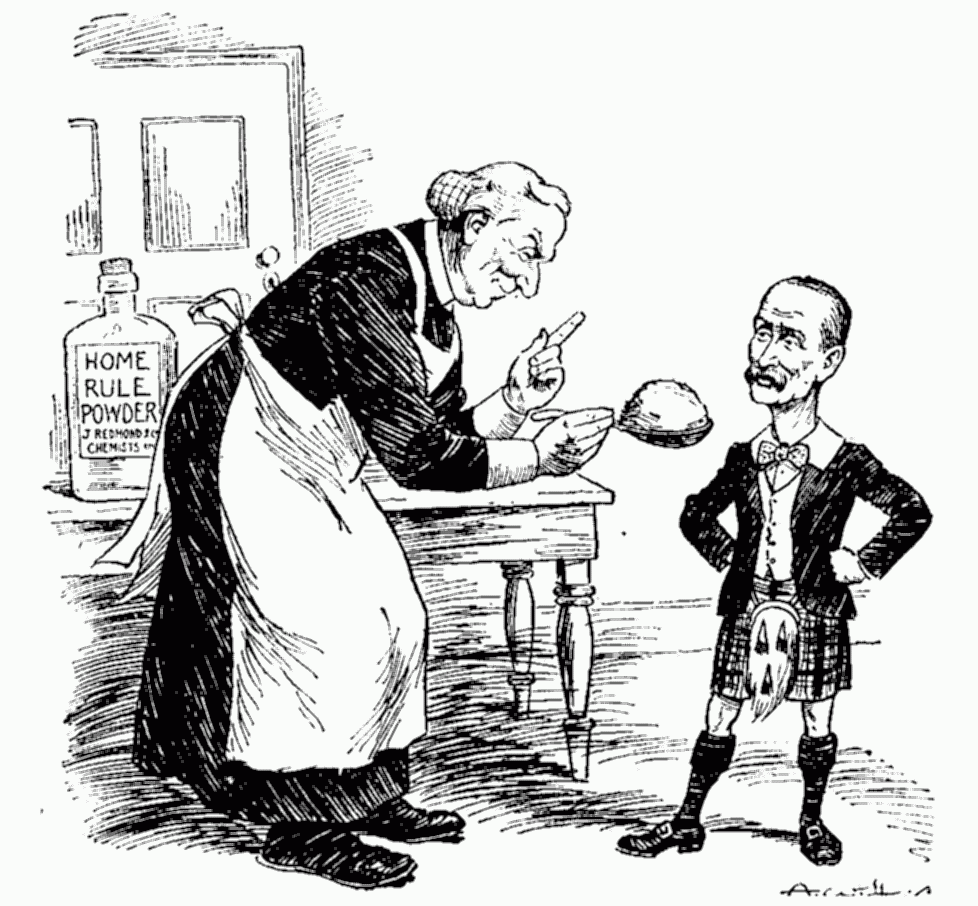
THE BILL AND THE AMENDING BILL.
Nurse Asquith. "Now, take the powder like a good boy."
Master Bonar Law. "Where's the jam?"
Nurse Asquith. "Oh, that comes later."
Master Bonar Law. "Well, I want to see it now. What's it made of?"
Nurse Asquith. "I must have notice of that question."
Tuesday.—What at outset promised to be businesslike debate verging on dulness suddenly leapt into flame and fury, signifying angry passion stirred by Home Rule Bill. In studiously moderate speech Premier moved resolution identical with that adopted last year, whereby Committee stage of Home Rule Bill, Welsh Church Disestablishment and Plural Voting will be forgone. Pointed out that Committee stage is designed for purpose of providing opportunity of amending Bills. Since under Parliament Act none of these measures can be amended in the Commons, what use to go into Committee on them?
Being in increasingly businesslike mood Premier went a step further. Abandoned proposal to submit and discuss "suggestions" to Home Rule Bill. Authoritatively announced by Walter Long and others that the Lords are predetermined to throw it out on second reading. What use then to formulate and discuss suggestions that could be dealt with by the Lords only in subsequent Committee? Finally announced intention of getting Bill through all Parliamentary stages before Whitsuntide, placing it on Statute Book by automatic process of Parliament Act. Will then bring in Amending Bill dealing with Ulster.
It was Prince Arthur who roused crowded House from chilled condition following upon douche of this application of ordinary business principles to legislative procedure. In best fighting form. Stirred to profoundest depths of scorn for actual working of that detested statute, the Parliament Act.
"We are," he said, amid strident cheers from Opposition, welcoming their old captain back to the fighting line, "asked to force through under the Parliament Act a Bill which by hypothesis requires amendment. What is worse than that is that we are to be compelled to read it a third time and to part with it while we know that it is to be amended, but while we have not the smallest conception in what respects or in what way." Insisted that before Home Rule Bill is added to Statute Book Parliament should know in what points it would be amended. "Let us have the Amending Bill first."
Prince Arthur having stirred the embers of slumbering fire, Chancellor of Exchequer vigorously fanned them.
"If," he said, "every conciliatory offer put forward by the Government is to be treated in the spirit displayed by the right hon. gentleman, that is the way to promote civil war."
Hereupon storm burst over Opposition quarters. Shouts of "Shame!" and "Liar" hurtled through the suddenly heated atmosphere. The Chancellor's attempt to proceed with his speech baffled by continuous cry,—"Withdraw! Withdraw!" At length Speaker interposed with suggestion that the Chancellor had been misunderstood. Claimed for him the right of explanation. This conceded, Lloyd George pointed out that what he had meant to say was that argument such as that forthcoming from Front Opposition Bench, making it difficult for the Government to submit proposals of peace, would have effect of promoting civil war.
Prince Arthur naturally falling into "old style" of House of Commons debate, not only frankly accepted explanation but chivalrously took upon himself blame of the outbreak, which he said "apparently arose from an unfortunate expression of mine." Ended with pretty turn of grave satire that greatly pleased the House.
After this, debate quietly proceeded to appointed end, everyone mutely invoking
Blessings on the falling out That all the more endears, When we fall out with those we love And kiss again with tears.
Business done.—Premier's resolution carried by 276 votes against 194. Majority 82. House of Lords by common consent passed second reading of useful little Bill for protection of grey seals threatened with extinction by mercenary sportsmen.
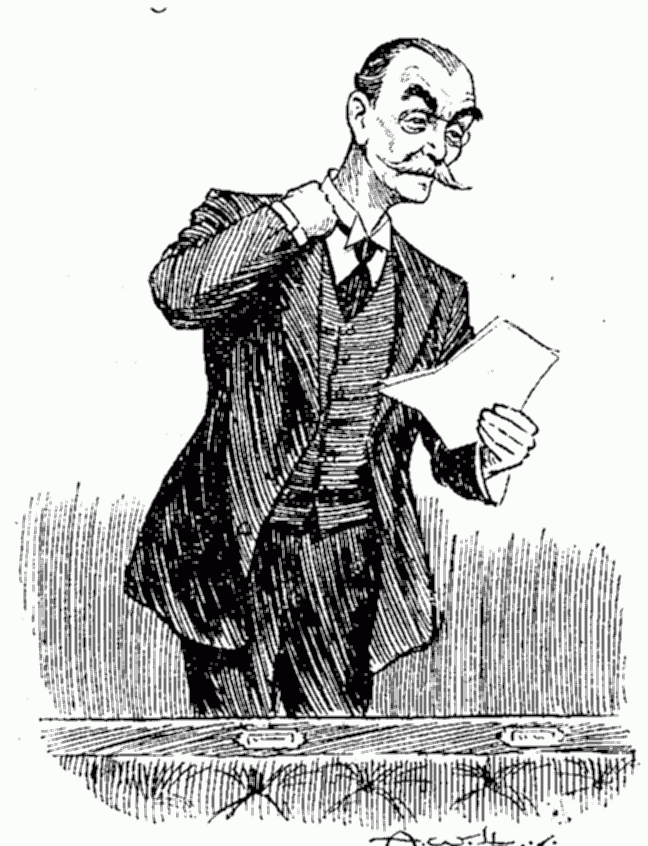
Mr. ROWLAND HUNT IN HIS BEST FORM.
"I don't know [laughter] what honourable Members [renewed laughter] are laughing about [loud and prolonged laughter]."
Thursday.—Remarkable how Shakspeare (or was it Bacon?) wrote not only for all time but for all circumstance. The marvel came to light again in scene in House yesterday. Writing of the time of Romeo and Juliet Shakspeare reports dialogue between two fighting men of the houses of Capulet and Montague. Meeting Sampson in a public place in Verona, Abram truculently asks. "Do you bite your thumb at us, Sir? Sam. I do bite my thumb, Sir. Abr. Do you bite your thumb at us, Sir? Sam. (aside, to his comrade Gregory). Is the law on our side if I say ay?
Greg. No.
Sam. No, Sir, I do not bite my thumb at you, Sir; but I bite my thumb.
Kinloch-Cooke, having put question to Wedgwood Benn, following it up by two supplementary inquiries, put a third when the Speaker interposed. Shrugging his shoulders in silent protest against this tyranny Kinloch-Cooke resumed his seat.
Said the Speaker sternly, "It is no good shrugging your shoulders at me."
This is prosaic account of incident given in this morning's papers. Refer to Hansard and see how it runs.
Speaker. Do you shrug your shoulders at me, Sir?
Kinloch-Cooke. I do shrug my shoulders, Sir.
Speaker. Do you shrug your shoulders at me, Sir?
Kinloch-Cooke (aside to Winterton). Is there anything in the Standing Orders that forbids my shrugging my shoulders at the Speaker?
Winterton (who is training for Speakership and has them all by heart). Yes.
Kinloch-Cooke. No, Sir, I do not shrug my shoulders at you, Sir; but I shrug my shoulders.
Speaker. Order! Order!
Business done.—Another plot that failed. For some weeks Opposition have not attempted to snap a division. Ministerialists, lulled into sense of security, off guard. Secret preparations sedulously made for trapping them this afternoon. Questions over, division challenged on formal motion. Ministerial Whips awake in good time to emergency. Urgent messages had been sent out to their men by telephone and special messengers. Arrivals watched with feverish interest. Ministerialists hurriedly drop in by twos and threes, presently by tens. Illingworth's massive brow, temporarily seared with wrinkles, smooths out. When, after division, Clerk hands paper to him indicating that ambush has been baffled, hilarious cheer rises from Ministerial benches. Renewed when figures read by the Speaker show that the motion is carried by 255 votes against 234.
"Not a high-class game in imperial politics," says Sark. "Rather akin to the humour of making a butter slide on the pavement for the discomfiture of unsuspecting passers-by. But boys will be boys."