Volume 146 — ESSENCE OF PARLIAMENT.
Reading edition
(Extracted from the Diary Of Toby, M.P.)
House of Commons, Monday, March 2.—In speech of flawless lucidity displaying perfect command of columnar figures upon which strength of British Navy is based, the Winsome Winston moved Supplementary Estimates amounting to two and a-half millions. These raise total expenditure of year on the Navy to forty-eight millions. "A serious event," he admitted amid sympathetic cheers from below Gangway to his right. Necessity arises from increased expenditure on oil reserves; from demand for a quarter of a million for the new aircraft programme, an item unknown to Old Morality or Childers when successively at the Admiralty; from increment of wages and acceleration of ship-building.
He might have mentioned that of grand total close upon two millions is legacy left by former Ministry on account of liabilities incurred before 1905. Whilst present Government, austerely-minded, pay their way as they go, meeting increased expenditure out of revenue, Prince Arthur, with characteristically light heart, built ships and strengthened fortifications, raising the money by loan, which he gaily left to posterity to pay off. Posterity has this pleasant task in hand now, and will continue to be engaged upon it for next twenty years.
Winston judiciously refrained from pressing the point. Had enough on his hands with discontented supporters below Gangway, who resent ever-increasing burden of Naval expenditure. Ramsay Macdonald lodged protest on behalf of Labour Members; stopped short of moving reduction of vote. This done by David Mason of Coventry.
"A hollow demonstration," was Gilbert Parker's terse description of the revolt. On a division Estimates were carried by a majority of 203. Only 34 voted for reduction.
Prolongation of debate plainly boring. By exception, one listener sat it out with unwearied attention. Nothing precisely cherubic in face or figure of Lord Fisher of Kilverstone, better known on sea and land by the affectionate diminutive Jacky Fisher. Nevertheless, as he sat perched in Peers' Gallery immediately over the clock, a place ever associated with the genial presence of Edward Prince of Wales, there flashed across the mind a familiar couplet sung by Dibdin:—
"There's a sweet little cherub that sits up aloft To keep watch for the life of poor Jack."
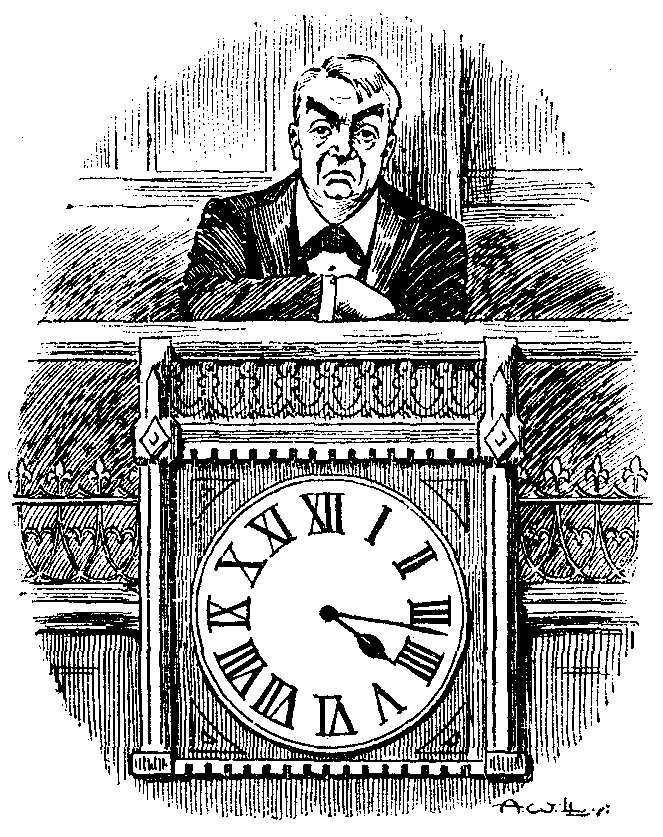
JACK'S JACK.
(Lord Fisher).
Whilst jealous for maintenance of Naval power, no Admiral or Sea Lord did more to improve conditions of life on the lower deck than did Jacky Fisher. Retired from active service, his multiform commissions under hatches, to-night his body has gone aloft to a seat in Peers' Gallery. There he heard expounded biggest Navy vote submitted since days of the "Great Harry." Exceptionally swollen by provision for reserves of oil fuel, a new departure, for which he in his capacity as Chairman of a Royal Commission has, as Winston testified, been chiefly responsible.
Business done.—Naval Estimates discussed.
Tuesday.—Another scene testifying to electricity of atmosphere. As usual, explosion from unexpected quarter. House in committee on Naval Estimates. Lord Robert Cecil, ever alert in interests of working-man with a vote, moved reduction in order to call attention to housing accommodation provided for men employed at Rosyth. Chairman ruled debate out of order on Supplementary Estimates. Lord Bob nevertheless managed to sum up purport of intended speech by denouncing state of things as "a scandal and disgrace to the Government." At this stage Opposition Whips, counting heads, discovered that, if not at the moment in actual minority, Government would, if division were rushed, find themselves in parlous state. The word—it was "Mum"—went round Opposition benches.
Unfortunately for success of plot Ministerial Whips also alive to situation.
"After your ruling, Sir," said Lord Bob with ominous politeness, "I cannot develop my argument, but I propose to persist in my motion, and will divide the Committee."
Not if Leif Jones knew it. For him, as for all good Ministerialists, subject suddenly developed interest, urgently demanded consideration. This he proposed to bestow upon it. A Bengal tiger about to lunch off a toothsome native, discovering the anticipated meal withdrawn from his reach, could not be more sublimely wrathful than were gentlemen on Opposition benches. And Leif Jones, too! The mildest-mannered man that ever turned on a water-tap.
After a moment of petrified pause, natural to Bengal tiger on discovering reality of his discomfiture, there burst forth roar of "'Vide! 'Vide! 'Vide!" From appearance of Leif Jones's lips, he was continuing his remarks. Not a syllable rose above the storm. After it had raged for some moments Chairman pointed out that, whilst divigation in direction of Rosyth was out of order, it was competent to any Member to discuss the vote as a whole.
This too much for A. S. Wilson, who has been surprisingly reticent since Session opened.
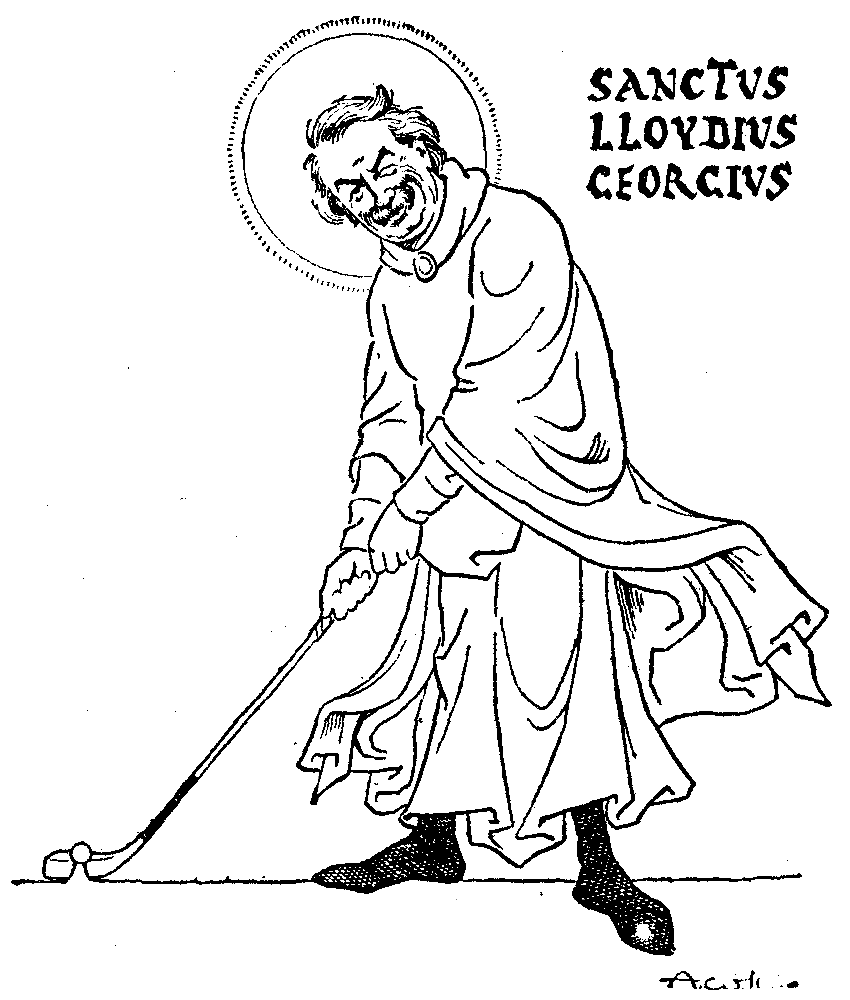
"I understand you have only one Welsh saint. Well, there'll soon be another; it will be Saint Lloyd George. I would canonise him right away."—The Rev. Dr. Clifford at Westbourne Park Chapel.
"Is it right for the Chairman," he asked, "to protect the Government from what may be an inconvenient position?"
"A grossly disorderly observation," the Chairman retorted.
A. S. withdrew the remark, the more willingly since designed effect gained.
Cousin Hugh, for some time moving uneasily in corner seat below Gangway, bounded to his feet. Member near him simultaneously rose. With sweep of left arm, after manner of Richard III. directing the cutting off of the head of Buckingham, he waved the appalled Member down. Was getting on nicely with what he had to say when, like Grand Cross on historical occasion, he "heard a smile."
It came from Winston.
"I notice," said Cousin Hugh glaring on the Treasury bench, "that the First Lord of the Admiralty, who is very ignorant on many matters, is amused at this observation."
Winston explained that what he had laughed at was "the lordly gesture with which the noble Lord swept away another honourable gentleman."
Leif Jones, proposing to continue his remarks, presented himself again. Greeted with fresh yell of execration. Battled for some moments with the storm. Too much for him. Reached forth hand; seized imperceptible tankard of invisible stout; gratefully wetted his parched lips withal. Refreshed, he tried again; no articulate word dominated the din.
After further ten minutes of uproar, through which from time to time A. S. Wilson tried to get in more or less relevant remark and was instantly extinguished by the Chairman, who masterfully managed difficult situation, Winston interposed. A bird of the air had brought news from Whips' Room that all was well. Accordingly the First Lord graciously conceded division clamoured for.
Its result profound surprise. So far from Government lacking support, the amendment was negatived by more than two to one. Majority rushed up to 140.
Evidently been a mistake somewhere.
Business done.—Supplementary votes agreed to.
Thursday.—Dramatic turn in position of Home Rule Bill. Premier hitherto steadfast in deferring Second Reading till close of financial year. As result of confabulation between two Front Benches arranged that Supplementary Estimates shall be hurried up so as to make opening for immediate debate on Second Reading.
Accordingly St. Augustine Birrell to-day brought in Bill for First Reading. No need of persuasion of silver tongue to carry this stage. Proceeding purely formal. Fight opens on Monday, when Premier, moving Second Reading, will explain his "suggestions" of amendment.
Business done.—Home Rule brought in, being third time of asking. Welsh Church Disestablishment Bill and Plural Voting Bill also read amid vociferous cheering by Ministerialists.
"His brilliant flashes of wit and humour evoked hearty applause, and sometimes even laughter."—Teesdale Mercury.
Almost the last thing you would have expected.
"One of the strongest traits in Mrs. Barclay's character is a love of all creatures, great and small—thrushes, wagtails and robins come to her when she calls, and she keeps a little box of worms to feed them."—Woman at Home.
Sometimes the worms must wish she wasn't quite so loving.