Volume 146 — AT THE PLAY.
Reading edition
"Helen with the High Hand."
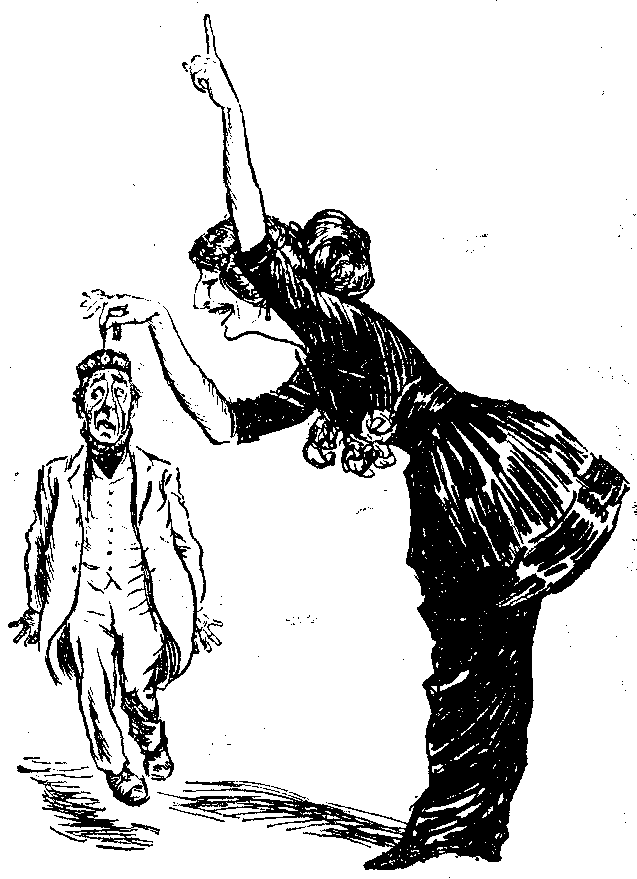
THE HIGH HAND.
Helen Rathbone Miss Nancy Price.
James Ollerenshaw Mr. Norman McKinnel.
There is great entertainment at the Vaudeville for the admirers of Mr. Norman McKinnel, among whom I propose to count myself whenever, as so rarely happens, he takes an evening off from his tyrannical methods—seldom very edifying when a woman is the victim. As the gentleman says in one of Oscar Wendell Holmes's books, "Quoiqu'elle soit très solidement montée, it ne faut pas brutaliser la machine." Here it is true that Mr. McKinnel started out on his familiar courses, but he soon found that he had to do with his match; that Helen's hand was always a little higher than his own. And, even when we saw him at his most dogmatic, the fact that the question of sex, in its physical aspects, did not enter into their relations—he was only her step-great-uncle—saved us from a great deal of uneasiness. In all his moods, whether of blustering self-assertion or reluctant surrender, of canny craft or protesting generosity, Mr. McKinnel was equally admirable.
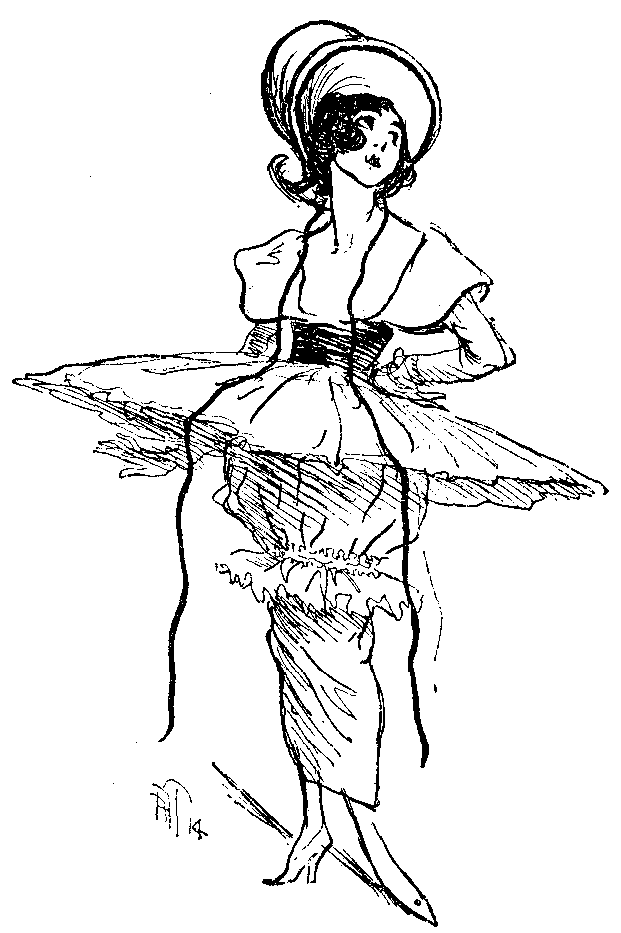
MODES FROM "THE POTTERIES."
What Mr. Arnold Bennett's ladies wear to-day Vienna wears to-morrow.
Lilian Swetnam Miss Mièle Maund.
The local atmosphere of the Five Towns was established with less delay over detail than is customary in this kind. There was a lot of tea-drinking, I admit, but no doubt this beverage plays a strong part in the social life of the Potteries. There was also much handling of domestic provisions—streaky bacon, cheese, and so forth—but all this was proper enough in a play that largely turned upon the changes in an old celibate's ménage. But in the main it was a comedy of character, a struggle between youth and crabbed age, in which the younger will and the quicker wit prevailed. As we first see him, James Ollerenshaw is a crusty, browbeating, misogynist, hoarding his wealth, content with a mean habit of life, and convinced that nobody can get the better of him. As we see him at the end he is a tamed man, dependent on female protection against the wiles of a designing widow, and established, at great cost, with his niece in the noble and ancient mansion of her desire. There were subsidiary love-episodes, of course, but these, though novel in some particulars, were relatively perfunctory. The character of James Ollerenshaw was the real matter of resistance.
Miss Nancy Price's Helen was a very probable performance. For myself I found her a little too minx-eyed for my taste, but no doubt this was part of the right Pottery touch. Minor characters were all brightly played, Miss Mièle Maund being particularly happy as a garrulous young girl in the first flush of an engagement, who subsequently throws over her violent fiancé on the ground that "she could never marry a man who pushes people into lakes." Even the vieux jeu of the designing widow took on a certain freshness in the robust bands of Miss Rosina Filippi.
I am in the fortunate position of having yet to read Mr. Arnold Bennett's novel, from which Mr. Pryce's comedy has been adapted, and am therefore free to treat the play itself on what I take to be its merits. It may be that the adapter assumed in us a little previous knowledge of the history of Helen's love affair, or that at least there was an obscurity about her past that wanted clearing up by retrospective illumination; but that is my only possible criticism; and I heartily congratulate the Vaudeville management on having at last discovered a play that promises to reward their enterprise.
Not suspecting that there would be a change of hours after the second night, I arrived on the third night punctually at 8, to find that the performance was announced to begin at 8.30. Punctually at that hour I returned, to find that it did not commence till 9; that in the meantime I was to assist at a song-and-talk recital of which no threat had been published. My quarrel is not with Mr. Frederic Norton who did it, though his clever entertainment began with some songs about fishes and things that might have warmed a Penny Readings' audience but left me bitterly cold. My complaint is of a wasted hour and a bolted dinner. I mention it only to prove that, whatever the provocation he has suffered, a Dramatic Critic is incapable of prejudice.
O. S.