Volume 146 — "FOR PROFESSIONAL SERVICES."
Reading edition
"You know this sort of thing isn't good enough," said I, returning the document to Minerva.
"His charges are certainly high," observed the lady of the house; "but I don't think, Jack, we could get as good a doctor anywhere for less money."
"I don't complain about the charges; I suppose they are all right. What I object to is this pompous way of telling me I am in his debt: 'Mr. John Spratt to Dr. Thom. For Professional Services to date, Ten Guineas.'"
"But, my dear, they all do it like that."
"Then they shouldn't. Tradesmen give full particulars of all charges made for their services: why not doctors?"
"Oh, they would never agree to that, Jack!" said Minerva in surprise. "It isn't etiquette. After all, a doctor is a doctor!"
"Let us hope so. At times I doubt it. But that is not the story. How do you suppose I am to check this account without the necessary details?"
"My dear," exclaimed Minerva, "how positively quaint you are! One never dreams of checking a doctor's account; one simply pays. Imagine asking a doctor for an invoice! The idea!"
"And a jolly good idea too," I said. "Then we should know where we were. Would you pass your butcher's bills if they merely said, 'For Commercial Services to date'?"
"That is quite a different matter. Doctors are not butchers."
"Sometimes surgeons are, so it comes to much the same. Anyhow, I object to paying money without knowing what for. Let's apply for an invoice, if only for the principle of the thing."
"We'll do nothing of the sort," said Minerva rather sharply. "It sounds so mean, Jack, to ask a doctor for a detailed account—almost as if we didn't trust him."
"I shall mention that to the butcher next time I see him, and to the other tradesmen. It will save you a lot of trouble about the domestic accounts."
"Don't be absurd. If you're so anxious to have those petty details I think I can remember all the doctor's visits for you, without worrying him."
I drew out a sheet of account-paper.
"The first time he came this year," she began, "was to attend Tommy. You remember—after that New Year party. He called twice—no, three times to see him."
"'Item 1,' I wrote. 'To overhauling and repairing Tommy's tummy, time and material, say 15s.' When Tommy next overeats himself I shall attend to his little business myself. Yes?"
"Then there was Aunt Maria who was staying with us and imagined she had appendicitis, poor old thing! You remember the specialist, Jack?"
"I remember the specialist's fee—three guineas for absolute tomfoolery! 'Item 2. To diagnosing Aunt Maria and failing to find anything wrong and recommending appendicitis.... ' Shall we say a guinea for Aunt Maria's put-up job? I ought to get my money back since nothing was found in Aunt Maria. There should be at least a discount on false alarms."
"Then there was Baby," continued Minerva. "We didn't know what was wrong with him—and really I don't think now there was very much the matter, although I felt so anxious at the time. But the doctor never would explain fully."
"Of course not; that would be giving the game away. 'Item 3. To baby to rights, 2s. 11d.'"
"Two-and-elevenpence for baby!" protested Minerva. "If Aunt Maria was worth a guinea—"
"She was not. I said so at the time."
"—Baby is certainly worth more than two-and-elevenpence."
"Well, make it two pounds eleven. I don't care either way. What I want is an approximate idea of the way this fellow makes up his total."
"If he's charging two pounds eleven for all the little he did to Baby, he's certainly charging too much, Jack; and you ought to see him about it at once."
"Well, what next?"
"That was all, I think.... Oh, no. There was the time about Maudie's cold."
"Oh, those kids' colds!"
"Well, my dear, I have spoken to the children about it until I am tired. Do be reasonable."
"'Item 4. To thawing Maudie's chest, lubricating throat, and taking hard edge off voice, time and expenses.' ... How much?"
"He was only twice at Maudie, three times at Tommy. What did you put down for Tommy?"
"Fifteen bob; but Maudie is bigger than Tommy."
"She is big for her age," reflected Minerva. "I remember asking the doctor if he thought she was growing too fast."
"He'd call that a consultation."
"'Item 5. To advising on rate of speed recommended for Maudie's growth, one guinea.'"
"I might have saved that charge," sighed Minerva. "But that was all. How much does it come to?"
"Allowing two visits to Maudie to be equal to three visits to Tommy, the total bill amounts to six pounds three shillings."
"But that's four pounds seven less than he charges."
"And observe I am allowing two pounds eleven for Baby's fidgets—or rather for your fidgets about baby—on the basis of Aunt Maria being worth a guinea a whim."
"Two pounds eleven for looking at Baby's tongue every other day when there was nothing really the matter with him at all! It's preposterous, Jack. There must be something wrong. You must see Dr. Thom at once about that account. Call to-morrow, dear, on your way to town."
I called. After all there is, as Minerva says, something inexpressibly mean in asking a doctor for a detailed account. This thought occurred to me as Dr. Thom shook hands, beaming as usual with that genial heart-warming smile of his.
"Ah—er—Doctor—my wife would like to see you first time you're passing," I managed to say.
"Nothing serious, I hope?"
"Nothing much. A little matter of detail—that is—I mean Maudie's chest—or rather Tommy's stomach."
"Oh, we'll soon put that right, bless you. Don't you worry yourself about that, Mr. Spratt. Beautiful morning, isn't it?"
A little rough on Tommy, perhaps, but rougher on me.
THE AMERICA CUP.
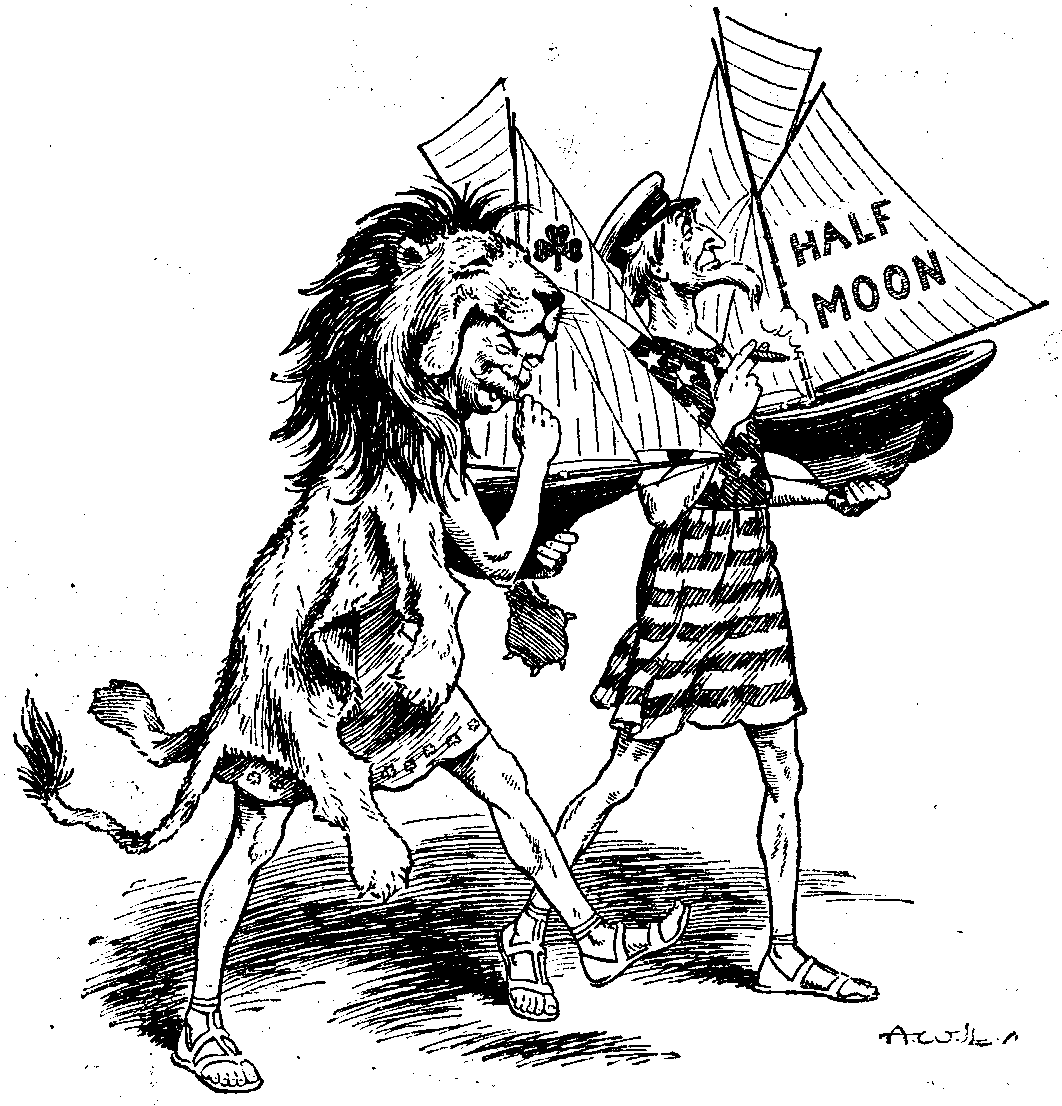
Here comes two noble beasts in, a moon and a lion.
A Midsummer Night's Dream, Act. V., Scene 1.
[It is announced that the Defender is to be named Half Moon.]
THE WARRANT.
Our village cobbler, Roberts, has reduced the principle, "Put not thy trust in any child of man," to its very lowest and worst. He regards himself as simply born to be robbed and oppressed. Yet is he so mild and uncomplaining and unassuming about it all that no one, even the most persistent robber and oppressor, could ever find it in his heart to do him down. But even so his pessimism and readiness to be done are such that he must make it very hard for people to spare him sometimes. I have this story from our local banker, who was called upon by the Income Producer Company, Limited (of some obscure address in the City of London) to put the matter right.
It appears that Roberts had, after many years of economy, amassed some savings, which from the first he regarded as bound to land him in trouble. He indulged in twenty £1 shares in the I. P. Co., Ltd., only because he had to do something with the twenty pounds. He told everybody that he neither expected to see his capital again nor even to get any interest on it. He hinted darkly at worse things to come from the transaction, though what these might be he didn't pretend to know.
I have no inside knowledge of the I. P. Company, except that its stock doesn't appear among the use of Trustee Securities. But whatever trustees may think of it, it did declare at the end of 1913 (after a somewhat prolonged silence) a decent dividend on its ordinary shares. Maybe this was by reason of its innate honesty; maybe it was simply because it hadn't the heart to deny his rights to such a man as Roberts. Anyhow it declared its dividend, and, what is more, proceeded to pay it in the manner usual to limited companies.
And so in due course Roberts received a formidable-looking piece of paper, with the title, in very impressive lettering, "Dividend Warrant," and below the figures £1 8s. 3d.
There must be many, among the uninstructed classes, who have no idea what a dividend warrant may be, but few would, I think, at once take the dismal view of the thing that Roberts took.
By return of post the Secretary of the Income Producer Company, Limited, received an envelope addressed in a shaky hand and enclosing a postal order for a pound, together with a letter from Roberts, in which he prayed for a few days of grace, in which a poor but honest old man might raise the further 8s. 3d. thus demanded of him by legal process.
"The bride will be supported by five piers."
Evening Standard.
Read this aloud to your wife and see if she isn't jealous. And then try her with this from The Greater Britain Messenger:—
"Big Dams and what they mean to the Church."
She ought to be shocked.
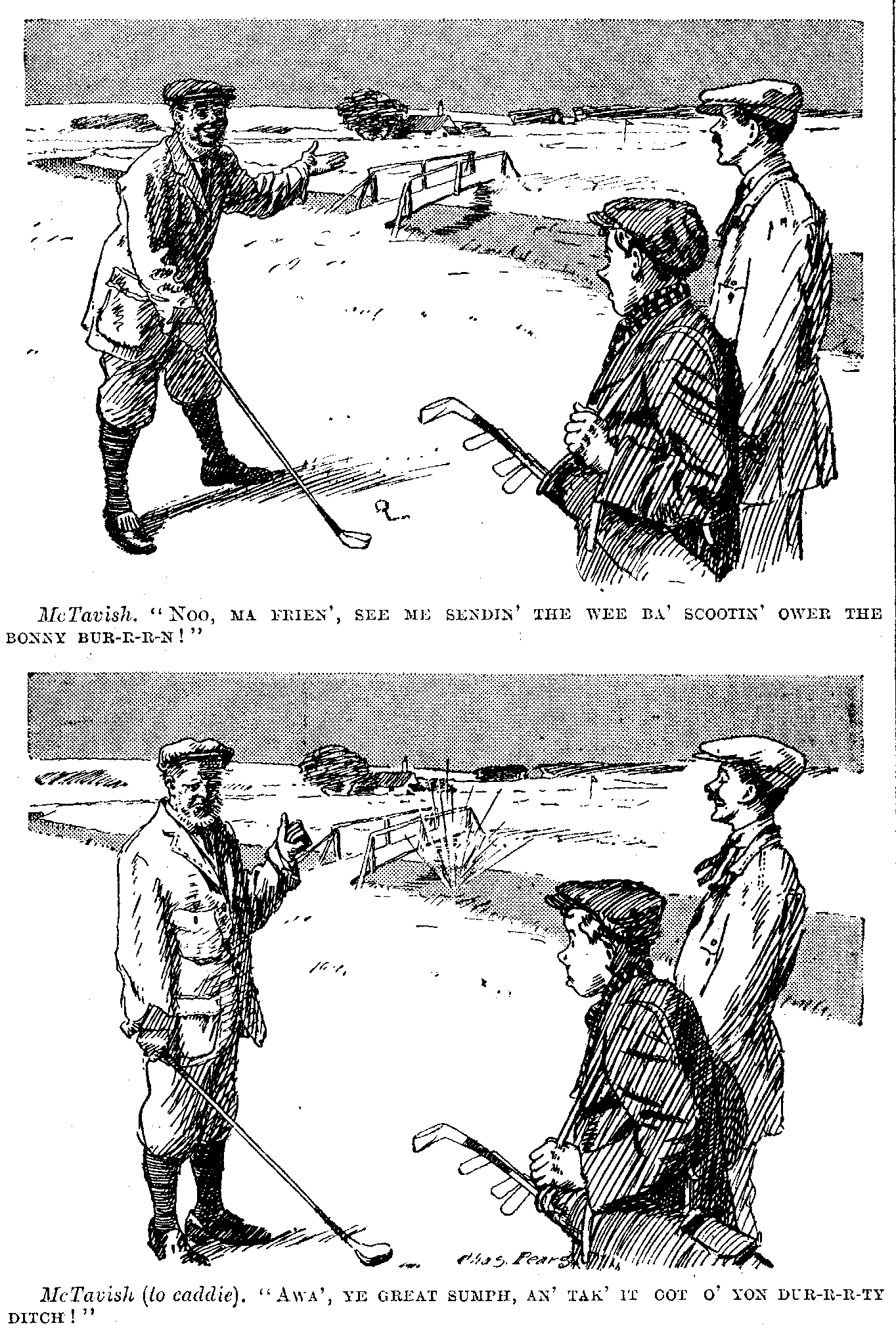
McTavish. "Noo, ma frien', see me sendin' the wee ba' scootin' ower the bonny bur-r-r-n!"
"McTavish. (to caddie). "Awa', ye great sumph, an' tak' it oot o' yon dur-r-r-ty ditch!"