Volume 146 — A KEY TO CUBISM.
Reading edition
The chief exponent of "the new geometric art" explains the whole movement in the following passage, as reproduced in The Observer:—
"Primitive space has entered into us, as it were.... Against that space within us, as against the space that appalled the savage from without, we erect always more hard and logical images.... All brute material, animate and inanimate, of earth, becomes an organism to confront the soul. Formerly the soul as a simple figure, like a ballet, faced the environing vagueness.
"Appearance then, at present, becomes a dyke around the invision from within. And, as a consequence even of this, the appearance, as it is seen in art to-day, tends to be more removed from everyday objective reality than at any former period of art. A new religion is being built up, girder by girder, around the vague spirit. Space, the physical space of savage shyness, is now on our side."
The comment of the writer in The Observer runs thus: "This, at any rate, is the language of people who know what they are about."
Mr. Punch, being a little fearful lest the average reader of the above passage may not share this knowledge of "what they are about," ventures to add his own views on Cubism, confident that even those who disagree will applaud his clarity.
From Raphael until Pceszy Turgidoff (the brilliant young Slav whose canvas has recently been acquired by the Royal Geological Museum) all true artists have striven to adumbrate the eternal conflict between the morbid pathology of Realism and the poignant simplicity of Nihilism. In other and shorter words, chaos must ever be on the side of the angels. But, until the advent of the new Truth, the whole mission of art had trickled into a very delta of arid sentiment. The critic could walk all the galleries of Europe and find nothing to lighten his melancholy until he entered one of those caverns of earliest man and stood in ecstatic reverence before the incomparable masterpieces wherein the first of the Futurists created (with perfect parsimony of a sharpened flint) Man, not as he is to his own dull eye, but Man as he is to the inner retina of the universe. Man, the simple triangle on two stilts, the creature on one plane and of one dimension, an outline without entity, a nothingness staring, faceless, at the nothingness which baffles his soul.
Emotion, idealism, beauty—these have been always the evil spirits that have fettered art. The new art has so exorcised them that they have fled from it with demoniac cries. Pulziacco's splendid rhomboid, "Cleopatra"; Weber-Damm's tender parallelograms, "The Daughters of James Bowles, Esq., J.P"; Todwarden Jones's rectilineal wizardry, "A Basket of Oranges"; and Arabella Machicu's triumph of astigmatism, "The Revolving Bookcase," are examples of this conquest of the inner retina over the brutal insistences of form and matter.
Of still deeper significance is that terribly sad picture of Philip Martini, "The Mumpers: a Group at Lloyds." Nothing is more illustrative of the courage demanded for the struggle of the new art against convention than this poignant work, wherein, true to the verities, the artist has confounded realism in its own domain by the unrecognisable faces of his sitters.
Let us sum up the new movement so clearly that the dullest will apprehend. Surely the inhibition of all apperceptions in art is correlative to the inner ego? That simple postulate granted, it will be unquestioned that the true focus of vision should co-ordinate the invisible. Faith we must have, or we faint by the roadside of the intelligible. The only altruism is that which can defy the cold brutality of things as they are, and convince us with things as they are not. Thus alone can the contemplation of art bring us back to primal infelicity, and restore in our souls the perfect vacuity of infants and cows. Thus only can we achieve the suffusion of vision of the happy inebriate.
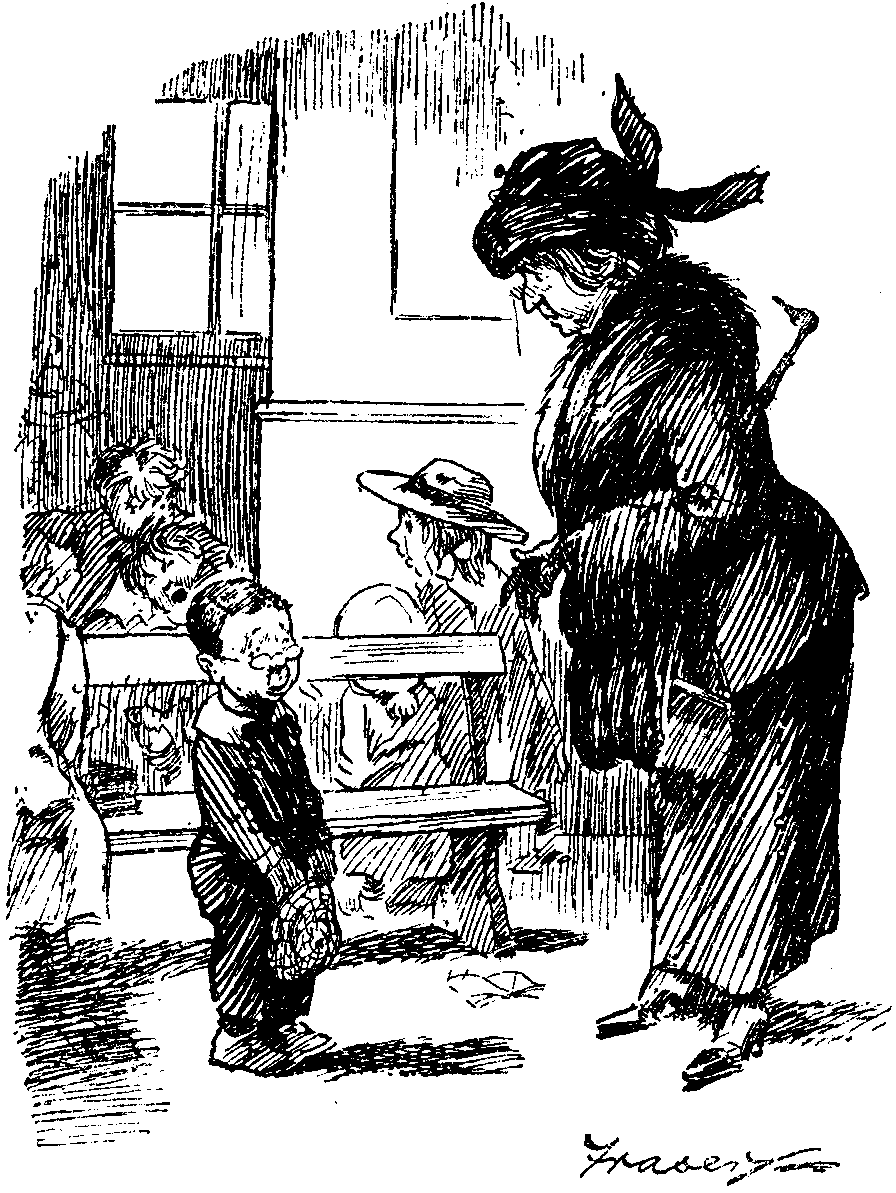
Sunday-school Teacher. "And now, Tommy, about your prize—would you like a hymn-book?"
Tommy. "A yim-book's all right, teacher, but—er—er—I'd sooner 'ave a squirt."
THE TROPHY.
I'd dined at home; I'd read till ten; I'd thought, "The space upon the wall Above the stuffed Thames trout Wants filling." That was really all: And then I closed my eyes, and then I let my pipe go out. We crawled, the Khan of Khot and I, On a Thibetan precipice (It was Thibet, I think), A place of snow and black abyss; We lay on rock—mid wind and sky— Above a beetling brink. For lo, along the ridge there fed The sheep that ne'er a shepherd know Save the shrill wind of morn, Five "Oves Ammon" of the snow; I saw the big ram lift his head, Twin-mooned in mighty horn. Broadside he turned, a mountain-god In sweep of coronal sublime, And the fierce whisper broke— The Khan of Khot's, he hissed, "Tak time!" And handed me my spinning-rod; And as he did I woke! One thing at least is clear, and that's My empty wall is yet to fill; Though oft with even's shade I see that great head from the hill, Unstable as the Cheshire cat's, Look down therefrom and fade.
Two quotations from The Publisher's Circular:—
"Mr. Robert Bowes (who by the way is in his sixty-seventh year)...."
"Mr. Robert Bowes is in his seventy-ninth year.... But then he is much younger than many older men."
So are all of us. Mr. Bowes's distinction is in being twelve years younger than himself.
ALL'S WELL THAT BEGINS WELL.
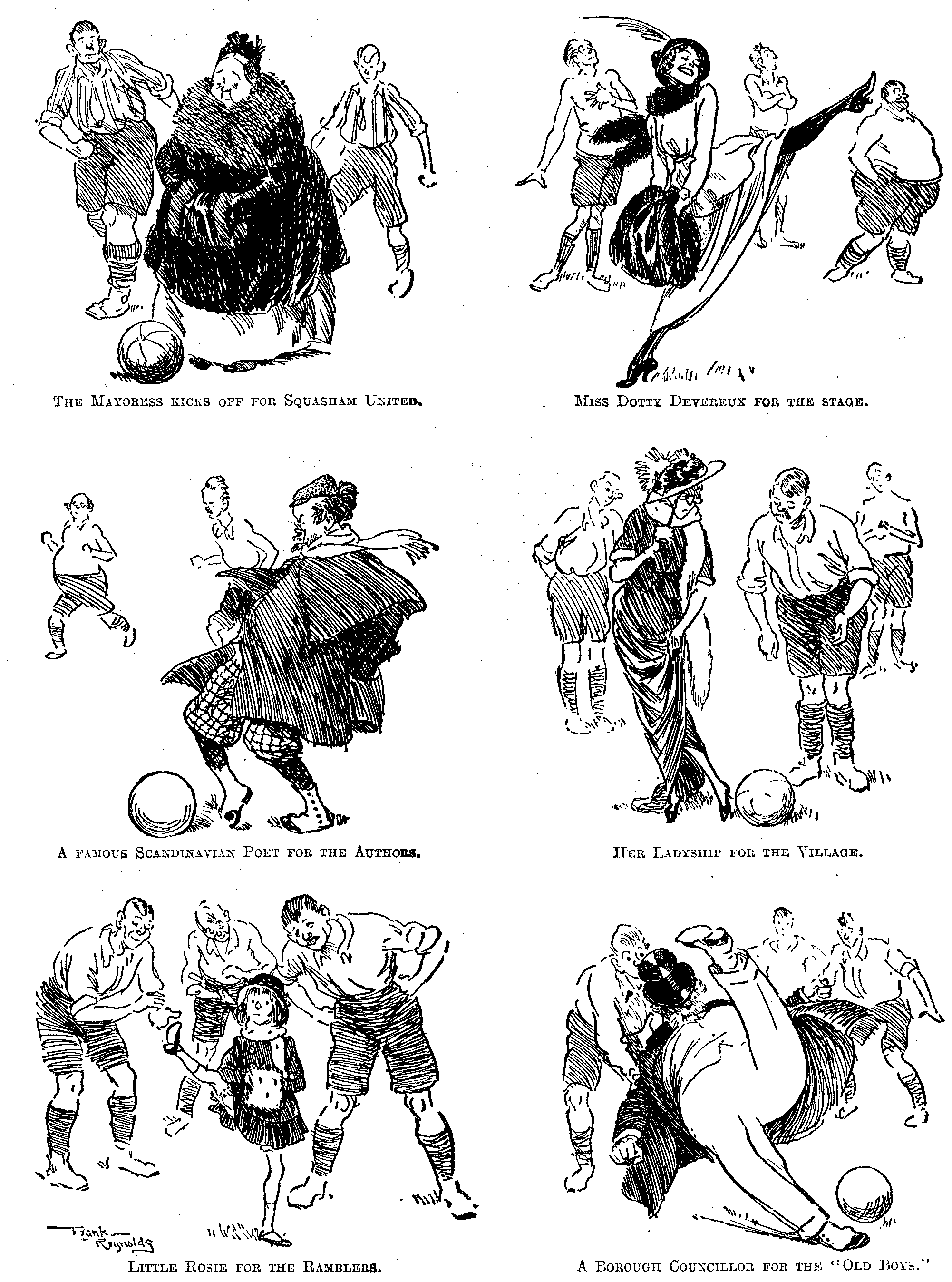
The Mayoress kicks off for Squasham United.
Miss Dotty Devereux for the stage.
A Famous Scandinavian Poet for the Authors.
Her Ladyship for the Village.
Little Rosie for the Ramblers.
A Borough Councillor for the "Old Boys."]