Volume 146 — ESSENCE OF PARLIAMENT.
Reading edition
(Extracted from the Diary of Toby, M.P.)
House of Commons, Tuesday, April 14.—Back to grindstone after so-called Easter recess. Divisions reveal presence of aggregate of something less than 200 Members. Watchful Whip, ever suspicious of ambush, succeeded in mustering four-fifths of the whole. Ministerial majority maintained at average of six-score.
Increased by a unit consequent on return of Premier after re-election by faithful Fife. Towards close of Questions was discovered standing at Bar awaiting Speaker's call.
"Members desiring to take their seats will please come to the Table."
As he advanced, escorted by Chief Whip and Scottish colleague, Liberals and Irish Nationalists leaped to their feet, waving hats and handkerchiefs in loyal greeting. Only the haughty Labour Member remained seated. Not for him to pay court to chiefs of other parties, howsoever friendly. He is there as representative of the Working Man; is neither to be bought nor sold, cowed nor cajoled.
A fine spectacle. Pity Strangers' Galleries almost empty.
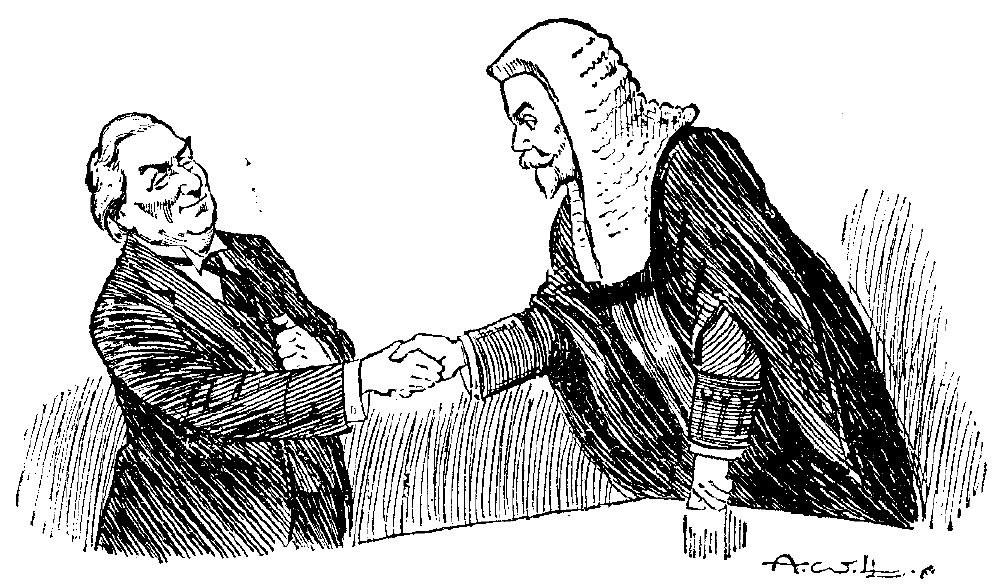
THE NEW MEMBER.
Mr. Speaker. "Pleased to make your acquaintance, Sir. Somehow I seem to know your face."
In process of swearing-in new Member nothing taken for granted. Halsbury discovered this when, far back in the last century, he, known at the time as Hardinge Giffard, came up to take his seat for Launceston. Challenged by the Clerk for production of writ of return, made painful discovery that it was not at hand. Sure he put it in his pocket when he left home; but which pocket?
In full gaze of four hundred quizzical Members he proceeded to search. Was there ever mortal man with so many pockets stuffed with such miscellaneous contents as Disraeli's Solicitor-General littered the Table withal? In the end—and its coming seemed interminable—the desired document was found coyly hidden in his hat left on the seat he had occupied under the Gallery awaiting summons to the Table.
The Prime Minister, cool and businesslike as usual, had necessary document ready. Handing it to the Clerk, he once more signed the roll of Parliament.
Then came critical moment, awaited with keen interest by House. The roll signed, it is duty of Clerk to conduct new Member to Speaker and introduce him by name.
"Mr. Asquith!" the Clerk announced.
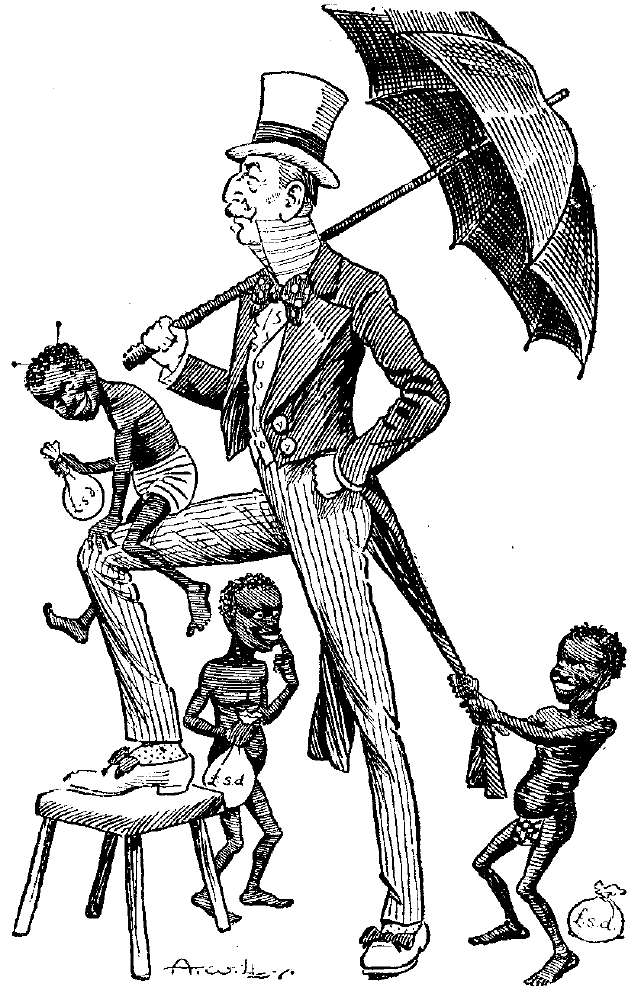
THE GREAT EAST AFRICAN PROTECTOR.
"Come under de ole umbrella, Come along, piccaninnies, do; Hark to Uncle Lulu a-callin', Room for all ob you!"—Coon Song. (Mr. Harcourt.)
With half start of surprise Speaker regarded newcomer; thought he recognised him as he stood at the Table. All doubt now removed. Yes, it was Asquith. With genial smile and friendly grip of the hand he welcomed the new Member. Delighted Ministerialists cheered again at this happy conclusion of the episode.
Business done.—Committee stage of Bill pledging national credit for loan to East African Protectorates entered upon. Not without opposition from Ministerial benches. Alpheus Cleophas Morton, of whom we hear little in these degenerate days, insisted that this kind of charity should begin at home—that is in the Highlands of Scotland. Wedgwood and Thorne thought Government had gone far enough in the way of lavish expenditure of tax-payers' money by providing them and others with salaries of £400 a year. From other side of House Banbury made several speeches in succession. Division called and opposition swamped.
Wednesday.—"Such larks!" as Joe Gargery used to say to Pip when they met for confidential confabulation. Of all men it was Cousin Hugh began them. At first sight difficult to associate tendency to larkiness with austerity of Member for Oxford University. But human nature is complex, and, after all, Cousin Hugh is only human.
In a former Parliament he was convicted of what was officially known as loitering in the Lobby. It was a Wednesday afternoon, and in those days debate automatically stood adjourned at half-past five. Business to the fore related to Marriage with a Deceased Wife's Sister. Every prospect of Resolution being approved if there were opportunity for division. The thing to do was to prevent one taking place. Accordingly, when House divided on Closure motion, Cousin Hugh and his confederates were such an unconscionably long time returning to their places that half-past five struck before main question could be put from Chair. Debate accordingly stood adjourned for indefinite period.
A fortnight ago another of those domestic questions which stir Cousin Hugh's soul to the depths came up. At the ballot-box a Member secured favourable position for motion relating to Divorce. Cousin Hugh straightway blocked it by a bogus Bill. Last Wednesday Opposition proposed on motion for adjournment for Easter to attack Government from divers points of compass. Ministerialists, taking leaf out of Cousin Hugh's book, put down notices that blocked the whole lot. To-day Premier's attention called to the matter. Admits "situation is scandalous"; undertakes forthwith to submit Resolution dealing with it.
Characteristically odd feature in case is that it was Brother Bob who brought matters to a head by tabling a Resolution making impossible in future the vagaries of Cousin Hugh.
Which shows afresh how remarkable are the resources of a family rooted in the spacious times of Queen Elizabeth.
Business done.—Criminal Justice Administration Bill read a second time.
Thursday.—As at approach of Spring the time of the singing of birds comes, and the voice of the turtle is heard in the land, so thus early in the session the voice of the objector is heard in the House of Commons. On days when Private Bills come up for consideration, there is a scene which interests while it perplexes occupants of Ladies' Gallery, in whose full view it is set. As soon as Speaker takes the Chair, before galleries are open to male strangers, there enters from hidden staircase leading to gallery over clock a procession of businesslike gentlemen. Silently, swiftly, they flood what is known as Distinguished Strangers' Gallery.
Clerk at Table reads list of Private Bills awaiting second reading: (1) Middlesbrough Corporation Bill, (2) Lurgan Gas and Electricity Bill, (3) Northwich Urban District Council Bill. From one side or other of benches below Gangway sounds a single word: "Object!" Title of next Bill on list recited. Again the cabalistic word, and so on to end of catalogue. This reached, anonymous Strangers in gallery rise and depart as swiftly, as silently, as they came, and what is still known as Question-hour (though it is limited to forty-five minutes) opens.
Whisper runs round Ladies' Gallery that mysterious Strangers are detachment of Ulster volunteers out on drill. As a matter of fact they are solicitors concerned for fate of private measures. With extreme rarity is a Private Bill debated on second reading. As a rule that stage is formally conceded, real work being done in select committees upstairs. One of the archaic absurdities of legislative practice remaining in Commons is that a single Member has autocratic power to delay progress of particular Bills approaching Committee stage by murmuring or shouting a magic dissyllable.
Last Session Tim Healy, offended at certain course taken by Board of Trade in respect of Private Bill for which he was concerned, held up for a fortnight the whole course of private legislation. At the end of that time Government with a majority still a hundred strong capitulated. It was an exceptionally weary time for solicitors filing in and filing out of the Gallery, day by day passing and their Bill "getting no forrarder."
Fortunately in these cases there are two Bills that run concurrently. One is the legislative measure to which a Member objects; the other the bill of costs in which these daily attendances at the opening of successive sittings, this mounting and descending of unsympathetic stairways, are doubtless duly noted.
Business done.—Irish Votes in Committee of Supply.
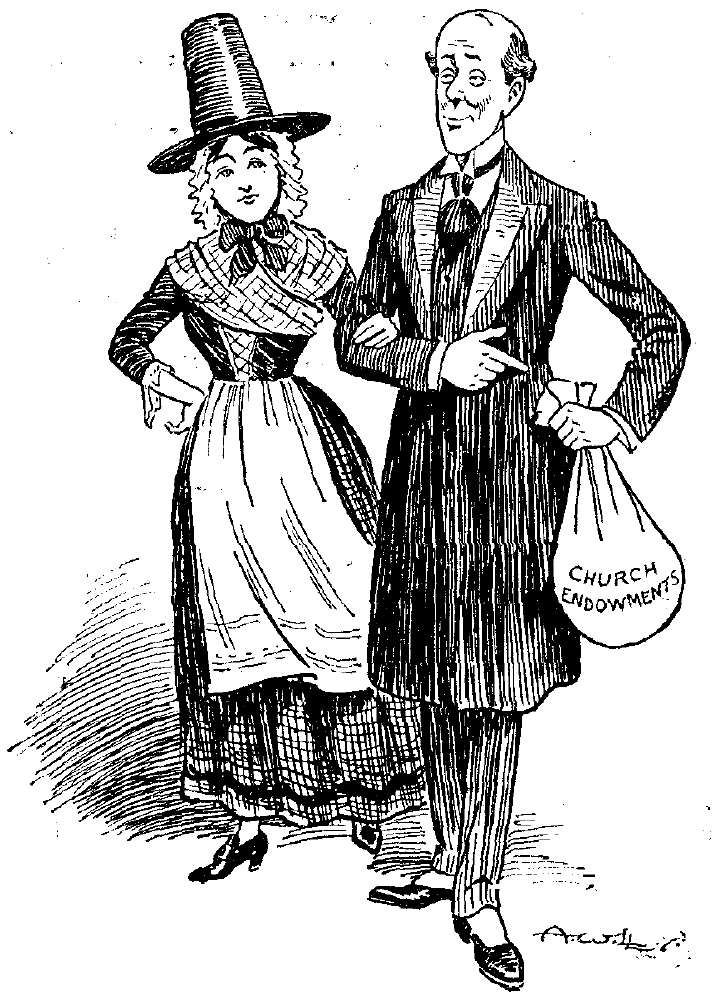
THE THIRD TIME OF ASKING.
The Postmaster-General is making heroic efforts to improve the telephone service. According to the current Post Office Circular the name of the "Coed Talon" exchange has been altered to "Pontybodkin."