Volume 146 — AT THE PLAY.
Reading edition
"Pygmalion."
The original Pygmalion took a block of dead ivory and made of it so fair a figure of a woman that he fell in love with his own creation, and Aphrodite, at his request, brought it to life. Mr. Shaw's Pygmalion takes a live flower-girl, turns her into a lifeless wax figure fit for a milliner's shop-window, and flatters himself, as an artist, on the result, but, as a man, proposes to take no interest in it, moral or physical. So you can easily see why almost any other proper name you can think of would have done better for the title.
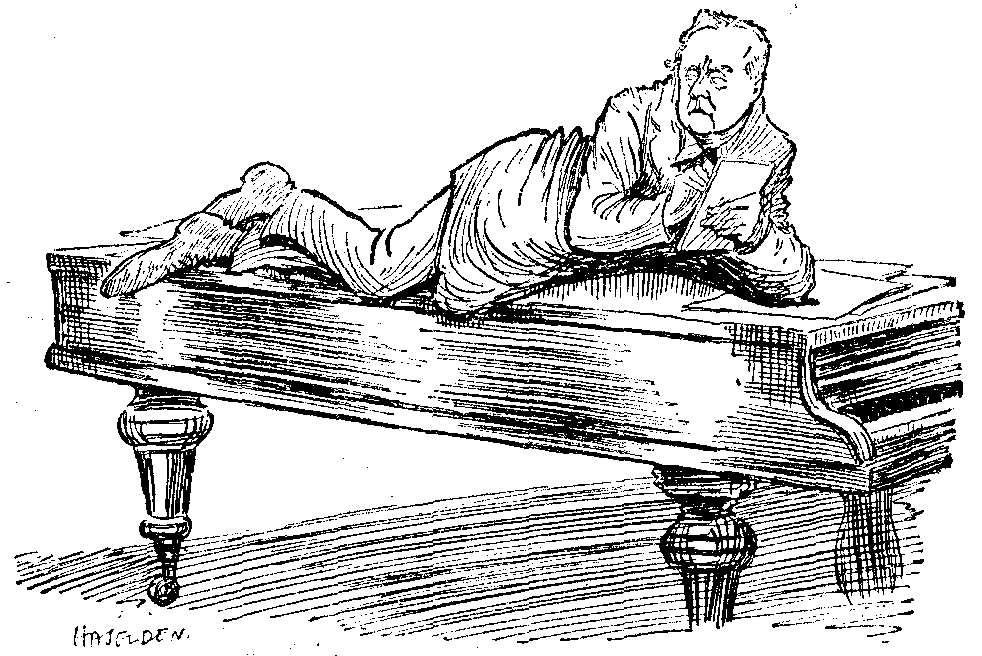
We venture to suggest a new attitude to illustrate the ease of manner which one expects from a Master of Phonetics and Deportment.
Henry Higgins Sir Herbert Tree.
The play itself shows the same typical inconsequence, the same freedom from the pedantry of logic. Eliza Doolittle's ambition is to become fitted for the functions of a young lady in a florist's shop. Henry Higgins, professor of phonetics, undertakes for a wager to teach her the manners and diction of a duchess—a smaller achievement, of course, in Mr. Shaw's eyes, but still a step in the right direction. And he is better than his word. After six months she has acquired a mincing speech, from which she is still liable to lapse into appalling indiscretions; but after another six months the product might pass muster in any modiste's showroom. And then she turns on him and protests that he has spoilt her life. As a flower-girl, she tells him, she used to earn her living honestly; now there is nothing she is good for.
Of course, you say, her contact with refined society—"we needs must love the highest when we see it"—has unfitted her for mixing with inferior people. On the contrary. She has, it is true, passed the final test of a series of social functions; but meanwhile all this time of her apprenticeship in manners she has been living her daily life, doing half-menial duties, in the house of Higgins, who happens to have no manners at all. One trembles, indeed, to picture the figure that he himself, the master, must have cut when he took his pupil to the halls of the great.
Then perhaps, you say, she has fallen into an unrequited passion for him, and this accounts for her peevishness? Well, if she has, we have only Mr. Shaw's word for it, and she gets no sympathy from us for her deplorable taste in men. There was another man who was always about the house, a man with a habit of courtesy, but this gallant soldier left her cold. Such is the perversity of women—and Mr. Shaw. Higgins's one act of civility to his protégée, on which we had to base our hopes of a happy issue, was to throw a bunch of flowers at her from a balcony in Chelsea—not perhaps a very tactful reminder of her origin. But he was only just in time. Another two seconds of delay and the final curtain would have cut off this tardy and inadequate effort of conciliation.
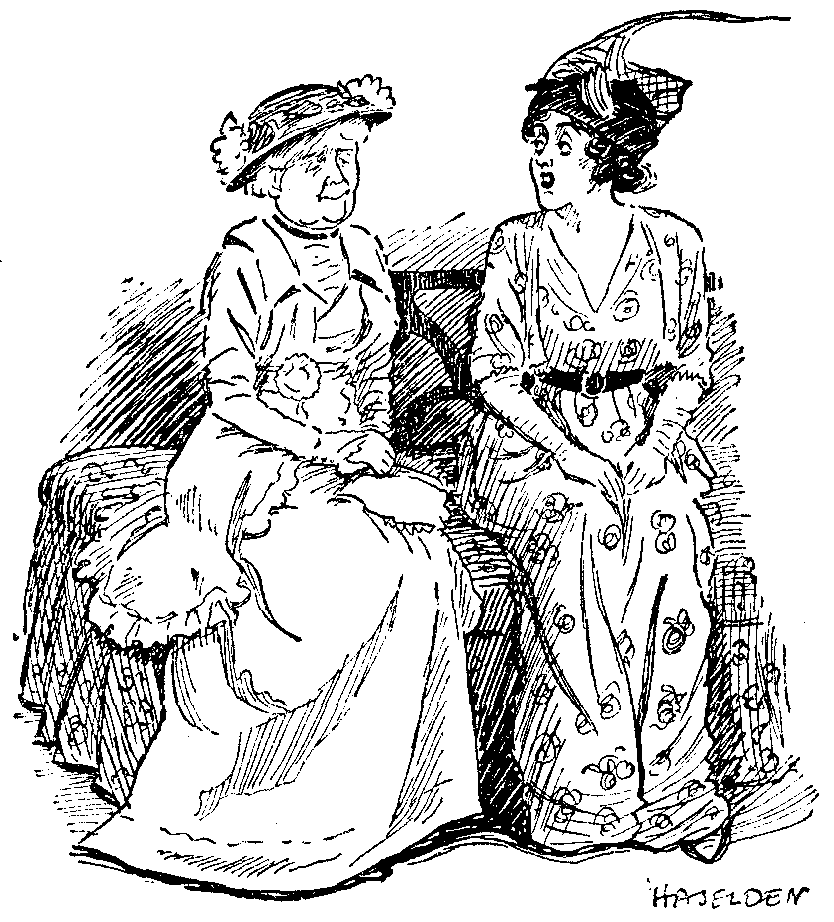
FROM FLOWER-GIRL TO PERFECT LADY.
(Showing middle stage in course of lessons in Polite Conversation.)
Eliza Doolittle (Mrs. Patrick Campbell) to Mrs. Eynsford-Hill (Miss Carlotta Addison). "An aunt of mine died of in-flu-en-za: but it's my be-lief they done h-her in."
However, nobody goes to a production of Mr. Shaw's with the idea of seeing a play. We go to hear him discourse on just anything that occurs to him without prejudice in the matter of his mouthpiece. This time he was represented by a dustman; and for once Mr. Shaw consented to temper his wisdom to the limitations of its repository. His Alfred Doolittle (father of the flower-girl) threw off a little cheap satire on the morality of the middle-classes, yet admitted the drawbacks of unauthorised union (as practised by himself), since a man's wife is there to be kicked, whereas a mistress is apt to be more exigent of the amenities; you must adopt a more lover-like attitude if you want to retain her. He also argued brightly in defence of his proposal to sell his own daughter to any man for a fiver; let fall a platitude or two in praise of the lot of the undeserving poor; and (having come in for a fortune) found that charity had lost its blessedness—that the touch of nature which makes the whole world kin was only admirable when you did the "touching" yourself. Not bad for a dustman, but Mr. Shaw has done better.
For the rest the attraction lay in the performance of individual actors rather than in the stuff of the play. Mrs. Patrick Campbell was delicious, both in her unregenerate state, and even more during the middle phase of the refining process. She made the Third Act a pure delight. Later, when she became tragic, she sacrificed something of her particular charm to the author's insincerity.
Sir Herbert Tree, always at his best in comedy, was an excellent Higgins in his lighter moods. As for Mr. Edmund Gurney, he was far the best dustman I have ever met. His freedom from scruples, combined with a natural gift for unctuous and persuasive rhetoric, commanded admiration. Higgins, indeed, who could read potentialities at a glance, considered that he might, under happier conditions, have gone far toward attaining Cabinet rank or filling a Welsh pulpit.
Of the others, Mr. Philip Merivale played the too subsidiary part of Colonel Pickering with admirable self-repression; and Miss Rosamond Mayne-Young, as the mother of Higgins, was a very gracious figure.
The play was curiously uneven. If one might be permitted to enter and leave at one's pleasure I would advise you to miss out the desultory First Act. But if you insist on seeing it then take care to read your programme before the lights go down and find out that the scene is the porch of a church. I thought all the time that it was the porch of a theatre. Make sure in the same way about the Chelsea flat, or you may mistake it for a charming country cottage. The Second and Third Acts are not to be missed on any account, but I shouldn't worry about the Fourth. In the Fifth you should go away for good the moment that the dustman makes his exit. The tedium that follows is most distressing, and can only be explained as the author's revenge for your laughter. It was a cruel thing to do.
But I forgive him. I take away many delightful memories of my evening with Pygmalion, and, best of all, the picture of Sir Herbert's frank and childlike pleasure at having discovered Mr. Bernard Shaw.
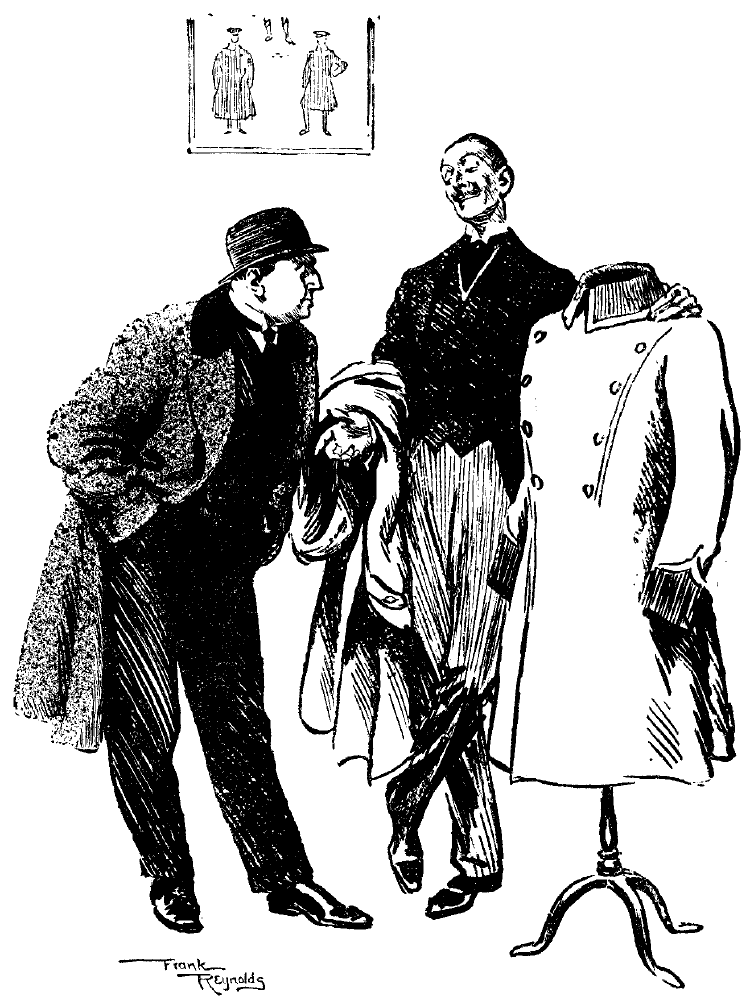
Jones (selecting a uniform for his chauffeur). "I like this one best, but it's rather expensive."
Expert Salesman. "Then I should have it. After all, the guv'nor pays!"
"Potash and Perlmutter."
If you have ever been to an American commercial drama, you will know the opening scene of this one before the curtain goes up. The business interior; the typewriter on the left; the head of the firm opening cryptic correspondence and dictating unintelligible answers; spasmodic incursions of cocksure buyers and bagmen; a prevailing air of smartness, of hustle, of get-on-or-get-out. In The Melting Pot Mr. Zangwill has been creating a diversion with an Hebraic theme, his hero being a refugee from Kieff, where his family had perished in a pogrom. This new variation has occurred—independently, no doubt—to the author of Potash and Perlmutter, who has grafted it (including the detail of the immigrant from Kieff) on the old commercial stock, and done very well indeed with his blend.
His two protagonists in the Teuton-American-Semitic firm of "cloak and suit" manufacturers that gives its title to the play are extraordinarily alive. I am but imperfectly acquainted with this racial variety, but I can easily recognise that Messrs. Augustus Yorke and Egbert Leonard, who represent the two partners, are gifted with the most amazing powers of observation and reproduction.
The pair are alike in their mercenary tastes and in that loyalty which is so fine a feature of the Jewish race, and is here found in frequent conflict with their commercial instincts. The cruel wrench that their generosity always costs them is a true measure of its excellence. They quarrel alike over details of business policy; but they always stand together where profit is obviously to be made by a common attitude, or where they find themselves in a tight corner. Yet the author has preserved a nice distinction between them. It is Potash, the elder of the two, and encumbered by fetters of domestic affection, who is the weaker vessel, and commits the indiscretions with whose issue he is impotent to cope; it is Perlmutter, with the quicker brains, contemptuous but devoted, who throws all the blame where it is due, yet stands by to share the punishment.
I found their language and accent rather hard to follow, a difficulty not shared by the strong Jewish element in an audience that was extremely quick to appreciate the humour that kept one always on the alert. It is profitless to ask how much of the fun was due to the things said and how much to the manner of saying them. The essential matter is that actors and author between them gave us an unusually good time, and I am much obliged to them.
Apart from the leading characters, the Mrs. Potash of Miss Matilda Cottrelly was a most delightful study, and the breezy methods of Mr. Charles Dickson as a buyer and Mr. Ezra Matthews as a salesman were effective of their kind.
The plot, as usual in such plays, was rather elementary. So, too, with the love interest; but the right kind of sentiment was not wanting in the very human characters of Potash and Perlmutter. For a rare moment or two there was a break in our laughter and tears were not far away.
O. S.